CTO's Guide to ERP Modernization Strategy
Build a defensible ERP modernization strategy. Guide for CTOs: risk analysis, costs, migration paths, & when NOT to modernize.
On this page
- Overview
- ERP Modernization Is a Business Risk Program
- The baseline has shifted
- What executives misdiagnose
- The success standard is operational continuity
- The Pre-Mortem Assessment Checklist
- Four domains that matter
- A short checklist for the steering group
- What a good output looks like
- The Migration Path Decision Matrix
- Start with rollout philosophy
- ERP migration path decision matrix
- How to choose without fooling yourself
- Real-World Risk and Failure Analysis
- The numbers that matter
- The failure map by phase
- A better risk register
- Partner Selection and Negotiation Tactics
- Governance is the first due diligence test
- The contract should hold the partner accountable
- What to ask in reference checks
- The Unspoken Option When NOT to Modernize
- Three red lights
- What restraint looks like in practice
- The board-level test
- Frequently Asked Questions
- How should we handle decades of ERP customizations
- Is phased rollout always safer than big bang
- What's the real cost center that teams underestimate most
- Should AI change our ERP modernization strategy
- How do we avoid turning hybrid ERP into an integration mess
- When should we pause an ERP program already in flight
- What should the executive steering committee actually review
ERP modernization fails at the decision stage long before it fails at go-live.
Companies get into trouble when they define ERP modernization as a technology upgrade instead of a business risk transfer. An ERP cutover changes how finance closes, how orders ship, how inventory is valued, how entities consolidate, and whether executives trust the numbers in front of them. Once the program is framed that way, the question becomes clearer: should you modernize now, delay, narrow the scope, or avoid a full replacement altogether?
Vendor content usually skips that question because the commercial incentive is obvious. More software and more services produce a larger deal. In practice, some of the best ERP decisions I have seen were decisions to postpone a migration by 12 months, retire a small set of customizations first, or ring-fence the legacy core while other systems were cleaned up. Those moves look conservative. They often reduce failure risk more than an aggressive platform switch.
That is why this guide focuses on decision points and failure modes, not product messaging. If you need a broader cloud modernization strategy playbook, use one. For ERP, the standard advice is usually too generic because ERP concentrates process, controls, and reporting dependencies in one place.
The CTO's role is to ensure the final decision is defensible.
A defensible decision rests on evidence: process complexity, customization density, data quality, control maturity, partner incentives, and the business's tolerance for disruption. If those variables are weak, modernization can still be the right call, but only with a narrower scope, a staged path, or a deliberate deferral. That is the part many ERP guides avoid, and it is often where the highest-value judgment sits.
ERP Modernization Is a Business Risk Program
ERP modernization strategy sits in the same risk category as a plant move, a finance transformation, or a supply chain redesign. Treat it like a software upgrade and the cost of that mistake shows up in missed closes, shipment delays, control failures, and emergency workarounds across the business.
Cutover failure in ERP rarely stays inside IT. Finance may lose confidence in close data. Procurement can fall back to manual approvals. Customer service starts working from stale order status. Operations leaders usually discover this too late, after the program has already been scoped around features, licenses, and implementation timelines instead of operating risk.
That is why the common "lift and shift first, optimize later" logic performs badly in ERP. It can relocate the system, but it leaves process defects, weak controls, poor master data, and unnecessary customization in place. The hosting model changes. The operational exposure often does not.
The baseline has shifted
Cloud adoption has changed the default assumption around ERP architecture. A cloud ERP position usually requires less justification than extending an aging on-premise estate with rising support effort and shrinking internal expertise.
Cloud is not automatically the right answer for every company, every module, or every timeline. But "stay where we are" now needs a sharper defense than it did ten years ago. If a leadership team wants to defer modernization, it should do so for concrete reasons such as regulatory constraints, unresolved process fragmentation, heavy customization that still creates economic value, or a near-term M&A event that would make a major migration poorly timed.
A practical starting point is a broader cloud modernization strategy playbook, then a narrower ERP filter based on cutover tolerance, control requirements, data lineage, and cross-functional process dependencies.
What executives misdiagnose
ERP programs start to fail long before go-live when leaders frame the problem incorrectly.
Three assumptions are especially expensive:
- "This is an application replacement." It is a redesign of process ownership, control points, approval paths, and reporting logic across finance, operations, procurement, and sales.
- "We can choose the platform first." Platform selection should follow target operating outcomes, not precede them. Otherwise the project becomes a search for reasons to justify a preselected tool.
- "The SI will absorb the complexity." A systems integrator can configure, migrate, and test. It cannot supply missing business ownership, weak governance, poor source data, or unresolved policy conflicts between functions.
Some organizations should modernize in phases. Some should narrow scope to finance and procurement first. Some should ring-fence the legacy core for a period while they retire custom code, clean data, or standardize processes. In a surprising number of cases, a 9 to 18 month deferral creates a higher probability of success than an immediate full-suite migration.
The success standard is operational continuity
The benchmark is preserving operations while improving them, which go-live alone does not show.
That requires answers to five questions before vendor selection becomes serious:
- What breaks if cutover slips
- Which business outcomes justify the disruption
- Which legacy customizations are differentiators
- Where data quality will fail under migration pressure
- Who owns decisions when process standardization conflicts with local preferences
If those answers are vague, the project is already behind schedule.
The strongest ERP business cases I have seen do not promise transformation everywhere at once. They specify where standardization will create measurable value, where exceptions will remain, what temporary coexistence is acceptable, and under what conditions the company should defer or abandon a broader modernization plan. That discipline is less exciting than a full-platform narrative. It is also closer to how successful programs are run.
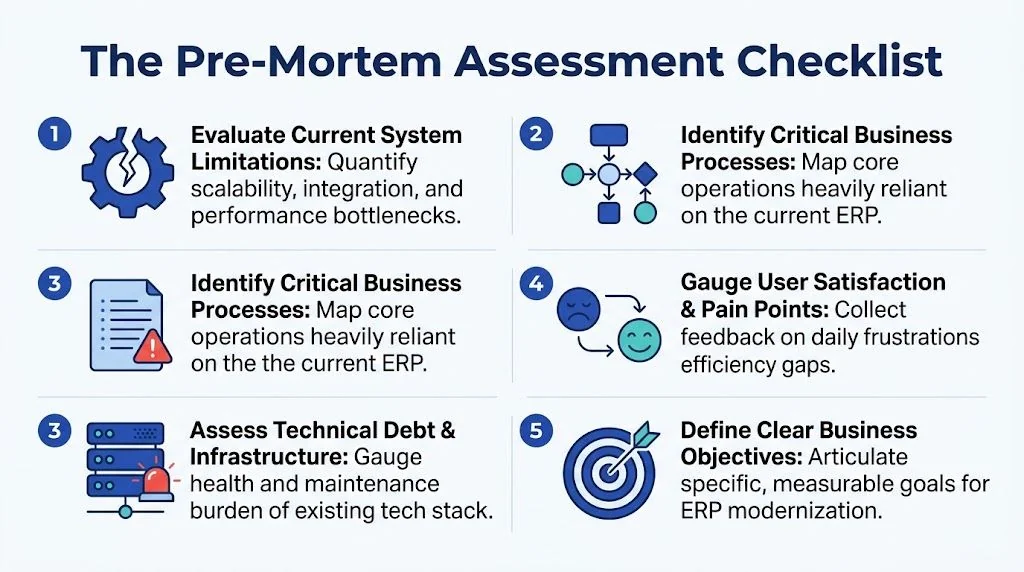
The Pre-Mortem Assessment Checklist
Most failed ERP programs begin with a vague complaint: the system is old, hard to maintain, and users hate it. None of that is enough to fund a defensible modernization.
A pre-mortem forces precision before procurement starts. It asks what will go wrong, where the current environment is creating operational drag, and which constraints are real rather than political.
Four domains that matter
Your self-audit should cover four areas.
Technical debt
Start with the engineering reality. Count custom modules, brittle point-to-point integrations, unsupported middleware, batch jobs with unclear owners, and reporting logic embedded outside the ERP. If you can't map the current architecture cleanly, any migration estimate is fiction.
This is also where AI claims need discipline. 70% of CIOs prioritize AI and predictive analytics in ERP modernization, and generative AI can cut migration times and costs by up to 40% for tasks like code conversion and data mapping, according to KPC Team's ERP statistics and trends roundup. Useful, yes. But AI only helps if your source data structures, code inventory, and mapping rules are already understood.
Operational drag
Translate system pain into business impact. Measure close-cycle delays, inventory reconciliation friction, exception handling effort, order processing workarounds, and how often teams export data into spreadsheets to finish basic tasks.
Don't stop at complaints from super users. Interview controllers, plant managers, supply chain leads, and integration engineers. They usually describe different failures.
Strategic limitation
A legacy ERP becomes dangerous when it blocks business moves. Common examples include slow subsidiary onboarding, weak real-time visibility, poor support for two-tier operating models, and a reporting model that breaks every time the organization changes how it sells or ships.
You don't need a giant transformation thesis. You need a small number of outcomes that justify replacing institutional muscle memory.
Talent risk
The system may still run, but the people who understand it may be a critical single point of failure. Look for custom logic owned by one person, unsupported reporting scripts, fragile nightly jobs, and dependency on skills the organization no longer recruits for.
Practical rule: If the current state can't be explained in plain language by both IT and the business, you're not ready to write an RFP.
A short checklist for the steering group
Use this in your first steering session:
- Document critical process dependencies: Identify month-end close, order-to-cash, procure-to-pay, manufacturing, or field operations that cannot absorb disruption.
- Map customization value: Separate true competitive differentiation from historical exceptions nobody wants to revisit.
- Score data readiness: Check master data quality, duplicate records, inconsistent naming, and undocumented transformations.
- Identify decision bottlenecks: List where approval latency, political conflict, or local autonomy will stall design choices.
- Define measurable outcomes: State the business result in terms operators can verify after go-live.
What a good output looks like
A credible pre-mortem doesn't end as a slide deck. It produces a decision packet with:
| Assessment output | What it should contain |
|---|---|
| Current-state architecture | Core modules, integrations, data flows, customization hotspots |
| Business outcome set | A small number of measurable operational targets |
| Risk register | Known failure points by process, data, and ownership area |
| Modernization boundary | What stays, what moves, what gets retired |
| No-go triggers | Conditions that would justify delay or descoping |
If you can't produce those five artifacts, your ERP modernization strategy is still marketing copy.
The Migration Path Decision Matrix
The question to answer is "Which path fits our business risk, legacy burden, and tolerance for disruption?" rather than "Should we modernize ERP?"
Most organizations are choosing how much of the legacy estate to preserve, how much process change they can absorb, and whether cutover risk is acceptable, rather than choosing between cloud and on-prem.
Start with rollout philosophy
Three implementation approaches dominate modern ERP programs: Big Bang, Phased Rollout, and Custom Modular Development, according to FingoWeb's ERP modernization analysis. The same analysis notes that when 10% to 20% of IT budgets are consumed by technical issues in legacy systems, the ROI for phased or hybrid models becomes strategically stronger.
If legacy operations are already eating budget through defects, patches, brittle integrations, and emergency support, preserving the whole estate for one dramatic cutover usually increases exposure rather than reducing it.
For teams evaluating the broader architecture options behind these choices, this overview of migration patterns in software modernization is useful because it separates infrastructure moves from deeper application redesign.
ERP migration path decision matrix
| Primary Driver | Recommended Path | Risk Profile | Typical Timeline | Best For |
|---|---|---|---|---|
| Data center exit with minimal process change | Rehost | Lower application change risk, higher risk of carrying legacy problems forward | Shorter | Organizations under hosting or infrastructure pressure |
| Vendor support deadlines with moderate cleanup | Replatform | Moderate | Medium | Teams that need technical uplift without major process redesign |
| Broken business fit and obsolete operating model | Rip and Replace | Highest organizational disruption risk | Longer | Enterprises willing to standardize processes aggressively |
| Need for differentiated workflows and future flexibility | Rearchitect | High execution complexity, lower long-term rigidity | Longer | Companies where ERP is tightly linked to unique operating models |
| Core stability plus selective innovation | Hybrid | Controlled if governance is strong, dangerous if interfaces are weak | Variable | Multi-entity groups, regulated environments, risk-averse enterprises |
How to choose without fooling yourself
Use these rules.
Choose big bang only when uniformity matters more than flexibility
Big bang is attractive because it ends parallel operations faster. It also concentrates failure. If one shared process model fits the enterprise, executive alignment is strong, and cutover rehearsals are disciplined, it can work.
If those conditions aren't true, big bang turns a design disagreement into an operational incident.
Choose phased rollout when local variation is real
Phased rollout is slower, but it gives you a chance to test governance under real conditions. This matters when business units operate differently, when integrations are messy, or when one region can serve as a proving ground for another.
The cost is complexity. You'll run bridging logic, temporary interfaces, and dual-process operations longer than anyone wants.
Choose hybrid when the core is stable but bottlenecks are obvious
A lot of enterprises don't need a full rip-and-replace. They need to remove the modules or workflows that actively hurt performance, reporting, or scalability while preserving stable financial controls in the core.
This is the least fashionable option and often the smartest one.
If the board wants fast transformation but the business can't absorb a single-point cutover, hybrid is the responsible way to deliver it.
Real-World Risk and Failure Analysis
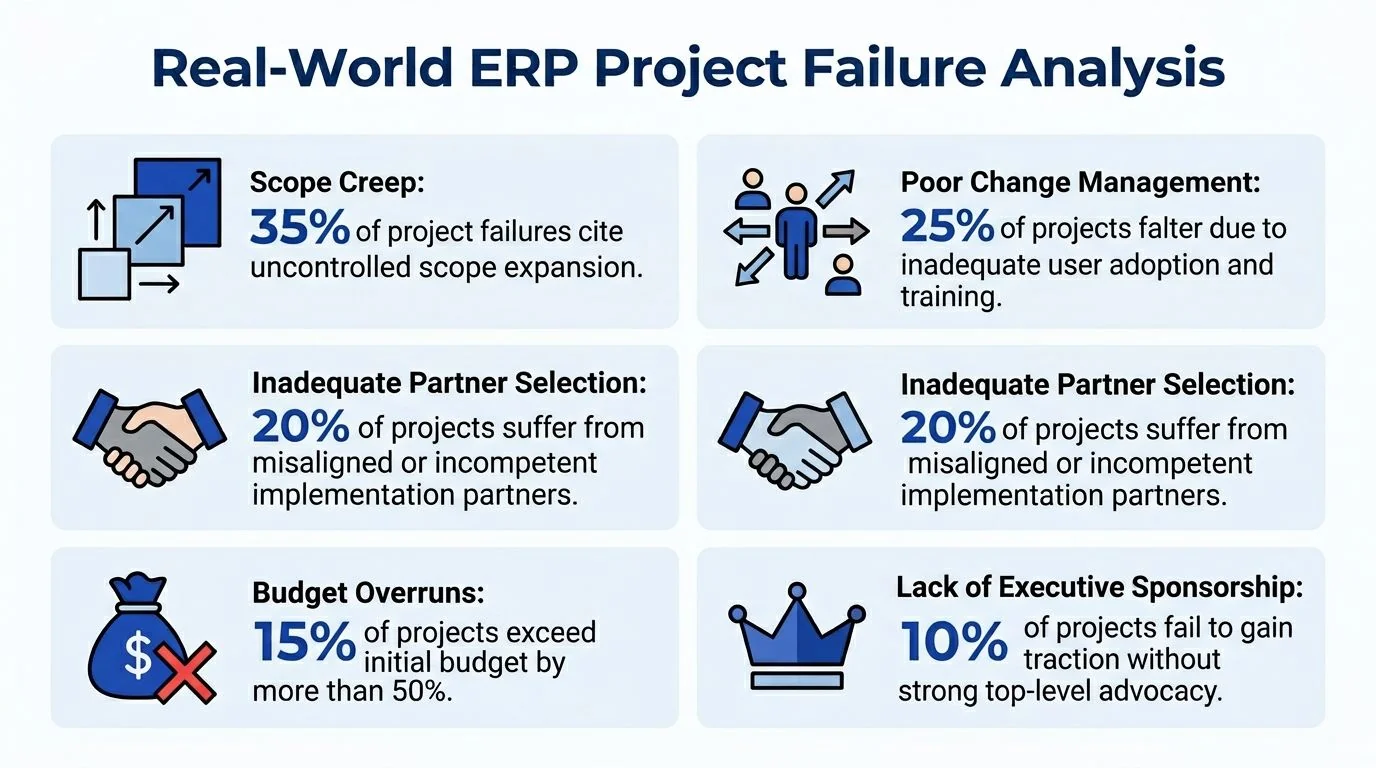
ERP failures aren't random. They cluster in predictable phases, and the same warning signs show up again and again.
The most useful risk lens is phase-by-phase failure analysis tied to what derails cost, timeline, and operational stability, not generic project management language.
The numbers that matter
55% of ERP implementations overrun budgets by 20% or more, and nearly 50% experience timeline slippage, based on Strategies Group's guide to ERP implementation risks. The same analysis identifies two recurring causes: scope creep during the Blueprint phase, which averages 50%+ cost inflation when objectives aren't measurable, and inadequate data migration testing.
That should change how you read project status reports. Budget overrun is usually the visible consequence of earlier ambiguity, not the first failure.
The failure map by phase
Strategy and selection
The project starts badly when the business objective is "modernize ERP." That's not an objective. It's a placeholder for unresolved conflict.
Early warning signs include:
- Competing executive narratives: finance wants control, operations wants flexibility, IT wants simplification
- RFP inflation: every stakeholder smuggles local preferences into core requirements
- Vendor scoring distortion: demos win over operating fit
Blueprint and design
This is where projects become unaffordable. If the future state isn't constrained by measurable outcomes, design workshops become a museum of historical exceptions.
What to watch:
- Requirements multiply faster than decisions
- No one will retire old process variants
- Interface inventory keeps growing during design
Build and test
Teams often confuse configuration progress with delivery progress. They're not the same.
A system can look complete and still fail under integration, role design, exception handling, or volume assumptions. Weak testing usually traces back to rushed scope and poor ownership in earlier phases.
Data migration
This is the most consistently underestimated technical risk. Legacy ERPs usually contain years of naming inconsistencies, mismatched fields, duplicate entities, and undocumented transformations. If teams don't validate migrations batch by batch in test environments before cutover, they push unknown defects into production.
Most ERP data problems aren't conversion problems. They're decision problems that stayed hidden until migration forced the organization to define what a record actually means.
Change and training
This phase gets trivialized as communications and learning content. In reality, it's where process credibility is tested. If users don't trust the new workflow, they route around it.
The result is poor adoption and value erosion after launch.
Cutover and stabilization
Unresolved defects converge. Teams that don't define command structure, rollback thresholds, and decision rights before go-live end up improvising under pressure. That's when operational disruption becomes self-inflicted.
A better risk register
Don't use a generic PMO template. Use a working register with three fields for each major risk:
| Risk field | What to capture |
|---|---|
| Root cause | The actual mechanism, such as vague KPIs, hidden custom logic, or unvalidated mapping |
| Early warning sign | What appears before failure, such as rising exceptions, unresolved design decisions, or repeated test defects |
| Mandatory control | The required mitigation, such as batch testing, KPI locking, or executive arbitration rules |
That format forces accountability. It also makes it much harder for a partner to hide behind status color coding when the project is drifting.
Partner Selection and Negotiation Tactics
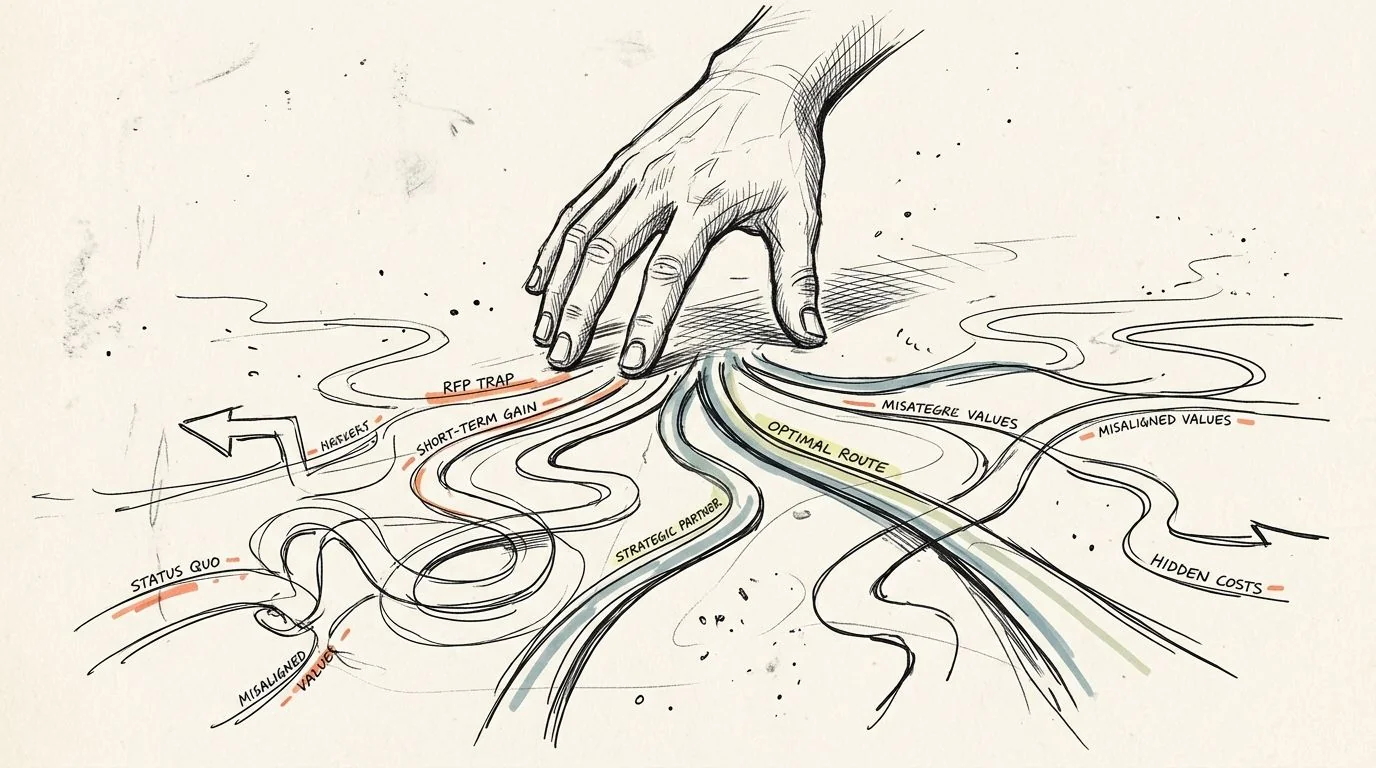
Most ERP partner selections are too polite. The buyer asks for methodology, staffing, references, and a price sheet. The seller responds with a slide deck full of accelerators and logos. Then both parties act surprised when governance fails in month six.
That process is broken because it overweights delivery theater and underweights execution control.
Governance is the first due diligence test
A major blind spot in ERP modernization strategy is governance. 42% of organizations run ERP in the cloud, but only 64% report having a defined cloud strategy, according to ERP Today's research on uneven ERP modernization and governance gaps. The practical implication: many teams choose cloud deployment without putting in place the decision rights, standards, and controls needed to realize value.
That means you shouldn't ask a partner only how they migrate. Ask how they govern.
A serious implementation partner should be able to show:
- Decision-rights structure: who resolves process conflicts, integration disputes, and scope trade-offs
- Integration standards: how APIs, middleware, naming conventions, and ownership are enforced
- Commercial controls: how change requests are triaged so the partner doesn't profit from avoidable ambiguity
- Outcome tracking: how business KPIs are measured after go-live, not just milestone completion
If a partner treats governance as PMO paperwork, they're telling you exactly how your program will drift.
The contract should hold the partner accountable
Most SOWs protect the seller from uncertainty while leaving the buyer exposed to endless interpretation. Reverse that.
Use these negotiating rules:
- Tie milestones to outcomes, not activity. Don't pay because design workshops happened. Pay because approved process decisions, tested integrations, and validated data sets exist.
- Require named personnel for key roles. If the partner sells with senior architects and delivers with juniors, you need substitution controls.
- Define change order thresholds. Many projects become margin expansion engines for the SI.
- Set escalation timeframes. Governance dies when major decisions wait in committee.
- Demand transparency on assumptions. Every estimate sits on assumptions about scope, data quality, and business availability.
A well-built procurement process helps here. If your internal team is refreshing its sourcing model, this powerful Request for Proposal guide is a practical reference for structuring sharper vendor questions and avoiding the usual vague language.
What to ask in reference checks
Don't ask whether the partner was collaborative. Ask what they did when the project got ugly.
Use prompts like these:
- Where did scope control fail first
- How did they handle bad source data
- Which promised experts remained on the account
- What governance artifacts were useful after go-live
- Would you sign the same commercial model again
For a more structured evaluation process, this vendor due diligence checklist is a useful internal benchmark. Platforms such as Software Modernization Intelligence also compile partner intelligence across modernization paths, including execution risks and specialization areas, which is useful when your shortlist includes firms with very different strengths.
This short discussion covers the execution reality behind partner selection.
A partner doesn't reduce risk just by being experienced. They reduce risk by making ambiguity expensive for themselves, not for you.
The Unspoken Option When NOT to Modernize
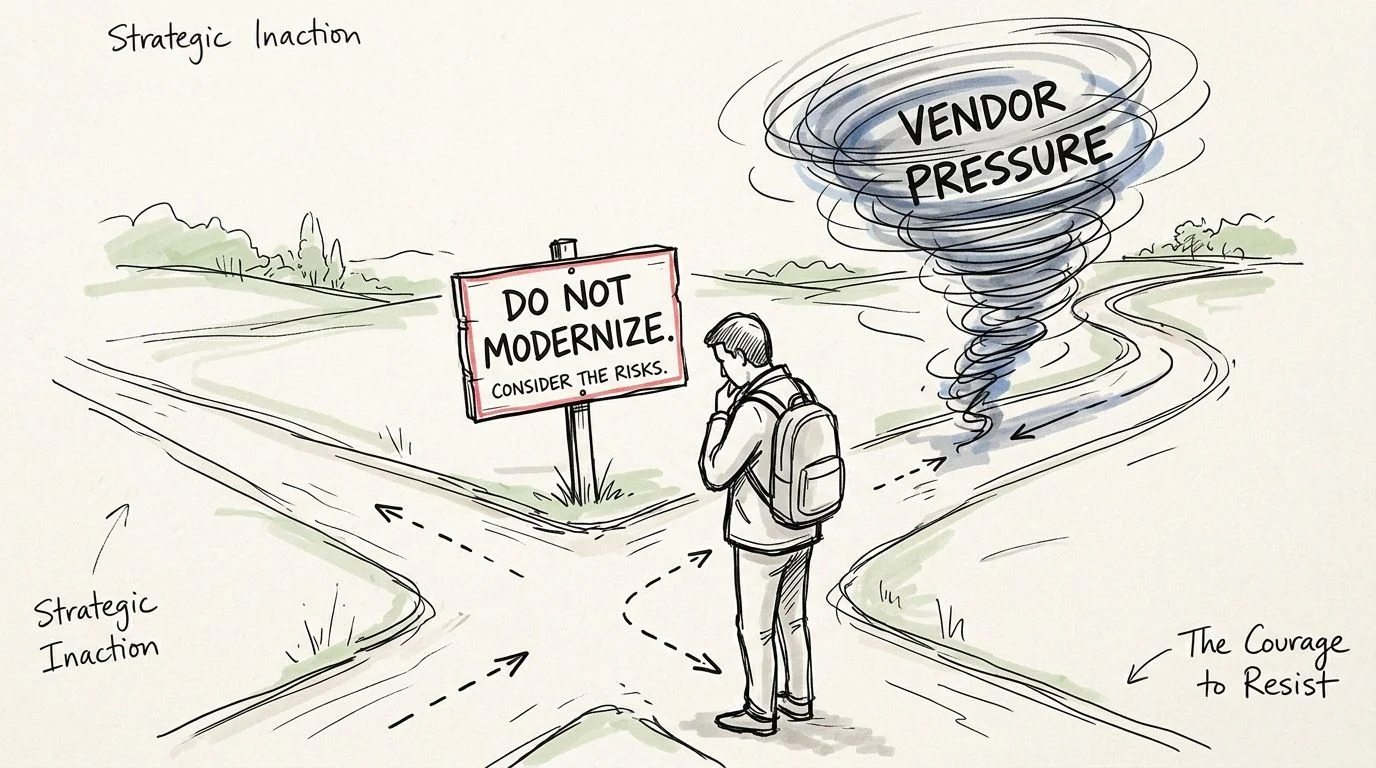
Sometimes the strongest ERP modernization strategy is restraint.
That sounds contrarian only because too much ERP content is written by firms that make money when you buy something. CTOs need a different rule: if the business case depends on optimism, weak governance, and broad assumptions about adoption, reject it.
Three red lights
The target state is unclear
If leaders still can't name the operating model they want, a large ERP program won't create clarity. It will amplify confusion at scale.
This is the classic case where the company says the system is the problem, but the underlying issue is unresolved process ownership. Replacing software before resolving that conflict just makes the future-state design phase longer and more expensive.
The organization can't absorb the change
Some companies are too operationally stretched to survive a major ERP cutover. Signs include unstable leadership, constant reorganizations, weak data stewardship, and functional teams that are already overloaded keeping the current operation running.
In that environment, the smart move is often a smaller program: retire one painful module, clean up data domains, or stabilize integrations first.
The real bottleneck isn't the ERP
A surprising number of "ERP modernization" requests are really asking for better analytics, cleaner integrations, improved workflow tooling, or subsidiary flexibility. In those cases, a targeted solution outside the ERP core can remove most of the pain with much lower organizational risk.
This is especially true when the finance core is stable but reporting, planning, or local operational workflows are the actual source of frustration.
What restraint looks like in practice
Saying no doesn't mean defending stagnation. It means choosing a narrower move with a better risk-adjusted return.
That might mean:
- Upgrading within the current vendor line instead of replacing the whole stack
- Adopting a two-tier model where subsidiaries move first and the core stays put
- Replacing one high-friction module instead of rewriting enterprise process architecture
- Cleaning master data and governance before restarting platform selection
If you're evaluating ecosystem fit around Microsoft platforms, this overview of Microsoft Dynamics Partners UK is a useful example of how to assess partner specialization rather than assuming every integrator fits every workload.
The board-level test
Ask four questions before approving a full modernization:
| Decision test | Red-light answer |
|---|---|
| Are outcomes measurable and owned | No |
| Is data quality understood well enough for migration planning | No |
| Can the business tolerate disruption during cutover and stabilization | No |
| Does the problem actually require ERP replacement | No |
If you get two or more red-light answers, defer the program.
Deferring on those answers is governance, not indecision.
Frequently Asked Questions
How should we handle decades of ERP customizations
Don't start by asking which customizations can be migrated. Start by asking which ones still matter.
Sort every customization into three buckets: genuine differentiation, regulatory or control necessity, and historical residue. Most enterprises discover that a meaningful share of custom logic exists to preserve legacy process variants that no longer deserve enterprise-level support. The mistake is migrating all of it because users are familiar with it.
A good rule is to require a business owner for every customization that survives into design. No owner, no carry-forward.
Is phased rollout always safer than big bang
Operationally, phased rollout is often safer because it limits the blast radius. But it also creates temporary interfaces, dual-process overhead, and a longer period of organizational fatigue. If your company has a high degree of process uniformity and unusually strong executive alignment, big bang can still be rational.
The safer answer is to choose the model your governance can support, not to default to phased.
What's the real cost center that teams underestimate most
Data migration.
Not because extraction and loading are mysterious, but because source data usually contains unresolved business ambiguity. Teams discover duplicate customers, inconsistent product naming, missing history, conflicting ownership, and undocumented transformations only when migration forces precision. That's why test migrations need business validation, not just technical completion.
If the business won't staff that validation work, the project estimate is wrong.
Should AI change our ERP modernization strategy
AI should change the delivery toolset, not the decision standard.
Used well, it can accelerate code conversion, mapping, and analysis. Used carelessly, it gives teams false confidence that undocumented logic or poor-quality data can be automated away. Keep AI focused on acceleration after you've established architecture inventory, data rules, and acceptance criteria.
How do we avoid turning hybrid ERP into an integration mess
By limiting exceptions and enforcing ownership early.
Hybrid fails when every business unit gets a special rule, every integration has a different pattern, and no one owns canonical data definitions. If you keep a core ERP while modernizing selective modules or subsidiaries, define three things before build starts: system of record by domain, integration standard by pattern, and operational owner by interface.
Without that, hybrid becomes permanent transition architecture.
When should we pause an ERP program already in flight
Pause when ambiguity is compounding faster than decisions.
Common triggers include uncontrolled requirements growth, unresolved process ownership in core areas, repeated migration test failures, or a partner commercial model that rewards constant change orders. A short, explicit reset is cheaper than pushing a confused program into build and pretending status is progress.
What should the executive steering committee actually review
Not status colors.
They should review open decisions with business impact, KPI alignment, migration readiness, integration risk, and change-order exposure. If the committee spends its time on generic updates rather than hard trade-offs, it's acting as ceremony, not governance.
If you're planning an ERP modernization strategy, the next step is a hard pre-mortem, a migration path decision, and a written list of conditions under which you will say no, all before vendor demos. That's how you avoid buying a transformation story you can't execute.
Chief Analyst, Software Modernization Intelligence · 10+ years B2B market research
Published: