Moving Beyond the Firewall: A CTO’s Guide to Zero Trust Network Segmentation
Implement zero trust network segmentation to secure your modernization projects. A CTO's guide to architecture, common pitfalls, and effective vendor selection.
On this page
- Overview
- Why Zero Trust Segmentation Matters for Modernization
- Why Perimeter-Based Trust Fails
- Core Principles of Zero Trust Segmentation
- The Business Case for Segmentation
- Architecting Your Segmentation Blueprint: Macro vs. Micro
- Macro-Segmentation: A Pragmatic First Step
- Micro-Segmentation: The Granular End Goal
- Decision Framework: A Phased Approach
- Implementation Patterns and Common Failure Modes
- Pattern 1: Protecting High-Value Applications
- Pattern 2: Securing the CI/CD Pipeline
- Common Failure Modes and How to Avoid Them
- Choosing Your ZTNS Vendor: A Defensible Decision Matrix
- Core Evaluation Criteria
- A Framework for the Decision
- Vendor and Partner Evaluation Matrix
- Phased Migration From Legacy to Segmented
- The Crawl Phase: Discovery and Visibility
- The Walk Phase: Your First Enforcement
- The Run Phase: Scaling Across the Enterprise
- Measuring Success: KPIs and Runbooks for Your ZTNS
- Defining the KPIs
- Building Your Operational Runbooks
- Common ZTNS Questions
- How Does Micro-segmentation Impact Network Performance?
- Can ZTNS Be Applied to OT and IoT Environments?
- How Do You Manage Policies at Scale?
- How Do You Gain Visibility Into Encrypted Traffic?
Zero trust network segmentation is an architectural decision for modernizing security infrastructure, not a feature you bolt onto it. It operates on a single principle: assume every user, device, and application is hostile until proven otherwise. Every access request must be authenticated and authorized, which removes the attacker’s primary advantage: lateral movement across a flat network.
Instead of a monolithic perimeter defense, you divide your network into isolated micro-perimeters. For senior technical leaders, the question is how to implement zero trust segmentation to de-risk modernization initiatives, secure cloud migrations, and build a security posture that can withstand a sophisticated breach.
Why Zero Trust Segmentation Matters for Modernization
The "castle-and-moat" security model was designed for clear network perimeters. Cloud adoption, distributed architectures, and remote work have dissolved that perimeter, making internal lateral movement a primary vector for major breaches.
Without zero trust network segmentation (ZTNS), your modernized, cloud-native systems remain vulnerable to threats that traditional security was never engineered to stop. It is a foundational control for protecting your investment in digital transformation.
Why Perimeter-Based Trust Fails
Legacy security architectures operate on a flawed assumption: entities inside the network are trusted. This model fails in hybrid and multi-cloud environments where assets are scattered across on-prem data centers and multiple cloud providers.
Once an attacker breaches the perimeter, they find an open internal network, allowing them to move laterally, escalate privileges, and exfiltrate data. ZTNS counters this by operating under a "breach-assumed" mindset.
By dividing a network into smaller, secure subnetworks, each with its own access controls, segmentation upholds the core Zero Trust principle to "never trust, always verify." Even if an attacker gains entry, they are effectively trapped within a single segment, unable to access more sensitive systems.
This strategy moves security from a static, location-based control to a dynamic, identity-driven one. Understanding the foundational zero trust architecture principles defined by NIST (SP 800-207) is a prerequisite for any successful implementation.
The table below contrasts legacy perimeter defense with a segmentation strategy.
Core Principles of Zero Trust Segmentation
| Principle | Traditional Perimeter Defense | Zero Trust Network Segmentation |
|---|---|---|
| Trust Model | Trust anything inside the perimeter | Trust nothing; verify every request |
| Access Control | Based on network location (IP address) | Based on identity (user, device, context) |
| Network Visibility | Blind to east-west (internal) traffic | Full visibility into all traffic flows |
| Breach Impact | High; attacker has free lateral movement | Low; breach is contained to one segment |
| Policy Enforcement | Static rules at the edge (firewall) | Dynamic, granular policies per workload |
Implementing ZTNS means rearchitecting security for a distributed enterprise, not swapping one technology for another.
The Business Case for Segmentation
The global Zero Trust Network Access (ZTNA) market, where segmentation is a core component, is projected to grow from USD 3.91 billion in 2025 to USD 26.50 billion by 2034, a CAGR of 23.7%. The market data for Zero Trust Network Access adoption shows investment is substantial.
Organizations with mature segmentation detect threats 59% faster, which can translate into millions of dollars in averted losses from data breaches and operational downtime.
For a CTO or VP of Engineering steering modernization, segmentation enables:
- Secure Cloud Migration: Isolate legacy workloads as you move them to the cloud, protecting them and the new environment from cross-contamination.
- Protect Critical Applications: Create secure enclaves around high-value assets and sensitive data, irrespective of their physical or virtual location.
- Enable Secure DevOps: Enforce strict, automated controls between development, testing, and production environments, securing the CI/CD pipeline from supply chain attacks.
Without zero trust network segmentation, your modernization efforts build new features on outdated security.
Architecting Your Segmentation Blueprint: Macro vs. Micro
The primary architectural decision in a ZTNS project is choosing between macro-segmentation and micro-segmentation. This choice sets your implementation path, tooling, and timeline, and it depends on your existing architecture, risk tolerance, and the pace of your modernization efforts.
Modern threats don’t stop at the firewall; they exploit internal vulnerabilities to spread laterally, and segmentation is a primary defense against that pattern.
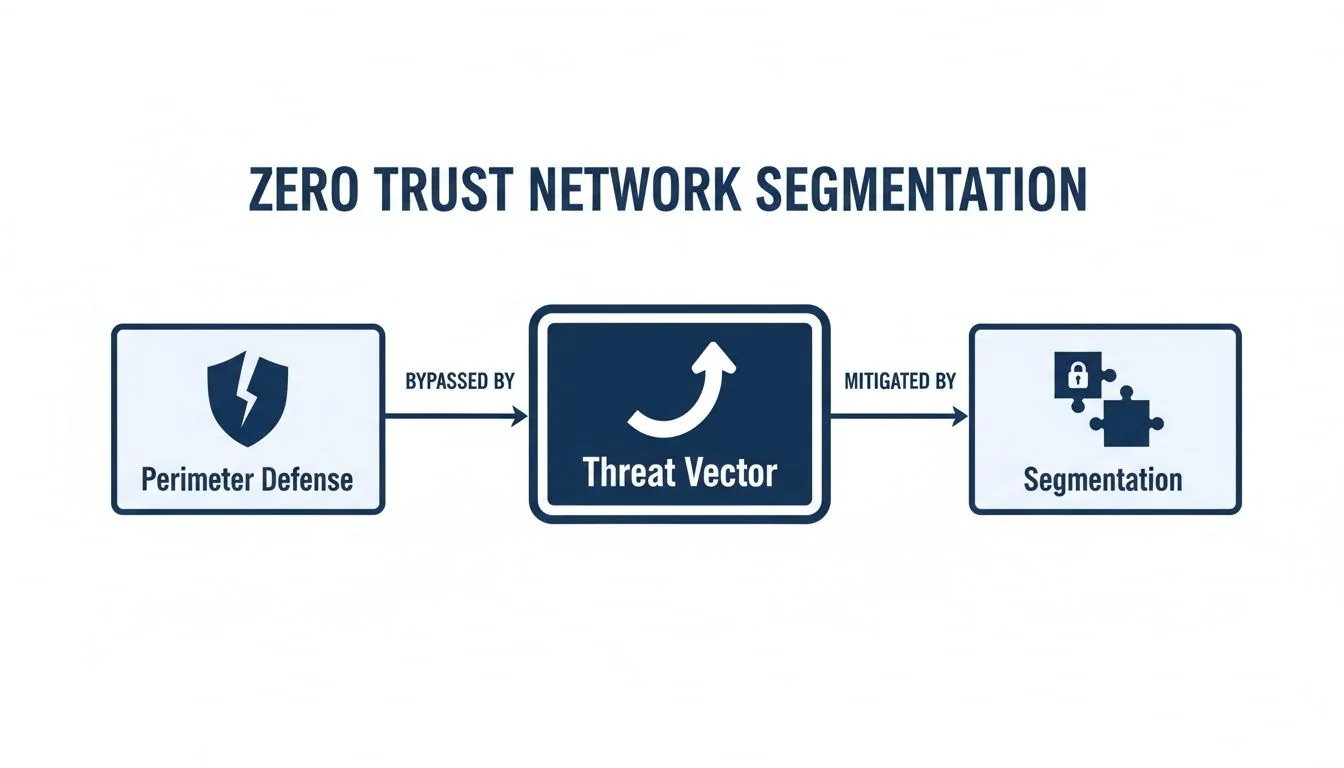
As the diagram shows, once an attacker gains initial access, segmentation is a key control for keeping a minor breach from escalating.
Macro-Segmentation: A Pragmatic First Step
Macro-segmentation involves creating broad, logical boundaries across your network. This means creating separate zones for production workloads, development environments, and corporate IT. It’s a practical approach that delivers immediate risk reduction without the complexity of a complete network overhaul.
This is typically implemented with existing tools like Next-Generation Firewalls (NGFWs) and Virtual LANs (VLANs). It is effective for preventing coarse-grained violations, such as a developer’s workstation directly accessing a production database. However, it provides no protection against an attacker who has already compromised a server within a production segment. 75% of organizations still rely on this method, which is difficult to manage and leaves them exposed to internal threats.
Micro-Segmentation: The Granular End Goal
Micro-segmentation is the most granular implementation of a zero trust strategy. Instead of large network zones, you create a secure perimeter around every individual workload—each VM, container, or serverless function. The attack surface shrinks and lateral movement becomes much harder.
Micro-segmentation is the principle of least privilege enforced at the network level. If a web server is compromised, it cannot communicate with the adjacent database unless an explicit policy allows it. The breach is contained instantly.
Achieving this level of granularity requires a modern, software-defined toolkit:
- Software-Defined Perimeters (SDP): Create one-to-one encrypted tunnels between a user and a resource, rendering the underlying infrastructure invisible to unauthorized entities.
- Agent-Based Solutions: Install lightweight agents on each host (server, VM) to enforce security policies directly at the workload, independent of the network topology.
- Native Cloud Controls: Use built-in cloud platform tools like AWS Security Groups or Azure Network Security Groups, which act as stateful firewalls for every cloud instance.
Micro-segmentation is the destination, not the starting point. It demands deep application visibility and a mature policy-as-code practice. A comprehensive zero trust architecture design is required to integrate these components effectively.
Decision Framework: A Phased Approach
Successful ZTNS projects phase the work rather than choosing one approach.
- Start with Macro-segmentation: Implement broad controls to secure quick wins and wall off critical environments.
- Apply Micro-segmentation Surgically: Target high-value assets first—new cloud-native applications, critical databases, and systems holding sensitive data.
- Expand Incrementally: Over time, expand granular controls across the rest of the enterprise as part of your ongoing modernization roadmap.
This hybrid approach balances the ideal security state with operational reality and avoids the "boil the ocean" problem that sinks large-scale security projects.
Implementation Patterns and Common Failure Modes
A ZTNS strategy depends on execution. The objective is surgical controls that protect high-value assets without friction, not a web of policies that grinds business operations to a halt.
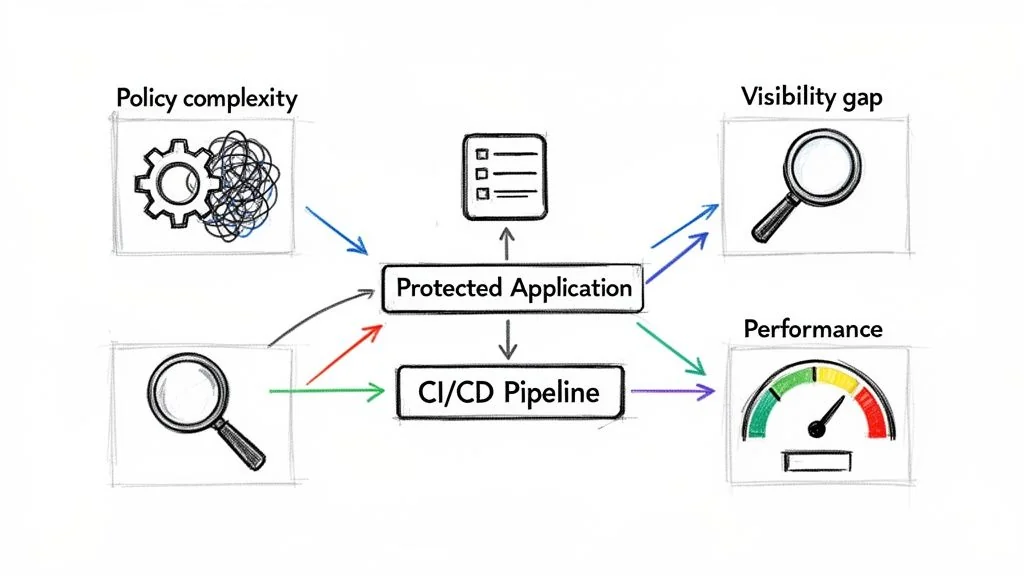
Success depends on a clear view of what you are protecting. We have found that two patterns consistently deliver the most risk reduction and build momentum for broader adoption.
Pattern 1: Protecting High-Value Applications
Your "crown jewel" applications—those processing sensitive PII, financial transactions, or intellectual property—are the obvious first target. The strategy is to create a secure enclave using micro-segmentation, isolating them from the general network.
The process has three steps:
- Map All Dependencies: Use a traffic visibility tool to create a definitive map of every inbound and outbound connection for the application. You cannot protect what you cannot see, so do not skip this step.
- Define and Test Policies: Draft allow-list policies based on the legitimate traffic flows identified. Run these policies in a "monitor-only" or "logging" mode for several weeks to identify exceptions and legitimate edge cases without causing an outage.
- Enforce and Lock Down: Once you are confident the policies accurately reflect required communications, switch to enforcement mode. All unauthorized traffic is now blocked by default.
The payoff is immediate. Even if an adjacent, less-secure system is compromised, the attacker has no network path to the critical application.
Pattern 2: Securing the CI/CD Pipeline
A modern software delivery pipeline is a prime target for supply chain attacks. A compromised build server or artifact repository allows an attacker to inject malicious code into every application you ship. Securing this pipeline with zero trust network segmentation is necessary.
This requires isolating each stage of the pipeline at the network level:
- Development: Developer environments must have zero direct network access to production infrastructure.
- Build: The build server must only be allowed to pull code from a trusted source repository and push to a specific artifact repository. All other communication is blocked.
- Testing: Staging and testing environments must be completely isolated from production. There is no acceptable reason for test systems to have a network path to live data.
- Production: Only the automated deployment tool (e.g., Argo CD, Spinnaker) should have the credentials and network access required to push new artifacts into the production environment.
This enforces separation of duties at the network level, making the pipeline harder to tamper with.
Common Failure Modes and How to Avoid Them
ZTNS projects fail due to operational missteps, not technology limitations. Just 5% of organizations are micro-segmenting their networks today partly because these challenges feel hard to overcome. If you want to implement Zero Trust security successfully, you must anticipate these failure modes.
- Overly Complex Policies: Teams attempt to write hyper-granular rules for every workload from day one, creating an unmanageable mess that leads to outages. Avoid this by starting with broader, environment-level policies and refining them iteratively.
- Poor Application Visibility: Deploying policies without a complete dependency map leads to failure. You will either break applications or leave security gaps. Avoid this by investing in visibility and traffic mapping tools before writing a single enforcement rule.
- Performance Bottlenecks: Some segmentation solutions, particularly those that proxy all traffic through a central appliance, introduce unacceptable latency. Avoid this by choosing solutions that enforce policy at the host level where possible and by rigorously performance testing them against production-level traffic loads.
Without proper segmentation, the 59% faster threat detection capability is lost, on top of the 67% project failure risk already present in complex cloud migrations. Vendors like Zscaler and Fortinet offer powerful Software-Defined Perimeter (SDP) solutions, but over-customization drives up cost: 30% of large-scale rollouts exceed budgets by 50% because of underestimated legacy integration costs.
Choosing Your ZTNS Vendor: A Defensible Decision Matrix
Choosing the technology and implementation partner is one of the highest-leverage decisions in a ZTNS project, and a mismatch between your architecture and a vendor’s core technology is a leading driver of failure. Marketing material is not enough; use a structured, evidence-based framework to make a defensible choice.
The goal is not to find the "best" vendor, but the right vendor for your specific environment, your team’s capabilities, and your modernization roadmap. A solution built for cloud-native startups will fail in a legacy-heavy enterprise.
Core Evaluation Criteria
Your evaluation must focus on three core areas: technical alignment, integration depth, and total cost of ownership (TCO). These factors determine whether a solution works in your environment.
- Technical Specialization: Does the vendor specialize in agent-based or agentless deployments? Is their "cloud-native" solution a repackaged on-prem product? A vendor excelling at agentless, on-prem segmentation is the wrong choice for securing ephemeral workloads in Kubernetes.
- Integration Ecosystem: A ZTNS tool cannot operate in a silo. It must have deep, native integrations with your Identity Provider (Okta, Azure AD), SIEM, and CI/CD pipeline. A weak IdP connection undermines identity-based policies.
- Total Cost of Ownership (TCO): Look beyond the license price. Factor in the hidden costs of implementation, ongoing operational overhead, and performance impact. Agent-based tools may demand more management cycles, while network-based approaches can force expensive hardware upgrades.
Effective segmentation helps a CTO de-risk a legacy system modernization, which can otherwise have failure rates as high as 67%. When you overlay zero trust controls, modernization costs can range from $2.50 to $5.00 per line of code. The payoff is significant: segmented organizations report up to 70% better compliance outcomes, a defense against fines that average €2.28 million per case under GDPR, across 2,685 enforcement actions tracked since 2018 (CMS Enforcement Tracker Report 2025/2026, cutoff March 2026). See market research on zero trust security trends for more context.
A Framework for the Decision
Use a quantitative scoring matrix to move the decision from gut-feel to a data-driven conclusion. Assign a weight to each criterion based on what matters most to your organization, not what the vendor’s sales team emphasizes.
A classic mistake is over-weighting "advanced features" you will never use while underweighting "ease of policy management." A sophisticated tool that no one can operate is more dangerous than a simpler tool that is configured correctly 100% of the time.
The matrix forces an explicit discussion about priorities and gives a defensible rationale for your final choice.
Vendor and Partner Evaluation Matrix
Adapt this scoring matrix to drive your evaluation. Be honest in your scoring and in the "Notes & Red Flags" column, which is where the decision is really made.
| Evaluation Criteria | Weight (1-5) | Vendor A Score (1-10) | Vendor B Score (1-10) | Notes & Red Flags |
|---|---|---|---|---|
| Agent vs. Agentless Alignment | 5 | 8 | 4 | Vendor B is primarily agent-based; our environment is 70% unmanaged legacy. Dealbreaker. |
| IAM/IdP Integration Depth | 5 | 9 | 7 | Vendor A has native connectors for our IdP. Vendor B requires a custom script. High risk. |
| SIEM & SOAR Integration | 4 | 7 | 8 | Both are solid. Vendor B provides richer, more actionable log formats for our SOAR playbooks. |
| Multi-Cloud Policy Consistency | 4 | 6 | 9 | Vendor B's policy engine is way better at abstracting cloud-native controls. Huge plus. |
| Performance Impact (Latency) | 3 | 8 | 5 | Lab tests show Vendor B adds 15ms of latency to database queries. Red flag. |
| Policy Management Overhead | 5 | 7 | 4 | Vendor B’s model would require three full-time engineers for policy upkeep. Not happening. |
| TCO (3-Year Projection) | 4 | 9 | 6 | Vendor A is 20% cheaper over three years once we factor in operational and staffing costs. |
| Partner Expertise with Legacy | 5 | 8 | 3 | Vendor A's partner has a proven, verifiable track record with mainframe modernization. |
This structured analysis reduces emotion in the decision and helps the zero trust network segmentation solution you choose align with your architecture, team, and modernization goals.
Phased Migration From Legacy to Segmented
A "big bang" migration to zero trust network segmentation risks serious outages. Attempting to segment an entire flat, legacy network overnight will break critical applications, burn out engineering teams, and can get the project canceled. A phased approach is the viable strategy.
This "crawl-walk-run" model de-risks the transition with small, incremental wins that build momentum and avoid the business disruption that sinks overly ambitious rollouts.
The Crawl Phase: Discovery and Visibility
You cannot segment what you cannot see. This initial phase is solely about discovery and mapping, with zero enforcement. Rushing this step is a common reason segmentation projects fail. With 64% of organizations connecting over 5,000 assets to their networks, manual discovery is impossible. You will miss critical dependencies.
Your only goal here is to build a high-fidelity map of all network assets and their communication patterns. This is also the time to gain buy-in from application owners by framing the project around reducing risk to their services, not as a top-down security mandate.
The goal of the Crawl phase is a map of reality, not blocking packets. Any policy written without that foundation is guesswork and is likely to break production.
With this map, you can draft policies in a "monitor-only" mode, allowing you to test your assumptions against live traffic and identify missed dependencies without causing downtime.
The Walk Phase: Your First Enforcement
With a validated traffic map and stakeholder buy-in, you can move to limited enforcement. Start small by securing a quick win. A new cloud-native application or a well-understood, isolated legacy service is an ideal candidate.
Here, you apply your first real micro-segmentation policies, creating a secure enclave around the pilot application. The rules refined during the monitoring period are now switched to "enforce." This gives you a fast, tangible result to show leadership.
Your checklist for this phase is simple:
- Select a Pilot App: Choose a non-critical but visible application where the owners are cooperative.
- Enforce Policies: Switch the validated rules from "monitor" to "block" for the pilot segment.
- Establish a Baseline: Measure performance and document all operational issues to create a feedback loop.
- Communicate the Win: Demonstrate the real risk reduction by showing how the pilot app is now isolated from lateral threats.
The Run Phase: Scaling Across the Enterprise
With successful pilots complete, the Run phase is about systematically expanding segmentation across the enterprise. You use the lessons, refined policies, and operational playbooks from your initial wins to accelerate deployment into more complex and critical environments.
This is where you can tackle harder challenges, such as isolating a monolith as part of a larger legacy system modernization initiative to contain its risk before a full refactor.
Policy automation becomes essential at this stage. As you scale from a few segments to hundreds, manual rule management becomes unworkable. You must adopt a policy-as-code model, integrating your segmentation platform with your CI/CD pipeline to automate rule creation, testing, and deployment. At this point, segmentation is how you operate, not a project.
Measuring Success: KPIs and Runbooks for Your ZTNS
A zero trust network segmentation strategy is only as good as its operational reality. To justify the investment, move from a project mindset to continuous measurement and response. Without metrics and pre-scripted runbooks, your architecture is a complex firewall with no provable impact on risk.
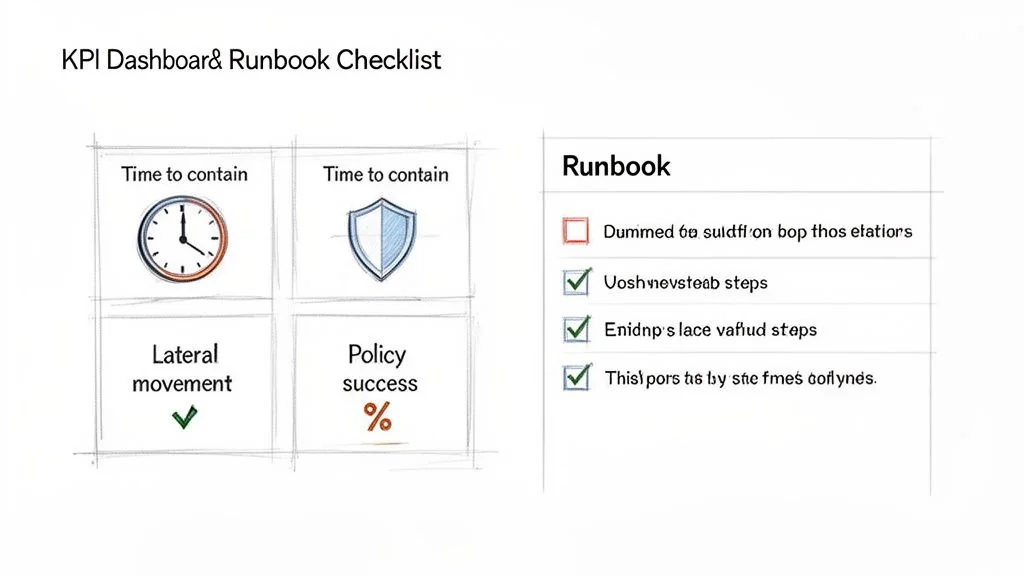
Focus on KPIs that directly map to security posture and resilience, not vanity metrics.
Defining the KPIs
Tie KPIs to concrete security outcomes that show a quantifiable reduction in business risk:
- Reduction in Detected Lateral Movement: This is the key test. Track alerts from your SIEM or EDR flagging east-west threat activity. In a successful ZTNS implementation, this number should fall, showing that even when a host is compromised, the attacker is contained.
- Time to Contain (TTC): Measure the time from the initial alert of a compromised asset to the moment you confirm its full isolation. With proper segmentation and automated runbooks, TTC should drop from hours or days to minutes. A 90% reduction is a realistic target for a mature program.
- Policy Enforcement Success Rate: Track the ratio of blocked, illegitimate connection attempts to allowed, legitimate ones. A high success rate (e.g., 99.9%) proves your policies are effective at stopping threats without causing business disruption from false positives.
A common failure of a ZTNS rollout is treating it as a one-time project. Continuous monitoring of these KPIs helps ensure your policies adapt as your environment changes and your security investment keeps delivering value.
Building Your Operational Runbooks
Incident response must be fast, precise, and pre-scripted. Operational runbooks make it predictable and repeatable.
Your ZTNS runbooks must address specific scenarios with clear, step-by-step actions.
Scenario: Unauthorized Access Attempt Detected
- Automated Trigger: The SIEM detects a blocked connection attempt to a critical database from an unauthorized workload and fires an alert.
- Instant Isolation (Automated): A SOAR playbook is triggered, placing the source workload into a "quarantine" segment with zero outbound network access, instantly containing the threat.
- Alert & Ticket: The on-call engineer receives a PagerDuty alert, and a Jira ticket is automatically created with all relevant logs, asset tags, and policy context.
- Forensic Analysis: The engineer analyzes the quarantined workload in a sandboxed environment, completely isolated from production.
- Remediation & Recovery: Based on the analysis, the workload is either terminated or cleaned and returned to its proper production segment.
This structured response speeds containment and investigation.
Common ZTNS Questions
Implementing zero trust network segmentation raises hard questions that vendor marketing materials tend to skip. These are answers for CTOs and architects.
How Does Micro-segmentation Impact Network Performance?
It depends entirely on the architecture. Agent-based solutions generally perform best, enforcing policy on the host with minimal latency. In contrast, older network-based or firewall-centric models that force traffic through a central chokepoint can severely degrade performance.
For any high-throughput or latency-sensitive application, host-based micro-segmentation is usually the only viable path. A performance penalty of even 5-10ms per transaction can degrade a real-time system. Rigorously test any solution against your actual production traffic loads before making a commitment.
Can ZTNS Be Applied to OT and IoT Environments?
Yes, but not with your standard IT toolset. Operational Technology (OT) and IoT devices often run on legacy or minimal operating systems that cannot support a security agent and use specialized industrial protocols.
For these environments, the effective strategy is agentless zero trust network segmentation. This is enforced by network hardware like Next-Generation Firewalls (NGFWs) or specialized OT security appliances. The approach is to create isolated zones around groups of similar devices (e.g., HVAC controllers, manufacturing PLCs) and lock down communication to known-good patterns.
How Do You Manage Policies at Scale?
Manual management of thousands of granular rules is unsustainable and leads to misconfigurations and security gaps.
The scalable solution is policy-as-code. Segmentation rules must be defined in a declarative format (e.g., YAML), stored in a Git repository, and deployed through an automated CI/CD pipeline. This provides version control, peer review, and automated testing. Large enterprises, which accounted for over 65% of ZTNA implementations in 2024, are already standardizing on this model to manage risk. Analysis of zero trust network architecture trends (accessed August 2026) points to this level of automation becoming the industry standard.
How Do You Gain Visibility Into Encrypted Traffic?
You do not need to break TLS/SSL everywhere. Widespread "man-in-the-middle" decryption is resource-intensive and creates significant privacy and compliance risks.
A more pragmatic approach is to focus on metadata. Modern ZTNS solutions can infer traffic context and enforce policy based on metadata alone—such as source, destination, and identity—without decrypting the payload. This provides strong security without hurting performance or creating compliance risk.
Chief Analyst, Software Modernization Intelligence · 10+ years B2B market research
Published: ·Updated: