Digital Marketing Startup: A CTO's Tech Platform Blueprint
Build a defensible digital marketing startup platform. This CTO's guide covers the tech stack, data architecture, failure modes, and costs for modern MarTech.
On this page
- Overview
- The Real Opportunity in the $786B Digital Marketing Market
- Legacy MarTech fails at the integration layer
- The economic opening is in system replacement at the boundary
- What technical buyers actually evaluate
- Defining Your Modernization Wedge
- Pick a segment with incompatible service needs
- Productized service beats generic agency work
- Use operating model as a product filter
- Revenue Models and Their Architectural Consequences
- The business model determines what the platform must meter
- Where each model breaks in production
- Design for channel proof, not just channel connectivity
- The Composable MarTech Stack Blueprint
- Ingestion and identity form the control plane
- The data platform should support diagnosis, not just storage
- Decisioning belongs above channels, not inside them
- Engineering Roadmap and Common Failure Modes
- Build the minimum viable control loop
- The common failure modes are architectural, not cosmetic
- A pragmatic execution checklist
- The CTOs Go-To-Market and Scaling Playbook
- Design partners should influence interfaces, not architecture principles
- Apply 70 20 10 to engineering allocation
- Use a build-versus-buy rule that protects the core
A digital marketing startup looks crowded only if you stare at the front end of the market. The visible layer is saturated with agencies, campaign tools, and thin wrappers around ad platforms. The underbuilt layer is the software spine underneath them.
That's where the modernization opportunity sits. The global digital advertising and marketing market was estimated at $667 billion in 2024 and is projected to reach $786.2 billion by 2026, with 72% of marketing budgets allocated to digital channels according to WordStream's digital marketing statistics. For a CTO, that points away from building another marketing service: the budget has already moved. The bottleneck has shifted into integration, attribution, identity resolution, and workflow automation across brittle legacy systems.
Most incumbent MarTech stacks weren't designed as coherent platforms. They were assembled through tool sprawl, point integrations, CSV exports, duplicated customer identities, and reporting layers that can describe activity but can't explain outcomes. A serious digital marketing startup wins by replacing that fragmentation with a product architecture that makes measurement, orchestration, and service delivery operationally scalable.
The Real Opportunity in the $786B Digital Marketing Market

A market expected to approach $786.2 billion by 2026 attracts attention to channels, creative, and media spend. For a CTO, the more important signal is what happens after that budget enters the stack. Growth in digital spend increases the volume of events, identities, and decisions that legacy systems must process. In many organizations, the software layer fails before demand does.
That failure rarely appears as a single outage. It shows up as slow reconciliation, conflicting attribution reports, duplicated customer records, and campaign logic scattered across ad platforms, CRMs, CDPs, and spreadsheets. Each tool may work on its own terms. The system as a whole does not.
Legacy MarTech fails at the integration layer
Incumbent vendors often optimized for channel depth, not for shared state across the stack. As a result, data enters through multiple collectors, lands in different schemas, and gets normalized only after analysts or operators intervene. By the time reports reach finance or revenue leaders, the data is already late and often contested.
The common pattern looks like this:
- Event collection is inconsistent across web properties, ad platforms, CRM objects, and offline conversions
- Identity resolution is partial because email, cookie, device, and account identifiers do not map cleanly across systems
- Workflow execution is fragmented because automation rules live inside channel tools instead of a central orchestration layer
- Measurement is downstream and lossy because attribution depends on exports, joins, and heuristic matching after the fact
This is a platform problem.
A modernization company in this market builds a control plane, not just visibility. The control plane can ingest events reliably, reconcile customer state, and trigger actions with enough precision that reporting and operations use the same underlying data model.
The economic opening is in system replacement at the boundary
Broad platform ambition sounds attractive, but buyers usually approve budgets for narrower reasons. They fund projects that remove a costly boundary between systems they already own. That boundary might sit between paid media and CRM, between product analytics and lifecycle messaging, or between warehouse data and campaign execution.
The strongest product wedges usually start at one of three boundaries:
| System boundary | What breaks in the legacy stack | What a modern platform has to do |
|---|---|---|
| Event to identity | Different tools create different versions of the same customer | Standardize event schemas and maintain an identity graph with deterministic and probabilistic matching |
| Identity to decisioning | Segments drift across platforms and trigger logic becomes inconsistent | Centralize audience rules, suppression logic, and eligibility checks |
| Spend to outcome | Channel reports describe activity but not business impact | Connect campaign events to revenue, retention, or pipeline events in a shared measurement layer |
That distinction matters because it changes the build thesis. A startup that starts with reporting often becomes another analytics surface. A startup that starts at a system boundary can replace manual reconciliation, then absorb adjacent workflow and measurement functions over time.
What technical buyers actually evaluate
Engineering leaders do not evaluate this category by UI polish or channel count first. They look for evidence that the platform can survive messy production conditions.
The due diligence questions are usually architectural:
- Can ingestion handle late, duplicated, and out-of-order events without corrupting downstream state?
- Does the identity model degrade safely when deterministic matching fails?
- Can tenants isolate data, workflows, and model behavior without creating operational sprawl?
- Does attribution logic remain explainable when channel APIs change or privacy rules remove identifiers?
- Can the platform expose APIs and logs that let customers audit decisions instead of trusting black-box outputs?
A digital marketing startup becomes durable when it solves one expensive bottleneck completely and expands from that foothold. In this market, the durable asset is the underlying data and decisioning infrastructure that legacy marketing tools were never designed to provide, not a campaign builder.
Defining Your Modernization Wedge
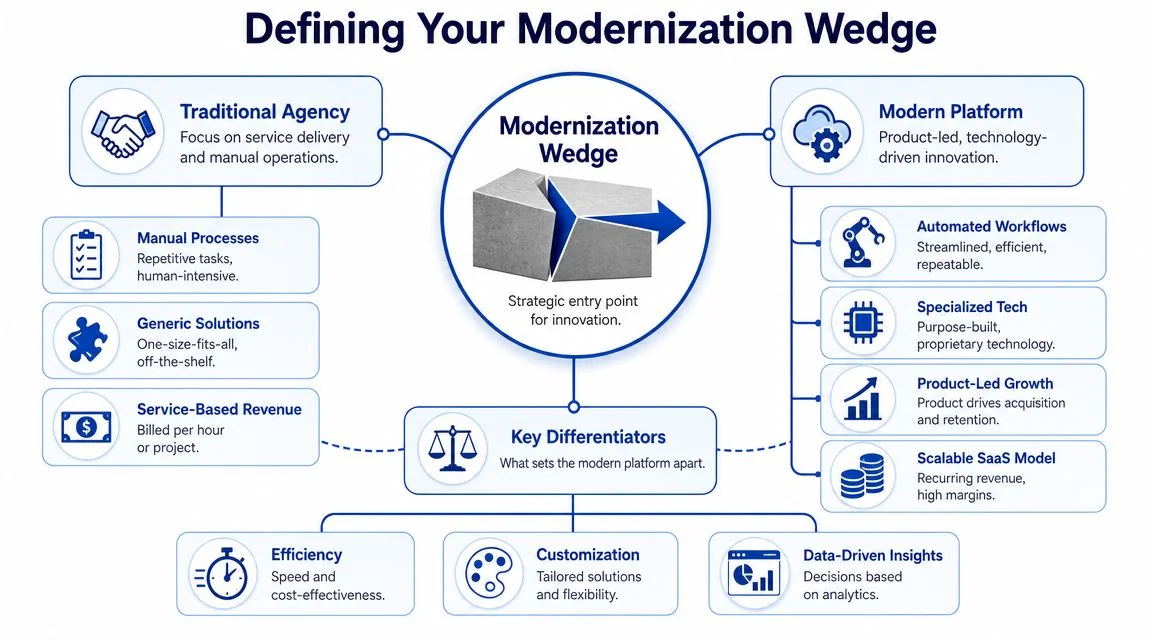
Most founders define their wedge in market language. They say they serve SMBs, ecommerce brands, or B2B SaaS teams. That's too vague for a platform company. Your wedge has to be operational. It has to specify which service model your software makes viable.
That distinction matters because small-business markets punish generic delivery models. Bain's analysis of underserved small-business markets argues that winning requires explicit trade-offs between digital self-serve, inside sales, and support tiers. For a CTO, that is a platform design constraint, not just a go-to-market note.
Pick a segment with incompatible service needs
A useful modernization wedge often emerges where incumbent vendors force every customer through the same operating model. Small accounts need low-friction onboarding, opinionated defaults, and productized workflows. Larger SMBs need API access, data portability, support escalation, and room for custom processes.
Trying to serve both through one undifferentiated application usually creates the worst of both worlds. The product becomes too complex for self-serve users and too rigid for higher-value accounts.
A sharper pattern looks like this:
- Microbusiness tier with self-serve setup, templated automations, and constrained configuration
- Growth SMB tier with integration endpoints, approval workflows, and managed onboarding
- Shared platform core for identity, event processing, billing, permissions, and observability
That model turns service complexity into a software boundary instead of an organizational burden.
Productized service beats generic agency work
The platform advantage appears when you turn recurring human work into software primitives. A traditional agency sells effort. A modern platform sells repeatability.
Three examples make the difference clear:
- Onboarding logic becomes a guided workflow with validation rules, not a consultant playbook.
- Channel setup becomes reusable integration modules, not one-off implementation labor.
- Optimization tasks become closed-loop recommendations and alerts, not manual weekly audits.
The best wedge is often narrow enough to force architectural discipline. Broad positioning hides weak product boundaries.
That's why “we help businesses market better” is not a wedge. “We unify acquisition, lifecycle, and attribution for self-serve SMB teams with a managed upgrade path” is closer. It tells engineering what to build and what to reject.
Use operating model as a product filter
Before approving any roadmap item, test it against the service model you're trying to scale.
Ask these questions:
- Does this feature reduce human intervention or merely relocate it?
- Can support handle this through tiered workflows, or does it require bespoke knowledge every time?
- Does the feature belong in the shared core, or is it customer-specific variation disguised as roadmap demand?
- Will this improve expansion into the next support tier without bloating the self-serve product?
If you can't answer those cleanly, the wedge is still fuzzy.
A digital marketing startup becomes defensible when its architecture enforces customer economics. Bain's point about trade-offs is the key one. The winners don't “serve SMBs” in the abstract. They build a platform whose tenancy model, onboarding flow, permissions, and support paths are engineered for that exact market shape.
Revenue Models and Their Architectural Consequences
Revenue model choices look commercial on a pitch deck. In practice, they're infrastructure decisions. A digital marketing startup that sells self-serve subscriptions, usage-based data services, or tech-enabled managed operations will need different tenancy boundaries, billing events, and control planes.
That connection is easy to miss early. It becomes painful later, when product usage no longer lines up with invoicing, cost allocation, or customer expectations. In this category, architecture has to prove business value, not just deliver features. Insivia's digital marketing statistics report that email marketing returns $36 to $42 for every $1 spent, PPC returns about $2 for every $1 spent, and search accounts for 40.9% of the global digital advertising and marketing market. If those are the channels your platform claims to optimize, your system has to ingest and attribute outcomes back to them with defensible accuracy.
The business model determines what the platform must meter
If you can't meter value, you can't monetize it cleanly.
| Revenue Model | Core Architectural Requirement | Primary Failure Mode |
|---|---|---|
| Pure SaaS | Strong multi-tenancy, role-based access, feature flagging, predictable subscription billing | Product becomes too customizable and drifts into hidden services work |
| Usage-based | Event-grade metering, immutable usage logs, cost-aware processing, billing reconciliation | Billing disputes caused by inconsistent event definitions or delayed aggregation |
| Tech-enabled managed service | Workflow orchestration, operator tooling, customer-specific runbooks, audit trails | Margin collapse because humans sit inside every customer transaction |
A CTO should treat this table as a design warning, not a taxonomy.
Where each model breaks in production
Pure SaaS works when customer value can be packaged into a common product experience. That demands strict boundaries. Shared schemas, standardized workflows, and opinionated UI constraints matter more than flexibility. The failure mode appears when enterprise prospects pressure the team into custom logic that bypasses the core model.
Usage-based pricing fits products built around data volume, activation volume, or API activity. It sounds elegant until finance asks engineering to explain invoice variance. If event schemas are unstable, if ingestion retries create ambiguity, or if different services count usage differently, trust erodes fast.
Tech-enabled managed services can be the right bridge for early revenue, especially when buyers need expertise layered on top of software. But that model only scales if internal operator actions are themselves productized. Otherwise, the company becomes an agency with better tooling.
Design for channel proof, not just channel connectivity
Many products stop at integration. That's not enough. Buyers want evidence that a platform improves outcomes in the channels they care about.
That means your architecture should support:
- Channel-specific ingestion for email, search, CRM, and product telemetry
- Normalized revenue events so downstream reporting doesn't rely on platform-native definitions
- Attribution lineage that records how decisions were made and which inputs informed them
- Auditability for disputed conversions, delayed events, and campaign changes
A connector tells the customer you can move data. Attribution tells the customer you deserve budget.
Start with a small set of high-value channels and make them financially legible before adding integrations. In this market, a digital marketing startup earns trust when billing, product telemetry, and channel performance line up without manual cleanup.
The Composable MarTech Stack Blueprint
Monoliths keep failing in this category for a simple reason. Marketing operations change faster than the procurement cycle that installed the original suite. A composable platform survives because it treats channels, data pipelines, and decision logic as replaceable modules around a stable core.
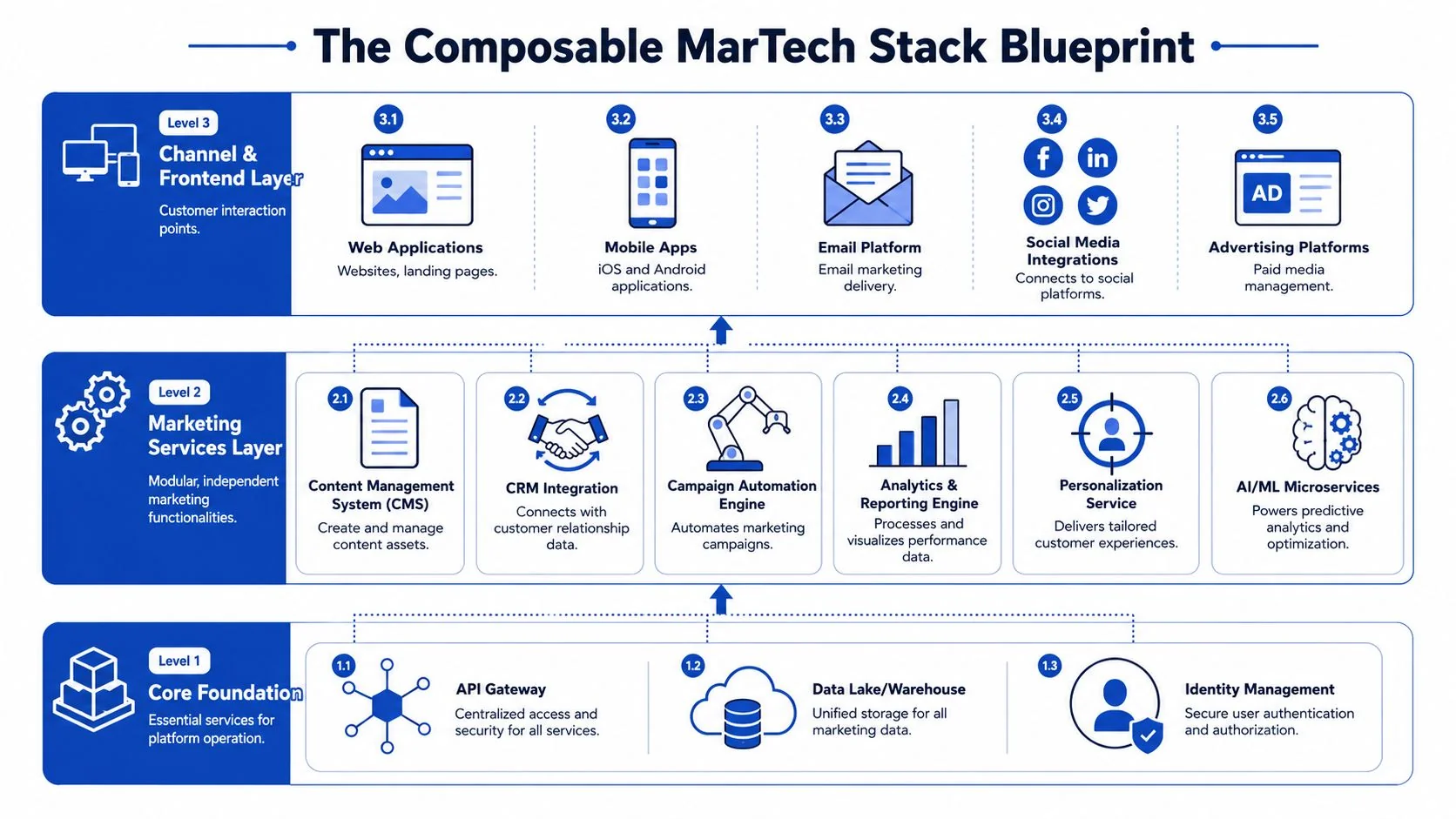
The architecture should center on six layers, each isolating a different class of change.
Ingestion and identity form the control plane
Start with event collection. Web SDKs, APIs, webhooks, CRM sync jobs, and batch imports all feed the same system, but they shouldn't land as raw chaos. You need a canonical event model early.
That model usually includes customer identifiers, account context, timestamps, source metadata, consent state, and business events such as signup, activation milestone, expansion, renewal, and referral actions. Without that discipline, your downstream automations become channel-specific hacks.
Then comes identity. Most legacy tools maintain their own customer truth. That creates duplicate profiles, orphaned conversions, and broken segmentation. Your platform needs a dedicated identity service that resolves cross-channel records into a persistent entity model, while preserving provenance and merge history.
The data platform should support diagnosis, not just storage
A customer data platform or equivalent warehouse-centric core should sit in the middle. The purpose is a closed-loop system, not centralization for its own sake.
MaRS' guidance on digital marketing analytics recommends measuring the AARRR funnel: Acquisition, Activation, Retention, Revenue, Referral, and using telemetry such as click-through ratio, cost-per-click, conversion rate, and email opens and clicks to decide what to stop, start, or continue. Architecturally, that means your platform must support causal separation. Low growth can't remain one vague symptom. You need to isolate whether the issue is traffic quality, onboarding friction, retention decay, or weak referral mechanics.
For teams modernizing legacy integration layers, API-led connectivity for legacy systems is useful. The lesson transfers directly: decouple source-system constraints from domain APIs so downstream services don't inherit every quirk of the tools you connect.
If acquisition data and activation data live in separate truths, your product will generate reports, not decisions.
A practical stack blueprint usually includes:
- Collection layer with SDKs, connectors, import services, and schema validation
- Storage layer with raw event retention plus modeled analytical datasets
- Identity layer for profile stitching, account hierarchies, and consent-aware joins
- Decision layer for segmentation, triggers, scoring, and orchestration
- Activation layer for email, CRM tasks, paid audience syncs, and in-product messaging
- Analytics layer for funnel diagnostics, attribution, and operator visibility
Later in the stack, delivery quality matters as much as orchestration quality. If your platform depends on lifecycle email, teams often validate sender reputation and inbox placement with tools like the MailGenius email deliverability tool before treating campaign underperformance as a targeting problem. That's a good architectural instinct. Don't misclassify infrastructure failure as growth failure.
A deeper implementation walkthrough is worth watching before you freeze interfaces:
Decisioning belongs above channels, not inside them
A common pitfall is letting each downstream tool own its own business logic. The email system decides who qualifies. The ad platform decides audience timing. The CRM decides lead state. Once that happens, no one can reason about customer treatment globally.
Central decisioning fixes that. Segments, triggers, and suppression logic should be defined once, versioned, and pushed outward. Channels become execution endpoints, not sources of truth.
That's the architectural difference between a toolchain and a platform.
Engineering Roadmap and Common Failure Modes
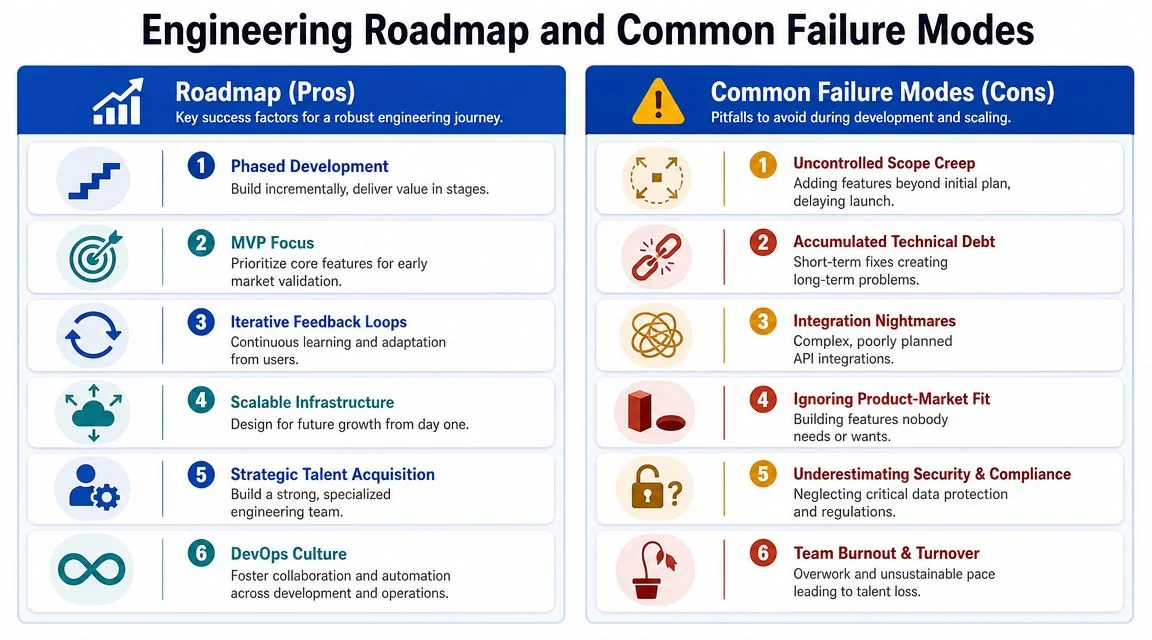
Most MarTech scale-ups fail long before scale. They fail when the team confuses platform completeness with market validation. The fix is tighter sequencing, not more planning.
The right roadmap starts embarrassingly small: one source system, one activation channel, one customer segment, one measurable workflow. If the first release can't create a cleaner feedback loop than the legacy stack it's replacing, adding more channels only multiplies ambiguity.
Build the minimum viable control loop
An early platform should do four things well:
- Ingest one trusted source of customer or campaign data
- Normalize that data into a usable internal model
- Trigger one downstream action reliably
- Show enough telemetry to explain whether the action worked
That scope is deliberately narrow. The first milestone is a defensible control loop that a design partner would keep using, not a “unified marketing cloud.”
A good initial slice might be CRM plus product events feeding a lifecycle email workflow. Another might be paid search plus conversion events feeding attribution diagnostics. The exact choice matters less than keeping the loop closed.
The common failure modes are architectural, not cosmetic
The post-mortems tend to repeat.
- Data lake first, product later. Teams overbuild ingestion and storage before proving which decisions the product needs to support.
- Channel sprawl too early. Every new connector introduces schema variance, rate-limit behavior, and support complexity.
- Weak compliance posture. Consent, deletion workflows, and data residency get treated as backlog items instead of platform primitives.
- Wrong early hires. Founders hire for interface polish while the actual bottleneck is data modeling, integration reliability, and platform operations.
- No operator tooling. Internal users end up querying databases or editing records manually because the product exposes only the customer-facing surface.
- Attribution without lineage. The system makes claims it can't explain, and customer trust collapses the first time numbers don't match another tool.
The fastest way to waste a year is to build a “unified” platform that can't tell you why one customer converted and another didn't.
A pragmatic execution checklist
Use this as a pre-launch gate for the first production version:
- Schema discipline in place, including event naming, versioning rules, and ownership
- Tenant isolation designed at the data and application layers
- Replay strategy defined for failed ingestion, delayed events, and downstream retries
- Consent and deletion paths implemented before broad customer onboarding
- Observability covering ingestion latency, failed activations, and billing-impacting events
- Operator console available for support, audit, and controlled remediation
- Unit economics instrumentation visible enough to connect platform actions to customer value
This is also where many teams learn that “marketing software” is really a data systems business with user-facing controls. Treat it that way from the start.
The CTOs Go-To-Market and Scaling Playbook
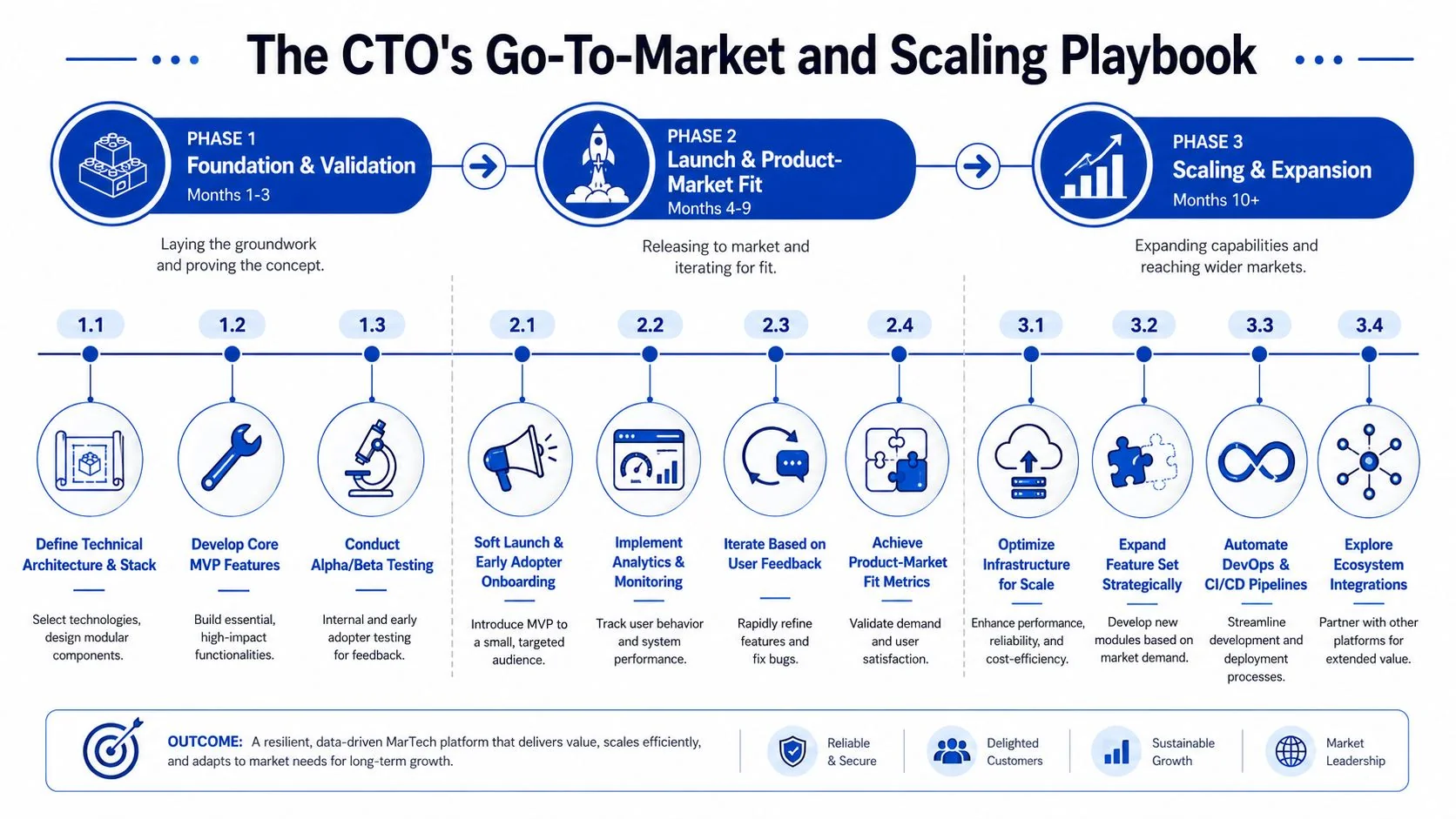
The first customers for a digital marketing startup shouldn't be treated as revenue accounts. They should be treated as design partners with operational pain strong enough to shape the product.
That changes go-to-market in a useful way. Sales stops promising broad platform capability. Engineering stops shipping speculative modules. The company learns from a small set of users whose workflows expose the actual modernization problem. If you want a concise external reference on framing this motion, Building a winning GTM strategy is useful because it keeps the focus on sequencing and fit instead of channel noise.
Design partners should influence interfaces, not architecture principles
The trap is overfitting to early customers. You want their workflow reality, not their entire legacy process encoded into your product.
Use a hard filter for early accounts:
- They already feel the pain of fragmented tools
- They can expose real data and real operators
- They'll accept product constraints in exchange for solving a painful workflow
- Their use case resembles a repeatable segment, not a one-off consulting engagement
Once those customers are live, instrument everything. Usage telemetry matters as much as revenue telemetry. You need to know which integrations break, which workflows stall, which users bypass the system, and where support interventions cluster.
For teams formalizing ownership as they scale, a clear platform engineering team structure helps. MarTech platforms fail when integration ownership, data platform ownership, and product-surface ownership are blurred across the org.
Apply 70 20 10 to engineering allocation
A useful discipline comes from startup marketing but translates cleanly into platform building. Milk & Cookies Studio's guidance for tech startups recommends the 70-20-10 model. In engineering terms, that means 70% of resources on the core, proven roadmap, 20% on promising platform improvements, and 10% on experimental features.
That allocation works because MarTech founders are especially vulnerable to shiny-object drift. New channels, AI features, custom dashboards, and partner requests all look urgent. Most of them are not.
In practice the split looks like this:
| Allocation | Engineering focus | What to reject |
|---|---|---|
| 70 | Core ingestion, identity, decisioning, billing-critical telemetry, reliability | Bespoke features for single accounts |
| 20 | Scalability work, key integrations, operator tooling, deployment hardening | Broad rewrites with no customer-facing leverage |
| 10 | Experimental scoring, niche channel tests, new workflow concepts | Experiments without instrumentation or rollback paths |
Use a build-versus-buy rule that protects the core
CTOs in this market face a steady stream of decisions: build email delivery or integrate it, build identity resolution or license a component, build workflow execution or adopt an orchestration engine.
The rule is simple. Build what defines your wedge. Buy what is table stakes and operationally expensive.
Build when the component:
- Directly encodes your differentiation
- Needs tight coupling with your data model
- Must expose behavior or controls existing vendors don't support
Buy when the component:
- Is infrastructure-heavy but strategically generic
- Requires specialist operational maturity
- Can be abstracted behind stable interfaces
A digital marketing startup scales when engineering remains opinionated about where proprietary value belongs. Not every subsystem deserves invention. The best teams protect their scarce complexity budget.
If you're evaluating whether this category is a genuine modernization play or just another SaaS wrapper, compare the architecture you want to build against the failure patterns that show up in real transformation work. Software Modernization Intelligence publishes the kind of implementation analysis technical leaders actually need: where systems fail, what the migration traps look like, and when not to build at all.
Chief Analyst, Software Modernization Intelligence · 10+ years B2B market research
Published: