Navigating Robotic Process Automation Companies in 2026
Don't just pick software. This 2026 guide dissects robotic process automation companies by archetype, cost, & failure rates to choose your ideal partner.
On this page
- Overview
- Choosing an RPA Partner
- Why partner choice carries more risk than the platform demo
- A selection framework that holds up under scrutiny
- The Four RPA Implementation Partner Archetypes
- Global system integrators
- Boutique specialists and platform-led firms
- BPO-led partners
- Partner Specialization Matrix for Industry and Process
- RPA Partner Archetype Fit Matrix
- Where each archetype usually wins
- Disqualify faster by process characteristics
- The Real Economics of RPA Implementation
- What belongs in the TCO model
- Pricing models and where they break
- Operating Model and Economics
- Why 70% of RPA Programs Fail to Scale
- What failure looks like in practice
- RPA is not process design
- The scaling controls that matter
- A Due Diligence Checklist for Vetting RPA Partners
- The questions that expose maturity
- Five checks CTOs should insist on
- Structuring a Pilot to De-Risk Your RPA Investment
- What to test in the pilot
- What good pilot design looks like
RPA spending is rising fast. Program outcomes are not.
That gap is why CTOs should evaluate robotic process automation companies as delivery partners first and software vendors second. The software brand rarely determines whether an automation program survives audit pressure, process drift, ownership changes, and production support demands. The partner's operating model does.
The selection mistake is usually structural. Buyers compare product demos and hourly rates, then treat implementation firms as interchangeable. They are not interchangeable. A generalist systems integrator, a platform-native boutique, a process consultancy, and an offshore delivery factory can all deploy the same bot on the same platform and still produce very different outcomes six months later. The difference shows up in governance, exception design, documentation quality, handoff discipline, and whether anyone inside your organization can maintain what was built.
The question for this market is which partner archetype fits your process mix, risk tolerance, internal engineering capacity, and target operating model. Which platform can automate a task is the easier question.
For teams evaluating automation beyond software features, this Practical guide to AI automation is a reference point.
RPA still has a clear role in modernization, especially in shared services, legacy back-office workflows, thick-client environments, and cross-system processes where APIs remain incomplete or impractical. But partner choice determines whether RPA reduces operational friction or adds another maintenance layer your team inherits later. The best engagements produce reusable components, clear controls, and a support model that stands up in production. The weaker ones produce brittle bots, undocumented logic, and a backlog of fixes disguised as automation progress.
Choosing an RPA Partner
A large share of RPA programs stall before they become part of normal operations. The common cause is rarely bot design alone. It is weak implementation governance, poor process selection, and a partner model that does not match the buyer's operating reality.
For a CTO, that changes the evaluation logic. Product capability still matters, but partner choice has more influence on whether automation survives production. Two firms can build the same workflow on the same platform and leave you with very different outcomes 12 months later: one delivers documented automations with change control and support ownership, the other leaves a queue of exceptions, credential issues, and undocumented dependencies for your internal team to absorb.
That is why RPA partner selection belongs with other architecture and integration decisions, not in a narrow software procurement lane. Teams that already assess system integration companies for enterprise modernization should apply the same discipline here: ask how the partner handles interfaces, release cycles, observability, security boundaries, and long-term maintainability.
Why partner choice carries more risk than the platform demo
A software demo is simpler than production.
A polished demo can show object recognition, workflow design, and attended or unattended execution. It does not show how the partner handles exception rates, failed runs after an upstream UI change, audit evidence for regulated workflows, or support ownership at 2 a.m. after a month-end close issue. Those are implementation questions, and they determine whether RPA reduces operating cost or creates a fragile layer between systems.
This is especially true in modernization programs. RPA is often used as a bridge around legacy systems, incomplete APIs, and manual swivel-chair work. In that role, the implementation partner is making architectural tradeoffs. They are deciding what gets automated now, what should wait for integration work, what must remain human-in-the-loop, and what control points need logging and review. Poor decisions at that stage raise maintenance effort later and can lock the enterprise into brittle process workarounds.
A selection framework that holds up under scrutiny
A defensible partner review should test four dimensions.
- Operating model fit: Does the partner build for a client-owned CoE, a managed service, or a hybrid model with shared support responsibilities?
- Process pattern fit: Have they automated the specific process category you care about, such as claims, reconciliations, customer onboarding, finance close tasks, or contact center after-call work?
- Control model fit: Can they show standards for documentation, credential handling, exception routing, testing, and change management?
- Cost model fit: Do they price the full lifecycle clearly, including support, bot remediation, platform administration, and post-go-live changes?
That framework surfaces a less obvious point: the biggest implementation risk is often misalignment between the partner's delivery model and your intended ownership model, not technical difficulty. A partner optimized for rapid bot output can fail in an environment that needs audit trails and internal capability transfer. A partner built for large transformation programs can over-engineer a narrow automation portfolio and erase the business case with overhead.
For a broader view of how automation initiatives are structured beyond one-off scripts, this Practical guide to AI automation covers how RPA fits inside a wider operating model.
The Four RPA Implementation Partner Archetypes
The phrase "robotic process automation companies" covers firms with different incentives, delivery models, and failure modes, so you are rarely comparing like with like.
MMR Statistics identifies a market concentrated around major platforms including UiPath, Automation Anywhere, Microsoft, Blue Prism, NICE, and Pegasystems, with one estimate putting UiPath at 30% global market share in 2025 (MMR Statistics RPA market report). That concentration has shaped the partner ecosystem. Many firms now organize around one vendor's stack rather than around neutral process engineering.
| Partner archetype | Core strength | Typical weakness | Best fit |
|---|---|---|---|
| Global System Integrator | Enterprise scale, governance, cross-functional programs | Slow delivery, heavy governance, high overhead | Large multi-region rollouts |
| Boutique RPA Specialist | Deep automation craft, sharper discovery, pragmatic delivery | Limited capacity or geographic coverage | Focused high-value process programs |
| BPO Provider | Strong process knowledge, operational ownership | Potential lock-in and weaker engineering flexibility | Outsourced operations with stable workflows |
| Platform-Aligned Consultant | Tool-specific depth and accelerator assets | Bias toward one stack, weaker tool neutrality | Organizations already committed to one platform |
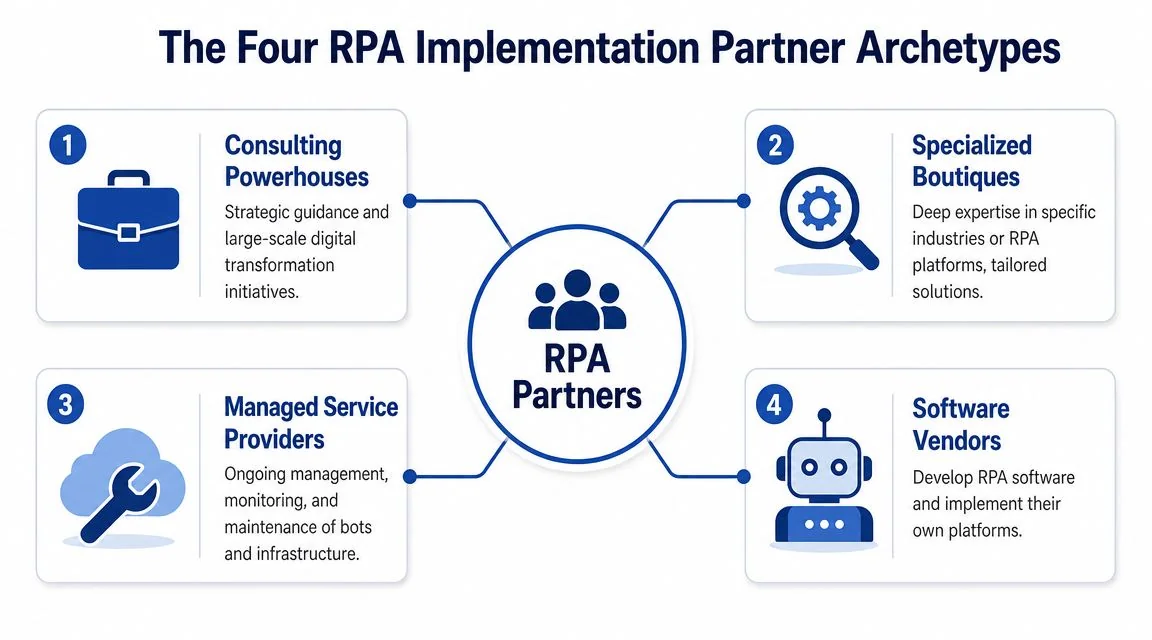
Global system integrators
GSIs work best when RPA is part of a broader modernization program. They can align automation with ERP changes, cloud migration, security controls, and enterprise architecture standards. Their advantage is institutional weight, not bot development speed.
The tradeoff is predictable. They often over-govern small programs and under-optimize for maintainability at the process level because delivery gets wrapped inside a broader transformation program.
Boutique specialists and platform-led firms
Boutique RPA firms usually outperform on process discovery, exception design, and production pragmatism. They live or die on whether bots keep running. That is why they are often the better choice for a contained program in a regulated process or a legacy-heavy environment.
Platform-aligned consultants are different. They are experts in one ecosystem, often with prebuilt accelerators and direct familiarity with the platform's orchestration, control room, and deployment patterns. That's valuable if you've already standardized on UiPath or Microsoft. It becomes a liability if you still need an architecture decision and not just an implementation team.
For technical leaders comparing these firms against broader integration providers, this analysis of system integration companies is a companion piece, because many RPA decisions fail when buyers confuse workflow automation with enterprise integration strategy.
BPO-led partners
BPO providers can be strong when the target process is already operationally outsourced or when you're buying an outcome with service accountability. Their weakness is that they often optimize for service efficiency inside their model, not for your long-term internal automation capability.
If a partner can't explain how you'd take over bot ownership later, assume they don't want you to.
Partner Specialization Matrix for Industry and Process
An RPA partner that looks competent in a sales deck can still be the wrong choice for your workload. Industry context and process type matter more than generic automation claims because they determine exception patterns, compliance pressure, integration complexity, and support burden.
A finance reconciliation workflow in manufacturing has different constraints than patient intake support in healthcare or account maintenance in retail. That changes which partner archetype is likely to succeed.
RPA Partner Archetype Fit Matrix
| Project Type | Global System Integrator (GSI) | Boutique RPA Specialist | BPO Provider | Platform-Aligned Consultant |
|---|---|---|---|---|
| Financial services, finance and accounting | Strong fit when governance, auditability, and cross-system coordination dominate | Strong fit for targeted reconciliations, claims support, and exception-heavy back office work | Moderate fit where process ownership already sits with a service provider | Strong fit if the bank or insurer has already standardized on one platform |
| Healthcare, HR and payroll | Moderate fit for enterprise shared services and identity-linked workflows | Strong fit for regulated, documentation-heavy automations that need careful process scoping | Moderate fit for administrative operations, weaker fit for workflows needing frequent adaptation | Moderate fit if platform controls align with compliance expectations |
| Manufacturing, supply chain | Strong fit for multi-region rollouts tied to ERP or plant systems | Strong fit for supplier onboarding, order handling, and repetitive legacy UI tasks | Moderate fit when external service operators already run the workflow | Moderate to strong fit in platform-standardized environments |
| Retail, IT operations | Moderate fit when automation spans stores, finance, and corporate systems | Strong fit for service desk tasks, account administration, and repetitive back-office flows | Strong fit for highly standardized support processes | Strong fit when internal IT already uses the same automation stack broadly |
Where each archetype usually wins
GSIs win when the automation program touches many systems, many countries, or many governance bodies. If your RPA roadmap intersects SAP modernization, identity controls, or a cloud operating model, broad coordination matters.
Boutique firms win when process understanding is the source of value. They tend to ask harder questions earlier. Which screen changes often? Where do exceptions pile up? Which rules are undocumented? Those questions save more pain than another polished architecture slide.
BPO providers win when you're buying operational continuity with automation embedded in service delivery. They are often less attractive when your goal is to build internal engineering capability around automation assets.
Platform-aligned consultants win when the platform decision is settled and the challenge is execution quality inside that ecosystem. They lose value when your team still needs neutral advice on whether RPA is even the right mechanism versus API integration, workflow orchestration, or process redesign.
Disqualify faster by process characteristics
Use process traits to narrow the field before you score vendors:
- Structured and stable work: Platform-aligned firms and BPO providers tend to perform well when workflows are highly repeatable and policy-controlled.
- Exception-heavy operations: Boutique specialists usually handle this better because they spend more effort on fallback logic and operator intervention design.
- Cross-functional rollout: GSIs become more credible when the program needs architecture governance, security alignment, and executive coordination.
- Legacy interface dependence: Specialists with thick-client and desktop automation experience often outperform larger firms that default to generic delivery templates.
The wrong archetype slows delivery and also distorts process selection, because the partner starts picking work that fits its business model instead of your architecture.
A good shortlist should feel narrow. If every partner seems equally suitable for every process, your selection criteria are too generic.
The Real Economics of RPA Implementation
RPA business cases routinely understate cost because they treat licenses as the main spend category. In practice, partner delivery model, support design, and governance usually have more impact on total cost than the software subscription.
A defensible business case starts with unit economics. Measure the current cost per transaction, the expected cost after automation, and the effect on cycle time, accuracy, exception handling, and control coverage. If a partner cannot model those variables at the process level, the proposal is a staffing estimate dressed up as an automation strategy.
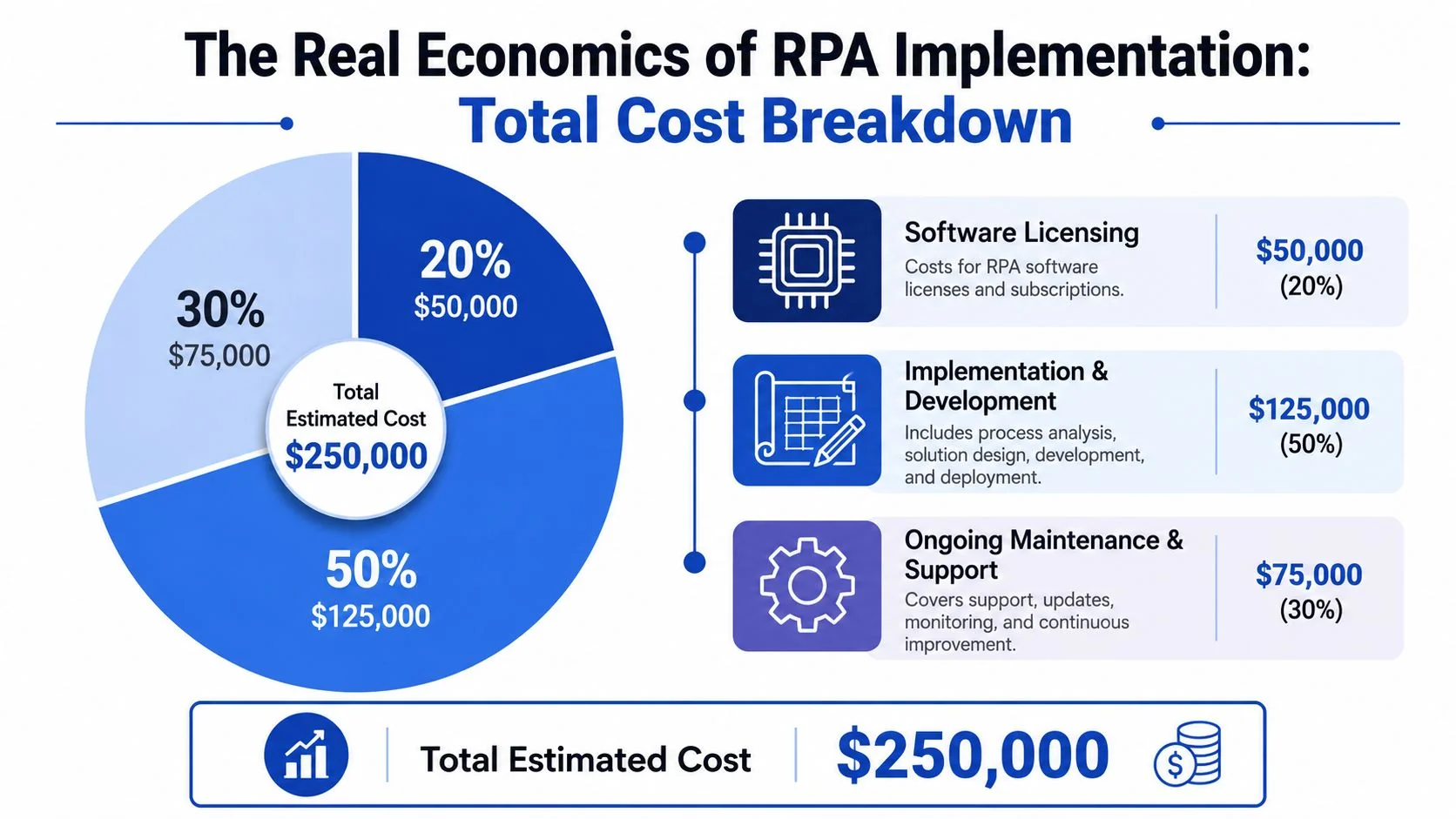
What belongs in the TCO model
The full cost base is broader than many vendor quotes suggest:
- Discovery and process mapping: Time spent validating rule stability, exception rates, handoff points, and audit requirements.
- Environment setup: Orchestrator configuration, access controls, credential vaulting, logging, and deployment workflows.
- Build and test effort: Bot development, integration work, exception logic, regression testing, and user acceptance.
- Support and maintenance: Monitoring, incident response, UI change remediation, release management, and bot performance tuning.
- Program overhead: CoE staffing, documentation, coding standards, reusable component libraries, and platform administration.
Partner archetype starts to matter economically. A low day rate from a generalist firm can produce a higher three-year cost if each bot is built as a one-off asset with weak documentation and expensive support handoffs. A more expensive specialist can be cheaper over time if it reduces rework, shortens incident resolution, and leaves behind reusable patterns your internal team can maintain.
Pricing models and where they break
Three pricing models dominate RPA services, and each shifts risk in different ways.
Time and materials fits uncertain discovery work, legacy environments, and exception-heavy processes. It exposes scope clearly, but it requires tighter buyer governance because weak partners can extend analysis and testing indefinitely.
Fixed-price per process works only when inputs, exceptions, and dependencies are already known. If process variability is still being discovered, fixed price often turns into change-order negotiation, with delivery slowing while both sides argue about what was "in scope."
Outcome-based pricing sounds attractive, but it fails when the partner is accountable for results that depend on upstream data quality, policy changes, or business-team behavior. It can work for narrow, measurable use cases. It breaks down in shared-control environments.
For non-technical stakeholders, this DataTeams' guide on BPA helps separate process value from tool selection.
Cheap implementation often shows up later as higher support cost, slower change cycles, and more production incidents.
Operating Model and Economics
The strongest partners present an operating model, not just a build estimate. They specify who owns production support, how exceptions are triaged, what percentage of components are reusable, how bot changes are approved, and what handoff looks like after go-live.
Those details determine whether automation gets cheaper as the estate grows or becomes a portfolio of fragile scripts with rising maintenance cost. For a CTO evaluating robotic process automation companies, that is the key distinction. The software brand influences capability at the margin. The partner's delivery model determines whether the economics hold after the pilot.
Why 70% of RPA Programs Fail to Scale
The common explanation for weak RPA outcomes is that the technology isn't flexible enough, but that is the wrong diagnosis. The scaling problem is operational. SiliconANGLE's coverage of the category's evolution points to the causes: poor planning, weak change management, and a lack of skilled staff, along with the need for a Center of Excellence model, stakeholder coordination, and reusable bot components to avoid bot sprawl (SiliconANGLE on RPA as a transformation catalyst).
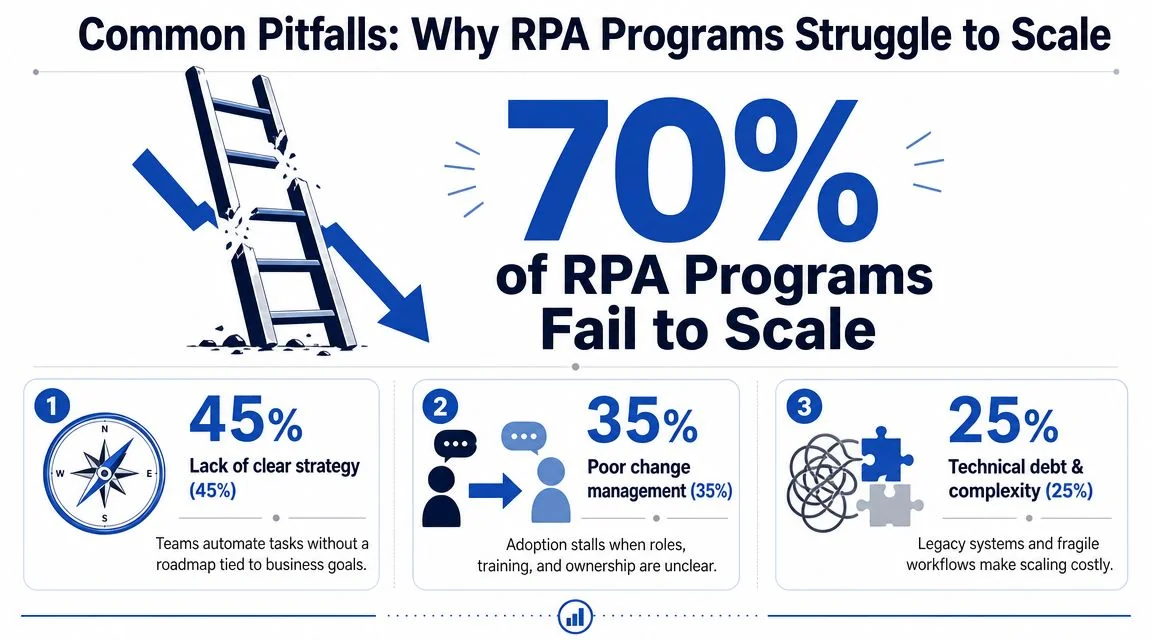
What failure looks like in practice
Most failed programs decay rather than crash. One team automates a report pull. Another automates claims intake. A third builds desktop scripts for HR. Nobody owns standards, logging, or reuse. Then a UI changes, exceptions spike, and support work multiplies.
That is bot sprawl: progress in the first quarter, technical debt by the second year.
The underlying issues usually come in clusters:
- Bad process selection: Teams automate unstable workflows that should have been redesigned first.
- Weak governance: No one defines development standards, release controls, or exception routing.
- No reusable architecture: Every bot gets built as a bespoke asset with duplicate logic.
- Thin change management: Business teams treat bots as magic rather than as production systems that require ownership.
RPA is not process design
Many robotic process automation companies oversell the product. RPA is good at structured, rule-based workflows. It is not a substitute for process simplification. If the task relies on tribal knowledge, constant judgment calls, or daily policy changes, the right answer may be process redesign, API integration, or workflow tooling rather than another bot.
This short video covers the scaling challenge and is worth sending to program sponsors who think a successful pilot proves enterprise readiness.
A bot that works in production proves that one process was automatable. It does not prove a viable automation program.
The scaling controls that matter
To keep the program viable, require four controls early:
- A CoE with real authority over standards, intake, and prioritization.
- Reusable components for login flows, logging, exception handling, and notifications.
- Business ownership for process rules and exception decisions.
- Architecture review for when RPA should be rejected in favor of a better modernization path.
A Due Diligence Checklist for Vetting RPA Partners
A weak partner selection process can lock you into years of avoidable support cost. Vendors rarely lie outright; standard RFP questions simply reward polished methodology language over evidence from live operations.
The partner archetype matters more here than the software logo on the slide. A global SI, specialist boutique, staffing-led shop, and software vendor services arm can all claim the same delivery steps. Their failure modes are different. Your due diligence process should be built to expose those differences before contract signature.
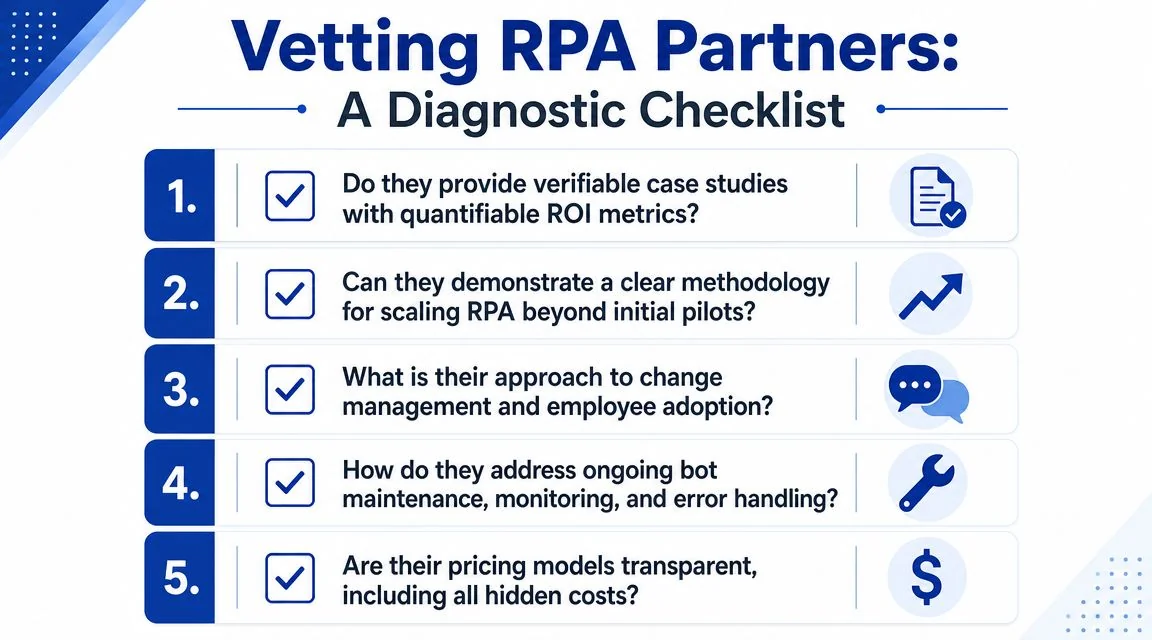
Good diligence starts with artifacts from production. Ask bidders to show what they built, how it failed, how often it changed, and who carried support responsibility after go-live. If they cannot produce sanitized examples of runbooks, bot design documents, exception matrices, and change records, you are evaluating sales capability, not delivery maturity.
The questions that expose maturity
Ask for evidence from production.
- Show production documentation: Request sanitized runbooks, support procedures, release notes, and design docs for an automation that has been live long enough to require maintenance.
- Show exception design: Ask how the partner separates business exceptions, system exceptions, credential failures, and upstream data defects, then routes each to the right owner.
- Show reuse discipline: Ask which components are standardized across automations and which are process-specific. Reuse lowers support effort. Custom logic in every bot raises it.
- Show operating metrics: Ask for before-and-after measures on cycle time, exception rates, rework, and bot stability, with enough context to explain why results changed.
- Show handoff mechanics: Ask what your internal team would need to own the automation estate without the partner, including documentation, access model, monitoring, and L2-L3 support boundaries.
Five checks CTOs should insist on
-
Governance evidence
Ask who approves intake, solution design, security exceptions, and production changes. Mature partners can map decision rights clearly between the CoE, engineering, security, and process owner. -
Maintenance realism
Ask what breaks most often after release. Strong partners will name UI changes, credential issues, source-data drift, and rule changes quickly, then explain their remediation workflow and time-to-recover targets. -
Platform bias disclosure
Ask for three situations where they would recommend API integration, workflow redesign, or no automation at all. Partners that cannot answer are probably compensated to maximize bot volume, not program outcomes. -
Delivery team continuity
Ask whether the discovery lead, solution architect, and support lead stay involved after go-live. Handoff-heavy models often create the exact accountability gap that later shows up as slow fixes and recurring defects. -
Commercial transparency
Ask which activities sit outside the statement of work. Common gaps include hypercare, production support, infrastructure setup, test data prep, credential vault integration, and bot updates triggered by application changes.
One question is especially revealing: ask for an automation that became expensive to maintain. Then ask what changed in the process, how often incidents occurred, what the monthly support load looked like, and what standard the partner added afterward. That answer usually tells you whether the firm learns systematically or just patches issues one case at a time.
Procurement teams should also test third-party risk controls, not just technical capability. These vendor management best practices complement engineering review. If you need a sourcing template that covers commercial, operational, and governance checks, adapt this vendor due diligence checklist to your RPA evaluation process.
Show me one automation that required repeated intervention after release. What changed, how was it fixed, and what standard did you add so the problem didn't repeat?
That question cuts past capability decks because it forces the partner to discuss operating model, not just implementation.
Structuring a Pilot to De-Risk Your RPA Investment
RPA already works, so a pilot should answer whether this partner, this process, and this operating model work in your environment.
The most useful benchmark guidance comes from process-level KPIs, not executive summaries. Zigpoll's RPA evaluation guidance recommends tracking execution success, processing time, exception rates, and error reduction, while also testing scalability, integration quality, and audit-ready logging (Zigpoll RPA vendor evaluation guidance).
What to test in the pilot
Choose one process with meaningful volume, stable rules, and visible business ownership. Avoid the easiest possible workflow, because easy pilots create false confidence.
Your pilot scorecard should include three layers:
- Bot performance: execution success, processing time, exception handling behavior, and logging quality.
- Partner performance: documentation quality, responsiveness, collaboration with engineering and business teams, and change control discipline.
- Program readiness: whether the process intake model, support model, and governance decisions hold up under real usage.
What good pilot design looks like
Treat the pilot as a capability assessment. Require production-grade documentation instead of prototype shortcuts, audit-ready logs, a support workflow, and a clear owner for business exceptions.
Then decide based on the evidence. Either scale with the same partner and operating model, scale with a revised model, or stop. A pilot that doesn't change your conviction one way or the other was badly designed.
If you're comparing robotic process automation companies as part of a broader modernization agenda, the right next step is a partner shortlisting exercise built around archetype fit, process fit, governance maturity, and lifecycle economics. Software Modernization Intelligence helps technical leaders make those decisions with partner research, failure analysis, and implementation due diligence specific to software modernization programs.
Chief Analyst, Software Modernization Intelligence · 10+ years B2B market research
Published: