A Pragmatic Guide to Platform Engineering Team Structure
On this page
- Overview
- Which platform team structure fits your organization?
- Choosing your initial platform engineering team structure
- Apply product management to either structure
- Defining critical roles and sizing your team
- Responsibility matrix
- Size capacity around the supported service
- Worked example: shared deployment, domain-owned extension
- Platform team charter template
- Your 90-day action plan for building the team
- Days 1-30: secure sponsorship and find your first customer
- Days 31-60: define the MVP and make the build-vs-buy call
- Days 61-90: operate the pilot and decide what to change
Choose a centralized platform engineering team structure when application teams share deployment, provisioning, or observability needs. Consider a federated structure when business units need domain-specific capabilities alongside a shared platform. In either structure, name an owner for the developer experience and roadmap, and define which services the platform supports.
Start with a recurring delivery problem and test one capability with an application team. Expand when developers can use it without manual help from platform engineers.
Which platform team structure fits your organization?
These editorial criteria help you choose a structure to test; they do not prescribe headcount or rank maturity. Centralized and federated describe how work and ownership are distributed; platform as a product describes how either structure discovers developer needs, sets priorities, and improves the service.
| Decision | Centralized platform team | Federated platform ownership with a shared core |
|---|---|---|
| When to consider it | Teams repeatedly build similar pipelines, environments, or monitoring setups. | Business units share core services but have distinct runtime, regulatory, or migration requirements. |
| Mandate | Own shared interfaces, templates, documentation, and one platform backlog. Name which underlying services it operates and which rely on another operator. | A central team owns common interfaces and core capabilities; named domain teams maintain agreed extensions and their backlogs. |
| Reporting and funding | An engineering sponsor funds the shared service and resolves priorities across its users. Reporting to a VP of Engineering or CTO can work if that authority is explicit. | A sponsor funds the core. Domain leaders fund extensions, with a named decision-maker for disputes about standards, compatibility, and duplicated investment. Engineers may report centrally or locally; federation depends on who owns the core and extensions. |
| Interaction with application teams | Collaborate on the pilot, then provide documented self-service, support, and a feedback route. Application teams own their product code and release decisions. | Use the core through the same interfaces. Domain owners collaborate on extensions and upstream reusable work. Embedded engineers can help application teams adopt the platform while ownership stays with the core team. |
| Escalation | Platform support owns platform failures and contacts backing-service operators. Application on-call owns application failures. Use a cross-team incident lead when the fault spans both. | Core failures go to core on-call; extension failures go to the domain owner. Document handoff to backing-service operators and a cross-team incident lead. |
| Failure mode | Routine deployments still queue for a platform engineer, or the backlog ignores important user needs. | Units maintain incompatible copies of the same capability, or no one accepts maintenance and incident responsibility. |
| When to change the structure | First fix scope, documentation, interfaces, and capacity. Consider domain ownership when persistent, materially different needs justify a separately maintained extension. | Consolidate duplicated extensions into the core when needs converge. Review capability scope and ownership when compatibility disputes or unclear support prevent teams from using the platform. |
The CNCF Platforms White Paper recommends user-driven capabilities, self-service, and clear responsibility for platform interfaces and experience. It distinguishes those responsibilities from operating underlying services, which other internal teams or managed providers may perform.
Before changing reporting lines, test the smallest useful platform capability with an application team. Team Topologies' thinnest viable platform guidance recommends keeping the platform no larger than needed to help its users. Use the pilot to test whether shared or domain-specific ownership fits the work.
Choosing your initial platform engineering team structure
Choose a repeated task whose current delays and errors you can observe. For a modernization program, that might be deploying a new service alongside a legacy application, provisioning a test environment, or giving teams consistent access to logs and traces. Confirm that the proposed capability fits the pilot's runtime and release constraints before selecting tools.
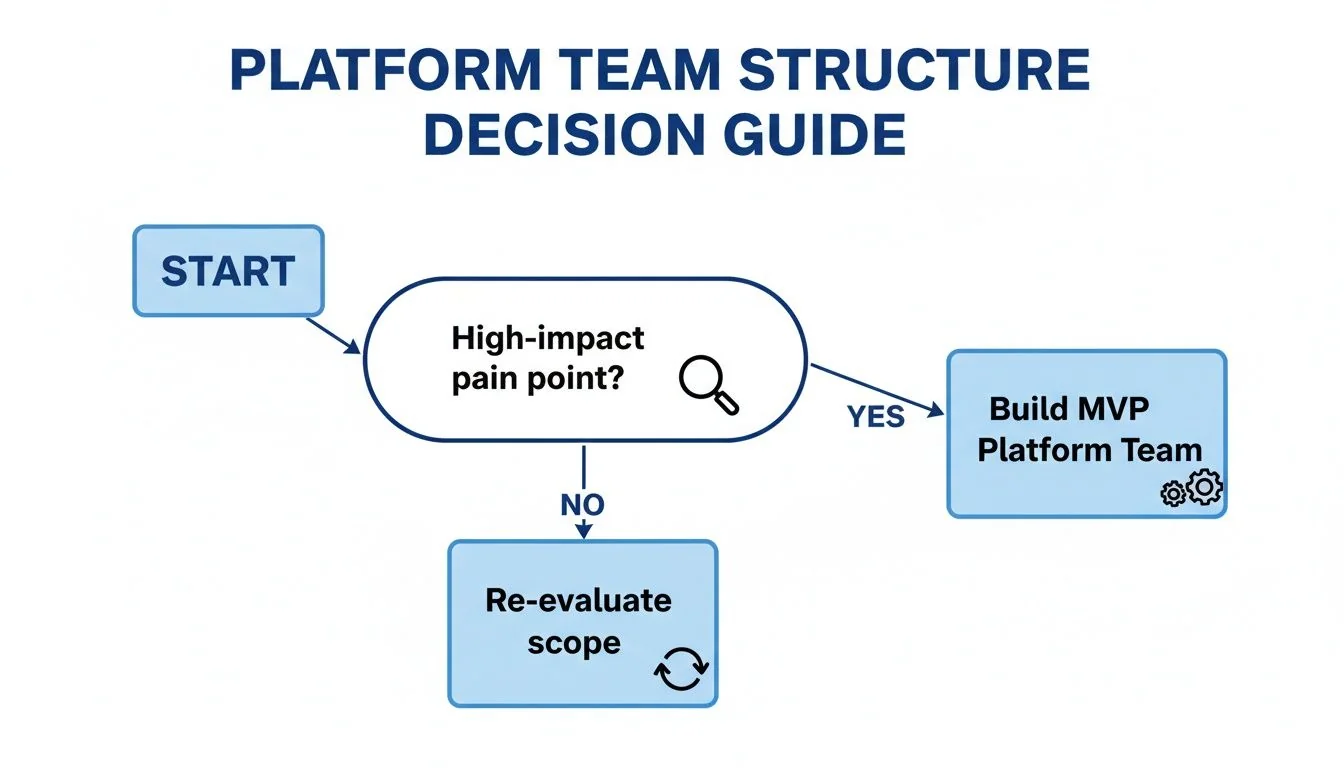
The flowchart starts with a high-impact delivery problem. If one is clear, form a team to test the smallest useful platform capability; otherwise, reconsider the scope. Set the reporting line and staffing plan separately.
For a deployment pilot, have a developer deploy through the documented interface, inspect a failure, and recover using the agreed procedure. Count manual interventions and record where the developer needed help. Measure whether the application team can complete the task independently, as well as how long it takes.
Apply product management to either structure
CNCF recommends developing the platform with users, gathering feedback, and including product managers from the start. Name who gathers developer needs and prioritizes the backlog. A dedicated platform product manager can do this work; when roles are combined, record the responsible person in the charter.
In either structure, use developer feedback to update the backlog, document supported use cases, and give developers a way to request changes. Publish how teams can obtain an exception when a supported path cannot meet their needs. Security requirements may be mandatory even when a particular platform interface is optional.
A portal is one possible interface. The Team Topologies TVP example can be as small as documented guidance over existing services. Judge an interface or integration by the work it removes for developers. A portal launch alone does not demonstrate that benefit.
Defining critical roles and sizing your team
Separate the engineering sponsor, platform product owner, capability maintainers, and service operators. One person may cover several responsibilities, but each needs time and decision authority.
The sponsor approves scope and funding and resolves competing priorities. The product owner gathers developer feedback and orders the backlog. Platform engineers build and maintain shared interfaces, automation, and documentation. Application teams retain product logic, application configuration, tests, and release decisions. Security defines control requirements and the exception process. SRE contributes reliability engineering and operates only the services it has explicitly accepted.
DevEx, security, and observability specialists can contribute from existing teams or join the platform team when sustained work justifies it. Keep application security and reliability responsibilities assigned even when those specialists join the platform team.
Responsibility matrix
Use this editorial responsibility matrix as a starting point and adapt it to your service catalog. Name an accountable owner and operator for each capability. In a federated structure, use the core platform team for core capabilities and the named domain platform owner for extensions.
| Work or event | Platform team | Application team | Security team | SRE team, where present |
|---|---|---|---|---|
| Shared deployment platform | Own interfaces, templates, documentation, and platform changes. Operate it unless another operator is explicitly named. | Own product-specific pipeline inputs, application tests, and release decisions. | Define required deployment controls and review exceptions. | Advise on reliability; operate agreed components only under a documented support arrangement. |
| Product-specific service | Support platform dependencies and the documented deployment path. | Own business logic, data use, configuration, application SLOs, and service maintenance. Remain the default application operator unless support is explicitly delegated. | Review relevant risks and control requirements. | Provide agreed reliability work or operational support; do not assume ownership of every service. |
| Production incident | Respond to platform failures; engage backing-service operators. | Respond to application failures and restore product behavior. | Lead security investigation and containment decisions for suspected security incidents. | Respond for services it supports; may coordinate a cross-team incident if designated in the runbook. |
| Security control | Implement and maintain controls in shared platform capabilities; retain platform evidence. | Implement application controls, remediate application findings, and retain application evidence. | Own policy, control criteria, and security exception review; identify the authorized risk acceptor. | Implement operational controls for services it operates and retain their evidence. |
Separate incident coordination from technical remediation. The runbook names who declares an incident, who leads it, which on-call team receives the first page, and when additional teams join. The first responder keeps coordination until a named person accepts a handoff, including when the cause is still uncertain.
Google's SRE guidance on being on-call emphasizes explicit escalation paths and agreed incident procedures. Its SRE-supported development teams also participate in on-call and can receive escalations. Keep application-team responders in the escalation plan when SRE provides support.
Size capacity around the supported service
Estimate capacity from the capability catalog, number and diversity of users, maintenance work, adoption support, and operating coverage. Include leave, incident follow-up, documentation, and time to improve the platform. If the team cannot sustain the proposed support hours, reduce scope or arrange operating support before promising them.
The primary guidance used here does not establish a universal platform staffing ratio. Base staffing on the capabilities you support and the work required to operate them. Google describes on-call sizing under its own coverage and workload assumptions; those figures should not be reused as a platform-team hiring formula.
Worked example: shared deployment, domain-owned extension
This hypothetical organization illustrates ownership decisions. It provides no measured results or headcount benchmark.
Assume a company has commerce and payments application groups. Both use the same cloud environment and deployment tooling. Payments needs an additional release-evidence workflow; commerce does not. The company already has security and SRE functions, and SRE has agreed to operate the shared runtime. Application teams remain on-call for their product services.
The company chooses federated platform ownership with a shared core. A platform lead reports to the VP of Engineering and owns the shared deployment API, templates, documentation, and backlog. The payments engineering leader funds a domain platform owner to maintain the evidence extension. That owner reports within payments and agrees interface compatibility and support obligations with the core team. A product owner gathers feedback from both groups; product management applies across this structure.
| Question | Assignment in this hypothetical organization |
|---|---|
| Who owns the deployment platform? | The core platform team owns the deployment interface and templates. SRE operates the runtime under the agreed support arrangement. |
| Who owns the payments service? | The payments application team owns its code, configuration, releases, SLOs, and application on-call. The domain platform owner maintains the release-evidence extension. |
| Who responds when a release fails? | The payments team first checks its service and inputs. A failed shared deployment interface goes to core platform on-call; an evidence-extension failure goes to the domain owner; a runtime failure goes to SRE. |
| Who leads a production incident? | The first responder coordinates until the runbook's designated incident lead accepts the role. Component owners investigate and remediate their parts. Security leads any security investigation and containment decisions. |
| Who owns the security control? | Security defines release-evidence requirements and the exception process. The domain owner implements the evidence mechanism; payments supplies application evidence. The named risk acceptor decides exceptions. |
The VP of Engineering resolves a disagreement about whether an extension belongs in the core. If commerce later needs the same evidence workflow, the two owners evaluate moving it into the shared backlog. If payments no longer needs it, the domain owner plans retirement.
Platform team charter template
Open the plain-text charter template, or copy the outline below.
Replace the brackets with named teams, people, and decisions. Review it with application, security, and operational owners before the pilot begins. It is a planning template, not an approved support agreement.
PLATFORM TEAM CHARTER
Version, approver, and review date: [fill in]

Purpose and users
- Recurring delivery problem: [observed task and current friction]
- Initial users and pilot application team: [names]
- Supported capability and interface: [scope]
- Out of scope: [product logic, unsupported runtimes, other exclusions]

Structure and authority
- Topology: [centralized / federated with shared core]
- Engineering sponsor and reporting line: [name / role]
- Core funding and priority decision-maker: [name / role]
- Product discovery and backlog owner: [name / role]
- Domain extensions, owners, and funding, if any: [list]
- Authority for compatibility and scope disputes: [name / role]

Ownership and operation
- Deployment platform owner and operator: [names; distinguish them]
- Backing-service operators and contact routes: [list]
- Product-service owners and application on-call: [list]
- Security policy owner and control implementers: [names]
- Security exception reviewer and risk acceptor: [names]
- SRE-supported services and acceptance boundaries: [list or none]

Team interactions
- Pilot work and completion criteria: [task / evidence]
- Self-service interfaces and documentation: [locations]
- Routine support channel and support hours: [details]
- Feedback and roadmap review: [cadence / participants]
- Exception request and domain-extension process: [details]

Reliability and escalation
- Platform service objectives and monitoring owner: [details]
- Initial alert recipient and response commitment: [details]
- Incident declaration authority and coordination lead: [names / roles]
- Core, extension, application, and backing-service escalation: [routes]
- Security incident escalation: [route]
- Handoff rule: [named recipient accepts before coordination transfers]
- Recovery procedure and incident follow-up owners: [locations / names]

Pilot evidence and review
- Baseline task, workload, and observation period: [details]
- Success criteria: [self-service completion, manual steps, reliability]
- Developer feedback and unresolved friction: [method]
- Capacity for maintenance, support, and improvement: [assumptions]
- Decision date: [expand / revise / stop]
- Structure review triggers: [persistent domain needs, duplication,
  incompatible interfaces, unclear ownership, unsustainable support]
Your 90-day action plan for building the team
Use these periods as planning windows. Delivery depends on access, existing tooling, operating coverage, and the pilot's complexity; a working platform within 90 days is not guaranteed.
Days 1-30: secure sponsorship and find your first customer
- Interview developers and observe a recurring deployment or provisioning task. Record delays, manual work, and failure recovery before selecting a solution.
- Name the engineering sponsor and platform product owner. Select centralized or federated ownership as a hypothesis using the early comparison.
- Agree the pilot with one willing application team. Complete the charter's scope, operators, support hours, and escalation routes with security and SRE or the existing operations function.
Days 31-60: define the MVP and make the build-vs-buy call
- Define one complete supported task, including failure handling and documentation. Reuse a managed service or existing internal capability where it meets the requirements; build integrations for the gaps you have identified.
- Work with the pilot team to test the interface. Record each request that still needs a platform engineer and distinguish missing automation from a necessary review.
- Exercise application, platform, and backing-service escalation. Confirm that security controls have implementers and that exceptions have an authorized decision-maker.
For the broader capability choices, use the DevOps and platform modernization research hub. If buying implementation help, use the engagement-scoping and provider-evaluation guide to define deliverables and handover.
Days 61-90: operate the pilot and decide what to change
- Have the application team complete the task from the documentation. Check operational coverage and recovery procedures before relying on the capability in production.
- Compare the same task before and after the pilot: elapsed time, manual interventions, failed attempts, and developer feedback. Include platform maintenance and support effort.
- Review the evidence with the sponsor and users. Expand when the capability works independently and can be supported; revise it when friction remains; stop or narrow it when costs exceed the observed benefit.
Report the observation period, workloads, and other changes that could explain the result. Measure failed deployments and recovery alongside deployment frequency. Distinguish time saved from cash savings. Revisit the charter when a new domain, operator, or support commitment changes the ownership boundary.
Chief Analyst, Software Modernization Intelligence · 10+ years B2B market research
Published: ·Updated: