Ruby vs Ruby on Rails: CTO's 2026 Modernization Guide
Get a CTO-focused Ruby vs Ruby on Rails comparison for 2026. Covers technical trade-offs, performance, migration costs & decision criteria for modernization.
On this page
- Overview
- Introduction to the Modernization Dilemma
- Overview of Ruby and Rails
- What that separation means in practice
- How to map the stack to the modernization goal
- Technical and Operational Comparison
- Side-by-side operational view
- Performance and Scalability Trade-offs
- Benchmark the path, not the language
- Modern Rails is not the old Rails
- When to keep Rails and when to carve it down
- Use Cases and Team Requirements
- Match the work to the engineer profile
- Where each approach fits modernization work
- Modernization and Migration Cost Analysis
- The cost profile changes by project type
- What to budget for before you start
- Decision Framework and Next Steps
- Decision matrix
- Checklist for the next planning meeting
Your platform still runs, the product team wants faster delivery, and every week spent on the wrong modernization path adds risk that won't show up on a sprint board. The core question is not whether Ruby is “better” than Rails but whether your modernization program needs a language-runtime change, a framework refactor, or a full-stack replacement. That decision changes cost, staffing, and operational risk immediately.
For teams trying to understand the hidden exposure inside old application stacks, uncovering legacy IT system risks is a useful lens because the code you keep, not just the code you write, determines migration pain.
| Decision path | What changes | Best fit | Main risk |
|---|---|---|---|
| Upgrade Ruby | Runtime only | Scripts, services, backend logic | Leaves application architecture intact, including old framework constraints |
| Refactor Rails | Framework layers, gems, app structure | Full-stack web products | Scope creep, dual-write complexity, dependency churn |
| Replace stack | Language, framework, deployment model | High-performance or boundary-heavy systems | Highest delivery risk, longest adoption curve |
Introduction to the Modernization Dilemma
A CTO with a Ruby 2.x and Rails 5.x platform is usually deciding whether the business can tolerate incremental change or needs structural change, not debating syntax. That distinction matters because Ruby and Rails solve different modernization problems, and the wrong one burns calendar time without reducing operational drag.
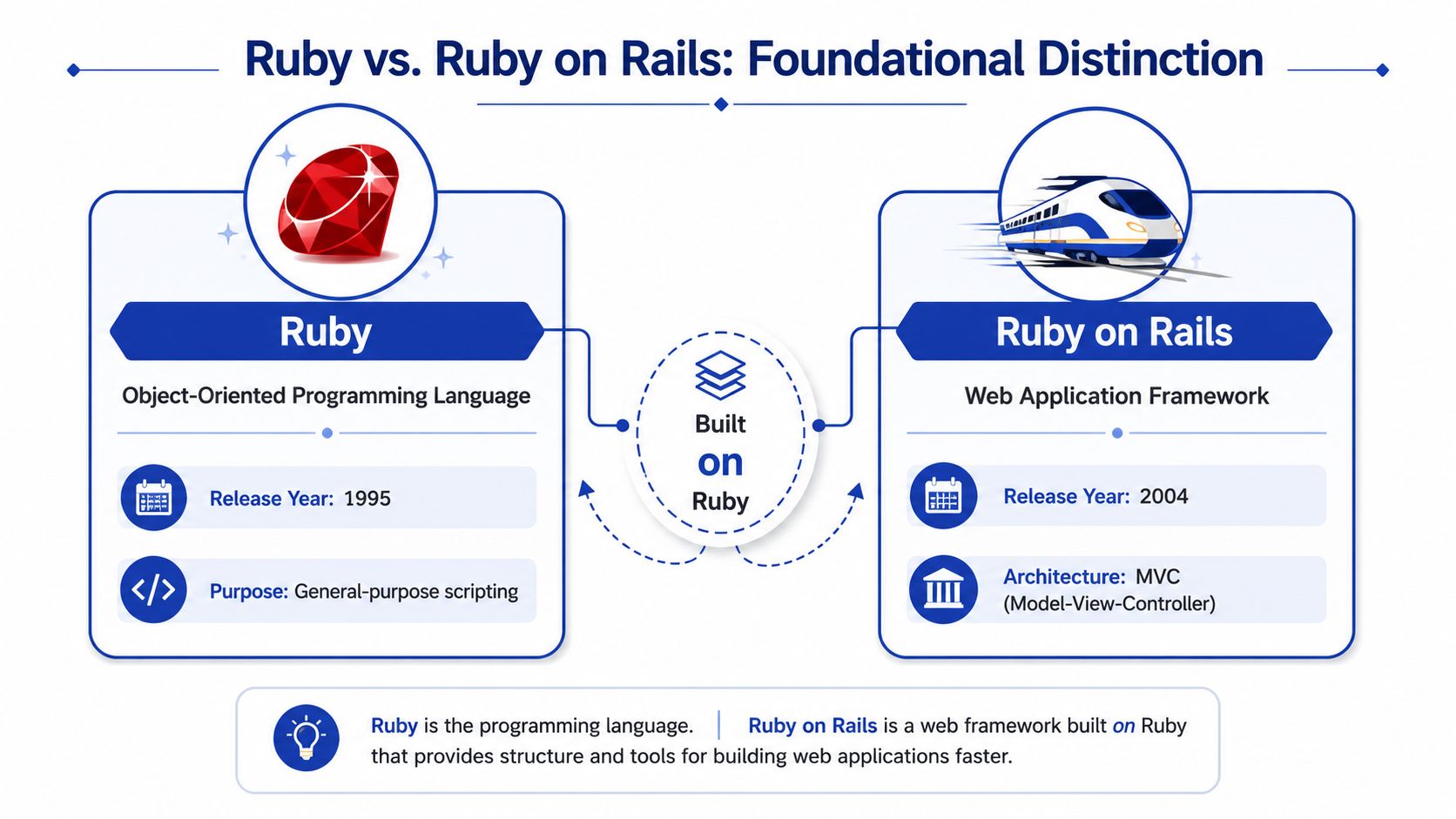
Ruby is the general-purpose language. Rails is the web framework built on top of it, and the nine-year gap between Ruby's 1995 release and Rails' 2004 arrival matters because Rails was created to speed up web application development on an already mature language (Ruby on Rails history). If your system is mostly automation, service glue, or backend logic, a runtime upgrade can be the rational move. If your system is a database-driven product app, the framework itself is part of the modernization surface.
Practical rule: upgrade the runtime when the architecture still fits the business. Refactor the framework when the architecture is the problem.
A language edit changes how code executes. A framework update changes how the application is composed, tested, deployed, and staffed. Teams that treat those as equivalent usually underbudget the work and discover the full migration cost during integration testing, not during planning.
Keep the stack when the delivery model is still aligned. Refactor when the app is strategically right but mechanically stale. Replace only when the system boundary, performance target, or team model makes the current stack the wrong vehicle.
Overview of Ruby and Rails
A modernization team looking at Ruby and Rails is comparing two different layers of the stack. Ruby is a general-purpose, object-oriented programming language launched in 1995 (Ruby versus Ruby on Rails). It fits scripts, automation, backend services, and application logic that does not require a full web framework. Rails, by contrast, is an MVC web framework under the MIT License that sits on top of Ruby and is built for database-driven web applications.
What that separation means in practice
Ruby is the runtime and language ecosystem. Rails is the opinionated application framework that brings routing, controllers, models, views, and conventions for full-stack product delivery. The distinction determines whether the business can tolerate incremental change in existing code or needs a structural rewrite of how the application is organized.
Rails became widely adopted because it added a framework layer without asking teams to change languages. That let organizations keep Ruby while standardizing web application structure under one application framework (Ruby on Rails history). For modernization work, teams can sometimes preserve domain code and replace framework edges, but only when the architecture already separates those layers cleanly enough to support that move.
How to map the stack to the modernization goal
Use Ruby alone when the modernization target is narrow, such as a background process, command-line utility, or service that does not need a full web product shell. In those cases, the main risk is overbuilding. Adding Rails where a lighter runtime change would suffice increases dependency surface and raises the cost of testing, deployment, and maintenance without a clear operational return.
Use Rails when the target is a customer-facing or internal web application that depends on conventions, scaffolded structure, and integrated request handling. That choice usually reduces coordination risk for product teams because the framework enforces a predictable shape across the application. It also creates a clearer path for modernization partners that specialize in Rails-based refactoring, since they can work inside a known structure instead of reconstructing one from scratch.
Operational takeaway: Ruby gives you language flexibility. Rails gives you product delivery structure. If the modernization goal is a web application, Rails is the relevant abstraction, not just Ruby.
Technical and Operational Comparison
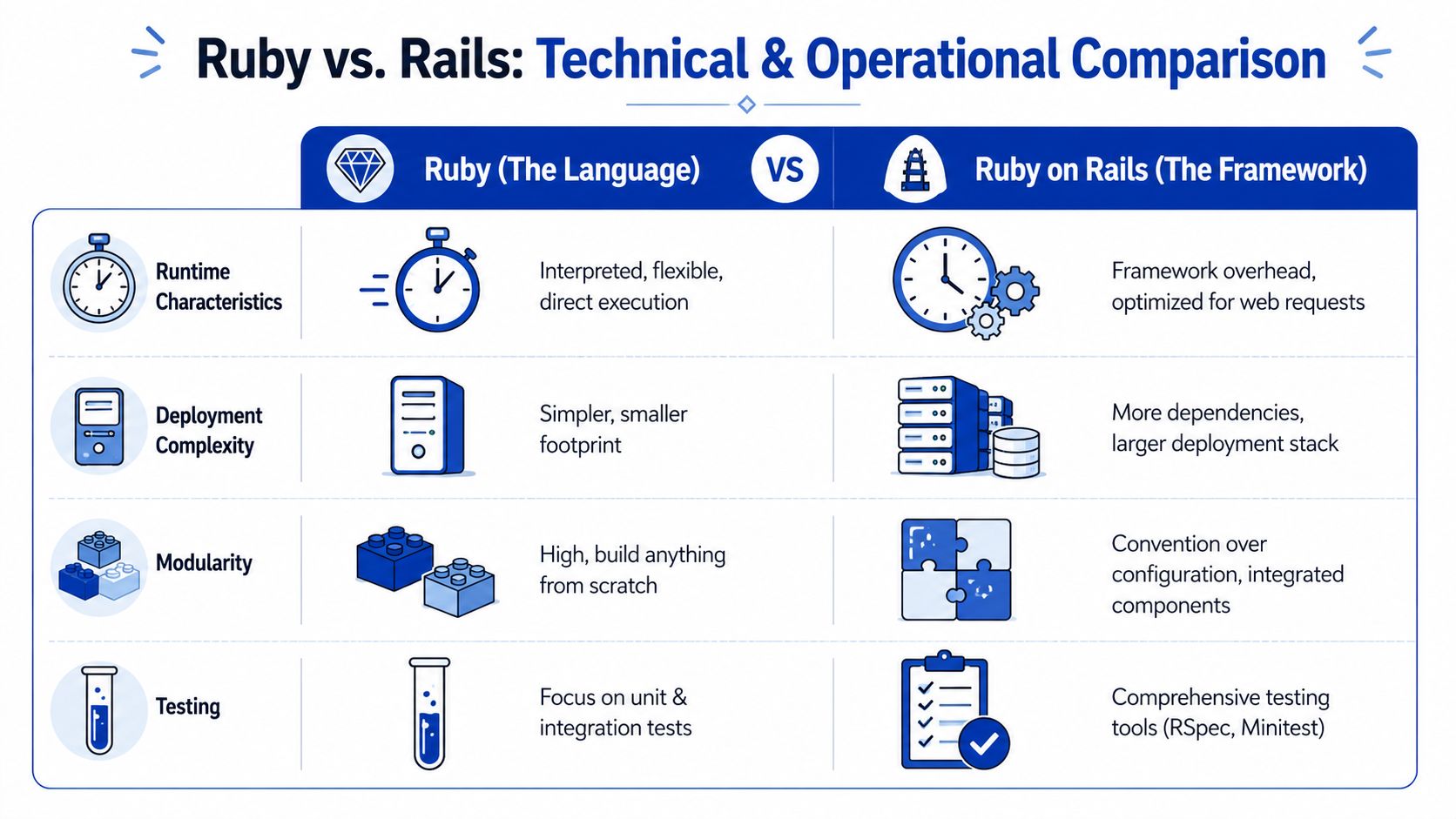
Ruby and Rails get compared as if they're substitutes. They're not. Ruby is the language layer, Rails is the product framework layer, which affects release planning and test strategy.
Side-by-side operational view
| Criterion | Ruby | Rails |
|---|---|---|
| Runtime characteristics | Interpreted, flexible, direct execution | Framework overhead, optimized for web requests |
| Deployment complexity | Smaller footprint, simpler stack | More dependencies, larger deployment surface |
| Modularity | High, build from scratch | Convention-driven, integrated components |
| Testing | Focus on unit and integration tests | Comprehensive web-app tooling and conventions |
The table understates a key distinction for modernization teams. Ruby is easier to isolate when you're rebuilding a small slice of behavior. Rails is easier to govern when you're modernizing a whole product because the framework enforces structure across controllers, models, and views. The trade-off is that Rails adds some overhead in exchange for a coherent application shape.
The strongest operational evidence comes from an actual web-stack benchmark. In a reported test, Puma + Rails measured 129 ms versus 31.3 ms for a Roda + Sequel + Puma stack, which shows that framework and ORM overhead can materially affect latency-sensitive endpoints (Speedshop benchmark). That doesn't make Rails bad. It means the abstraction cost is real, and you should measure it before choosing it for hot paths.
If your modernization plan includes strict latency targets, the framework decision matters as much as the language choice. Teams often spend months tuning infrastructure while leaving a heavy ORM or a layered request path untouched. That's backwards. The application path, not just the server, determines what your users feel.
Performance and Scalability Trade-offs
Rails performance debates usually get stuck at “it's slower” or “it's fast enough.” Neither is a useful analysis. The useful question is where framework overhead matters enough to justify change, and where it doesn't.
Benchmark the path, not the language
Rails performance testing is more credible when it uses production-like workloads. Rails Ruby Bench was built around a real open-source Rails application and a realistic workload so teams can measure Ruby speed in a way that reflects application behavior rather than synthetic microbenchmarks (AppFolio on Rails Ruby Bench). That matters for modernization because runtime upgrades and framework choices should be judged against app behavior, not toy loops.
For hot endpoints, the benchmark in the earlier section already shows the problem. The overhead comes from the stack, not from a simple “Ruby is slow” label. If you keep Rails, you need to identify whether the slow path is in request orchestration, ORM behavior, or application code. Those are three different remediation strategies.
Modern Rails is not the old Rails
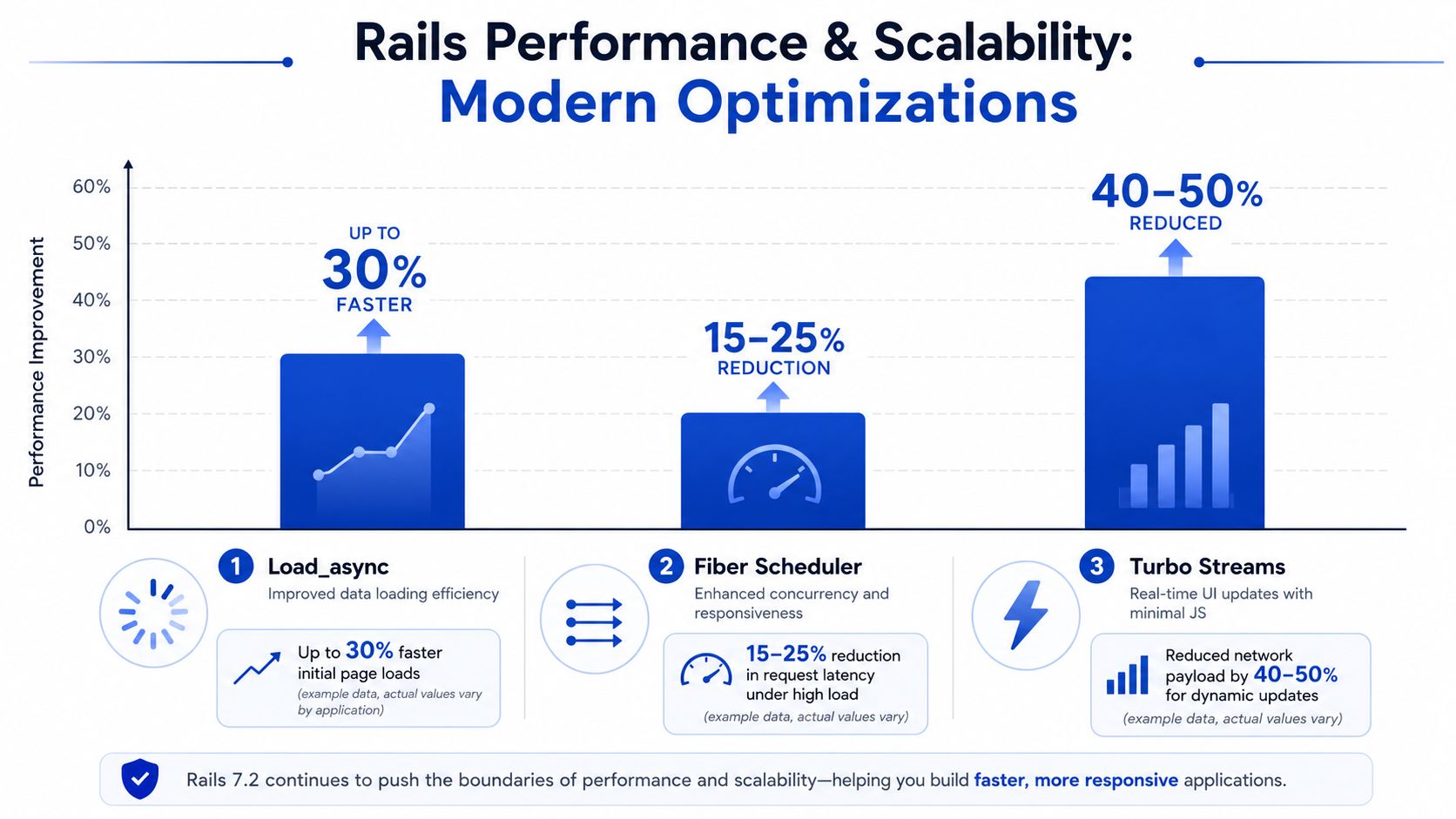
Recent coverage highlights materially improved performance and real-time support through Hotwire, Turbo Streams, Rails 7.2, load_async, the Fiber Scheduler, and parallel execution features (modern Rails capability summary). Historic Rails criticism still appears in buying committees, but the framework now supports patterns that narrow the old gap for real-time and high-traffic products.
This doesn't erase overhead. It changes the default answer. If your product needs a lot of interaction but the team already knows Rails, the framework is still viable for many modern workloads. If the application is endpoint-heavy, latency-sensitive, and fragmented into several data access patterns, the abstraction cost deserves scrutiny before you assume Rails is the right modernization target.
Rails is no longer a blanket “CRUD only” answer. The better distinction is whether your system boundaries reward framework conventions or punish them.
When to keep Rails and when to carve it down
- Keep Rails when the app is product-centric, the team already operates inside the Rails conventions, and your modernization objective is delivery stability.
- Carve out services when a narrow endpoint is carrying disproportionate latency or coupling cost.
- Replace selected layers when framework and ORM behavior dominate the response path and the app boundary is clean enough to extract.
For teams comparing options, Unbiased API modernization insights are useful because API work exposes where framework weight resides, which is often clearer than full-app rewrites.
Use Cases and Team Requirements
The skill question matters as much as the stack question. A modernization program fails fast when the code path and the hiring profile don't match.
A remote hiring lens helps here too. If you need current market context, insights on the remote Rails job market are relevant because staffing strategy changes once you commit to Rails as the main delivery model.
Match the work to the engineer profile
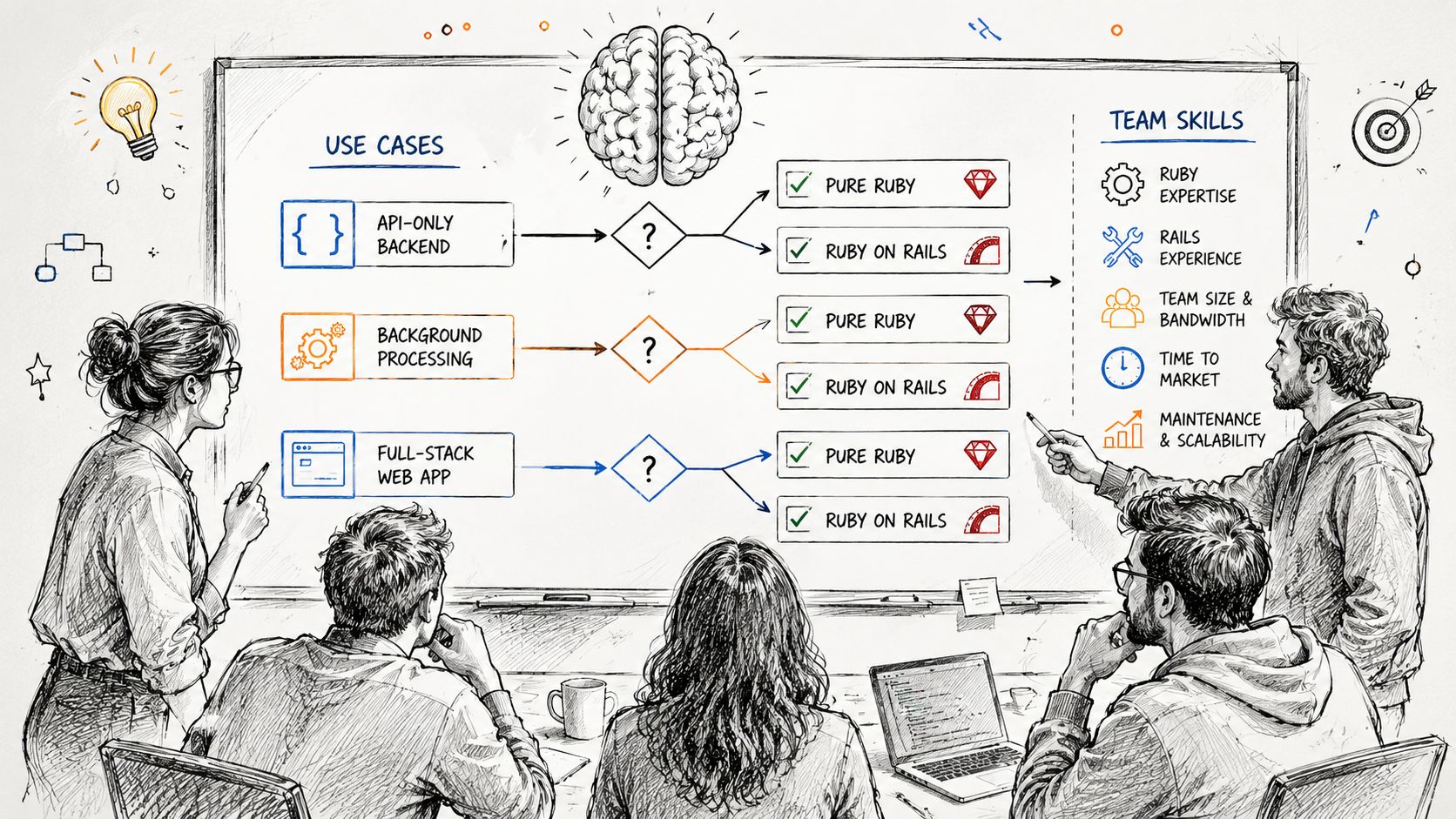
A Ruby-only profile fits automation scripts, background jobs, service integrations, and narrow backend logic. A Rails full-stack engineer fits product delivery, database-driven workflows, and teams that need a coherent path from request to response. The key decision for teams is whether to hire for Ruby-only skills or Rails full-stack engineers, since Rails has become the default for most product work while Ruby frameworks serve niche automation tasks (hiring specificity for Ruby and Rails).
That distinction affects onboarding. Ruby-only work lets a team optimize for local ownership of a narrow domain. Rails work requires people who understand conventions, application boundaries, and the cost of framework coupling. If you hire the wrong profile, you get velocity in the wrong part of the stack.
Where each approach fits modernization work
A Ruby-only modernization path makes sense when you're wrapping a legacy process, replacing scripts, or isolating backend logic into a service. Rails makes sense when the product itself is the modernization target and the goal is to ship features with less structural drift. Specialized Ruby frameworks sit in the middle, but they're better suited to narrower automation or endpoint scenarios than to whole-product transformation.
Hiring rule: if the target system is a product, staff for Rails delivery. If the target system is a tool, service, or automation layer, Ruby-only skill sets are usually enough.
Modernization and Migration Cost Analysis
A wrong choice is expensive. The difference between a runtime upgrade, a Rails refactor, and a rewrite includes budget shape, stakeholder churn, and how many teams you need to coordinate, as well as technical risk.
The cost profile changes by project type
Software Modernization Intelligence's market data shows average Rails refactor budgets of $300K to $1.2M with 34% failure rates tied to scope creep and dual-write complexity, while Ruby runtime upgrades sit at $75K to $250K with 18% risk. Those numbers are not interchangeable. A runtime upgrade usually keeps the application contract intact. A refactor rewires the application itself, so every integration becomes a negotiation.
| Project Type | Cost Range | Failure Rate | Specialist Partners |
|---|---|---|---|
| Ruby runtime upgrade | $75K to $250K | 18% | In-house platform teams, runtime specialists, senior Ruby maintainers |
| Rails refactor | $300K to $1.2M | 34% | Rails modernization firms, API and data migration specialists |
| Full-stack rewrite | No data available | No data available | Architecture-led transformation teams, boundary and migration specialists |
The cost spread tells you where governance breaks down. Runtime upgrades fail when dependency testing is weak. Rails refactors fail when teams try to modernize everything at once, especially when old and new systems must both stay live long enough to support dual writes. Rewrites fail for a different reason, because teams overestimate how quickly they can rebuild business behavior with a fresh stack.
What to budget for before you start
A runtime upgrade budget needs time for regression testing, gem compatibility checks, and deployment rehearsal. A Rails refactor needs far more than code replacement. It needs domain mapping, data migration planning, test harnesses, and a firm decision about which parts of the old app stay in place during transition.
If your team is debating whether to replace existing code or reshape it, refactoring vs rewriting code decisions is a useful anchor because the financial problem is usually not “old versus new,” it's whether you can preserve business behavior while changing structure.
Specialist fit matters here. An in-house team is usually the right owner for a runtime upgrade because it preserves local knowledge and avoids unnecessary orchestration overhead. Rails modernization firms are the right call when the application needs structure changes, data movement, and long-lived cutover planning. Mixing those roles without a clear boundary leads to duplicated effort and unclear accountability.
Decision Framework and Next Steps
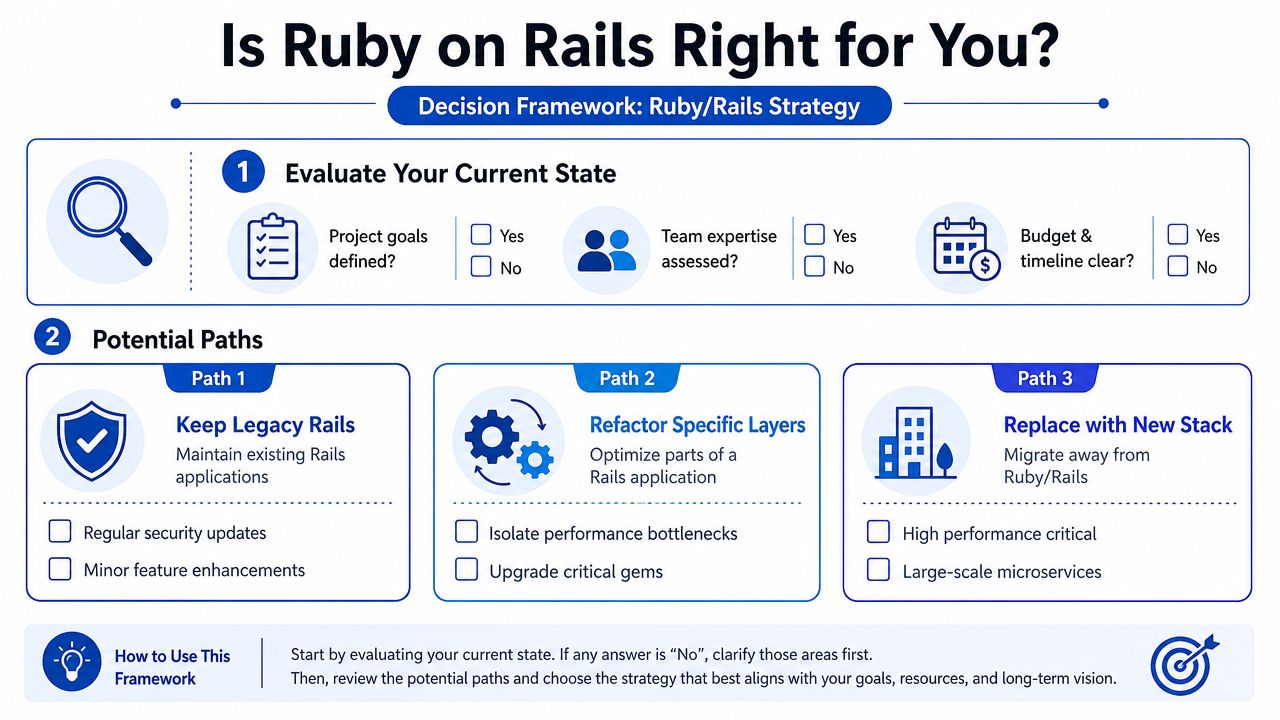
The right answer is the one that reduces risk without creating a second migration you didn't budget for. That's why the decision should start with the shape of the system, not the taste of the stack.
Decision matrix
| Condition | Keep Legacy Rails | Refactor Specific Layers | Replace with New Stack |
|---|---|---|---|
| Application fit | Current product shape still works | Some paths are too slow or too tangled | Core architecture no longer matches the business |
| Team readiness | Team knows the stack well | Team can isolate boundaries and test changes safely | Team has strong migration discipline and new-stack skills |
| Risk profile | Low change tolerance | Moderate, localized risk | High transformation risk |
| Best trigger | Security updates and small feature work | Clear bottlenecks and dependency pain | Large-scale boundary reset |
Checklist for the next planning meeting
- Confirm the goal: decide whether the issue is runtime cost, framework coupling, or system architecture.
- Map hot paths: identify where request latency or release friction concentrates.
- Check team fit: verify whether you have Ruby maintainers, Rails product engineers, or migration specialists.
- Define cutover boundaries: decide what stays live, what gets refactored, and what gets retired.
- Set success metrics: track deployment stability, regression rate, and endpoint behavior after each change.
If you need help deciding whether to keep, refactor, or replace your Ruby or Rails stack, Software Modernization Intelligence can help you pressure-test the economics, failure modes, and partner fit before you commit capital.
Chief Analyst, Software Modernization Intelligence · 10+ years B2B market research
Published: ·Updated: