
Privileged access management modernization: The practical guide to secure PAM
Privileged access management (PAM) modernization is not about swapping one password vault for another. It is a complete overhaul of how you grant and manage high-level access, moving from static, high-risk credentials to dynamic, just-in-time systems that enforce least privilege. This is the shift from a passive, perimeter-based security model to an active, identity-centric one. It is the only effective defense against modern attacks that hunt for standing privileges.
Why Your Legacy PAM Is a Security Liability
Your legacy Privileged Access Management (PAM) system is an indefensible vulnerability. Static password vaults and manual credential rotation might have been acceptable a decade ago, but today they represent a security posture that is fundamentally broken in a world of distributed cloud architectures and automated attacks. They are failing against modern threats that target insider risk and harvest credentials at scale.
The core problem is standing privileges—the “always-on” access granted to your administrators, developers, and, most critically, machine identities. In a legacy model, these powerful credentials sit idle in a digital vault, a trove of “keys to the kingdom” waiting to be stolen. An attacker who compromises a single vaulted password gets a free pass for unmonitored lateral movement across your entire network.
This risk has exploded with the proliferation of non-human identities. Your service accounts, API keys, and other machine identities now vastly outnumber your human users, and legacy PAM was never designed to manage them dynamically. Every hardcoded credential in a script or config file is a permanent, undiscovered backdoor.
The Failure of Static Controls
A huge blind spot in older PAM systems is their inability to integrate with modern insider threat detection tools. They lack the API-first design needed for real-time monitoring and anomaly detection, leaving you completely in the dark until after a breach has occurred.
The table below outlines why legacy approaches are being abandoned.
Legacy PAM vs. Modern PAM At-a-Glance
This table contrasts the outdated, high-risk features of legacy PAM systems with the dynamic, automated capabilities of modern PAM solutions, highlighting the shift in security posture and operational efficiency.
| Capability | Legacy PAM (High-Risk) | Modern PAM (Zero-Trust Aligned) |
|---|---|---|
| Credentials | Static, long-lived passwords in vaults | Ephemeral, just-in-time credentials |
| Access Model | ”Just-in-case” standing privileges | ”Just-enough” least privilege |
| Identity Scope | Primarily human users | Humans, machines, APIs, services |
| Provisioning | Manual, ticket-based, slow | Automated, policy-as-code, instant |
| Session Visibility | Limited or non-existent | Full session recording and auditing |
| Integration | Siloed, poor API support | API-first, integrates with CI/CD & SIEM |
| Accountability | Weak (shared admin accounts) | Strong (unique, short-lived identities) |
The weaknesses of the legacy model become clear when you examine its common failure points:
- Shared Admin Accounts: Using generic accounts like
rootoradministratormakes accountability impossible. When a breach happens, you have no idea who executed the malicious commands. - Manual Rotation & Provisioning: This process is slow, riddled with human error, and creates massive operational friction. Developers on a deadline will always find a way to bypass security for speed.
- No Session Monitoring: Without detailed session recording, you have zero visibility into what a privileged user actually does. This is a gap exploited in over 70% of privilege-related breaches.
The market is decisively shifting away from these outdated approaches. The global PAM market is surging from USD 4.50 billion in 2025 to a projected USD 29.88 billion by 2034. This explosive growth is driven by the urgent need to counter threats like insider attacks, which accounted for 20% of incidents in 2026, forcing a move toward dynamic, least-privilege enforcement.
Ultimately, legacy PAM promotes a culture of “just-in-case” access, which is the exact opposite of a modern, defensible security posture. Moving to a modernized model isn’t just an upgrade—it’s a mandatory response to an indefensible risk. It’s a foundational component of a true zero trust architecture design.
Choosing Your PAM Modernization Path
Picking the wrong Privileged Access Management (PAM) modernization strategy isn’t just a technical mistake—it’s a budget-killer that often leaves you less secure. The right path depends entirely on your tech stack, risk profile, and engineering maturity. A bad choice leads to a stalled project and wasted spend, while the right one accelerates your delivery and hardens your security posture.
There are three core modernization plays for technical leaders. Each one solves a different problem, from getting rid of on-premise hardware to taming access sprawl in a multi-cloud world. Understanding the trade-offs is the first step in building a strategy that will actually get funded and finished.
Replatform to a Cloud-Native PAM
Lifting and shifting your on-premise hardware vault to a cloud-native or SaaS-based PAM is the most straightforward play. This is the go-to option for organizations looking to exit the data center business and dump the overhead of managing infrastructure. The main technical lift comes from migrating secrets and re-wiring applications through new APIs.
This approach requires meticulous planning, especially when you start connecting the new PAM to cloud identity platforms like AWS IAM or Azure AD. The biggest risk here is vendor lock-in. You must ensure any platform you choose supports open standards and has a clear, proven process for data export. While replatforming gets you quick wins on the operational side, it does not fix underlying security flaws if you just replicate bad access habits in a new tool.
Rearchitect for Zero Trust Access
This is the most intensive—and most secure—path. It is a complete re-engineering of your access controls to build a true Zero Trust security model. This isn’t about simply vaulting credentials anymore; it’s about making standing privileges and long-lived secrets completely obsolete.
The core pillars of this approach are non-negotiable:
- Just-in-Time (JIT) Access: Privileges are created on-demand for a specific task and automatically destroyed the second it’s done. This radically shrinks your attack surface by ensuring credentials don’t exist to be stolen.
- Ephemeral Credentials: Instead of static passwords, you issue short-lived certificates or tokens for every single session. Credential theft becomes a non-issue.
- Policy-as-Code (PaC): Access rules are defined, managed, and versioned as code using tools like Terraform. This delivers automated, auditable, and repeatable access management that plugs directly into your CI/CD pipeline.
This strategy demands serious engineering investment and a major cultural shift. It’s built for organizations with high cloud maturity and a C-level mandate to rebuild their security architecture from scratch. If your organization is still working through the fundamentals of identity, our guide on security and identity modernization can help you build that foundation first.
Consolidate and Integrate Disparate Tools
Many large companies are drowning in “PAM sprawl”—a chaotic mess of siloed tools for human passwords, machine secrets, and application credentials. This strategy focuses on wrangling all those disparate systems into a single, unified platform. The goal is simple: achieve centralized visibility and enforce one consistent policy everywhere.
This approach is about integrating legacy password vaults, homegrown secret managers, and native cloud provider key stores under a single governance umbrella. It’s a pragmatic move for complex organizations that cannot justify a full-blown rearchitecture but have critical visibility gaps they need to close right now.
The flowchart below cuts right to the chase: is your current PAM a liability or an asset?
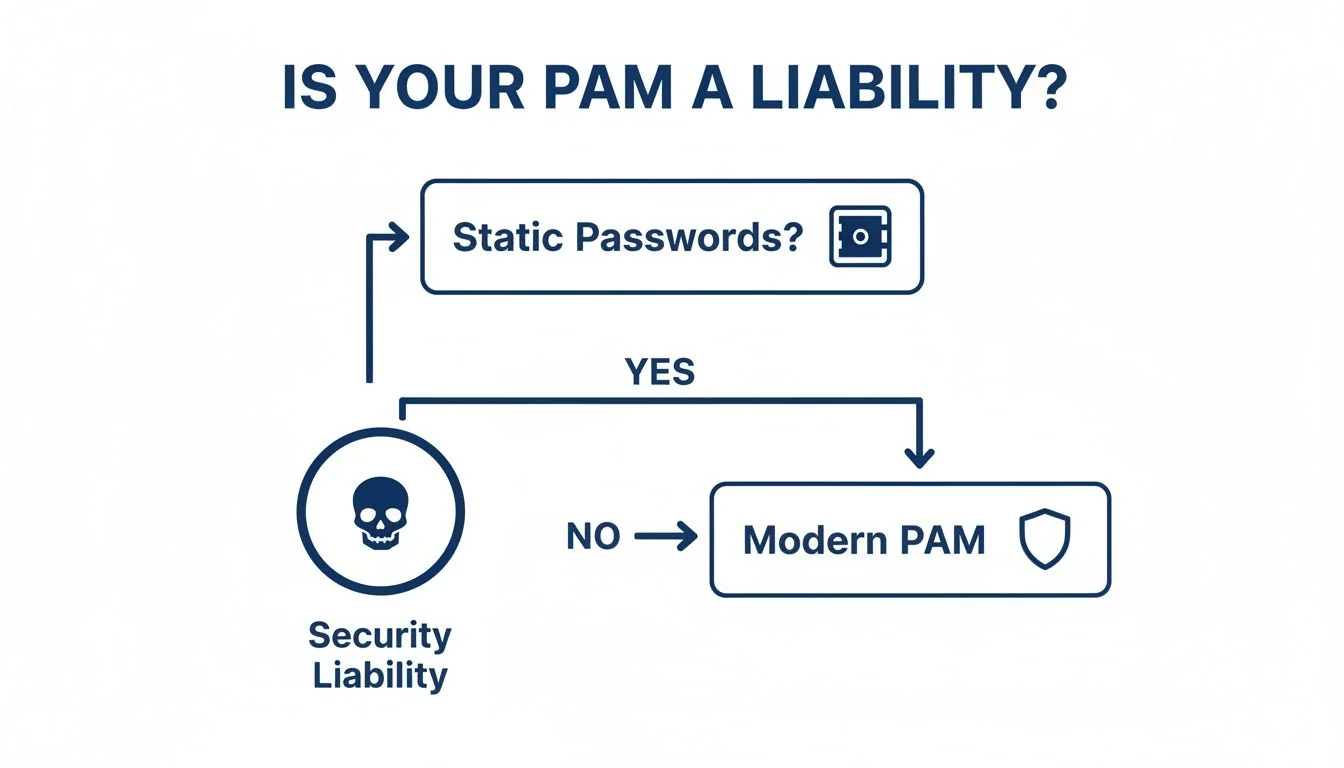
The logic is clear. If you’re still relying on static, vaulted passwords, your PAM is an active security liability. That is the trigger for a modernization initiative.
Decision Matrix: Choosing Your Modernization Path The best path is dictated by your pain points and strategic goals. Use this matrix to guide your decision.
| Criteria | Replatform to SaaS | Rearchitect for Zero Trust | Consolidate & Integrate |
|---|---|---|---|
| Primary Goal | Reduce operational overhead; shift from CapEx to OpEx. | Eliminate standing privileges; achieve highest security. | Gain centralized visibility; unify fragmented tools. |
| Effort Level | Medium | High | Medium to High |
| Best For | Orgs with on-premise hardware vaults, high cloud adoption. | Cloud-native orgs with mature DevOps practices. | Large enterprises with multiple, siloed PAM tools. |
| Key Risk | Vendor lock-in; replicating bad practices in a new tool. | High engineering cost; cultural resistance to change. | Complex integration; potential for scope creep. |
As you weigh these options, it’s smart to frame this decision within your company’s broader Legacy System Modernization Strategies. PAM is a critical component of your security stack, but it does not exist in a vacuum. Aligning your PAM project with the company’s larger transformation goals is the only way to ensure it delivers real, lasting value.
Where PAM Modernization Goes to Die
The promise of modern PAM is real, but so is the failure rate. These projects do not fail because of a bad business case; they fail in the trenches due to specific, avoidable technical pitfalls. Blunt analysis of failed projects shows the common traps that derail these security initiatives and send budgets spiraling.
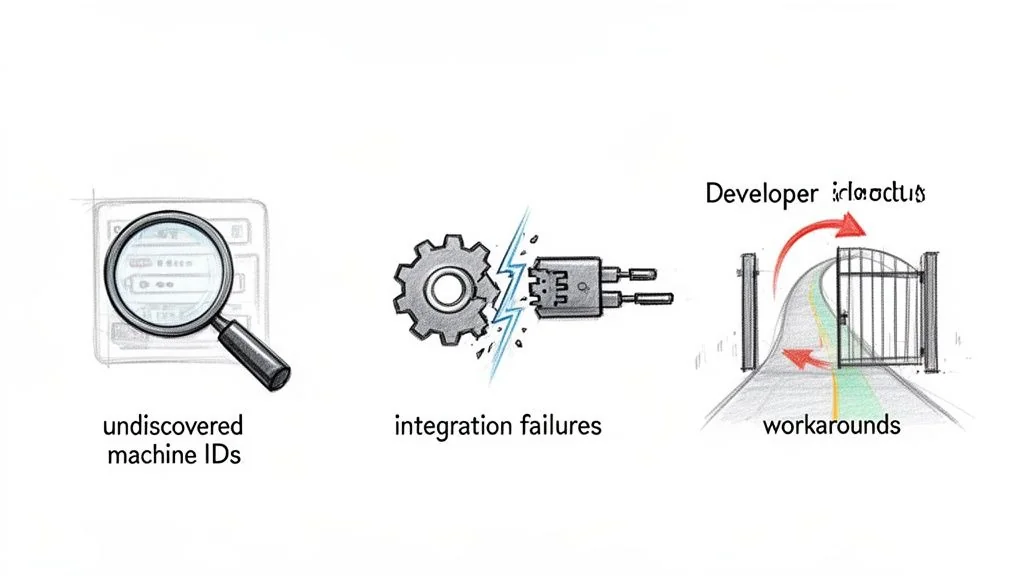
Most projects stumble right out of the gate because of incomplete privilege discovery. They fixate on human admin accounts while completely ignoring the sprawling, uncontrolled wilderness of non-human and machine identities. In any modern cloud environment, these service accounts, API keys, and ephemeral container identities outnumber human users by orders of magnitude.
If you fail to map these privileges, you’re modernizing less than 10% of your actual attack surface.
The Integration Breakdown with Reality
Another frequent point of failure is the ugly reality of legacy integration. A new cloud-native PAM tool connects to AWS or Azure in minutes, but it will almost certainly choke when trying to talk to a 40-year-old mainframe or a custom-built ERP.
These integrations are never plug-and-play. They demand deep, specialized expertise to build custom connectors or wrangle ancient protocols—a fact many vendors conveniently downplay. When these integrations break, you’re left with a fragmented system where your most critical assets are still sitting on the old, insecure platform.
The real nightmare is the technical debt hiding in your codebase. Years of hardcoded database connection strings, API keys buried in deployment scripts, and service account passwords in config files create a modernization disaster. Refactoring this mess is a massive engineering lift that’s often “discovered” mid-project, leading to scope creep and budget explosions.
Projects that do not budget for this refactoring see costs balloon. Project retries and cost overruns exceeding 50% of the initial budget are common.
Developer Pushback and Security Theater
Even with perfect technology, a PAM project dies if it ignores the people who have to use it. The most common friction point is implementing just-in-time (JIT) access for DevOps and SRE teams. If requesting temporary privileges is slow, clunky, or breaks their workflows, your engineers will find a way around it.
This operational resistance creates a few destructive patterns:
- “Break-Glass” Account Abuse: Legitimate emergency accounts get used for routine tasks because getting JIT access is too painful.
- Shadow Credential Caching: Developers start caching credentials locally or spinning up their own unauthorized secret stores just to avoid the new PAM system.
- Over-Privileged Hoarding: Engineers request broader, longer-lasting permissions than they need, completely defeating the purpose of least-privilege access.
When your developers see a new security tool as a roadblock, they treat it like one and route around it. This creates the illusion of modern security, but in reality, your most skilled users are operating completely outside its controls. A successful PAM modernization has to treat developer experience as a first-class citizen, right alongside security policy. If it does not, it’s destined to become expensive, bypassed shelfware.
Calculating the True TCO of PAM Modernization
Calculating the Total Cost of Ownership (TCO) for a privileged access management modernization project requires looking far beyond the vendor’s sticker price. Focusing only on licensing fees is a common and critical budgeting error. The real costs are buried in the integration labor, the ongoing operational drag, and the engineering hours it takes to untangle years of accumulated technical debt.
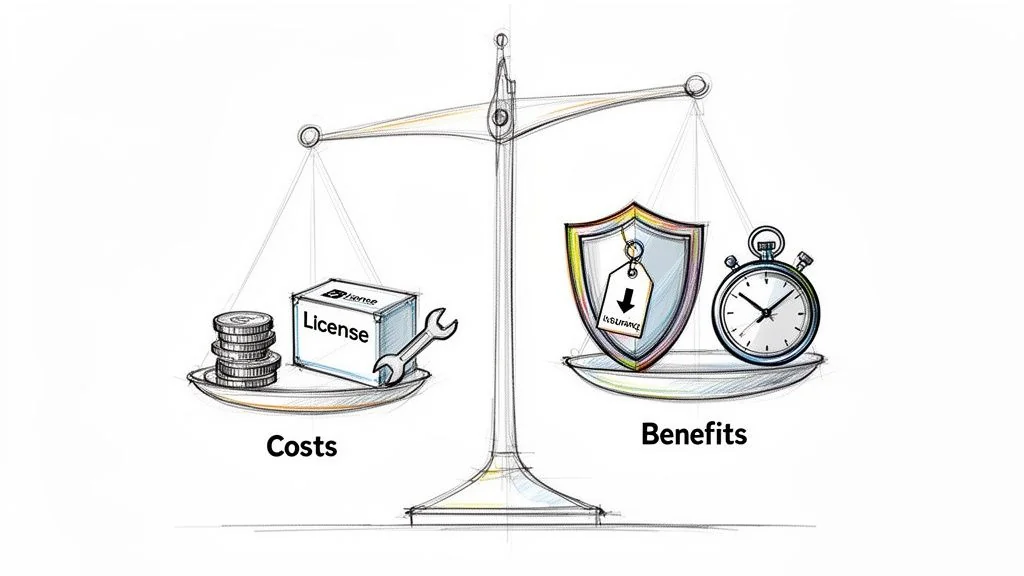
If you want to build a business case that actually gets funded, you must quantify both the direct and indirect costs. It’s the only way to get executive buy-in and prevent the project from becoming another underfunded failure.
Quantifying the Direct and Indirect Costs
That SaaS PAM subscription fee? That’s just the ante. The bulk of your spending will be on professional services and your own engineering team’s time. Implementation partner fees often land between 50% and 150% of the first-year software license cost, depending on the complexity of your environment.
Be prepared to dedicate a significant chunk of your internal engineering budget to these non-negotiable tasks:
- Integration with Core Systems: You absolutely have to connect the new PAM to your IdP, SIEM, and ITSM platforms. This requires real developer time.
- Legacy System Connectors: Do not expect off-the-shelf connectors for your mainframes or ancient homegrown applications. You’ll need to budget for custom development work here.
- Credential Refactoring: This is the hidden cost that sinks most budgets. It’s the painful, manual work of hunting down and refactoring every hardcoded credential buried in thousands of scripts, application configs, and build files.
A common blind spot is underestimating the ongoing operational cost. A modern PAM system isn’t a “set and forget” appliance. It demands continuous policy tuning, regular access review campaigns, and managing the lifecycle of machine identities, which can easily eat up 0.5 FTE for a mid-sized company.
SME adoption is a massive driver in PAM modernization, with their market segment projected to explode from USD 1.3 billion in 2025 to USD 4.85 billion by 2031. Cyber-insurance policies are now mandating least-privilege controls for businesses of all sizes, a trend seen across recent privileged access management reports.
Analyzing the ROI and Quantifiable Benefits
The cost side of the TCO equation is heavy, but the ROI is where the business case clicks. Modern PAM delivers hard financial returns that go beyond the fuzzy metric of “improved security.”
Start by quantifying the reduction in your cyber-insurance premiums. Insurers are now giving substantial discounts to organizations that can prove they’ve killed standing privileges and implemented just-in-time (JIT) access. Adopting a modern PAM with JIT elevation can unlock premium cuts of up to 18%.
Next, model the cost savings from making your operations more efficient:
- Reduced Incident Response Costs: A modern PAM gives you full session recording and a clear audit trail. This drastically cuts the time and money spent investigating a breach, often reducing incident investigation man-hours by over 50%.
- Streamlined Audits: Imagine reducing audit prep time from weeks to just a few days. Automating evidence collection and reporting for compliance frameworks like SOX, HIPAA, or PCI DSS makes that possible.
- Increased Developer Productivity: When you integrate access requests directly into developer workflows (think Slack bots or a CLI command), you eliminate the manual ticket queues. This automation gives valuable time back to your engineering teams, which directly boosts project velocity.
By mapping these direct costs against benefits you can actually count, you change the conversation. It’s no longer a security expenditure; it’s a strategic investment with a clear, defensible ROI. That is the financial model that gets the green light.
Next Steps: Define Your Implementation Path
A full-scale privileged access management (PAM) modernization project is not always the right answer. The pressure from vendors and auditors to modernize is constant, but a blanket mandate is fiscally irresponsible. Technical leaders need the data to make a defensible call to defer or descope an initiative when the ROI is negative. Pushing forward with a costly overhaul in the wrong context burns budget, erodes credibility, and pulls critical engineering resources away from projects that deliver actual value. The goal is strategic risk reduction, not security theater.
When to Defer Modernization
Some environments simply do not justify the expense and operational chaos of a complete PAM overhaul. The incremental security benefit you get is so marginal that the project becomes a massive waste of capital.
Consider these specific scenarios where pausing is the smarter choice:
- Truly Air-Gapped Environments: For systems with zero external network connectivity, the attack surface for remote privilege escalation is nonexistent. The risk from standing privileges is already contained, making the high cost of implementing Just-in-Time (JIT) access unjustifiable.
- Mature Compensating Controls: If you have already invested heavily in intensive, real-time session monitoring, strict network micro-segmentation, and advanced threat detection that scrutinizes all internal traffic, a new PAM tool brings little to the table. Your existing stack may already mitigate the primary risks modern PAM is designed to solve.
- Imminent Decommissioning: It is fiscally indefensible to spend six figures modernizing access controls for an application that will be shut down in the next 12-18 months. The investment will never break even.
Actionable Framework: The Go/No-Go Decision
Use this checklist to build a data-driven case for moving forward or deferring a PAM modernization project. A “No” to the first question or a “Yes” to any of the subsequent questions is a strong signal to re-evaluate or postpone the initiative and reallocate those resources.
| Go/No-Go Question | Implication | Decision |
|---|---|---|
| Do we rely on static, long-lived credentials? | This is the primary indicator of unacceptable risk. | Go if Yes, Stop if No. |
| Is the system fully air-gapped? | Primary attack vectors are not present. | No-Go (Defer) |
| Is the system scheduled for decommissioning within 18 months? | Project ROI is guaranteed to be negative. | No-Go (Defer) |
| Do we have mature, layered controls in place (e.g., total session recording, micro-segmentation)? | Incremental risk reduction is too low. | No-Go (Defer) |
Making the choice to wait is not a sign of weakness; it’s the mark of mature, data-driven security leadership. It stops you from wasting money on low-impact projects and focuses your team on a single goal: reducing the most enterprise risk for every dollar spent. Your next move is to either begin vendor vetting for a “Go” decision or reallocate the proposed budget to a higher-impact security initiative for a “No-Go.”