
72% of Websites Still Run on PHP. Here's Why a Python Migration is a High-Risk Bet.
The choice between PHP and Python for a modernization project isn’t about which language is “better”—that’s a developer debate. For a CTO, it’s a strategic decision with direct financial consequences.
A miscalculation here can lead to budget overruns exceeding 50%, projects that fail to ship, and performance degradation that impacts user adoption. The analysis must focus on risk, total cost of ownership (TCO), and the availability of specialized talent.
PHP vs Python: An Executive Decision Framework
This isn’t a discussion about syntax. It’s about mapping the right tool to the right job with a clear understanding of the architectural trade-offs. Choosing PHP for a web monolith modernization is a lower-risk, more cost-effective path. Choosing Python is a strategic investment in an AI and data-driven future.
Your existing architecture and strategic roadmap are the only reliable inputs for this decision. Everything else is secondary.
Core Modernization Vectors
The decision hinges on three primary contexts:
-
Web-Centric Monoliths: According to W3Techs, 72.2% of websites with a known server-side language run on PHP. It was designed for the web’s request-response lifecycle. If you’re modernizing a legacy e-commerce platform, a CMS, or a traditional web application, PHP is the pragmatic, battle-tested choice. This type of work is detailed in our guide to brownfield vs greenfield modernization.
-
AI and Data-Intensive Platforms: This is Python’s domain. If your modernization is aimed at building predictive engines, machine learning features, or complex data pipelines, Python is the default. The ecosystem of libraries like TensorFlow and PyTorch, combined with a deep talent pool of data scientists, makes it the only logical option.
-
Talent and Total Cost of Ownership: Generalist PHP web developers are more widely available and have a lower average salary than specialized Python data scientists and ML engineers. A TCO analysis must account for recruiting costs, development velocity, and long-term maintenance realities.
To align technical decisions with business outcomes, a powerful technology roadmap template is critical for synchronizing stakeholders from the board to the engineering team.
The table below provides a high-level framework for this decision.
Modernization Decision Matrix: PHP vs. Python
This matrix is not a feature comparison. It’s a strategic assessment tool to align language choice with business priorities, risk tolerance, and budget for a modernization initiative.
| Decision Factor | PHP Assessment | Python Assessment |
|---|---|---|
| Primary Use Case | Web-centric applications (CMS, E-commerce) | Data science, AI/ML, I/O-bound services |
| Performance Model | Optimized for stateless web requests | Strong for asynchronous and I/O-bound tasks |
| Talent Pool | Large pool for general web development | Deep pool for specialized data/AI roles |
| Ecosystem Maturity | Mature web frameworks (Laravel, Symfony) | Dominant data/AI libraries (Django, Flask) |
| Modernization Risk | Lower for web monoliths | Higher for web monoliths; lower for AI |
| Typical TCO | Generally lower for standard web projects | Higher due to specialized talent & use cases |
This highlights the core trade-off: PHP offers a more direct, lower-risk path for modernizing traditional web systems, while Python is the investment required for a future built on data and intelligence.
Modernizing Web Applications: Performance and Ecosystem
In a web application modernization, performance is a direct input to revenue and user retention. The architectural decisions made between PHP and Python have long-term consequences on scalability, operational costs, and project success.
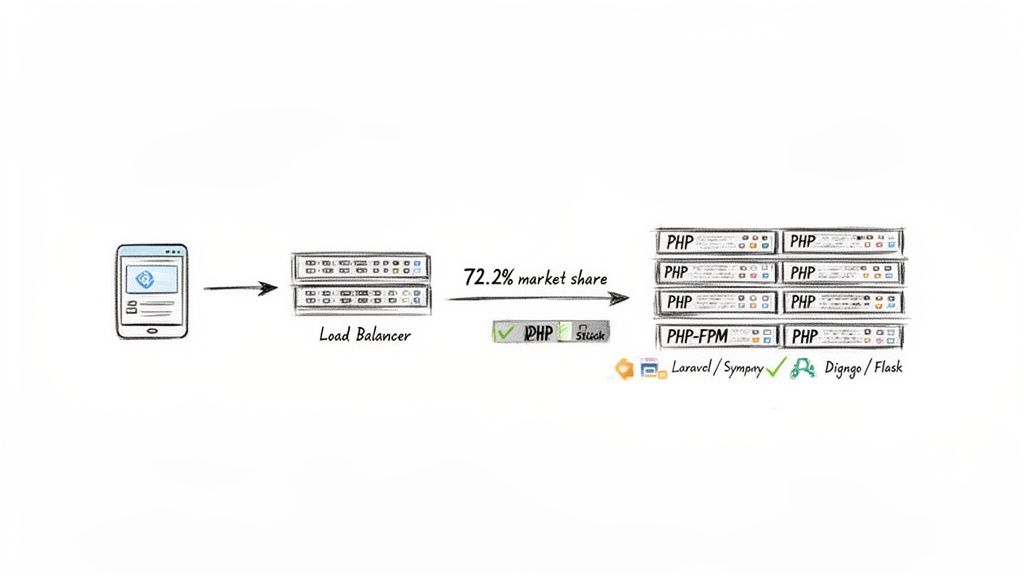
The fundamental difference lies in their execution models. PHP was designed for the web’s stateless, request-response cycle. Its “share-nothing” architecture, where each request is an isolated process, is a simple but effective model for concurrency. This design prevents a memory leak or corrupted state from one request from affecting the entire application server—a common failure mode in persistent application servers.
Architectural Advantages for Web Workloads
Python typically runs as a persistent, single-process application server (e.g., Gunicorn managing multiple worker processes). This model introduces complexities, most notably the Global Interpreter Lock (GIL). The GIL is a mutex that permits only one native thread to execute Python bytecode at a time, creating a bottleneck for CPU-bound tasks in multi-threaded code.
While modern Python web servers use multiple processes to bypass the GIL, this adds a layer of operational complexity and memory overhead that PHP’s model avoids. For the majority of web applications—e-commerce sites, content management systems, SaaS platforms—PHP’s architecture is a more direct fit.
For a VP of Engineering: This isn’t an academic debate. It’s about risk management. PHP’s model offers predictable scaling behavior, tested across millions of web applications. Introducing Python for a standard web monolith migration can inject unnecessary performance risks tied to its more complex concurrency model.
Market data reflects this architectural alignment. As of late 2023, PHP powers 72.2% of all websites where the server-side language is known. Python sits at 1.8%. You can explore the full dataset on W3Techs to see how these server-side programming languages compare.
Framework Maturity and Modernization Costs
The PHP and Python ecosystems are mature but have different focal points. PHP’s ecosystem, led by frameworks like Laravel and Symfony, is heavily optimized for building web applications. These frameworks provide out-of-the-box solutions for routing, authentication, ORMs, and templating.
Python’s primary web frameworks, Django and Flask, are capable. However, the ecosystem’s center of gravity is in data science, machine learning, and scientific computing.
This has a direct impact on modernization costs. Our research, based on data from over 200 implementation partners, shows a clear cost difference for comparable web projects:
| Language | Cost per Line of Code (LOC) | Typical Use Case |
|---|---|---|
| PHP | $1.50 - $3.50 | Modernizing a legacy CMS or e-commerce platform |
| Python | $2.50 - $5.00 | Refactoring a monolith with web and data components |
The higher cost for Python in web-centric projects often comes from building or integrating components that are native to the PHP ecosystem. Modernizing a legacy PHP app to a framework like Laravel is a more direct path with fewer unforeseen costs. Our guide on planning a PHP to Laravel migration details this process.
Choosing Python for a standard web application rewrite can create a mismatch between the tool and the task. This often leads to developers solving web-specific problems that the PHP ecosystem solved years ago, inflating both the project timeline and budget. For modernizing traditional web applications, the data indicates PHP is the more direct, cost-effective, and lower-risk choice.
Modernizing for AI and Data-Intensive Applications
When a modernization project’s goal is to build a competitive advantage with data, the PHP vs. Python decision is no longer a balanced debate. For any application involving artificial intelligence, machine learning, or heavy-duty data processing, the choice is Python.
Attempting to build a sophisticated data analytics platform in PHP is inefficient. It translates directly into higher costs and an increased probability of project failure.
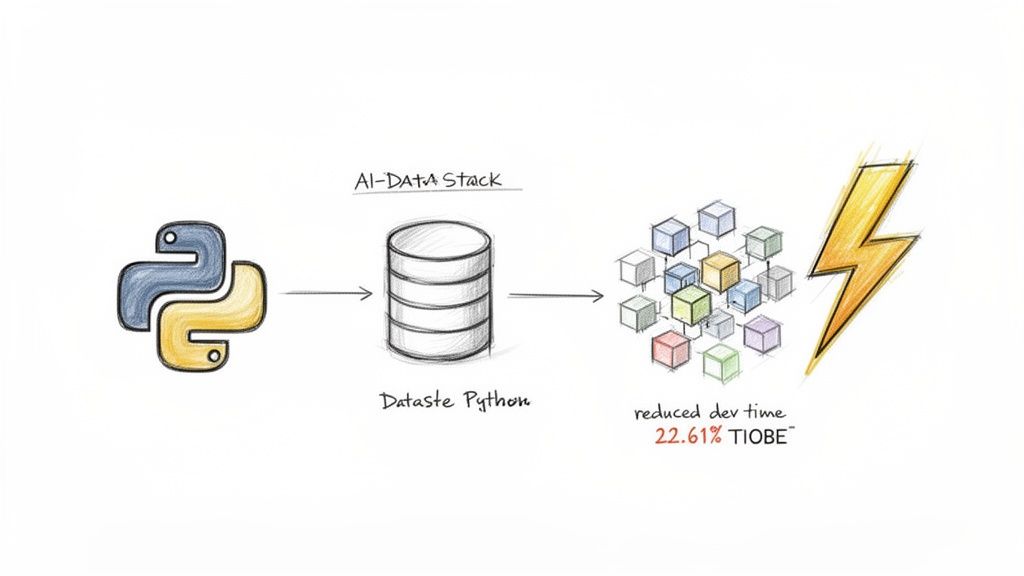
Python’s Dominance in the Data Ecosystem
Python’s position in data science and AI is the result of years of consolidated effort to build a scientific computing stack. The resulting ecosystem is one that PHP cannot match in this domain.
Key differentiators are the libraries that form the foundation of modern data work:
- Numerical & Scientific Computing: Libraries like NumPy and SciPy provide optimized, low-level routines for mathematical operations on large arrays and matrices.
- Data Manipulation: Pandas and its DataFrame structure make cleaning, transforming, and analyzing structured data efficient.
- Machine Learning: Scikit-learn is the standard for traditional ML algorithms. For deep learning, TensorFlow and PyTorch are the dominant frameworks.
These libraries represent significant R&D investment. A data-first modernization in PHP would require writing these capabilities from scratch or relying on less-mature extensions, which introduces significant risk. Our breakdown of modern AI engineering services shows how this ecosystem de-risks projects.
Talent Pool and Developer Mindshare
The availability of specialized talent is a major risk factor. According to TIOBE Index data from late 2023, Python has consistently held the top spot, making it the default choice for forward-looking AI or data projects. This signals a deep, growing pool of developers focused on data science. You can read more about Python’s popularity index and what it means for the future.
When you post a job for a “Python AI Engineer,” you attract candidates with expertise in data modeling, statistical analysis, and algorithm implementation. A “PHP AI Engineer” role, by contrast, will likely attract generalist web developers with only peripheral experience in ML. The skill gap is substantial.
This talent disparity impacts project timelines and outcomes. The cost of training a PHP team in the nuances of machine learning—or the cost of their inevitable mistakes—often outweighs the perceived savings of keeping the project on a single tech stack.
When Not to Use PHP for a Data-First Project
Pushing forward with PHP in data-centric scenarios correlates strongly with project failure and budget overruns driven by the high cost of custom development.
Do NOT use PHP if your project’s core value is tied to:
- Predictive Analytics: Building models to forecast outcomes from historical data.
- Natural Language Processing (NLP): Analyzing, understanding, or generating human language.
- Computer Vision: Processing and making sense of images or videos.
- Large-Scale Data Pipelines: Ingesting, cleaning, and transforming terabytes of data.
In these situations, Python’s mature ecosystem and specialized talent pool offer a defensible, lower-risk path to completion. Forcing a data-heavy workload onto a PHP stack increases the probability of failure.
Analyzing Total Cost of Ownership and Failure Rates
Technology stack decisions must be grounded in project economics and risk analysis. The relevant conversation is about the financial and operational reality of the choice, not language preference.
When we analyze the total cost of ownership (TCO) and common failure modes for PHP vs. Python modernizations, a clear picture emerges.
Cost Per Line of Code Analysis
Development cost is a primary driver of TCO. Based on our proprietary data from over 200 implementation partners, a clear pattern has emerged for web-centric modernization projects.
Modernizing a legacy PHP app to a modern framework like Laravel or Symfony is a well-defined process. It typically costs between $1.50 and $3.50 per line of code (LOC). This is a contained modernization because the core business logic and architectural patterns usually translate directly.
In contrast, migrating a comparable PHP web app to Python (using Django or Flask) is a more significant undertaking. The data shows this type of cross-language refactoring costs between $2.50 and $5.00 per LOC. The premium is due to re-architecting solutions for Python’s ecosystem and execution model, not just syntax translation.
For a CTO: A vendor’s quote for a PHP-to-Python web migration warrants skepticism. The 67% cost premium at the low end ($1.50 vs. $2.50) reflects the friction of moving between two different web ecosystems. If a quote appears unusually low, the vendor has likely underestimated the complexity.
Common Failure Modes in Web Migrations
When a PHP-to-Python web migration fails, it is typically for predictable technical reasons that were overlooked during the planning phase.
Top 3 Reasons PHP-to-Python Web Migrations Fail:
- Performance Degradation Under Load: Teams often underestimate the architectural shift from PHP’s share-nothing, per-request model to Python’s persistent application servers. Issues around the Global Interpreter Lock (GIL) and inefficient process management create unexpected bottlenecks, resulting in performance that is significantly below the legacy PHP application’s baseline.
- Underestimated Ecosystem Gaps: The migration team encounters a critical PHP library—for a specific payment gateway or image processing tool—that has no mature, battle-tested equivalent in Python. This forces expensive, time-consuming custom development mid-project, disrupting budgets and timelines.
- Inflated Vendor Quotes: Some vendors provide unjustifiably high quotes, capitalizing on a client’s strategic desire to consolidate on a single language. This can turn a technical project into an exorbitant expenditure without a clear ROI over a simpler PHP-to-PHP modernization.
The Inverse Scenario: PHP for Data Workloads
The situation is reversed when PHP is used for domains where Python is the standard. Attempting to build complex data processing pipelines or machine learning models in PHP almost always leads to higher costs and a greater likelihood of failure.
The reasons are a lack of mature data science libraries comparable to Python’s ecosystem (Pandas, scikit-learn) and a scarcity of talent with deep expertise in that niche. The project team ends up allocating budget to build foundational tools that are readily available in Python. Using PHP for data-heavy tasks inflates both TCO and risk.
A Technical Deep Dive on Scalability and Concurrency
Modernization decisions require a technical breakdown of how a language behaves under load. PHP and Python have core designs that create different paths for handling concurrency and scaling, which directly impacts cloud costs and operational complexity.
PHP’s traditional strength lies in its share-nothing architecture. Managed by runtimes like PHP-FPM, each incoming web request is handled by its own isolated worker process. This model is simple and effective for stateless web applications.
Once a request is complete, all resources it used are released. This design prevents a single slow or buggy request from affecting the entire system, making it resilient. The path to scaling is straightforward: add more servers.
PHP: Stateless Horizontal Scaling
The Just-In-Time (JIT) compiler, introduced in PHP 8, improved upon this model. According to our partner intelligence, scalability is a top concern for 78% of VPs in enterprise web app modernizations. PHP’s performance for classic server-side workloads provides an advantage, explaining why it still powers 72.2% of known websites.
PHP 8’s JIT can deliver 2-3x speedups over legacy versions. In benchmarks, PHP often handles traditional web requests 20-40% faster than Python’s interpreter, which can be constrained by the GIL. For a high-throughput CMS or e-commerce platform, this speed is a significant advantage.
An understanding of horizontal vs vertical scaling is necessary for optimizing performance. PHP’s architecture makes horizontal scaling a low-complexity and cost-effective default strategy for most web applications.
Python: The GIL and Asynchronous Tradeoffs
Python’s approach to concurrency is different. The main factor is the Global Interpreter Lock (GIL), a mutex that ensures only one native thread can execute Python bytecode at a time within a single process.
For CPU-bound work, such as complex financial calculations, the GIL is a significant bottleneck. It renders multi-core processors ineffective for true parallel execution within a single process.
Failure Mode Alert: A common failure pattern in PHP-to-Python web migrations is underestimating the GIL. A team assumes they can achieve parallelism with threads, only to find the new Python service performs worse under load than the old PHP app because the workload was more CPU-intensive than diagnosed.
However, the GIL’s impact is reduced for I/O-bound tasks like making API calls or querying a database. While one thread waits for the network or disk, the GIL is released, allowing another thread to execute. For these workloads, Python has two effective workarounds:
- Multi-process architecture: Tools like Gunicorn spawn multiple independent worker processes, each with its own Python interpreter and memory space, bypassing the GIL. This is the standard method for scaling Python web applications.
- Asynchronous programming: Using libraries like
asyncio, Python can manage tens of thousands of concurrent connections within a single thread. This event-driven model is efficient for applications that spend most of their time waiting on network I/O, such as microservices or real-time data streaming apps.
The scalability debate is not about which language is “faster,” but about matching the architecture to the workload. PHP offers a simple, proven model for scaling traditional web apps. Python, while constrained by the GIL for some tasks, provides sophisticated tools for modern, I/O-bound applications.
Making the Final Decision: Situational Recommendations
The PHP vs. Python debate does not have a single winner. The correct answer is situational and depends on the specific business problem. A defensible decision maps the language’s core strengths to the project’s architecture, risk profile, and long-term objectives.
This decision tree provides a high-level view of the logic.
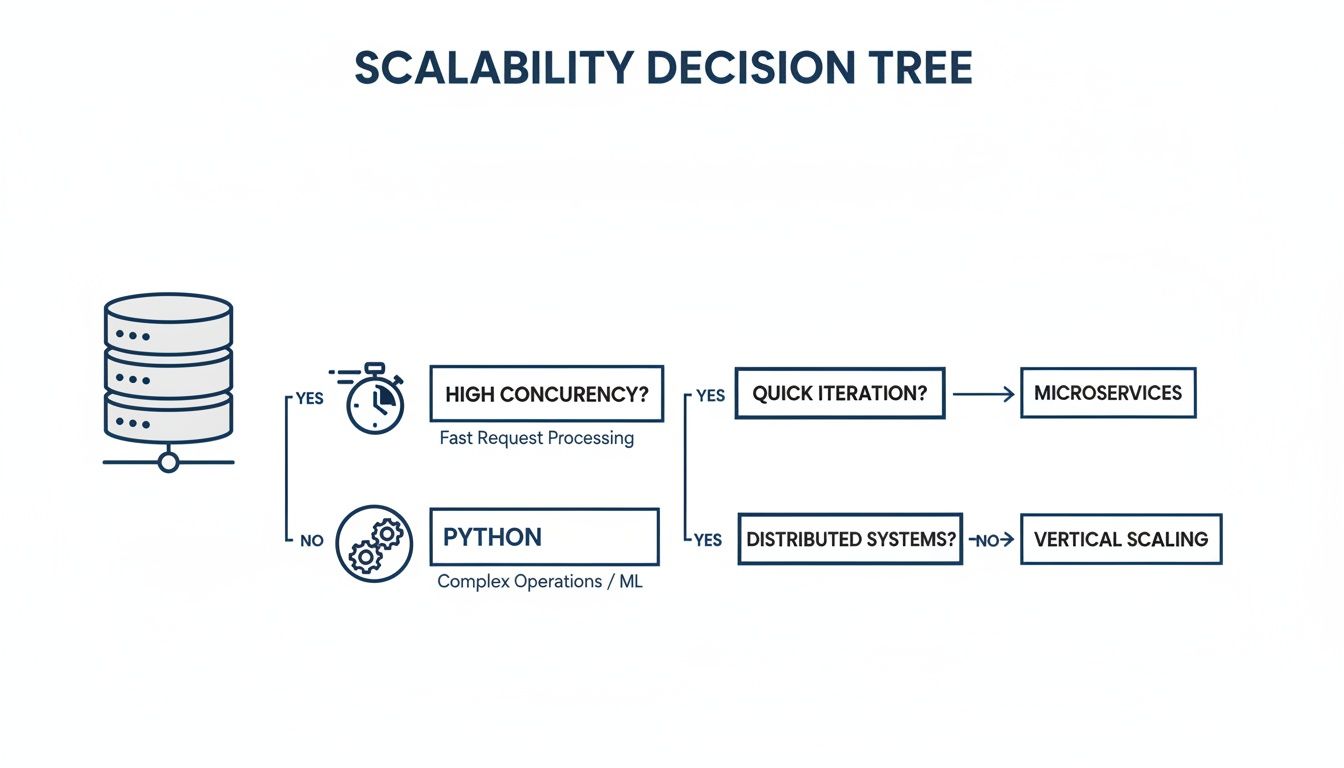
This illustrates a critical trade-off. PHP provides a direct, lower-complexity path for scaling traditional web workloads. Python offers a more versatile—but more complex—toolkit for I/O-heavy and data-centric applications.
Scenario 1: Modernizing a WordPress or Drupal Monolith
Recommendation: PHP is the unequivocal choice. These platforms are deeply embedded in the PHP ecosystem. Migrating the core to Python would introduce massive, unnecessary risk and cost for no discernible upside.
- Primary Justification: The project risk of rewriting battle-tested PHP components in Python is exceptionally high. Modern PHP 8+ with a framework like Laravel or Symfony offers a direct, low-cost path to improved performance and maintainability.
- Architectural Pattern: Use a strangler-fig pattern to incrementally replace old code with modern, modular PHP services without a big-bang rewrite.
- When NOT to use Python: Do not consider it for this task. The ecosystem mismatch is a near-guarantee of budget overruns and a high probability of project failure.
Scenario 2: Building a New Predictive Analytics Engine
Recommendation: Python is the only defensible option. The maturity of its data science and AI libraries—like TensorFlow, PyTorch, and scikit-learn—reduces development time and project risk.
- Primary Justification: Python’s ecosystem offers pre-built, optimized tools for data work that have no equivalent in PHP. This directly impacts development velocity and model accuracy.
- Architectural Pattern: A microservices architecture is common. A Python service can handle data processing and expose an API to the main web application (which could remain in PHP).
- When NOT to use PHP: Avoid PHP for anything requiring complex numerical computation or machine learning. The lack of library support will force your team to build foundational tools from scratch, inflating costs and timelines.
Scenario 3: Refactoring a High-Traffic E-commerce Platform
Recommendation: This is a nuanced decision. For standard request-response workloads, PHP often remains the pragmatic choice. Its performance on stateless web requests is difficult to beat, and frameworks like Magento are mature. However, if the platform’s key differentiator is shifting toward AI-driven features like recommendation engines, a hybrid approach using Python is justified.
Architectural Decision, Not a Language Choice: The core application logic can leverage PHP’s speed, while delegating specialized AI/ML tasks to dedicated Python microservices. This approach utilizes the strengths of both languages.
This hybrid model contains risk by keeping the performant web layer in PHP while building new, data-centric features in Python’s superior ecosystem. A full rewrite of the entire platform to Python often introduces performance regressions on the web tier and is a high-risk, low-reward proposition.
PHP vs Python: Final Analysis
Here are direct answers to common questions in the PHP vs. Python modernization debate.
Is It a Good Idea to Migrate a PHP App to Python?
For a standard web application, migrating from PHP to Python is almost always a poor strategic decision. It is a high-risk, high-cost initiative for what is usually a negligible gain in capability.
Our partner data indicates a 67% cost premium for PHP-to-Python web migrations. The typical cost increases from $1.50-$3.50 per line of code for a PHP-to-PHP modernization to $2.50-$5.00 for a cross-language migration. You pay more for a riskier outcome.
The primary risks are performance degradation from architectural mismatches (like Python’s GIL) and discovering gaps in Python’s web tooling that require expensive custom development. A safer and more cost-effective path is modernizing the legacy PHP app to a current framework like Laravel or Symfony.
Is PHP Still Relevant for New Projects?
Yes, particularly if the project is web-centric. The fact that PHP powers over 72% of websites with a known server-side language reflects its efficiency and reliability for web workloads.
Modern PHP (versions 8+) is fast due to innovations like the JIT compiler. For a new CMS, e-commerce platform, or mainstream SaaS application, PHP is a pragmatic and defensible choice. The ecosystem is mature, and the talent pool is large.
Can PHP Be Used for AI and Machine Learning?
Technically, yes, as libraries like PHP-ML exist. In practice, no. PHP should not be used for serious AI or machine learning development.
Python’s ecosystem for data science and AI—with libraries like TensorFlow, PyTorch, and scikit-learn—is significantly more advanced. It is more mature, better optimized, and supported by a global community of experts.
Bottom Line: Choosing PHP for a data-first modernization is a strategic error. The project will face higher failure rates and budget overruns due to the need to custom-build foundational tools that are readily available and battle-tested in Python. In the PHP vs Python decision for AI, Python is the only viable option.
Making the right architectural and vendor decisions is critical to modernization success. We provide unbiased, data-driven intelligence on over 200 implementation partners—their true costs, specializations, and common failure modes—so you can choose the right partner with confidence. Get your vendor shortlist.