
10 IAM Modernization Best Practices for Enterprise Architects
Your legacy Identity and Access Management (IAM) system is no longer a stable foundation; it’s an active liability. Designed for a monolithic, on-premises world, these fragmented systems are failing to secure distributed, cloud-native applications. The typical enterprise now juggles between four and six separate identity silos, creating security gaps and operational drag that block modernization goals. This is not a theoretical risk. 81% of security breaches involve compromised credentials, a failure directly attributable to outdated IAM models that cannot enforce consistent, fine-grained policies.
The critical decision for CTOs and VPs of Engineering is not if they should modernize IAM, but how to execute a complex migration without disrupting business operations or joining the 48% of IAM projects that fail outright. Standard advice offers vague principles instead of actionable instructions.
This guide provides a prioritized, data-driven checklist of the ten most critical IAM modernization best practices. Inside, you will find specific frameworks for implementation, real-world cost benchmarks, and clear guidance on making defensible technology and architecture decisions. We will cover adopting Zero Trust principles and passwordless authentication, implementing Just-In-Time provisioning, and integrating identity into your DevOps pipeline. The goal is to equip you with a precise roadmap for transforming your IAM from a liability into a core enabler of secure, scalable growth.
1. Zero Trust Architecture Implementation
Implementing a Zero Trust security model is the foundational step in any IAM modernization effort. This framework abandons the outdated “trust but verify” perimeter-based security model. Zero Trust operates on the principle of “never trust, always verify,” assuming that breaches are inevitable and that no user or device is trusted by default, regardless of its location.
For modern distributed systems spanning on-premises data centers, multiple clouds, and remote workforces, this shift is a necessity. Legacy IAM systems tied to network perimeters fail to secure access to cloud-native applications and data. A core component of IAM modernization best practices involves moving from a network-centric to an identity-centric security posture, where every access request is authenticated and authorized dynamically.
Actionable Implementation Strategy
A successful Zero Trust rollout is incremental and risk-driven, not a “big bang” deployment. Enterprises like Google (BeyondCorp) and Microsoft have demonstrated that phased adoption is the most effective path.
- Start Small: Begin by identifying your most critical assets and high-risk user groups. Focus on protecting sensitive data repositories or applications accessed by privileged administrators first.
- Audit and Segment: Before deploying controls, conduct a thorough audit of your network topology and data flows. Use this intelligence to prioritize microsegmentation efforts, isolating workloads based on data sensitivity and business criticality.
- Establish Policy Governance: Define your access policies and governance framework before you deploy technology. A cornerstone of modern IAM, understanding the principles of a robust Zero Trust Architecture is crucial for secure operations. The goal is to enforce least-privilege access consistently across all environments.
Implementation Timeline: For a large enterprise, a full Zero Trust implementation is an 18 to 24-month journey. Rushing the process without proper discovery and planning leads to operational friction and security gaps. You can learn more about effective Zero Trust architecture design to help structure your project roadmap.
2. Cloud Identity Platform Consolidation
The primary challenge in enterprise IAM is the sprawl of disconnected identity systems. Most organizations operate with multiple legacy directories like Active Directory alongside separate cloud Identity Providers (IDPs). This fragmentation creates security silos, inconsistent user experiences, and significant operational overhead. Consolidating these disparate systems into a unified cloud identity platform is a crucial step in any IAM modernization best practices roadmap.
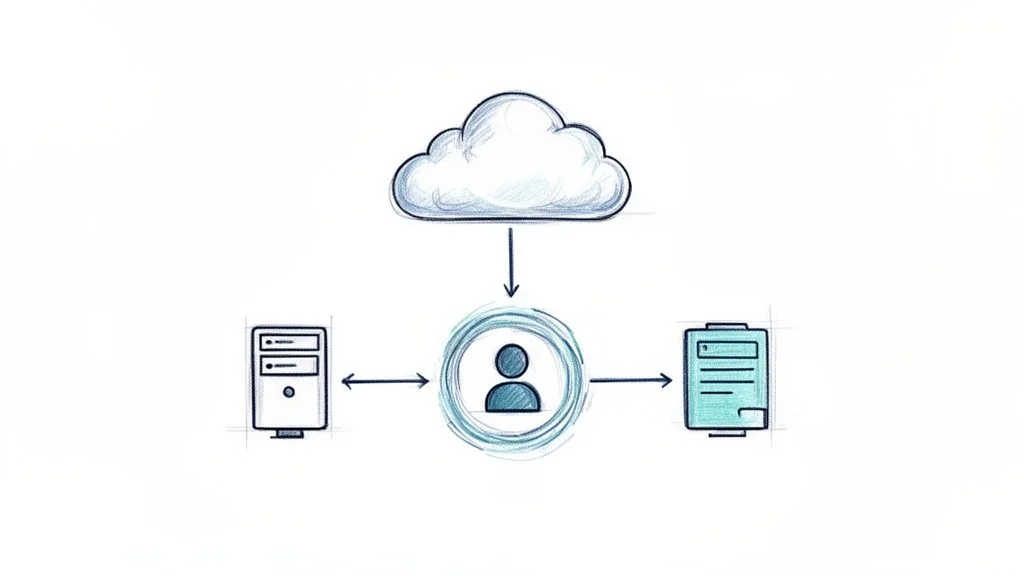
This process involves migrating user identities, credentials, and application integrations from legacy systems (e.g., CA Identity Manager, on-premises directories) to a central cloud IDP like Azure AD, Okta, or Ping Identity. The goal is to establish a single source of truth for identity data, enabling consistent policy enforcement, better visibility, and seamless access for cloud-native applications that cannot effectively consume identity from legacy architectures. For example, Deloitte successfully consolidated 12 IAM systems across over 150 entities using Azure AD to achieve this unified state.
Actionable Implementation Strategy
A consolidation project is not a simple lift-and-shift migration; it requires meticulous planning and a phased approach to avoid business disruption. It is a data-centric project with a focus on remediation and dependency mapping before any technical migration begins.
- Audit and Remediate: Start with a comprehensive audit of all existing identity stores. Identify data quality issues, duplicate accounts, and orphaned credentials. Budget 40-50% of the project cost for this data remediation and cleanup phase, as poor data quality is a primary cause of migration failure.
- Phased Application Rollout: Create a detailed application dependency map to understand all integration points. Begin the migration with non-critical applications to refine the process. Move to business-critical systems last, after the new platform and migration procedures are proven.
- Parallel Operations: Plan for a 3 to 6-month period where both the new and old IAM systems operate in parallel. This allows for validation, user feedback, and a rollback path before you fully decommission the legacy infrastructure.
Implementation Timeline: A large-scale consolidation project, such as a financial firm’s migration from CA Identity Manager to Okta, can take up to two years and cost over $3 million. Rushing this process without a detailed data quality assessment and dependency analysis will lead to access failures and security vulnerabilities.
3. Passwordless Authentication Adoption
Eliminating passwords is a decisive move in any IAM modernization strategy. Passwords are a primary attack vector, with compromised credentials implicated in a significant majority of security breaches. Adopting passwordless authentication methods, such as biometrics, hardware security keys, and cryptographic authenticators, directly addresses this vulnerability while improving the user experience, a critical factor for workforce productivity.
This approach replaces weak, stolen, or phished passwords with phishing-resistant alternatives. For an IAM system, this means transitioning from verifying what a user knows (a password) to verifying what a user has (a device or key) and who a user is (a biometric marker). This shift is fundamental to modernizing security controls and is a core component of effective IAM modernization best practices.

Actionable Implementation Strategy
A successful move to passwordless is a phased, user-centric process, not an abrupt mandate. A gradual rollout focused on education and targeted user groups yields the best results. By 2023, Microsoft reported that 99.9% of its Azure sign-ins were passwordless, showcasing the method’s viability at extreme scale.
- Pilot with Technical Users: Begin the rollout with low-risk, tech-savvy groups like IT and development teams. These users can provide valuable feedback and act as champions for broader adoption.
- Prioritize FIDO2: Standardize on FIDO2-compliant solutions. This ensures maximum interoperability across platforms and devices, future-proofing your investment and avoiding vendor lock-in.
- Communicate and Train: Invest heavily in user training and communication. Explain the security benefits and demonstrate the improved user experience. A clear campaign prevents confusion and resistance during the transition.
Implementation Timeline: For a mid-to-large enterprise, a full transition to passwordless authentication is a 12 to 18-month project. Plan to maintain password capabilities as a fallback for at least 18-24 months to accommodate all user segments and edge cases before full deprecation.
4. API-Driven IAM Architecture and Identity-Centric DevOps
Shifting to an API-first IAM architecture is a critical step in modernizing identity management. This approach treats all identity functions—from user provisioning to authentication and authorization—as programmable services accessible through well-defined APIs. It decouples the identity layer from underlying applications, enabling automation, developer self-service, and real-time, event-driven identity operations that legacy systems cannot support.
This model is fundamental for integrating security into modern software development, often called “identity-centric DevOps.” Instead of treating IAM as a separate, manual process, it is embedded directly into CI/CD pipelines and Infrastructure-as-Code (IaC) workflows. Platforms like Auth0 and Okta were built API-first from their inception, demonstrating how this architecture allows for deep, flexible integrations across thousands of applications and services.
Actionable Implementation Strategy
Successfully adopting an API-driven model means treating your IAM platform as a product for developers. This requires focusing on usability, documentation, and reliability, much like any other critical software component.
- Standardize on OIDC and API Security: Adopt OpenID Connect (OIDC) as the default protocol for application authentication. Secure your new IAM APIs with robust controls, including rate limiting, quotas, and a clear versioning strategy to prevent breaking changes for consumers.
- Eliminate Static Credentials in Pipelines: The primary goal of identity-centric DevOps is to remove long-lived credentials like API keys and secrets from source code and CI/CD environments. Use workload identity federation with OIDC, a feature supported by GitHub Actions, Google Cloud, and AWS, to grant pipelines short-lived, scoped credentials automatically.
- Empower Developers with Self-Service: Provide developers with excellent, well-maintained documentation, client libraries in multiple languages, and sandbox environments. This reduces their reliance on central IT or security teams for routine IAM tasks, speeding up development cycles and promoting secure-by-default practices. For more on this, you can explore effective DevOps integration modernization strategies.
Implementation Timeline: For an organization with established CI/CD, an initial pilot to remove static credentials from a critical pipeline can be completed in 3 to 6 months. A full-scale rollout across all development teams, including documentation and training, typically takes 12 to 18 months.
5. Just-In-Time (JIT) Provisioning and De-provisioning
Moving away from pre-provisioning all potential users is a critical IAM modernization best practice. Just-In-Time (JIT) provisioning automatically creates a user account the first time a user successfully authenticates via a federated identity provider. This approach, paired with immediate de-provisioning upon termination or role change, drastically reduces the attack surface created by dormant or unnecessary accounts.
Traditional provisioning methods leave orphaned accounts with active permissions, creating significant security liabilities and compliance headaches. JIT eliminates this problem by ensuring access is granted only when needed and revoked precisely when it is no longer authorized. This method directly supports a least-privilege model by default, making it an essential component for any modern, secure identity fabric. AWS IAM’s role assumption mechanism is a form of JIT access, replacing risky long-lived access keys with temporary, session-based credentials.
Actionable Implementation Strategy
A successful JIT strategy hinges on precise attribute mapping and robust monitoring. Poorly configured systems lead to access failures and operational friction, undermining the security benefits.
- Implement Careful Attribute Mapping: Begin by defining a strict contract between your identity provider (e.g., Okta, Azure AD) and the service provider. Ensure that attributes like
email,department, androleare mapped accurately to prevent provisioning errors. A common mistake is a mismatch in attribute naming conventions, which can cause silent failures. - Establish Tiered Approval Workflows: Not all applications are equal. For high-risk systems like production databases or financial platforms, implement a JIT process that requires manager or system owner approval before the account is created. This adds a crucial layer of oversight without slowing down access to less sensitive tools.
- Monitor and Set Failure Rate Targets: During the initial rollout, closely monitor JIT provisioning failures. Your goal should be a failure rate below 0.5%. Track metrics like time-to-access and time-to-remediate for any access violations to quantify the effectiveness of your JIT implementation.
Implementation Timeline: For a mid-sized organization with 10-15 core applications, a phased JIT rollout can take 3 to 6 months. Rushing the deployment without thoroughly testing de-provisioning rules for each application-specific scenario leads to lingering access and compliance failures.
6. Privileged Access Management (PAM) Modernization
Modernizing privileged access management involves replacing static, password-based systems with dynamic, risk-aware PAM solutions. Legacy PAM often relies on shared credentials stored in vaults and time-based access grants. This approach is insufficient for today’s hybrid environments, where privileged accounts are prime targets for attackers seeking to escalate permissions and move laterally across networks.

A core part of IAM modernization best practices is shifting to a model that uses ephemeral credentials, just-in-time (JIT) access, and real-time monitoring. For instance, a Fortune 500 financial services firm replaced its legacy PAM vault and reduced privilege escalation attempts by 67% within a year. Similarly, a major telecom provider used a modern PAM deployment to cut privileged account creation time from three days to just 15 minutes, directly improving operational agility. These systems are essential for meeting modern compliance frameworks like PCI-DSS and NIST 800-53.
Actionable Implementation Strategy
A successful PAM modernization project is incremental, starting with a comprehensive discovery phase to map all privileged accounts, including service accounts, embedded credentials, and administrator roles. Enterprises often find that 30-40% of their privileged accounts are undocumented, posing a significant security risk.
- Conduct a Full Inventory: Begin by using discovery tools to identify every privileged account across your infrastructure, databases, and applications. Classify them by risk level and business impact.
- Implement in Phases: Roll out controls incrementally to minimize disruption. Start with core infrastructure (servers, network devices), then move to databases, and finally tackle business applications.
- Define and Automate Workflows: Before deploying technology, establish clear approval workflows and escalation procedures for privileged access requests. Integrate these with your ITSM and communication tools to automate the process.
- Integrate with Security Operations: Connect your PAM solution with SIEM and SOC tools. This enables automated incident response when suspicious privileged activity is detected, closing the gap between detection and remediation.
Implementation Timeline: For a large, complex organization, a full PAM modernization can take 12 to 18 months. The initial three months are critical for monitoring and tuning policies based on operational feedback to balance security with developer and administrator productivity.
7. Identity Governance and Administration (IGA) Automation
Automating identity governance and administration (IGA) is a critical component of IAM modernization best practices, moving organizations beyond inefficient, manual processes. Legacy governance depends on spreadsheets and periodic, point-in-time access reviews. Modern IGA platforms replace this with continuous compliance monitoring, automated access certification campaigns, and real-time remediation of policy violations.
This shift is essential for managing the complexities of regulations like SOX, GDPR, and HIPAA, which demand continuous verification, not just quarterly audits. By automating the identity lifecycle from onboarding to offboarding, organizations can enforce least-privilege access consistently. A financial services firm used IGA automation to move from a six-month review cycle to a continuous one, discovering and revoking 2,100 unauthorized privileged accounts in the process.
Actionable Implementation Strategy
Deploying an IGA platform is a multi-stage process that requires significant preparation. Simply installing the software without addressing underlying data quality and policy definition will lead to operational failure and high rates of false positives. A phased approach is necessary for a successful IGA program.
- Establish a Clean Data Foundation: Dedicate the first three to six months to data quality improvement. Integrate with your HR system, treating it as the authoritative source for identity information, which typically drives 80% of access decisions. Clean, accurate identity data is the bedrock of effective automation.
- Define Policies and Risk Before Deployment: Before implementation, establish clear, written access policies and a risk-scoring model for applications and entitlements. This framework will guide the IGA tool’s automated decisions and prioritization of alerts.
- Plan for System Tuning and Adoption: Allocate a four to six-month tuning period post-launch to refine rules and reduce false positives. Engage business unit champions early to drive adoption, assist with policy refinement, and validate access controls, ensuring the system aligns with business reality.
Implementation Timeline: A full IGA implementation, including data cleanup and policy definition, typically takes 12 to 18 months. Rushing this process results in a noisy, ineffective system that creates more work than it saves. Success metrics should focus on reducing access violations, decreasing remediation time, and lowering the number of audit findings.
8. Cloud Directory and Hybrid Identity Synchronization
For most enterprises, a pure cloud-native identity model is an unrealistic short-term goal. Synchronizing on-premises directories like Active Directory or OpenLDAP with cloud identity platforms is a critical, non-negotiable component of IAM modernization best practices. This hybrid identity approach allows organizations to maintain existing investments while gradually adopting cloud services, providing consistent authentication and a unified identity for users across all environments.
This strategy avoids a disruptive “rip-and-replace” migration. It creates a durable bridge between legacy systems and modern cloud infrastructure. Tools like Azure AD Connect, which synchronizes over 50 million identities from on-premises Active Directory daily, demonstrate the scale and reliability of this model. For organizations with complex, multi-datacenter footprints, hybrid synchronization is the only practical way to extend identity controls to SaaS applications and IaaS platforms without completely re-architecting their core identity fabric.
Actionable Implementation Strategy
A successful hybrid identity deployment depends on the health of the source directory and a methodical, phased rollout. The goal is to establish a reliable sync process that becomes the single source of truth for identity data moving to the cloud.
- Audit On-Premises First: Before configuring any synchronization tool, conduct a thorough audit of your on-premises Active Directory. Clean up stale accounts, resolve duplicate attributes, and standardize data formats. A messy AD will only create bigger problems in the cloud.
- Stage and Test Sync Rules: Always implement a staging environment to test synchronization rules and attribute mappings before pushing them to production. This prevents accidental mass deletions or attribute overwrites that could lock out thousands of users.
- Monitor Sync Health Aggressively: Establish strict monitoring for sync failures and data discrepancies. A healthy sync service should maintain an error rate well below 0.1%. Implement redundant sync agents in an N+1 configuration to ensure high availability and prevent single points of failure from disrupting access.
Implementation Timeline: For a mid-sized enterprise, setting up and stabilizing a hybrid sync can take 3 to 6 months. This includes the initial on-premises cleanup, staging tests, and production rollout. Plan for the eventual retirement of the on-premises directory over a 5 to 7-year horizon as applications and dependencies are migrated.
9. Adaptive Authentication and Risk-Based Access Control
Static authentication policies, such as requiring multi-factor authentication (MFA) for every login, introduce user friction and are blind to context. Adaptive authentication represents a more intelligent approach, dynamically adjusting verification requirements based on real-time risk signals. This method moves beyond a one-size-fits-all security posture to one that is fluid and responsive.
This practice is a cornerstone of modern IAM, using signals like device posture, geographic location, behavioral analytics, and unusual login times to calculate a risk score for each access attempt. It tailors the security response to the specific context, demanding stronger verification only when the risk is high. For example, a login from a known device on the corporate network might be seamless, while an access attempt from a new device in a different country would trigger a step-up authentication challenge. This balance is critical for any effective IAM modernization best practices.
Actionable Implementation Strategy
Deploying adaptive authentication requires a shift from static rule enforcement to dynamic, risk-based decision-making. The goal is to reduce friction for low-risk activities while increasing security for high-risk ones. Providers like Okta, which blocks over one billion attacks monthly with its system, and Microsoft, which stops 99.9% of credential-based attacks, validate the model’s effectiveness.
- Establish Baselines First: Before enforcing any policies, dedicate a three-to-six-month period for the system to learn normal user behavior. This creates an accurate baseline to detect genuine anomalies, not just routine variations.
- Deploy in Monitor Mode: For the first 30 days, run the system in a non-blocking, “monitor-only” mode. Log all risk assessments and potential actions without actually enforcing them. This helps tune risk thresholds and identify potential false positives before impacting users.
- Integrate and Tune Signals: Integrate your adaptive authentication engine with a SIEM to correlate identity risk signals with broader security events. Define custom risk levels for different applications; a user accessing a payroll system should face stricter scrutiny than one accessing a public-facing knowledge base.
Implementation Timeline: A phased rollout over 6 to 9 months is realistic for a medium-to-large enterprise. Begin with a single, high-value application or user group to pilot the system and refine policies. Rushing deployment without adequate behavior learning and tuning will lead to high false-positive rates and frustrated users.
10. Compliance-Driven Access Policy Automation
Automating access policy based on compliance frameworks is a critical IAM modernization best practice for organizations in regulated industries. This approach moves beyond manual, error-prone policy management by directly mapping regulatory requirements from frameworks like HIPAA, PCI-DSS, SOX, or GDPR into access control policies. These automated systems continuously monitor and enforce the rules, achieving a state of continuous compliance rather than periodic, point-in-time audits.
For organizations handling sensitive data, manual compliance checks are no longer tenable. An automated system can instantly identify and remediate a policy violation, such as an employee gaining access to financial records that violates SOX separation-of-duties rules. This not only reduces risk but also dramatically lowers the operational overhead of proving compliance to auditors. For instance, a payment processor using PCI-DSS automation can achieve and maintain a near-perfect compliance rate, while a healthcare provider can use HIPAA-driven policies to automatically remediate thousands of potential data access violations.
Actionable Implementation Strategy
Adopting compliance automation requires a clear understanding of both the regulations and your organization’s specific risk posture. The goal is to translate legal text into machine-enforceable rules without disrupting business operations.
- Prioritize High-Risk Requirements: Begin with the most critical compliance mandates for your industry. For a healthcare organization, focus first on HIPAA rules governing Protected Health Information (PHI). For a payment processor, start with PCI-DSS requirements for cardholder data environments.
- Establish a Compliance Baseline: Before you automate, you must measure your starting position. Conduct a thorough audit to identify existing non-compliant access configurations. This data provides the baseline against which you will measure the success of your automation.
- Design a Formal Exception Process: No policy is perfect. Allocate a budget for policy exceptions, typically around 20-30%, to balance strict enforcement with business reality. Create a clear workflow for exception requests that requires business justification and time-bound approvals. A crucial component of modern IAM is ensuring robust compliance, and understanding the core principles of an effective Governance Risk Management and Compliance (GRC) framework is essential for managing these exceptions securely.
Implementation Timeline: A pilot program focused on a single, high-risk regulation can be deployed in 4 to 6 months. A full-scale, multi-regulation automation project is a 12 to 18-month initiative. Key metrics to track include compliance rate, mean-time-to-remediation (MTTR) for violations, and the volume and nature of policy exceptions.
IAM Modernization Decision Framework
| Practice | Implementation Complexity | Cost & Resources | Expected Business Outcome | Best Fit For | Key Advantage |
|---|---|---|---|---|---|
| Zero Trust Architecture | High (18–24 mo) | $500K–$2M+ initial, extensive integration work | Reduced breach impact, continuous verification | Large cloud/hybrid enterprises, regulated industries | Identity-centric security, micro-segmentation |
| Cloud Identity Consolidation | High (12-24 mo) | $2M–$5M+ initial, data cleanup, migration teams | Unified identity, faster cloud adoption, lower overhead | Orgs with multiple IAM silos, major cloud migration | Single source of truth, modern protocol support |
| Passwordless Authentication | Medium (12–18 mo) | $5–$25 per user initial, hardware keys, training | Fewer credential breaches, improved UX, lower helpdesk costs | Tech-forward organizations, security-sensitive teams | Phishing-resistant auth, faster sign-in |
| API-Driven IAM / DevOps | High (12–18 mo) | $1M–$3M initial, API dev, OIDC expertise | Real-time identity ops, faster app onboarding | Cloud-native, microservices, heavy CI/CD environments | API-first automation, developer self-service |
| Just-In-Time (JIT) Access | Medium (3-6 mo) | $200K–$800K initial, integration & testing | Reduced attack surface from orphaned accounts | SaaS-heavy environments, dynamic workforces | Automated provisioning, least privilege by default |
| PAM Modernization | High (12–18 mo) | $1M–$4M initial, licensing, monitoring, training | Lower privileged account risk, audit-ready logs | Financial services, healthcare, high-compliance infra | Ephemeral credentials, session recording, JIT elevation |
| IGA Automation | High (12–18 mo) | $800K–$2.5M initial, data quality, policy modeling | Continuous compliance, faster remediation | Regulated enterprises needing continuous access controls | Automated access reviews, audit readiness |
| Hybrid Identity Sync | Medium (3-6 mo) | $150K–$600K initial, sync agents, HA design | Consistent identity across environments, gradual cloud adoption | Orgs with on-prem AD and cloud apps | Seamless hybrid auth, lower migration disruption |
| Adaptive Authentication | Medium (6–9 mo) | $100K–$500K initial, behavioral analytics, ML tuning | Fewer MFA prompts, real-time fraud detection | Large user bases, customer-facing services | Contextual risk scoring, reduced user friction |
| Compliance Automation | High (12–18 mo) | $300K–$1.2M initial, compliance expertise, policy tools | Reduced audit effort, continuous compliance | Highly regulated orgs (finance, healthcare, payments) | Automated enforcement, consistent regulatory controls |
Next Steps: From Strategy to Execution
IAM modernization is a strategic program that underpins every other modernization effort. We have detailed the essential IAM modernization best practices, from implementing a Zero Trust architecture and consolidating on a cloud identity platform to adopting passwordless authentication and automating governance. Ignoring them means accepting technical debt that manifests as security vulnerabilities, operational friction, and a drag on developer velocity.
Modern IAM is an enabler, not a gatekeeper. When executed correctly, it accelerates application delivery by providing developers with self-service, API-driven identity controls. It reduces the attack surface by eliminating standing privileges with Just-In-Time access. It improves user experience through adaptive, risk-based authentication. These are not abstract benefits; they translate directly into a stronger competitive position. Your next steps must be methodical and focused on de-risking the entire program:
- Conduct a Discovery Audit: Map every application, service, and data store, paying special attention to how they handle authentication and authorization. Identify all privileged accounts, service accounts, and API keys, and document their ownership and usage patterns. This audit’s output is your source of truth.
- Quantify the Cost of Inaction: Use the audit data to build a risk model. How many applications rely on legacy authentication? How many dormant privileged accounts exist? Translate these findings into financial terms, such as the potential cost of a breach from a compromised service account or the engineering hours wasted per month on manual access requests.
- Prioritize Based on Impact vs. Complexity: Not all practices can be implemented at once. Use the decision framework above to plot each initiative based on its business impact versus its implementation complexity. Target a high-impact, medium-complexity item for an initial win to build momentum and credibility for the broader program.
The most critical decision is not which technology to use, but who will help you implement it. The failure rate for large-scale IAM projects is high, often due to poor planning and mismatched partner expertise. Your goal is to find a partner with a proven, verifiable track record in your specific context, not a generalist. Demand transparency on their IAM project failure rates, average cost overruns, and experience with your legacy systems. Grounding your strategy in a rigorous audit and selecting partners based on empirical data shifts IAM modernization from a high-stakes gamble to a calculated, strategic investment.