
COBOL Developer Shortage: A Guide to Modernization, Not Staffing
The COBOL developer shortage is not a staffing problem; it is a modernization imperative. The median hiring cycle for a qualified COBOL specialist is 90-180 days, and daily rates in markets like the UK consistently exceed £550. Attempts to solve this with staff augmentation are a stop-gap measure that fails to address the core issue: dependence on a fragile, shrinking talent pool.
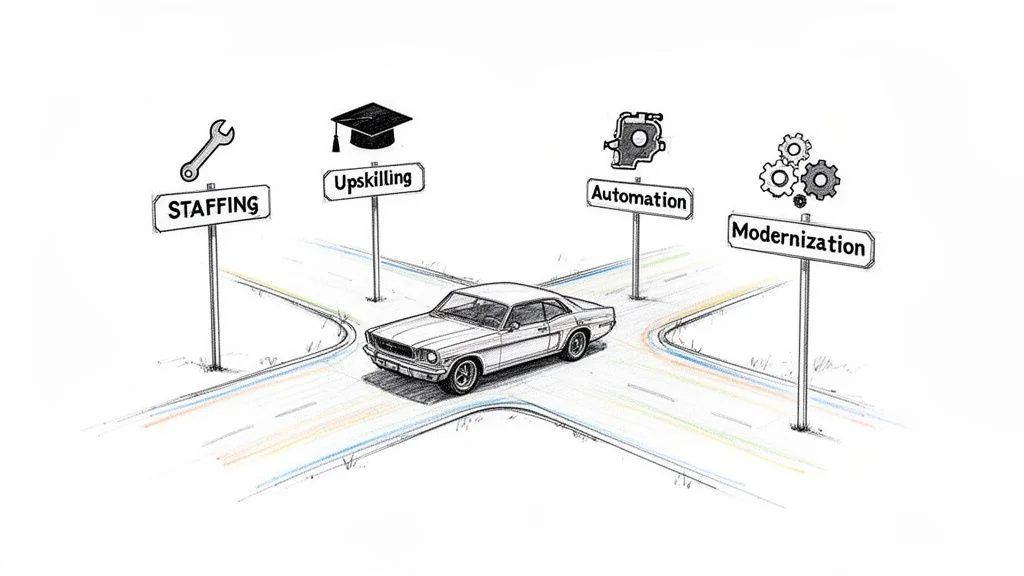
The only durable solution is to systematically reduce or eliminate the COBOL dependency itself. This requires a decision framework based on four strategic responses:
- Staffing: A temporary fix for immediate maintenance, not a strategy.
- Upskilling: A long-term investment for stable, non-strategic systems.
- Automation: An accelerator for code conversion that carries significant quality risk.
- Modernization: The definitive, albeit most complex, path to eliminating the dependency.
This guide provides a decision framework for CTOs and enterprise architects to select the right strategy, not based on wishful thinking, but on system criticality, risk tolerance, and long-term business goals.
The Scope of the Crisis: An Immediate Operational Risk
The retirement of the last generation of mainframe experts exposes mission-critical systems in global banking, insurance, and government to unacceptable levels of operational risk. This is not a future problem. The COVID-19 pandemic demonstrated the fragility of these systems when states like New Jersey saw their COBOL-based unemployment platforms fail under load, triggering a public scramble for retired programmers.
Training programs from providers like IBM and Micro Focus are insufficient to counter the ongoing 5 to 10-year retirement cliff. This has created a brutal hiring market where the exploding demand for COBOL skills far outstrips supply, driving costs to unsustainable levels.
The decision is not if you will address this, but how. The following matrix breaks down the cost, risk, and time-to-value of each of the four strategic responses.
COBOL Crisis Response Decision Matrix
| Strategy | Primary Risk | Relative Cost | Time-to-Value | Best For |
|---|---|---|---|---|
| Staffing | Talent Dependency (High cost, no IP capture) | High (Per Head) | Immediate | Urgent, short-term maintenance on non-strategic systems; buying time for a long-term plan. |
| Upskilling | Time Investment (Requires long-term commitment) | Medium | Long (12-24 mos) | Stable, well-documented systems where internal knowledge retention is a strategic goal. |
| Automation | Code Quality (Risk of unmaintainable transpiled code) | Variable (High initial license cost) | Medium (6-18 mos) | Applications with simple, well-defined logic; accelerating a broader modernization program. |
| Modernization | Execution Failure (High complexity, large blast radius) | Very High | Very Long (2-5+ years) | Business-critical systems that are a bottleneck to growth and innovation; eliminating technical debt. |
Your task is to evaluate these options against your operational reality. The choice you make will define your organization’s technical agility and risk profile for the next decade.
Strategy 1: Build an Internal COBOL Talent Pipeline (Upskilling)
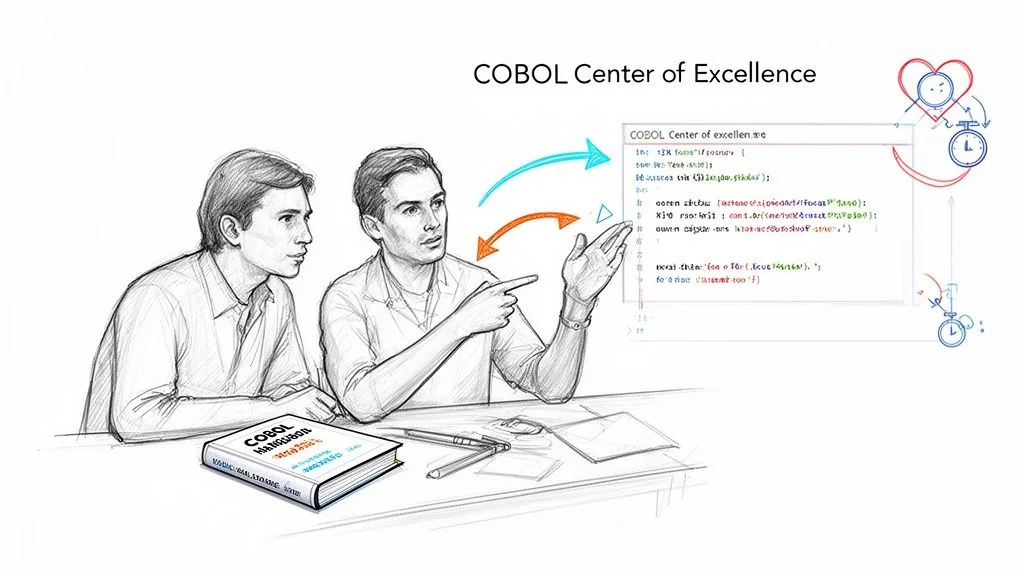
For organizations with stable, well-documented mainframe systems that are not immediate modernization candidates, building an internal talent pipeline is a viable long-term strategy. This is not a quick fix; it is a deliberate investment in knowledge transfer.
The objective is to establish a formal COBOL Center of Excellence (CoE). This is not a rebranding exercise. It is a structured program designed to transfer institutional knowledge from retiring senior experts to high-potential junior or mid-level engineers already on your payroll.
Identifying High-Potential Candidates
Your next COBOL maintainers are likely engineers who demonstrate an aptitude for procedural logic and systems-level thinking. Look for these traits:
- Methodical, detail-oriented mindset: COBOL is unforgiving, especially in financial calculations where precision is non-negotiable.
- Interest in system architecture: Engineers who enjoy debugging complex workflows and tracing data across system layers are prime candidates.
- Patience and a long-term outlook: This is a stewardship role, not a fast track to the latest JavaScript framework.
Once identified, pair these candidates directly with senior experts to transfer the unwritten business rules and system context that code comments never capture.
Do not mistake this for a simple training course. The core of a COBOL CoE is mentorship. The goal is to clone your senior experts’ brains, not just teach syntax. This is the only way to preserve the critical business logic embedded in your legacy code.
A Framework for Knowledge Transfer and Retention
A successful CoE requires a formal structure to prevent its goals from being overridden by daily operational pressures.
| Component | Actions | Outcome |
|---|---|---|
| Knowledge Transfer | 1. Structured Mentorship: Mandate dedicated weekly hours for pair programming and architectural reviews. 2. Documentation Blitz: Task pairs with documenting a specific module; the apprentice writes, the expert reviews. 3. Controlled Live-Fire Exercises: Assign low-risk bug fixes under direct mentor supervision. | Creates a durable knowledge base and develops practical competence. |
| Expert Retention | 1. Knowledge Transfer Incentives: Offer significant bonuses tied to the measurable success of their apprentices. Frame it as legacy-building. 2. Flexible Work & Phased Retirement: Provide options like flexible hours, remote work, or part-time consulting to create a graceful exit ramp. | Prevents the abrupt loss of critical institutional knowledge. |
This internal pipeline strategy is suited for organizations where the goal is stable, long-term maintenance, not immediate modernization. It converts the developer shortage from an external threat into an internal opportunity for knowledge preservation.
Strategy 2: Choose Strategic Partners, Not Staff Augmentation
When external help is required, the distinction between staff augmentation and a strategic partnership is critical. The choice determines who owns the project risk.
The market data is unequivocal: attempting to hire full-time COBOL developers is a losing proposition. A late 2023 analysis of over 35,000 UK IT contracts found only six for COBOL roles, yet daily rates remained at £525-£550. You cannot hire your way out of this problem. You can discover more insights about this talent scarcity on YouTube.
Staff Augmentation: The Illusion of Control
The staff augmentation definition is simple: hiring individual contractors to fill seats. This gives you temporary labor but leaves your organization fully accountable for project strategy, architecture, and outcome. It does not transfer risk. You are renting a pilot, but you still own the plane and are responsible if the engine fails.
Strategic Partnerships: Owning the Outcome
A strategic partnership with a modernization vendor transfers both execution and risk. The partner is accountable for the outcome—a successfully modernized application—not just the hours logged. They bring a proven methodology, specialized tooling, and experience from dozens of similar projects, which is critical given that 67% of migrations fail due to technical complexity.
A staff augmentation firm sells you hours. A true modernization partner sells you a guaranteed outcome. The first treats a symptom (no developers); the second provides a cure for the underlying disease (legacy dependency).
Vetting a True Modernization Partner
Generalist IT firms will claim COBOL experience; specialists have battle-tested playbooks for specific migration paths. Use this checklist to differentiate them:
- Proven Migration Path Experience: Do they have demonstrable experience with your exact target path (e.g., COBOL on z/OS to Java on AWS)? Demand case studies with a similar scope and technology stack.
- Data Fidelity Guarantees: How do they handle the notorious challenges of EBCDIC to ASCII conversion and COMP-3 packed decimal precision loss? A specialist will have a documented strategy for ensuring 100% data integrity.
- Documented Failure Rates: Ask for their project failure rate. A transparent partner will have this data and can explain the mitigation strategies learned from past projects. Our guide on COBOL migration services provides more detail.
- Tooling and Automation IP: What proprietary code analyzers, data validators, or refactoring engines do they use to de-risk and accelerate the project?
Choosing the right partner transforms the problem from a resource constraint into a manageable, outcome-based project.
Strategy 3: Navigate the Perils of Automated Transpilation
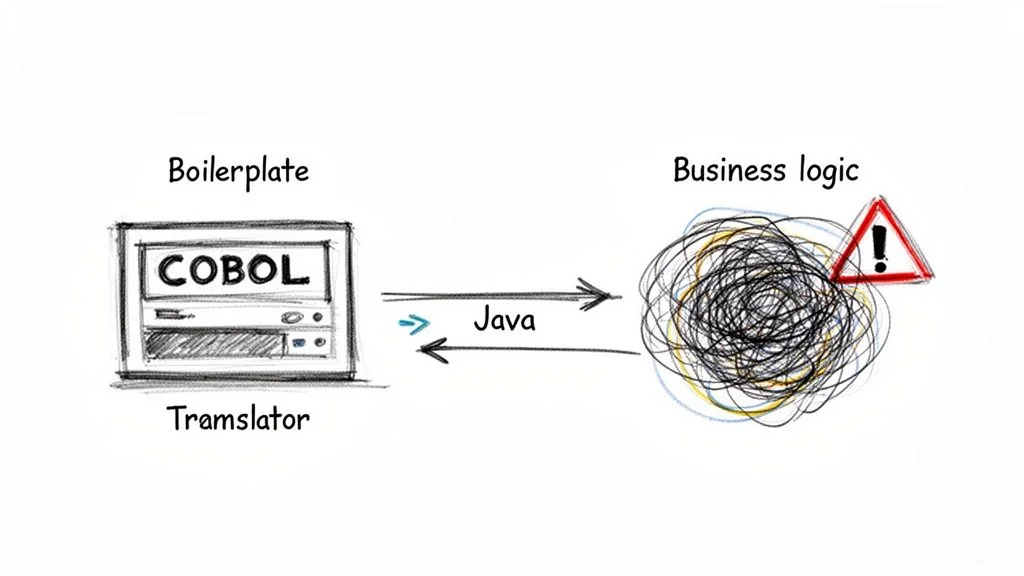
Automated code transpilation tools promise to convert COBOL to a modern language like Java or C# with the push of a button. This is a seductive but dangerous oversimplification. These tools are sophisticated parsers, not intelligent translators. They understand syntax, but have zero understanding of business intent.
Where Automation Excels
Transpilation can be a powerful accelerator for the high-volume, low-complexity portions of a codebase. It is reliable for:
- Boilerplate Logic: Converting standard COBOL verbs like
MOVE,ADD,COMPUTE, and basic control structures (IF/ELSE,PERFORM UNTIL). - Standard Data Structures: Translating simple data definitions and file I/O operations with high fidelity.
This makes transpilation a plausible first-pass strategy to reduce manual effort. Human engineers can then focus on the complex logic where business value resides. For more on optimizing team efficiency, corporate training automation offers parallel insights.
Where Automation Fails Catastrophically
The result of transpiling complex business logic is a “transpiled-mess”: syntactically correct Java or C# that is unreadable, unmaintainable, and untestable. It preserves the monolithic, procedural structure of COBOL, defeating the purpose of modernization.
You wanted agile, modular services; you got a COBOL program wearing a Java trench coat. This machine-generated code is often worse than the original COBOL because now nobody on your team understands it. Your COBOL veterans cannot read the Java, and your Java experts cannot decipher the mangled COBOL logic.
You have traded a known maintenance problem for an unknown one.
Transpilation Versus Rewrite Decision Framework
The choice to use a transpiler is a risk assessment. Use this framework to decide whether automated conversion is a smart accelerator or a path to project failure.
| Evaluation Criteria | Favorable to Transpilation | Favorable to Rewrite | Failure Risk If Ignored |
|---|---|---|---|
| Business Logic Complexity | Logic is simple, explicit, and well-documented. Minimal use of complex copybooks or REDEFINES clauses. | Logic is highly complex, poorly documented, or deeply embedded in obscure program structures. | High. Transpiling complex logic creates an unmaintainable “black box” that introduces massive business risk. |
| Architectural Goal | Goal is a like-for-like platform lift-and-shift with no immediate plans for refactoring. | Goal is to create a modern, microservices-based, cloud-native architecture. | Very High. Transpiled code retains the monolithic structure, making a transition to microservices impossible without a full rewrite anyway. |
| Testability | The original COBOL application has a comprehensive suite of automated tests that can be used to validate the transpiled output. | No automated testing exists. Validation relies on manual processes and subject matter experts. | High. Without automated validation, you cannot prove the transpiled code functions identically, leading to a flood of production defects. |
| System Criticality | The application is non-critical, or its functionality can be easily validated and has a low impact if it fails. | The application is business-critical, processing core transactions or handling sensitive financial data. | Extreme. Defects in critical systems can cause direct financial loss, regulatory penalties, and catastrophic reputational damage. |
Treat transpilation tools as a specialized instrument for converting non-critical, low-complexity code. For core business applications, a strategic, manual rewrite led by experts is the only path to a maintainable, future-proof outcome.
Strategy 4: Execute a Phased Modernization (The Strangler Fig Pattern)
A “Big Bang” migration—a single, massive cutover to a new system—is exceptionally risky. With project failure rates exceeding 70%, this approach is equivalent to swapping a car’s engine while speeding down the highway.
A phased modernization, known as the Strangler Fig pattern, is the disciplined alternative. This approach incrementally replaces pieces of the legacy monolith with new, modern services, slowly “strangling” the old system until it can be safely decommissioned. This de-risks the project, delivers value faster, and allows the team to learn and adapt.
The Mechanics of the Strangler Fig Pattern
This is a specific engineering practice, not a high-level concept. It methodically reduces dependency on the COBOL system one piece at a time.
- Identify and Carve: Select a self-contained “vertical slice” of functionality within the monolith (e.g., “customer address validation”). Prioritize based on business value and technical risk, not just ease of implementation.
- Build the Anti-Corruption Layer (ACL): This is a critical software layer that acts as a translator and gatekeeper between the new service and the old COBOL system. It ensures data integrity and prevents the new architecture from being “corrupted” by legacy data formats and logic.
- Redirect and Decommission: Once the new service and its ACL are rigorously tested, redirect live traffic from the old function to the new one. After confirming stability under real-world load, decommission that slice of the legacy codebase. Repeat the cycle.
Prioritizing Your Decomposition Strategy
A common mistake is starting with the easiest technical component, which often delivers zero business impact and kills project momentum.
Use a value vs. risk matrix. Plot each potential slice on a 2x2 grid with “Business Value” on one axis and “Technical Risk/Complexity” on the other. Your first target should always be a high-value, low-to-medium risk function. This secures an early win and proves ROI to the business.
This phased approach directly addresses the modernization pressure created by the COBOL shortage. However, technical execution is fraught with risk; data from our partners indicates that 67% of migrations fail due to technical issues like data conversion errors. To learn how to mitigate these risks, explore Modernization Intel’s insights on talent and technology shortages. A phased modernization provides a structured, risk-managed path away from legacy dependency. Our guide on legacy system modernization provides a deeper playbook for this process.
Next Steps: A Definitive COBOL Strategy Framework
This decision framework translates the four strategic options into an actionable plan. The right answer is a series of deliberate trade-offs tailored to your system, team, and risk tolerance.
The Modernization Path Decision Tree
Your first choice is between a high-risk “Big Bang” migration and a disciplined, phased approach. The decision tree below illustrates the stark contrast in risk profiles.
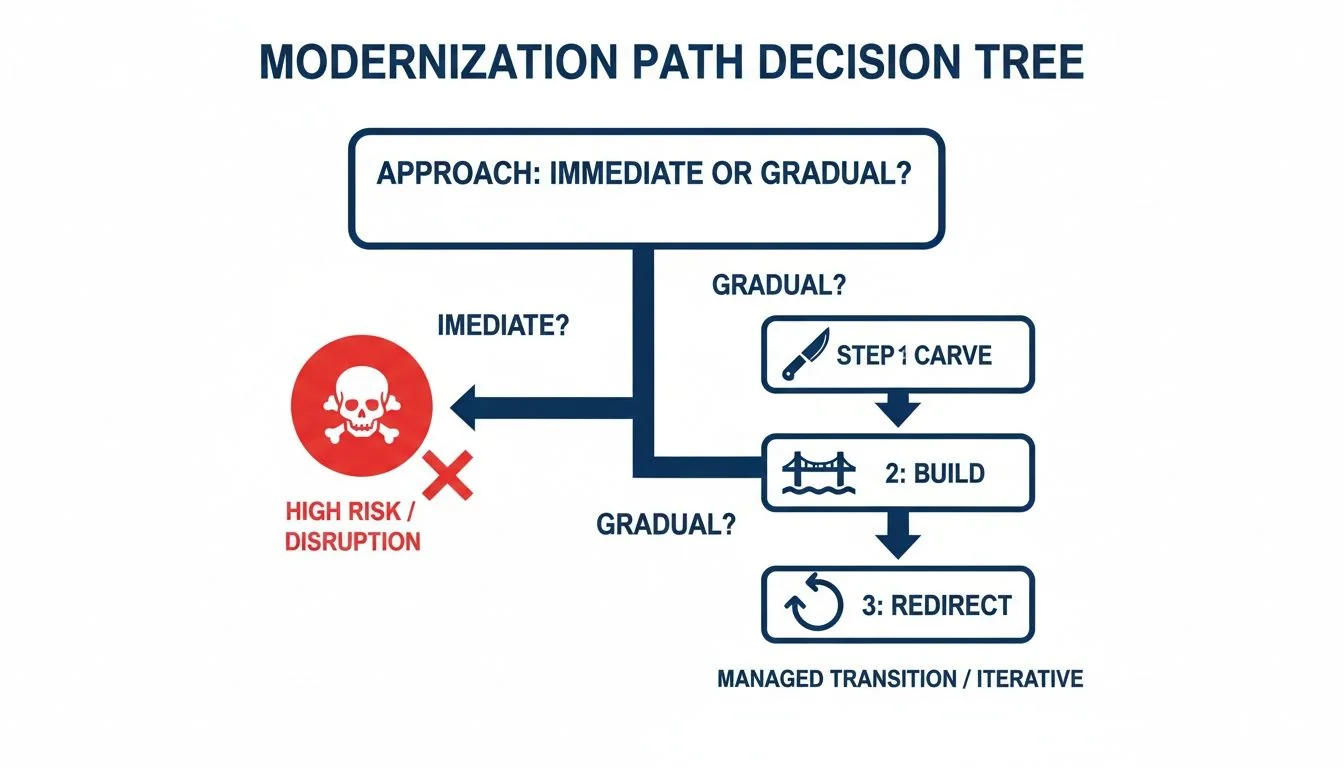
A phased journey provides multiple off-ramps and checkpoints, allowing you to manage risk proactively.
The Decision-Making Process
Use this sequence to identify your primary strategy.
-
Assess Business Criticality: Is the system a core operational backbone (e.g., payment processing) or a peripheral function?
- High Criticality: Points directly to a full modernization with a specialist partner. The operational risk of failure from talent attrition is too high.
- Low Criticality: Opens options for containment via a long-term maintenance contract, upskilling an internal team, or decommissioning.
-
Evaluate Technical Stability & Complexity: Is the codebase well-structured and documented, or a “big ball of mud”?
- Stable & Documented: Supports internal upskilling and maintenance.
- Complex & Brittle: Argues against automated transpilation and for a phased rewrite. Automated tools will fail on the complexity.
When Not to Modernize: If a COBOL system has low business value, is technically stable, has manageable maintenance costs, and has zero planned feature development, leaving it alone is a valid strategy. Modernization for its own sake is a waste of capital.
Your Prescriptive Next Steps
- Step 1: Audit Your Assets. Conduct a rigorous audit of your COBOL codebase to assess complexity and take an honest inventory of internal talent. Do not build a strategy on assumptions.
- Step 2: Select Your Primary Strategy. Use the decision framework to commit to a direction: phased modernization, building an internal CoE, or another path.
- Step 3: Vet Specialist Partners. If external help is needed, vet vendors based on proven track records with your specific migration path. Demand evidence of how they mitigate common failures like COMP-3 decimal precision loss. This diligence is your best defense against project failure.