Brownfield vs. Greenfield Modernization: A CTO's Decision Guide
Choosing between brownfield vs greenfield modernization? This guide provides a data-driven framework for CTOs to evaluate costs, risks, and strategic value.
On this page
- Overview
- The Modernization Dilemma: Brownfield Vs. Greenfield
- Understanding The Core Trade-Offs
- High-Level Comparison: Brownfield vs. Greenfield Modernization
- Analyzing The Financial Case For Brownfield Modernization
- The Timeline Advantage Is A Revenue Advantage
- The Hidden Costs: Technical Debt and Long-Term OpEx
- Quantifying The Risks In Legacy Migrations
- Evaluating The Strategic Value Of Greenfield Modernization
- Future-Proofing The Technology Stack
- The Financials of a Long-Term Bet
- Acknowledging The Inherent Risks
- Comparing Deployment Speed Versus Technical Risk
- The Brownfield Advantage: Speed to Market
- The Inherent Risk: Unforeseen Legacy Complexities
- Greenfield: Trading Time for Stability
- Risk and Reward Matrix for Modernization Approaches
- A Decision Framework For Modernization Strategy
- Triggers For A Brownfield Modernization
- Triggers For A Greenfield Modernization
- When Not To Modernize At All
- Vendor Selection And The Hybrid Modernization Approach
- Introducing A Third Option: The Hybrid Approach
- Common Questions from the Trenches
- Is a Hybrid Approach a Silver Bullet?
- How Do You Actually Budget for a Brownfield Project?
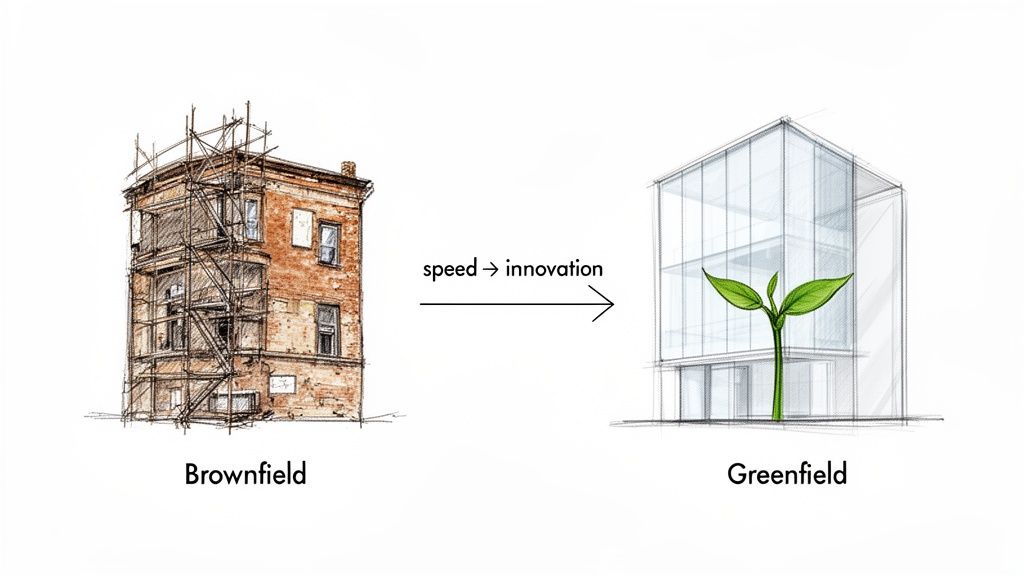
The choice between brownfield and greenfield modernization is a critical trade-off for technical leaders. A brownfield approach is a renovation—it gets you to market faster, but you inherit the problems hiding in the walls. A greenfield approach is a new build on an empty lot; you get a clean slate for innovation, but it comes with a higher price tag and a longer timeline.
The Modernization Dilemma: Brownfield Vs. Greenfield
This isn't just a technical decision; it's a strategic one with significant financial and operational weight. An incorrect decision can lead to budget overruns of 20-30% or lock you into a suboptimal architecture for the next decade. This is about balancing speed, cost, risk, and the long-term health of your technology stack.
This guide moves past simple definitions to provide a framework for making a defensible choice. We will break down the core trade-offs with cost data and failure-rate evidence to help you decide which path aligns with your strategic objectives.
Understanding The Core Trade-Offs
The fundamental difference comes down to how you handle existing systems. A brownfield project works within the constraints of what you already have, while a greenfield project starts from a blank slate.
-
Brownfield Modernization: This involves updating, refactoring, or augmenting a system that's already in place. It’s analogous to renovating a house—you keep the foundation but modernize the plumbing and electrical. It is almost always faster and requires less capital upfront.
-
Greenfield Modernization: This approach means building an entirely new system from the ground up, typically on new infrastructure. It’s the equivalent of tearing down an old building to construct a skyscraper. You get total design freedom, but it demands a much higher investment and a timeline that can stretch 18-36 months.
Brownfield retrofits can often be delivered in 6-12 months, compared to the 18-24 months typical for greenfield construction. This 50-70% timeline advantage is a primary reason organizations under market pressure choose to renovate.
To clarify, here’s a high-level look at how these two approaches stack up.
High-Level Comparison: Brownfield vs. Greenfield Modernization
This table summarizes the key differences to frame the decision.
| Decision Factor | Brownfield Modernization (Renovation) | Greenfield Modernization (New Build) |
|---|---|---|
| Initial Cost | Lower (reuses existing assets) | Higher (requires new infrastructure and build) |
| Time-to-Market | Faster (6-12 months) | Slower (18-36 months) |
| Inherent Risk | High (technical debt, integration complexity) | Lower (clean architecture, but new project risk) |
| Innovation Ceiling | Constrained by legacy architecture | Unconstrained; built for modern stacks |
| Ideal Scenario | Urgent deadlines, tight budgets, incremental wins | Long-term scalability and competitive advantage are key |
The central tension is clear: brownfield buys speed at the cost of being constrained by the past, while greenfield offers freedom at the cost of time and money.
Analyzing The Financial Case For Brownfield Modernization
The primary driver for a brownfield modernization strategy is usually financial. When justifying a budget, the conversation focuses on capital expenditure (CapEx) and speed. A brownfield approach works with existing assets—servers, databases, network configurations—which means a lower upfront investment.
This is not a minor budget adjustment. Analysis from Blue Cape Economic Advisors shows that brownfield approaches can reduce initial project costs by 30-40% compared to starting from scratch. By reusing existing assets, total startup expenses can be cut by 20-40%. That's a figure that gets a CFO's attention and frees up capital for other initiatives.
The Timeline Advantage Is A Revenue Advantage
Beyond direct CapEx savings, the faster timeline provides a competitive edge. Greenfield projects can extend into 12-24 month initiatives. Most brownfield modernizations can be live in 6-12 months. That speed is a strategic asset.
In industries like fintech or e-commerce, being first to market with a new feature or complying with a new regulation can be critical. A six-month head start can be the difference between leading a market segment and playing catch-up for years.
The core financial argument for brownfield is its ability to deliver tangible business value faster. You get a quicker return on investment and can react to market shifts with more agility than a team engaged in a multi-year rewrite.
The Hidden Costs: Technical Debt and Long-Term OpEx
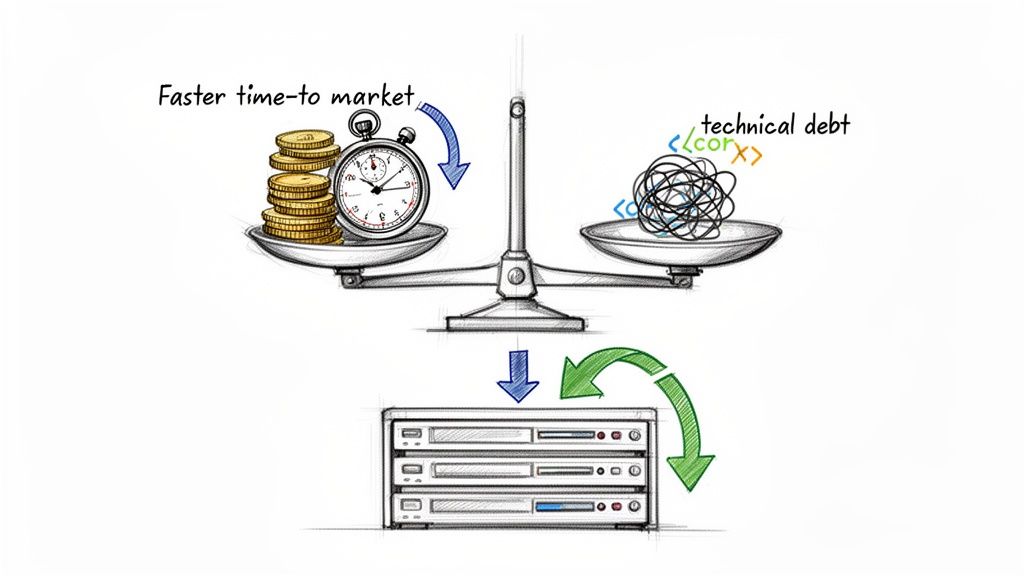
A purely optimistic financial model can be misleading. The single biggest risk in a brownfield project is inheriting technical debt. This is the cost of past shortcuts, and it can become a significant burden. When making the financial case, managing existing technical debt is a critical success factor, not just a line item.
Inherited complexity can bloat your long-term operational expenditure (OpEx). The same Blue Cape report warns that legacy systems can inflate maintenance costs by up to 25% if not addressed directly. Those initial CapEx savings can be eroded by years of inflated maintenance budgets, difficult-to-fix bugs, and the high cost of retaining developers with knowledge of the old codebase. For a deeper look at this trade-off, see our guide on refactoring vs. rewriting code.
Quantifying The Risks In Legacy Migrations
The financial risks become sharper with specific legacy technologies. Software Modernization Intelligence’s data, from over 200+ partners, shows that brownfield COBOL migrations average between $1.50 and $4.00 per line of code (LOC). The failure rate is the more concerning metric.
According to our research, 67% of COBOL migrations encounter major roadblocks or fail completely due to technical issues buried in the old code.
Common failure points include:
- Decimal Precision Mismatches: COBOL's
COMP-3data type uses fixed-point arithmetic, which is ideal for financial calculations and avoids rounding errors. Modern languages like Java use floating-point primitives by default, which can introduce small precision errors that become significant in financial contexts. UsingBigDecimalis a common but not always straightforward solution. - Undocumented Business Logic: Decades of quick fixes mean critical business rules are often embedded directly in the code. Extracting them without breaking functionality can be a complex and high-risk task.
- Integration Complexity: Connecting a new component to an old monolith often creates a brittle, slow integration layer. This can negate the performance benefits expected from the new code.
These risks underscore a key truth: while a brownfield strategy may look appealing on the initial P&L, its success depends on mitigating the long-term cost of inherited technical debt. Without expertise in navigating these legacy-specific traps, upfront savings can become a long-term liability.
Evaluating The Strategic Value Of Greenfield Modernization
While a brownfield approach is a tactical move to minimize current capital spend, greenfield modernization is a strategic, long-term bet on the business's future. This is about positioning the company to compete effectively for the next decade.
The value proposition is to build it right, once, without the constraints of the past. You are no longer shackled by architectural decisions made ten or twenty years ago. Instead of patching a legacy monolith, you have the freedom to design a system from a clean slate using modern, cloud-native principles.
Future-Proofing The Technology Stack
A greenfield build is an opportunity to adopt an architecture that is inherently more scalable, resilient, and cheaper to operate over the long term. This is about choosing the right architecture for where your business is going, not where it's been.
Key architectural advantages include:
- Microservices Architecture: You can break down a complex monolith into smaller, independently deployable services. This allows teams to develop, test, and release features faster without the risk of a single bug bringing down the entire system.
- Containerization with Kubernetes: Building on a platform like Kubernetes from day one provides scalability and portability that is difficult to retrofit. You can automatically scale services based on demand, ensuring you only pay for the resources you use.
- Serverless Computing: For event-driven workloads, a greenfield approach allows you to build with serverless functions from the start. This can reduce infrastructure management overhead and operational costs for suitable use cases.
The strategic freedom of greenfield is its main draw. You aren't forced into suboptimal design choices to accommodate fragile legacy code. Every component can be selected to create the most efficient and scalable system possible.
The Financials of a Long-Term Bet
The upfront cost of a greenfield project is significant, but focusing solely on initial expenses can be short-sighted. The initial investment often pays dividends over a five-year horizon.
Greenfield modernization often requires a 40-60% higher upfront investment, which can unlock superior scalability and a lower Total Cost of Ownership (TCO). While project timelines can stretch to 18-36 months, the payoff can be a TCO reduction of up to 80% over five years.
Software Modernization Intelligence tracks show greenfield cloud migrations costing 50% more initially but yielding 45% quicker adoption of new capabilities like AI/ML. Further analysis reveals that greenfield projects in major markets achieve a 25% higher ROI by the third year. This premium is the price of future-proofing—a strategy that powers 40% of high-growth tech firms' modernization paths. You can read more about the research behind these greenfield and brownfield facility decisions to better understand the findings.
Acknowledging The Inherent Risks
A greenfield strategy is not without significant risk. The same freedom that enables innovation can also lead to failure if not managed with discipline. Without the guardrails of an existing system, projects are susceptible to scope creep. What starts as a targeted rebuild can balloon into an unmanageable, multi-year initiative that never delivers.
The extended timelines also introduce market risk. The business needs that justified the project may change by the time it's ready to launch two years later. A competitor might have already shipped a similar product, eliminating your first-mover advantage.
This is why effective project governance and a focus on the minimum viable product (MVP) are non-negotiable survival mechanisms.
Choosing a greenfield approach is a declaration that your existing system is a liability. It is a conscious decision to absorb a significant upfront cost and a longer timeline in exchange for a modern, scalable, and competitive technology foundation.
Comparing Deployment Speed Versus Technical Risk
The central conflict in the brownfield vs. greenfield debate is immediate deployment velocity versus long-term technical risk. Engineering leaders must weigh the need to get a product to market against the risks of inherited complexity. A short-term win can become a long-term liability.
A brownfield strategy is about acceleration. By building on an existing foundation, teams can bypass long architectural planning and infrastructure procurement cycles. This provides a faster path to delivering business value.
But that speed comes at a price. Every brownfield project involves unknowns. The "contaminants" are logical—buried within brittle legacy code and undocumented data schemas.
The Brownfield Advantage: Speed to Market
When market pressure is high, deployment speed is often the deciding factor. Brownfield modernization typically reaches go-live in 6-12 months. Greenfield projects often take 12-36 months. That 50-70% timeline advantage allows for a more agile response to market shifts or regulatory demands.
In sectors like manufacturing, for example, IT upgrades must support immediate production goals. A reported 70% of projects in this space chose a brownfield approach for its speed. By using existing infrastructure, they reduce CapEx and see a quicker return.
The Inherent Risk: Unforeseen Legacy Complexities
The single biggest risk in a brownfield project is discovering a "structural flaw" mid-project. These technical issues, which don't appear on architectural diagrams, can derail timelines and increase budgets by 20-30%.
Software Modernization Intelligence's failure analysis attributes the 67% brownfield failure rate to these kinds of surprises:
- Brittle Integrations: Connecting a new microservice to a legacy system can reveal a web of undocumented dependencies. A seemingly simple API call can turn into a high-risk, multi-week integration effort.
- Data Migration Failures: Moving data from an old database often uncovers inconsistent data entry, hidden business logic in stored procedures, and incompatible data types that halt progress.
- Performance Bottlenecks: A new, efficient component can overwhelm older parts of the system, creating new bottlenecks that are difficult to diagnose and expensive to fix.
Brownfield modernization is a calculated risk. The strategy accepts the possibility of encountering unknown technical debt in exchange for a compressed delivery schedule. The success of this approach depends on the quality of the initial discovery phase and the team's expertise in legacy systems.
Greenfield: Trading Time for Stability
A greenfield approach is the opposite trade-off. It accepts a longer timeline in exchange for reduced long-term technical risk. By starting from scratch, architects can design a system using modern patterns without making compromises for legacy quirks. This lowers the odds of catastrophic surprises.
Here, the risk shifts from technical to procedural. Longer projects are prone to scope creep, shifting business requirements, and budget fatigue. While the final product may be technically superior, a greenfield project that takes three years to deliver a solution the business needed in one is effectively a failure.
For either path, effective software project risk management is non-negotiable. If neither extreme feels right, a middle-ground approach may be worth exploring. For more, see our guide on incremental legacy modernization.
Risk and Reward Matrix for Modernization Approaches
To make a defensible decision, you need a side-by-side comparison of the numbers. This matrix breaks down the core trade-offs between the two strategies.
| Metric | Brownfield Approach | Greenfield Approach |
|---|---|---|
| Typical Timeline | 6-12 months | 12-36 months |
| Typical Cost | Lower initial CapEx (uses existing infra) | Higher initial CapEx (new infra/tooling) |
| Risk of Budget Overrun | High (20-30% common) due to unknowns | Medium (scope creep is the main driver) |
| Technical Debt | Inherits existing debt by default | Starts with zero technical debt |
| Team Skill Requirement | Specialized: Legacy system experts required | Modern: Standard cloud-native skills |
| Business Disruption | Lower, often done incrementally | Higher, requires a "big bang" cutover |
| Failure Rate (MI Data) | 67% (due to unforeseen complexity) | 41% (due to changing business goals) |
This data highlights the fundamental choice: brownfield prioritizes speed and accepts a high risk of technical complications, while greenfield prioritizes stability and accepts the business risks of a long timeline. Your decision must be based on which category of risk your organization is better equipped to handle.
A Decision Framework For Modernization Strategy
A defensible framework is needed to make a real-world decision. The choice between a brownfield and greenfield path hinges on specific business and technical triggers. It requires an honest assessment of your company's constraints, risk tolerance, and strategic goals.
This is not about finding the "best" approach in a vacuum, but picking the right tool for the job. A rushed greenfield project can be financially disastrous, just as a poorly planned brownfield renovation can saddle you with technical debt for years.
This decision tree maps the path toward immediate value and incremental gains (brownfield) against the path toward long-term quality and innovation (greenfield).
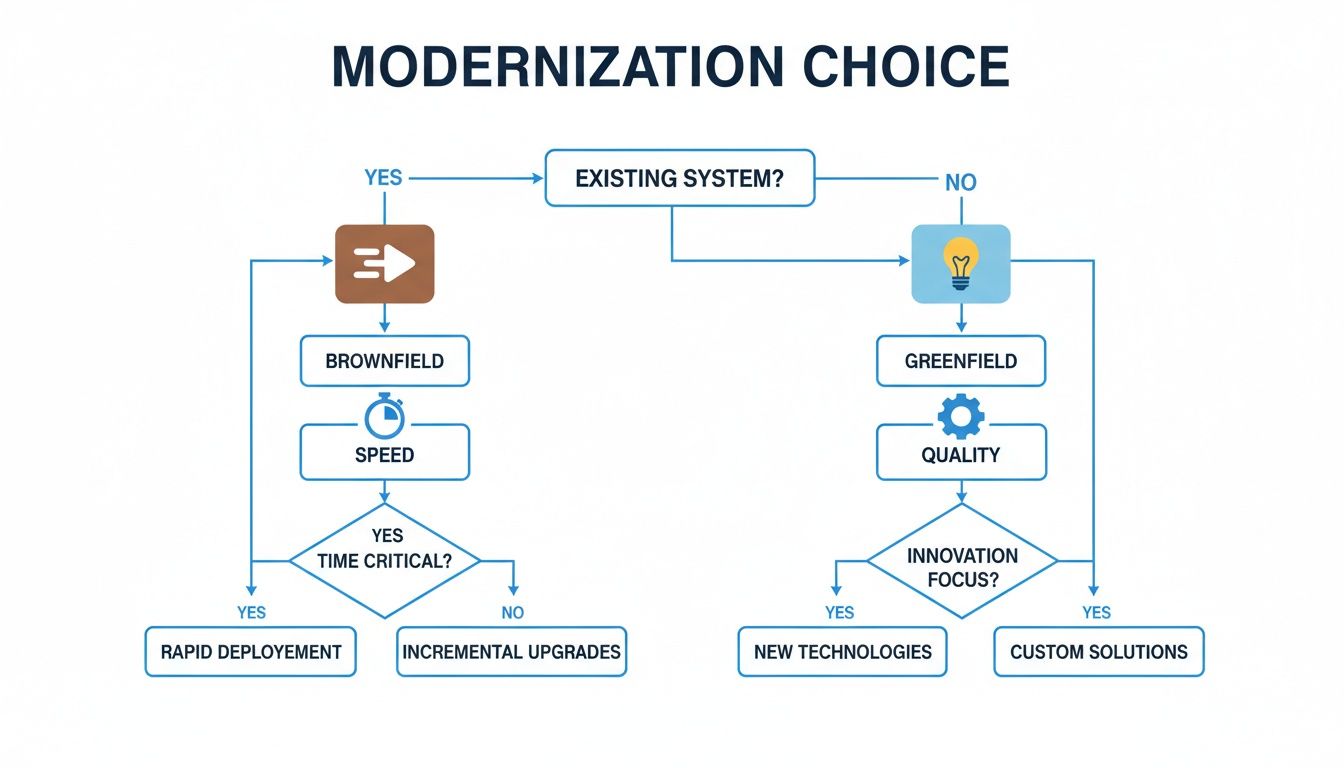
The flowchart clarifies the decision: brownfield is the choice when speed and budget are the primary constraints. Greenfield is necessary when a fundamental architectural shift is required for future growth.
Triggers For A Brownfield Modernization
A brownfield strategy is the pragmatic default when speed and capital efficiency are paramount. It is a tactical decision to deliver value quickly by working within the existing system. You should lean toward brownfield when you see these signals:
- Urgent Deadlines and Market Pressure: If you must respond to a competitive threat or a new regulation in the next 6-12 months, a greenfield build is not viable.
- Constrained Budgets: When capital is tight, reusing existing infrastructure is a necessity. A brownfield project avoids the large upfront costs of new hardware, licensing, and environment setup.
- Well-Understood Business Logic: If the system's core business rules are stable, well-documented, and unlikely to change, renovating it is a low-risk move.
- Incremental Improvement Is Sufficient: The goal is a targeted upgrade, not a total business transformation—replacing one component, adding a feature, or tuning a workflow.
A brownfield approach prioritizes delivering tangible value this fiscal year over achieving architectural purity in three years.
Triggers For A Greenfield Modernization
Choosing a greenfield path is a strategic declaration that the existing system is a liability holding the business back. It's an investment in long-term health over short-term fixes. A full rebuild is justified by these triggers:
- The Legacy System Is A Major Business Constraint: Your current technology is preventing you from entering new markets, launching new products, or scaling to meet demand. The cost of inaction has become greater than the cost of a rebuild.
- A Fundamental Business Model Shift: The company is pivoting, for example, from B2B to D2C or from products to subscriptions. The old architecture was not designed for this new reality.
- Radically Different Target Architecture: The strategic mandate is to move from a monolith to a cloud-native, microservices-based architecture. Retrofitting a monolith is often more complex and costly than starting clean.
- Long-Term Scalability Is The Primary Driver: The business forecasts exponential growth. The current system will not handle that load. Only a modern, scalable architecture can support the company's future.
When Not To Modernize At All
Sometimes, the best move is to do nothing. Modernization for its own sake can burn capital for no measurable ROI. Maintaining the status quo is the most financially responsible decision in a few scenarios.
If the legacy system is stable, meets current business needs, and has a low and predictable maintenance cost, leave it alone. Similarly, if the system is slated for decommissioning in the next 18-24 months, sinking capital into it is wasteful.
The key is to make a conscious, data-driven decision to maintain, not to defer the choice out of indecision.
Vendor Selection And The Hybrid Modernization Approach
The choice between brownfield and greenfield dictates the type of implementation partner you need. The partner required to modernize a legacy COBOL system is different from one needed to build a new cloud-native application. The implementation partner is often a critical factor in project success or failure.
For brownfield projects, you need specialists with deep expertise in specific legacy technologies and their failure points. A firm specializing in mainframe integration or RPG to Java migrations brings a skill set that a generalist cloud consultancy lacks.
Greenfield projects demand a different type of partner. Fluency in modern, cloud-native stacks is essential. You need a team with proven experience in microservices, Kubernetes, and serverless architectures. Their job is to design for future scale, not to untangle the past.
Introducing A Third Option: The Hybrid Approach
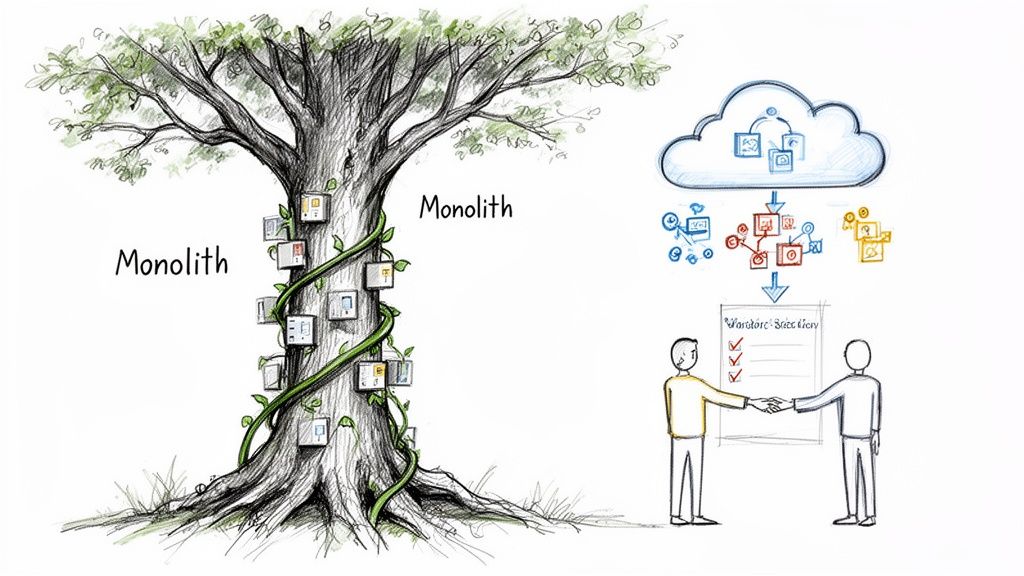
The binary choice between brownfield and greenfield can be too rigid. A more pragmatic middle ground is a hybrid strategy that blends both. The most proven model for this is the Strangler Fig pattern.
This pattern avoids the risk of a "big bang" cutover by incrementally replacing small pieces of a legacy system. You build new features as independent microservices (greenfield) and slowly route traffic to them, effectively "strangling" the old monolith until it can be safely decommissioned.
This method offers several advantages:
- Reduced Risk: Instead of one high-stakes release, you deploy small, independent services. Failure of a new component doesn't bring down the entire application.
- Phased Investment: Capital is spread out over time. You can fund the development of new services as you go, proving value at each step.
- Immediate Value: Users get new features faster than waiting for a complete greenfield rebuild, while the core system remains operational.
The Strangler Fig pattern is a risk mitigation strategy disguised as an architectural one. It allows an organization to modernize at a controlled pace, delivering value incrementally without betting the business on a single, massive project.
This approach requires a vendor with a dual skill set: the ability to safely interface with the legacy monolith while building modern, decoupled services. It is a sophisticated strategy that requires meticulous planning and an experienced partner. You can learn more in our guide to hybrid application development.
Common Questions from the Trenches
Even with a framework, CTOs have pointed questions when the brownfield vs. greenfield debate becomes real. The answer depends on your company's risk tolerance, the state of your technical debt, and your business objectives. Here are direct answers to common questions.
Is a Hybrid Approach a Silver Bullet?
A hybrid strategy like the Strangler Fig pattern is often the most pragmatic path, but it is not a silver bullet. It is effective for avoiding a "big bang" failure and allows for a phased investment.
However, it introduces its own complexity. The integration layer between the old monolith and new microservices can become an engineering challenge. If the core data model of the legacy system is fundamentally flawed, a hybrid approach is like putting new siding on a house with a cracked foundation. It only delays an inevitable, expensive rebuild.
Think of a hybrid approach as a risk-management tool. It’s the right call when your top priority is avoiding operational disruption and massive upfront spending. It's the wrong call when the legacy system's core is so problematic that incremental changes yield diminishing returns.
How Do You Actually Budget for a Brownfield Project?
Accurately forecasting the cost of a brownfield project is difficult. Projects often exceed their budget by 20-30% due to a rushed or superficial discovery phase. A reliable estimate requires more than static code analysis.
To get a trustworthy number, your discovery must be forensic:
- System Archeology: Interview the engineers who built or maintained the old system, even if they've left the company. Uncover the undocumented business rules and hidden dependencies that are not in the code.
- Data Schema Analysis: Conduct a deep dive into the database. Look for inconsistencies, business logic in stored procedures, and data migration traps.
- Integration Point Mapping: Identify every system that interacts with your legacy application, both upstream and downstream. A seemingly simple API change can cause a cascade of failures.
Without this level of detail, any cost estimate is a guess. Your final number must include a contingency buffer of at least 25%.
Making the right call on modernization demands unbiased, data-driven intel on what vendors can deliver. Software Modernization Intelligence provides the vendor intelligence and real-world cost data you need to build a defensible business case and find the right partner for your tech stack. Get Your Vendor Shortlist.
Chief Analyst, Software Modernization Intelligence · 10+ years B2B market research
Published: ·Updated: