
Technical Due Diligence Checklist: 8 Steps To Prevent Modernization Failures
A standard technical due diligence checklist frequently devolves into a box-ticking exercise that fails to uncover the nuanced risks that sink software projects. It generates reports that feel thorough but are useless for decision-making. The goal is not just to find flaws; it’s to quantify risk, forecast hidden costs, and make a defensible vendor selection based on evidence, not sales pitches.
A 2022 Gartner report found that nearly 50% of M&A deals fail to meet their technology synergy targets, a failure rooted in overlooked technical debt discovered too late. The same principle applies when selecting a modernization partner. A vendor’s polished presentation rarely matches the reality of their engineering discipline. Your job is to penetrate that surface.
This is not another generic list of questions. Instead, this technical due diligence checklist provides a prioritized, evidence-based framework for vendor evaluation. We will move beyond Q&A and focus on the specific artifacts to demand, the metrics to analyze, and the red flags that signal future overruns. This process forces clarity from potential partners, shifting the conversation from subjective claims to objective proof.
1. Architecture & System Design Review: Is It Resilient or Brittle?
The first stop on any technical due diligence checklist is the architecture. A vendor’s proposed system design is the foundation for everything that follows; a brittle foundation guarantees future costs and operational pain. The Software Engineering Institute at Carnegie Mellon found that architectural decisions are responsible for over 50% of a system’s total lifetime cost. Getting this wrong upfront is an expensive mistake.
This review goes beyond surface-level diagrams. The objective is to interrogate the architecture’s resilience, scalability, and maintainability. You are assessing its ability to support business growth, not just its capacity to function on day one. A vendor who presents a trendy microservices architecture without clear justification or an understanding of the associated operational complexity is a significant red flag.
What to Request and Analyze
- Architecture Diagrams: Request current diagrams, preferably using the C4 model (Context, Containers, Components, Code) for clarity at different zoom levels. These diagrams should clearly delineate service boundaries, data flows, and dependencies.
- Architecture Decision Records (ADRs): This is non-negotiable. ADRs reveal the why behind technology choices (e.g., “Why did you choose Kafka over RabbitMQ for this use case?”). The absence of ADRs often signals a lack of disciplined engineering.
- Technology Stack & Rationale: Get a complete list of technologies (languages, frameworks, databases, cloud services). Scrutinize choices for long-term viability, community support, and the availability of talent. A niche database may look impressive but can become a support liability.
- Disaster Recovery (DR) Plan: Ask for the formal DR plan and, more importantly, evidence of the last DR test, including the outcome and any lessons learned.
Key Questions to Ask
- “Walk me through the ADR for your primary data store selection. What alternatives were considered and why was this one chosen?”
- “What are the top three potential single points of failure in this architecture, and what are the specific mitigation strategies for each?”
- “How does the architecture support horizontal scaling? Can you show me the mechanism for adding new instances to handle increased load?”
- “What is the total cost of ownership implication of this stack, including licensing, cloud consumption, and specialized talent?”
Critically evaluating the architecture can identify hidden costs and future bottlenecks before they are embedded in a signed contract. For a deeper dive into designing robust systems, you can learn more about modern cloud architecture strategies.
2. Code Quality & Standards Compliance: Is the Codebase an Asset or a Liability?
After scrutinizing the architecture, the next layer is the source code itself. High-quality code is a direct indicator of disciplined engineering and lowers the total cost of ownership. A poorly managed codebase, riddled with technical debt, is a source of bugs, security vulnerabilities, and developer friction. Research from the Consortium for IT Software Quality (CISQ) has estimated the cost of poor software quality in the US alone to be $2.08 trillion.
This part of the technical due diligence checklist moves beyond theory and into the tangible reality of the vendor’s day-to-day engineering practices. You are evaluating whether their development process creates a maintainable asset or a convoluted liability that will require a costly rewrite. A vendor who dismisses formal code reviews or lacks automated quality gates is signaling that their long-term maintenance costs will likely be high.
What to Request and Analyze
- Static Analysis Reports: Request recent reports from tools like SonarQube, Veracode, or Checkmarx. Focus on critical issues, cyclomatic complexity, and code coverage metrics. A code coverage figure below 70% warrants a deep investigation.
- Code Review Process Documentation: Ask for their documented code review guidelines, often found in a
CONTRIBUTING.mdor internal wiki. Look for standards on review size, turnaround time, and what reviewers are expected to check. - Definition of “Done”: How does the team define a story or feature as complete? This definition should explicitly include passing all quality gates, code reviews, and having sufficient test coverage.
- Technical Debt Register: Mature teams actively track technical debt. Ask to see how they log, prioritize, and plan to address identified issues. Its absence is a red flag indicating a reactive, not proactive, approach to quality.
Key Questions to Ask
- “Can you show me the code review history for a recent, non-trivial feature? What was the most significant feedback given and how was it addressed?”
- “What are your current code coverage percentages for unit, integration, and end-to-end tests? How do you handle pull requests that decrease coverage?”
- “Walk me through your CI/CD pipeline’s quality gates. What specific checks must pass for code to be deployed to production?”
- “How do you measure and manage technical debt? Can you provide an example of a technical debt item that was prioritized and resolved in the last quarter?”
Assessing code quality directly impacts future maintenance budgets and development velocity. For more on building a culture of quality, it’s worth reviewing how organizations like the Apache Software Foundation manage contributions to ensure long-term project health.
3. Security & Vulnerability Assessment: Is It Secure or a Liability?
A vendor’s security posture is a foundational prerequisite for partnership. A security breach originating from a third-party vendor can lead to reputational damage, regulatory fines, and loss of customer trust. According to the Ponemon Institute’s “Cost of a Data Breach Report,” the average cost of a data breach in 2023 reached $4.45 million, with third-party involvement increasing that cost by an average of $340,000. Ignoring this aspect of a technical due diligence checklist is a high-stakes decision.
This evaluation goes beyond a simple checkbox for SSL/TLS. It’s an in-depth assessment of their entire security development lifecycle (SDL), from how they train developers on secure coding to how they respond to a zero-day vulnerability. A vendor who can’t produce a recent penetration test report or articulate their incident response plan signals that security is an afterthought, not an integrated practice.
What to Request and Analyze
- Penetration Test & Vulnerability Scan Reports: Request the full reports from their most recent third-party penetration test (pen test) and regular vulnerability scans. Look for the scope, the severity of findings (using a framework like CVSS), and evidence of remediation.
- Security Certifications & Attestations: Ask for copies of relevant compliance reports like SOC 2 Type II, ISO 27001, or HIPAA attestations. While not a guarantee of security, their absence for a vendor handling sensitive data is a major red flag.
- Secure Software Development Lifecycle (SSDLC) Policy: This document outlines their process for building security into the product. It should cover secure coding standards (like OWASP Top 10), static/dynamic analysis tools, and mandatory developer training.
- Incident Response Plan (IRP): The IRP details their step-by-step process for handling a security breach. Crucially, ask for evidence of the last tabletop exercise or a real-world incident post-mortem to verify it’s a living document, not shelfware.
Key Questions to Ask
- “Walk me through your process for triaging and remediating a critical vulnerability discovered in a third-party library. What are your SLAs?”
- “Can you provide the executive summary and attestation letter from your last external penetration test? What was the most critical finding and how was it remediated?”
- “How do you enforce the principle of least privilege for both internal administrators and customer access to the platform?”
- “Describe your data encryption strategy, covering data in transit and data at rest. What specific algorithms and key management practices are used?”
Rigorously inspecting a vendor’s security practices moves you from assuming trust to verifying it. For further reading on industry standards, the OWASP Application Security Verification Standard (ASVS) provides a useful framework.
4. Performance & Scalability Testing: Can It Handle Success?
A system that functions perfectly with 10 users is irrelevant if it collapses under the load of 10,000. This part of the technical due diligence checklist moves from theoretical design to empirical proof, evaluating if the system can handle projected business growth without degrading user experience. Performance isn’t a feature; it’s a fundamental requirement that impacts revenue. A slow system is a broken system.
The goal here is to validate the vendor’s performance claims against realistic conditions. You’re looking for evidence of deliberate capacity planning and testing, not just assumptions about cloud elasticity. Cloud providers are incentivized to have you over-commit on reserved resources; proper testing prevents this. A vendor who cannot provide concrete performance test results is essentially asking you to fund their R&D in your production environment.
What to Request and Analyze
- Load Test Strategy & Results: Ask for their comprehensive load testing plan, including user scenarios, data volumes, and environment configurations. The results should detail key metrics like response times (average, 95th percentile), error rates, and CPU/memory utilization under specific concurrent user loads.
- Scalability Test Reports: Request reports from tests that specifically demonstrate the system’s ability to scale. This includes evidence of how long it takes for new instances to provision and start serving traffic (auto-scaling) and how the system performs as resources are added.
- Baseline Performance Metrics: The vendor must provide documented baseline performance metrics for critical user journeys and API endpoints. The absence of baselines means they have no objective way to measure performance degradation.
- Monitoring & Alerting Configuration: Review their monitoring setup (e.g., dashboards in Datadog, New Relic) and alerting rules. This reveals their operational maturity and proactive approach to identifying performance bottlenecks before they become outages.
Key Questions to Ask
- “Walk me through your most recent spike test. What was the load profile, what broke first, and what was the resolution?”
- “At what percentage of resource utilization (e.g., 70% CPU) do your auto-scaling policies trigger, and how have you tested this mechanism?”
- “Can you provide the performance benchmarks for your write-heavy APIs versus your read-heavy APIs? How do you test for database connection pool exhaustion?”
- “What are the established Service Level Objectives (SLOs) for P95 latency on your top three most critical API endpoints, and can you show me the data that proves you are meeting them?“
5. Infrastructure & DevOps Evaluation: Is the Foundation Automated and Scalable?
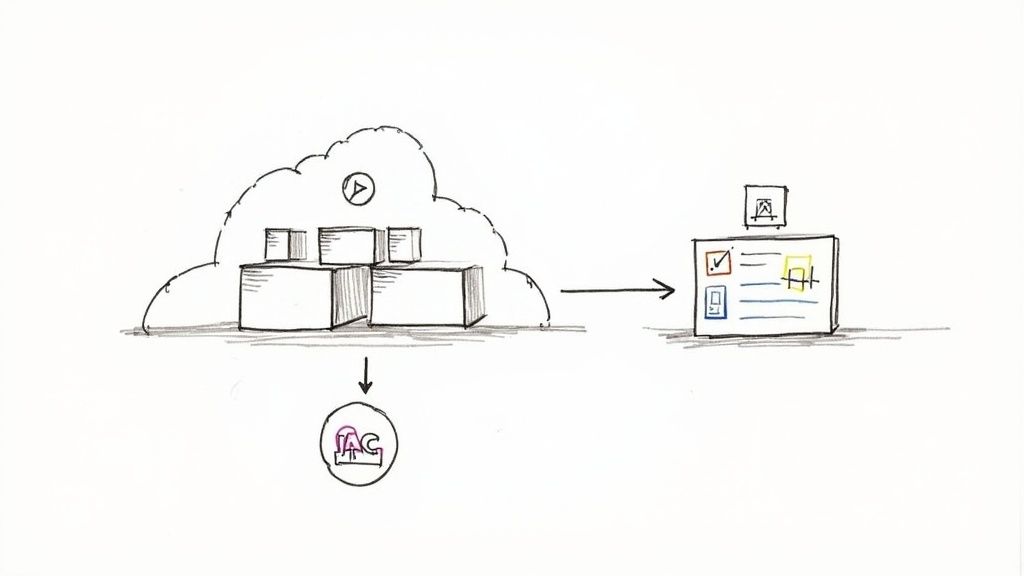
A sophisticated application architecture is worthless if it’s deployed on a shaky, manually configured foundation. The infrastructure and DevOps practices reveal a vendor’s operational maturity and their ability to deliver software reliably. Mature DevOps isn’t about using specific tools; it’s about a culture of automation, measurement, and continuous improvement. Neglecting this part of a technical due diligence checklist leads to unpredictable deployments and extended downtimes.
This evaluation inspects the entire software delivery lifecycle, from code commit to production monitoring. You are looking for evidence of reproducible environments and automated, auditable deployment processes. A vendor who relies on manual server configuration or “SSH-and-deploy” scripts introduces significant operational risk and key-person dependencies that can impact your ability to scale or recover from incidents. The goal is to ensure the system is manageable.
What to Request and Analyze
- Infrastructure as Code (IaC) Repository: Request access to their Terraform, CloudFormation, or Ansible repositories. The commit history, code structure, and use of modules are strong indicators of infrastructure management discipline.
- CI/CD Pipeline Configuration: Ask to see the actual pipeline definitions (e.g.,
Jenkinsfile,gitlab-ci.yml). Analyze the stages: are there automated tests, security scans (SAST/DAST), and controlled promotion between environments? - Monitoring & Alerting Dashboards: Review their primary monitoring dashboards (e.g., in Datadog, Grafana, or New Relic). Check for key performance indicators (KPIs) like latency, error rates, and resource saturation. Look at the alert configurations to understand what they consider an emergency.
- Runbooks and Incident Post-mortems: Request their operational runbooks for common failure scenarios and the last three incident post-mortem reports. This reveals their process for learning from failures and preventing recurrence.
Key Questions to Ask
- “How do you provision a completely new, production-like environment from scratch? What is the estimated time, and what percentage of the process is fully automated?”
- “Walk me through your CI/CD pipeline for a critical service. Where are the manual gates, and who has the authority to approve a production deployment?”
- “What are the top three business-critical alerts, and what is the documented procedure (runbook) when one of them fires at 3 AM?”
- “Can you show me the code change that fixed the root cause identified in your last major incident post-mortem?”
A thorough DevOps assessment separates vendors who can operate a system at scale from those who will struggle with every release. Building a robust internal capability requires significant investment; you can learn more about structuring these teams by reviewing a modern platform engineering setup.
6. Dependencies & Third-Party Libraries Assessment: What Lurks in the Supply Chain?
A modern application is an assembly of first-party code and an array of open-source libraries. This software supply chain introduces significant risk. A single vulnerable dependency, like Log4j (CVE-2021-44228), can create a critical security hole across the entire system. Ignoring dependencies is like building a fortress but leaving the supply gate unguarded.
This part of a technical due diligence checklist examines the vendor’s discipline in managing their software supply chain. The goal is to uncover hidden security, legal, and operational risks embedded within their dependencies. A vendor who lacks a clear process for vetting, updating, and monitoring libraries is introducing unpredictable vulnerabilities into your environment. The SolarWinds attack demonstrated that the supply chain is a primary target for sophisticated threats.
What to Request and Analyze
- Software Bill of Materials (SBOM): This is the foundational document. Request a complete, machine-readable SBOM, preferably in a standard format like CycloneDX or SPDX. It should list every library, its version, and its license.
- Dependency Vulnerability Scan Reports: Ask for the latest reports from their security scanning tools (e.g., Snyk, Dependabot, Veracode). These reports should show identified vulnerabilities, their severity (CVSS score), and the status of remediation.
- License Compliance Policy: How does the vendor manage open-source licenses? They must have a documented policy to avoid legal issues with restrictive licenses like the GPL, which could have implications for your own intellectual property.
- Dependency Update Process: Request documentation on how they handle dependency updates, especially for security patches. Is it automated? What is their defined SLA for patching critical vulnerabilities?
Key Questions to Ask
- “Can you provide the SBOM and the latest vulnerability scan report for the core application? Let’s review the high and critical findings together.”
- “Walk me through your process when a critical vulnerability like Log4j is announced. How quickly can you identify all affected components and deploy a patch?”
- “What is your policy regarding the use of libraries with restrictive or copyleft licenses (e.g., GPL, AGPL)? How do you enforce this?”
- “How do you manage and monitor transitive dependencies-the dependencies of your dependencies-for security and licensing risks?“
7. Data Management & Database Evaluation
A system’s architecture may be the skeleton, but its data is the lifeblood. Poor data management practices introduce risks, from data loss to regulatory fines and performance degradation. An evaluation of a vendor’s data strategy is a critical component of any technical due diligence checklist, as it directly impacts integrity, availability, and compliance.
This assessment probes beyond the choice of database technology. The goal is to understand how data is modeled, stored, secured, backed up, and governed throughout its lifecycle. A vendor that cannot produce a clear data retention policy or evidence of a successful backup restoration test presents a significant operational risk. The approach to data management reveals much about an engineering team’s discipline.
What to Request and Analyze
- Data Models & Schemas: Request detailed logical and physical data models. These documents should clearly define entities, relationships, data types, and constraints. An overly complex or poorly normalized schema is an indicator of future performance problems.
- Database Technology Rationale: Ask for documentation justifying the choice of each primary data store (e.g., PostgreSQL for transactional, Elasticsearch for search). A polyglot persistence approach can be powerful but requires a strong justification for the added complexity.
- Backup and Recovery Procedures: Demand the formal backup policy, including retention periods and storage locations. Crucially, ask for the report from the most recent backup restoration test, detailing the time to recovery and any issues encountered.
- Data Governance & Compliance Documents: Request policies related to data classification, access control, and compliance with regulations like GDPR or CCPA. The absence of these documents is a major red flag for any system handling sensitive information.
Key Questions to Ask
- “Walk me through your backup restoration drill. What was the recovery time objective (RTO) and recovery point objective (RPO), and were they met?”
- “What is your strategy for handling slow database queries? Can you show me how you monitor for them and an example of a query you recently optimized?”
- “How is sensitive data (e.g., PII) encrypted at rest and in transit? Who holds and manages the encryption keys?”
- “Explain the indexing strategy for your main transactional tables. How do you prevent table scans on high-traffic queries?”
Thoroughly vetting the data layer ensures the system’s core asset is protected, performant, and compliant. For teams facing complex data challenges, you can find more information about best practices for data migration.
8. Testing & Quality Assurance Coverage: Is Quality a Feature or an Afterthought?
A vendor’s approach to testing is a direct proxy for their engineering discipline. Without a robust testing strategy, you are inheriting bugs, future downtime, and reputational risk. Research from the Consortium for Information & Software Quality (CISQ) estimated the cost of poor software quality in the US alone was $2.08 trillion in 2020. A superficial testing process is a signal that a portion of that cost is being transferred to you.
This part of the technical due diligence checklist moves beyond asking “Do you test?”. It aims to uncover how they test, what they prioritize, and whether quality is embedded in the development lifecycle or bolted on at the end. A vendor who claims “100% code coverage” without a nuanced discussion of testing types likely misunderstands the goal. The objective is confidence in the software’s correctness, not hitting a vanity metric.
What to Request and Analyze
- Testing Strategy Document: This should outline their philosophy, including their interpretation of the testing pyramid (unit, integration, end-to-end). Look for an emphasis on fast, isolated unit tests.
- CI/CD Pipeline Configuration: Request a visual or YAML/Groovy file of their pipeline. It should clearly show testing stages as non-negotiable quality gates for any code merge.
- Test Coverage Reports: Ask for reports from their latest builds (e.g., from tools like SonarQube, JaCoCo, or Coveralls). Analyze the coverage for critical business logic, not just simple models. A target of 70-80% is often more pragmatic than 100%.
- Defect Tracking Metrics: Request data from their bug tracking system (e.g., Jira). Look at the defect density, bug resolution times, and the ratio of bugs found by QA versus those found by customers.
Key Questions to Ask
- “Can you describe your testing pyramid? What is the approximate ratio of your unit, integration, and E2E tests?”
- “Walk me through your CI pipeline. At what stage do tests run, and can a developer merge code if the test suite fails?”
- “How do you handle flaky tests? What is the process for identifying, quarantining, and fixing them?”
- “What types of non-functional testing, such as performance, load, and security testing, are automated and integrated into your delivery process?”
Scrutinizing quality assurance practices can differentiate a vendor with a disciplined, proactive approach to quality from one that treats testing as a final, rushed checkbox. This distinction is crucial for understanding the stability and long-term cost of the system.
9. Documentation & Knowledge Transfer Assessment: Is Knowledge an Asset or a Liability?
Technical debt is well-understood, but knowledge debt is an insidious risk. When a vendor’s critical system knowledge resides only in the minds of a few engineers, you are not buying a product; you are renting individual experts. This creates a single point of failure that is expensive and fragile. A core part of any technical due diligence checklist is assessing the quality and accessibility of documentation to ensure operational continuity.
The goal is to determine if knowledge is treated as a version-controlled asset or as an afterthought. High-quality documentation is a leading indicator of a mature engineering culture. It demonstrates a commitment to sustainable development, reduces onboarding friction, and ensures that the system can be maintained.
What to Request and Analyze
- Onboarding Materials: Request the complete set of documentation provided to a new engineer. This is the fastest way to gauge the quality and completeness of their knowledge base.
- API Documentation: Scrutinize API docs for clarity, completeness, and executable examples. Are endpoints, request/response schemas, and error codes well-defined? Outdated or missing API docs are a major red flag for integration projects.
- Runbooks and Troubleshooting Guides: Ask for operational runbooks for common incidents (e.g., “database connection pool exhausted”). The existence of these documents indicates a proactive approach to operations.
- Architecture Decision Records (ADRs): As mentioned in the architecture review, these are crucial for understanding the historical context and rationale behind key technical choices.
Key Questions to Ask
- “Can you show me the documentation an engineer would use to set up the complete development environment from scratch on a new machine?”
- “Where is the documentation for handling your most common production alert? Walk me through the troubleshooting steps outlined.”
- “How is documentation kept in sync with code changes? Is there an automated process or is it part of the ‘definition of done’ for a feature?”
- “What is your process for knowledge transfer during engineer offboarding to prevent knowledge loss?”
Treating documentation as a critical deliverable ensures the long-term maintainability of the system and mitigates the risk of key-person dependency. For more on building maintainable software, you can learn about Google’s approach to technical documentation.
10. Compliance, Regulatory & Legal Requirements: A Liability Minefield?
Ignoring compliance during technical due diligence is a significant business risk. A vendor’s failure to adhere to regulatory requirements like GDPR, HIPAA, or PCI DSS isn’t just a technical issue; it’s a direct financial and reputational liability. The EU’s GDPR, for example, has issued fines totaling billions, a reminder that non-compliance costs far more than proactive engineering.
This part of the due diligence process assesses whether the vendor’s software and operational practices are designed to meet specific legal and industry mandates. It’s about verifying that principles like “privacy by design” are embedded in their development lifecycle. A vendor who treats compliance as an afterthought is handing you a pre-packaged liability.
What to Request and Analyze
- Compliance Certifications & Attestations: Request current copies of certifications like ISO 27001, SOC 2 Type II reports, or HIPAA attestations. Look at the report dates and, more importantly, any noted exceptions or management responses.
- Data Processing Agreements (DPAs): For any vendor handling personal data, the DPA is critical. Review it with your legal team to ensure it covers data residency, sub-processor notifications, and breach response protocols.
- Data Governance Policy: Ask for their official policy document. It should clearly define data ownership, classification schemes (e.g., PII, PHI), and access control rules. A vague or non-existent policy is a major red flag.
- Audit Logs & Evidence: Request examples of audit trails for sensitive data access. Can they demonstrate, with evidence, who accessed what data and when? This is a core requirement for nearly every major regulation.
Key Questions to Ask
- “Walk me through your process for handling a data subject access request (DSAR) under GDPR or CCPA, from initial request to data deletion.”
- “What specific technical controls have you implemented to enforce data residency requirements for our specific region (e.g., EU, Canada)?”
- “How do you incorporate compliance requirements into your SDLC? Can you show me an example from a recent feature involving PII?”
- “Describe your last internal or external compliance audit. What were the key findings, and what remediation steps were taken?”
Failing to properly vet a vendor’s compliance posture in this technical due diligence checklist can expose your organization to significant legal penalties and erode customer trust. You can explore more on building compliant systems by understanding frameworks from organizations like the National Institute of Standards and Technology (NIST).
10-Point Technical Due Diligence Comparison
| Item | Implementation complexity | Resource requirements | Expected outcomes | Ideal use cases | Key advantages |
|---|---|---|---|---|---|
| Architecture & System Design Review | High — requires senior architects and deep analysis | Architects, system diagrams, time for workshops | Clear scalability plan; identified bottlenecks and costly risks | Major redesigns, scaling initiatives, M&A technical due diligence | Long-term scalability; reduced refactoring cost; informed tech choices |
| Code Quality & Standards Compliance | Medium — tooling and cultural adoption needed | Static analysis tools, reviewers, CI integration | Improved maintainability and lower defect rates | Active development teams; legacy code cleanup | Fewer defects; faster onboarding; consistent codebase |
| Security & Vulnerability Assessment | High — specialized skills and iterative work | Security engineers, pentest tools, continuous monitoring | Reduced breach risk; regulatory alignment; patched vulnerabilities | Apps handling sensitive data or regulated industries | Protects data and reputation; reduces legal and financial risk |
| Performance & Scalability Testing | Medium–High — realistic test setup and analysis | Load testing infrastructure, performance engineers | Capacity limits, bottleneck identification, performance baselines | High-traffic systems, pre-launch validation, scaling plans | Better UX; informed capacity planning; cost-optimized infra |
| Infrastructure & DevOps Evaluation | High — process and tooling changes required | DevOps engineers, IaC, CI/CD tooling, monitoring | Reliable deployments, automated infra, improved uptime | Frequent deployments, cloud migrations, platform teams | Faster, repeatable deployments; reduced human error; scalable ops |
| Dependencies & Third-Party Libraries Assessment | Low–Medium — mostly automated scans plus verification | SBOM tooling, vulnerability scanners, legal review | Inventory of risks, license compliance, prioritized updates | Projects with heavy OSS use or supply-chain concerns | Reduces supply-chain risk; prevents licensing issues |
| Data Management & Database Evaluation | High — deep technical and domain expertise | DBAs, backup systems, monitoring, storage resources | Improved data integrity, recovery plans, optimized queries | Data-intensive apps, compliance-sensitive systems | Reliable data, faster queries, robust backup/recovery |
| Testing & Quality Assurance Coverage | Medium — requires tooling and maintenance | QA engineers, test frameworks, CI integration | Fewer regressions, higher release confidence, automation | CI/CD pipelines, frequent releases, complex feature sets | Enables continuous deployment; reduces manual testing effort |
| Documentation & Knowledge Transfer Assessment | Low–Medium — process and discipline needed | Technical writers, docs tools, time for upkeep | Faster onboarding, reduced knowledge silos, documented ADRs | Team transitions, outsourcing, long-lived systems | Preserves institutional knowledge; improves supportability |
| Compliance, Regulatory & Legal Requirements | High — evolving legal complexity and audits | Legal/compliance experts, audit tools, policy enforcement | Regulatory adherence, reduced fines, audit readiness | Regulated industries (healthcare, finance), global operations | Enables market access; reduces legal and financial exposure |
From Checklist to Defensible Decision
Navigating a complex software initiative without a structured evaluation process is a high-stakes decision. This technical due diligence checklist moves your vendor selection process from a subjective art to an evidence-based science. It provides the framework to systematically deconstruct vendor claims and replace them with verifiable data points across critical domains. Completing this process isn’t about ticking boxes; it’s about building a multi-dimensional risk profile for each potential partner.
The difference between a multi-million-dollar success and a failure often hinges on the rigor applied during this diligence phase. A vendor’s sales presentation rarely mentions their real-world test coverage metrics, their strategy for handling breaking changes in third-party libraries, or the latency impact of their proposed data migration approach. Our checklist forces these conversations, demanding artifacts over assertions.
Key Takeaways: From Data Points to a Holistic View
After methodically working through the ten core areas of the technical due diligence checklist, you are no longer just comparing proposals. You are comparing capabilities, risks, and cultural alignment.
- Evidence Over Claims: The central theme is to shift the burden of proof to the vendor. Requesting specific artifacts like architectural decision records (ADRs), static analysis reports, and detailed CI/CD pipeline configurations forces transparency and reveals engineering maturity.
- Quantify, Don’t Qualify: Vague assurances like “we prioritize security” become concrete data points like “SAST scans are a mandatory, blocking step in our CI pipeline, and we have zero critical CVEs in production.”
- Look for Cost Signals and Failure Modes: A vendor’s reluctance to discuss their dependency management strategy or their lack of automated performance testing isn’t just a red flag; it’s a direct signal of future costs. These are the areas where technical debt accumulates, leading to budget overruns.
Actionable Next Steps: Turning Diligence into a Decision
Armed with this data, your next steps are to consolidate, compare, and communicate your findings.
- Build a Comparative Scorecard: Use a vendor comparison matrix. This visual tool makes it easy to see where each vendor excels or falls short, facilitating a more objective discussion with stakeholders.
- Conduct a Risk-Based Review: For each vendor, summarize the top three technical risks identified during the diligence process. A partner might score high on code quality but poorly on infrastructure automation. Understanding these trade-offs is crucial.
- Present a Defensible Recommendation: Your final recommendation should not be based on a “gut feeling.” It should be a defensible position backed by the scores, artifacts, and evidence gathered. Present your findings to the executive team, clearly articulating not just who you chose, but precisely why you chose them, supported by the data from your technical due diligence checklist.
Ultimately, this rigorous approach protects your organization from costly missteps and aligns your technology investment with a partner who has demonstrated the technical excellence required to deliver. It transforms the vendor selection process from a leap of faith into a calculated, strategic decision.
For teams that need to accelerate this process with unbiased, pre-vetted intelligence on over 200 implementation partners, Modernization Intel provides the unvarnished data required. We offer real-world cost models, documented failure analysis, and direct comparisons based on the critical data points covered in this checklist. Get your verified vendor shortlist at Modernization Intel to select the right partner with confidence.