
A Pragmatic Guide to Platform Engineering Team Structure
Getting the platform engineering team structure right is a high-leverage decision that dictates whether you industrialize development or create a new bottleneck. A flawed structure results in an expensive infrastructure silo; a correct one unlocks developer velocity and system reliability.
The correct approach is to start small. Focus on shipping a Minimum Viable Platform (MVP) that solves one, single, high-impact pain point hindering your software modernization efforts.
Choosing Your Initial Platform Engineering Team Structure
Platform engineering is not a rebrand of DevOps. Its rapid adoption signals a fundamental shift in how high-performing companies manage the complexity of modern software delivery and legacy system transformation. The push to create a platform team stems from leadership’s intolerance for the persistent common issues in engineering teams that kill modernization velocity.
The core decision is not about building a new infrastructure team. It’s about building an internal product team whose customers are your own developers. The product is a “paved road” of well-supported tools, automated workflows for cloud migration, and battle-tested services that make it simple for developers to ship modernized applications quickly and safely.
Start with the Modernization Pain
Successful platform initiatives do not start with a grand vision for a comprehensive internal cloud. That is a recipe for a multi-year death march that fails to deliver value. Instead, they begin by targeting a single, acute pain point that nearly every development team feels during their modernization journey.
Resist the urge to boil the ocean. Early, tangible wins are what build the political capital and momentum you need for the long haul.
Common starting points that deliver immediate value in a modernization context include:
- Standardizing CI/CD Pipelines for Microservices: Build one reusable, secure, and fast pipeline template for deploying new cloud-native services. Make it so effective that teams want to adopt it.
- Automating Cloud Environment Provisioning: Give developers self-service. Let them spin up consistent dev, test, and staging environments for cloud-native development in minutes, not weeks.
- Centralizing Observability for Distributed Systems: Offer a unified stack for logs, metrics, and traces. Stop forcing every team to reinvent the wheel by duct-taping their own monitoring solutions together for new architectures.
Assemble a Product-Minded Team
Your first platform team should be small and effective: 3-5 engineers with a potent mix of software development, cloud infrastructure, and automation expertise. Crucially, this team must operate with a product mindset, not a project one. They are not closing tickets; they are building a product for internal customers to accelerate modernization.
The platform team’s charter is to reduce the cognitive load on stream-aligned teams. They succeed by abstracting away the underlying complexity of cloud-native infrastructure, allowing application developers to focus on delivering business value, not on wrestling with infrastructure configuration.
This shift from project-based DevOps to an industrialized, product-led approach is the new industry standard. By 2026, 80% of large software organizations will have established platform teams to support their modernization efforts. This is a response to the reality of managing complex cloud architectures. For a deeper look, you can explore an analysis of this industry shift toward platform engineering and its future trajectory.
The mandate is clear: deliver immediate value by solving a real modernization problem. That is how you build the trust and buy-in needed to scale your platform.
Three Proven Platform Engineering Team Models
Picking your platform team structure is not an org chart exercise. It’s the decision that determines whether your internal developer platform becomes a modernization accelerator or just another ticket-queue bottleneck that everyone tries to route around.
A poorly chosen model creates immediate organizational friction, slows down delivery, and wastes your initial modernization investment. The right model fits your company’s scale and technical reality. Your team’s structure will evolve, but getting the starting point right prevents painful re-orgs and a total loss of momentum.
The first move is always the same: find a high-impact pain point in your modernization effort and build your initial team to solve that. Do not build a platform team and then go looking for a problem.
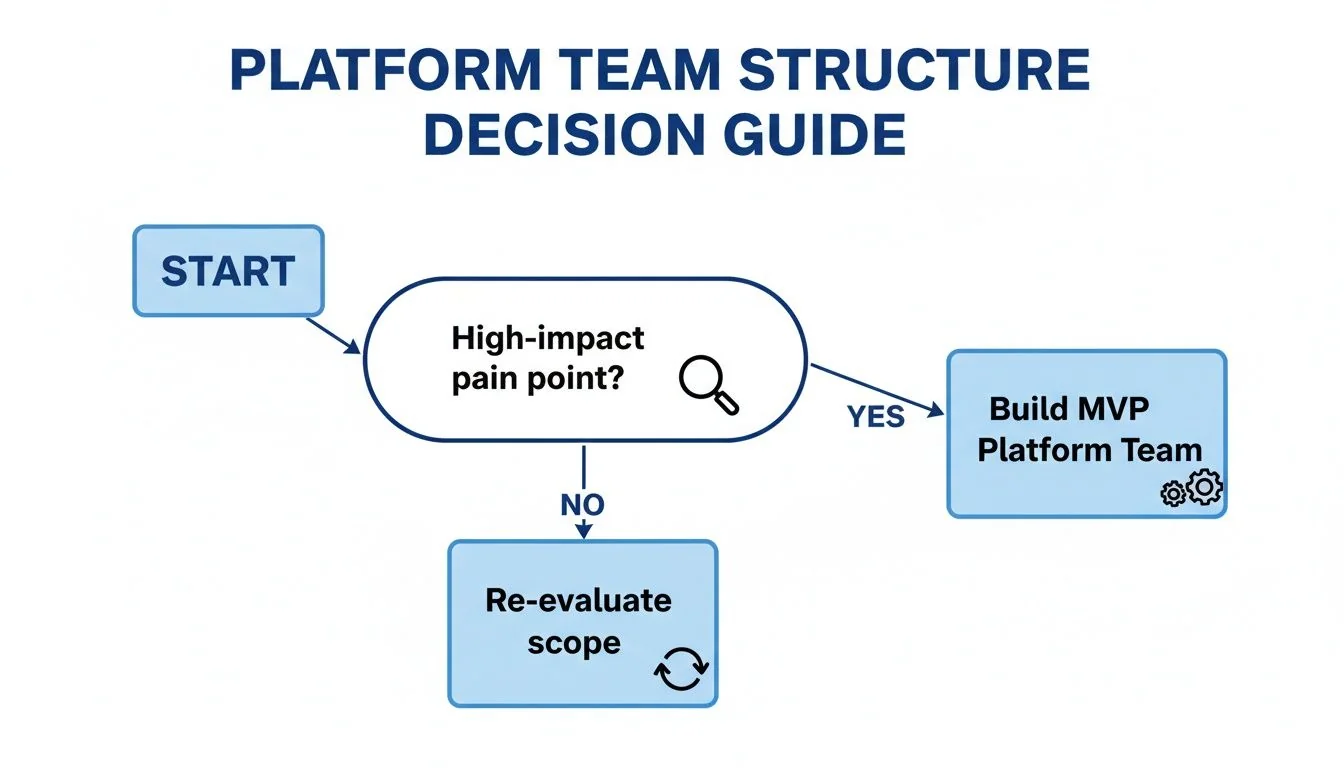
This approach forces you to validate the need before you commit a single engineer, ensuring your first platform initiative solves a real, acknowledged problem that developers will thank you for.
The Centralized Platform Team
This is the default starting position and the most common model. A single, dedicated team is given ownership of the entire internal developer platform—from the infrastructure and CI/CD pipelines to shared services and the developer portal. This team is usually funded as a central cost center, reporting up through a VP of Engineering or Infrastructure.
- Best For: Companies just starting their platform journey or smaller organizations that need to enforce consistency across modernization projects. This model is perfect for building the initial “paved road” and eliminating redundant tooling across a few dozen dev teams.
- Interaction Pattern: The team is the single front door for all other development teams. They own a global backlog, gather requirements, and provide support. The biggest risk is becoming a bottleneck if they do not ruthlessly prioritize self-service and adopt a product mindset from day one.
The Federated or Embedded Model
As you scale, a single central team cannot keep up. The needs of a team modernizing a mainframe are different from those of a team building greenfield microservices. The Federated Model solves this by embedding platform engineers directly within stream-aligned development teams or business units.
These embedded engineers are “platform ambassadors.” They report to a central platform org for standards and career growth, but their daily work is enabling their specific dev teams’ modernization efforts. They help teams adopt the core platform, build domain-specific extensions, and funnel real-world feedback to the central team.
This model is the antidote to the “ivory tower” platform team that builds a perfect platform nobody actually wants. Embedded engineers guarantee the platform solves real problems because they live and breathe those problems alongside application developers.
This approach demands strong coordination from the central team to prevent the platform from fragmenting into a dozen bespoke solutions. The central team’s job shifts from pure implementation to governance, standards-setting, and curating the core components shared by everyone.
The Platform as a Product Team
This is the most mature and effective model. It reframes the entire function: you are no longer running an infrastructure project; you are managing an internal product line designed to accelerate software modernization. The team is structured like any other product team, led by a dedicated Platform Product Manager (PPM) who owns the platform’s vision, roadmap, and success.
This model is defined by these key traits:
- Product-Driven Roadmap: The PPM’s job is to obsess over their “customers”—the developers. They conduct user research, analyze pain points in the modernization lifecycle, and build a roadmap that prioritizes features delivering the highest value to developers.
- Clear Value Proposition: The team actively markets the platform internally. Success is not measured by uptime; it is measured by adoption rates, developer satisfaction scores, and tangible gains in developer productivity on modernization projects.
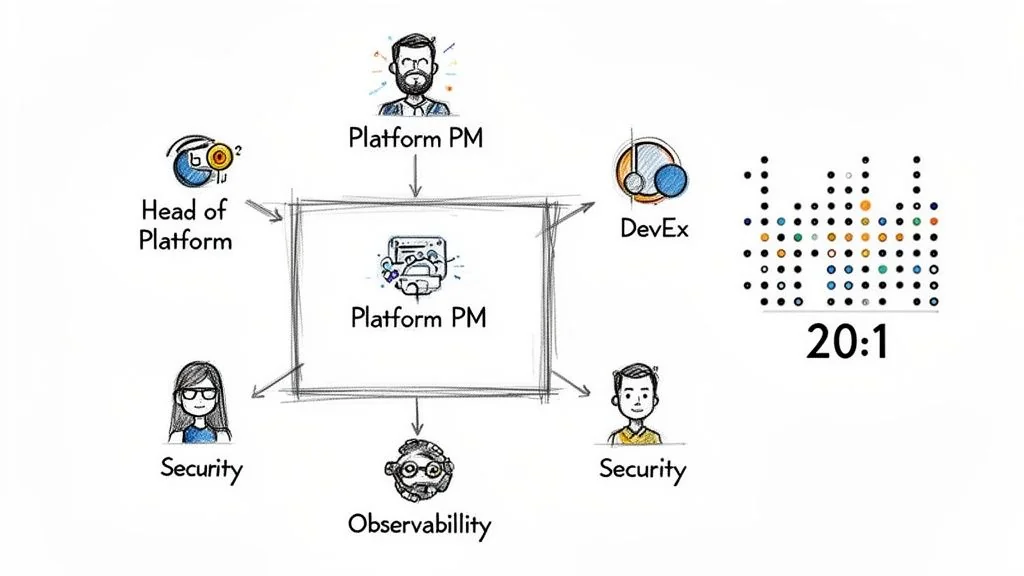
- Cross-Functional Team: The team is not just SREs and automation engineers. It includes specialists in Developer Experience (DevEx), security, and observability who are all focused on delivering a cohesive, valuable product.
This model is not mutually exclusive with the others. A federated structure can and should operate with a “Platform as a Product” philosophy. Adopting this product mindset is the only way to ensure long-term success. A coherent DevOps integration modernization strategy is what makes this model possible, creating the tight feedback loops necessary to treat your platform like a real product.
Defining Critical Roles and Sizing Your Team
The fastest way to kill a platform initiative is to rebadge your infrastructure or SRE team and call it a day. This is a costly mistake. It guarantees you build a support-function bottleneck, not a product-driven enablement engine for your modernization goals.
The roles, skills, and team size must reflect this shift. You are moving from closing operational tickets to building a self-service internal product. Getting the initial team composition right is non-negotiable—your first hires define the team’s DNA.
The Non-Negotiable Core Team
An effective platform team is cross-functional, blending deep infrastructure expertise with a relentless focus on the developer as the customer. Get this core trio wrong, and you are already behind.
-
Head of Platform Engineering: This leader owns the strategy. Their job is to secure budget, align the platform roadmap with business goals like faster modernization, and sell the platform’s value to the C-suite. They need technical credibility and political savvy.
-
Platform Product Manager (PPM): This is the single most critical and most frequently missed role. The PPM is the voice of the developer. They run user research, own the product vision, and manage the backlog. Without a PPM, your team builds what’s technically interesting, not what developers actually need to ship modernized systems faster.
-
Platform Engineers: These are your core builders. They are T-shaped software engineers who specialize in cloud, automation, and CI/CD. They build the platform’s components, from infrastructure-as-code modules for new cloud architectures to reusable service templates.
This group forms the nucleus. Their shared product-oriented mindset is the foundation for everything that follows.
Key Specialists to Add as You Mature
Once your platform has a foothold, you need specialists to refine the developer experience and make the platform robust, secure, and observable by default for all modernization projects.
-
Developer Experience (DevEx) Engineer: This role is obsessed with reducing developer friction. They improve documentation, build intuitive portal UIs, and optimize CLIs. They make the “paved road” the path of least resistance for adopting new technologies.
-
Security Engineer (DevSecOps): This specialist embeds security directly into the platform. They build pre-approved, secure-by-default components and pipelines, shifting security so far left that compliance becomes an automated, low-friction part of every deployment.
-
Observability Engineer: This engineer owns the platform’s central monitoring, logging, and tracing stack. They provide developers with a turnkey observability solution, ensuring every application launched via the platform is production-ready.
Sizing Your Team and Setting Ratios
The inevitable question is, “How many platform engineers do I need?” The answer depends on your maturity and goals.
By 2026, leading platform engineering teams will demonstrate remarkable efficiency with a 20:1 developer-to-platform engineer ratio. For instance, 40 platform engineers will be capable of supporting 800 developers, a significant improvement over the traditional 5:1 infrastructure support ratio. You can find more on the future of this discipline by exploring the trajectory of platform engineering teams.
Do not chase that 20:1 ratio on day one. A realistic starting point for an organization launching its first platform is a ratio between 8:1 and 12:1. Your initial focus must be on delivering overwhelming value to a pilot group of developers working on a critical modernization project.
The hyper-efficient 20:1 ratio is the outcome of a mature, widely adopted platform with extreme levels of automation and self-service. It is not a target for your first year. Scaling the team should be tied directly to the platform’s adoption rate across your engineering org. A well-designed platform team underpins a scalable cloud architecture, giving developers autonomy without creating chaos.
Navigating the Sociotechnical Challenge of Adoption
The most expensive platform is the one nobody uses. You can build technically perfect infrastructure, but if developers find it complex, poorly documented, or irrelevant to their immediate modernization problems, they will ignore it. This is the primary failure mode for even the best-resourced platform initiatives—a failure of adoption, not technology.
This is not a technical problem; it is a sociotechnical one. The biggest hurdles are human: cultural resistance, a lack of developer trust, and the failure of the platform team to operate like a product team. Overcoming these is the difference between building a strategic enabler and a costly new silo.
The Real Root of Platform Failure
The data is clear: platform engineering is first and foremost a people problem. Developer adoption is the single biggest challenge for 45.3% of platform teams. This is not a surprise when you see that 44.3% of organizations lack a shared vision for the platform, and 32.6% do not even have dedicated product management to guide it.
To see the full scope of these challenges, you can read the complete State of Platform Engineering report.
Actionable Framework: The Adoption-Driven Platform Roadmap
This framework ensures you address the primary sociotechnical failure modes head-on, from vision to execution.
| Pillar | Problem (Data Point) | Actionable Solution |
|---|---|---|
| 1. Vision & Buy-In | 44.3% lack a clear/shared vision. | Define the “Why.” Articulate the platform’s purpose in business terms (e.g., “Reduce new service time-to-market by 50%”). Secure executive sponsorship. |
| 2. Customer Focus | 32.6% lack dedicated product management. | Appoint a Platform PM. This role is non-negotiable. They must own the developer-facing roadmap, run user research, and prioritize based on impact. |
| 3. Adoption | 45.3% struggle with developer adoption. | Find “Customer Zero.” Partner with one friendly team on a critical modernization project. Solve their specific pain point to create an internal case study. |
| 4. Value Proof | 24.4% struggle to prove business value. | Measure Leading Indicators. Track developer satisfaction (DSAT), lead time for changes, and deployment frequency. Report these wins publicly. |
Source: State of Platform Engineering Report
These statistics point to a core dysfunction: teams build platforms without first understanding their customers—the developers. They operate like old-school infrastructure teams, pushing technology without generating pull from their user base. This leads directly to building a product nobody wants to “buy.”
Treat Your Internal Platform as a Product
The only sustainable fix is to treat your internal platform as a real product. This demands a fundamental shift in mindset, away from projects and tickets and toward customer obsession. Your developers are your customers, and your job is to make them ruthlessly effective at modernizing your software portfolio.
Adopting a product mindset means:
- Dedicated Product Management: You must have a Platform Product Manager (PPM). This role is non-negotiable. The PPM’s job is to run user research with developers, find their biggest bottlenecks in the modernization lifecycle, and build a roadmap that prioritizes solving those problems.
- Internal Marketing and Evangelism: You have to sell your platform inside your own company. This means crystal-clear documentation, tutorials, office hours, and broadcasting success stories from modernization projects. Make it easy and desirable for teams to get on your “paved road.”
- Gathering Relentless Feedback: Your platform team must live and breathe user feedback. This means running developer satisfaction surveys (DSAT), conducting direct interviews, and obsessively tracking adoption metrics to see what is working and what is not.
If you are not actively marketing your platform to internal developers, you are setting it up to fail. You must prove its value and make it the path of least resistance. Good technology does not sell itself, even inside your own company.
Strategies for Securing Developer Buy-In
Building trust with developers is everything. They are skeptical and short on time, so you must earn their attention by delivering immediate, tangible value. Abstract promises of future efficiency are meaningless noise.
Here is a playbook for winning them over:
- Find Your “Customer Zero”: Identify a single, friendly development team that is feeling acute pain in their modernization project. A team stuck with a painful deployment process or agonizingly slow cloud environment provisioning is a perfect candidate. Partner with them to co-create the first component of your Minimum Viable Platform (MVP). Their success becomes your first, most powerful case study.
- Solve One Problem, Perfectly: Do not try to boil the ocean. Pick one high-impact problem—like manual environment provisioning—and deliver a solution that is 10x better than the status quo. A marginal improvement will not overcome the inertia of old habits.
- Secure Executive Sponsorship: Your leadership must send a clear signal that the platform is the strategic path forward for modernization. Executive sponsorship provides the air cover needed to navigate organizational politics and push back against teams that insist on building their own bespoke solutions. Without it, your initiative will be starved of resources and authority.
By focusing on developer pain, proving value quickly, and securing top-down support, you transform the platform from a “nice-to-have” into an indispensable tool for accelerating software delivery.
Using the Platform Maturity Curve to Prove Value
Most platform initiatives get their funding pulled within a year. They fail because they ask for a series of small, disconnected investments that never show a return, bleeding credibility until the budget evaporates.
The fatal mistake is trying to build a perfect, all-encompassing platform from day one. That is a recipe for a multi-year slog with zero tangible results, leading to stakeholder fatigue and a canceled charter. The only path to survival is to treat your platform like a product, moving through clear maturity stages and delivering a “thin slice” of undeniable value at each step to build momentum.
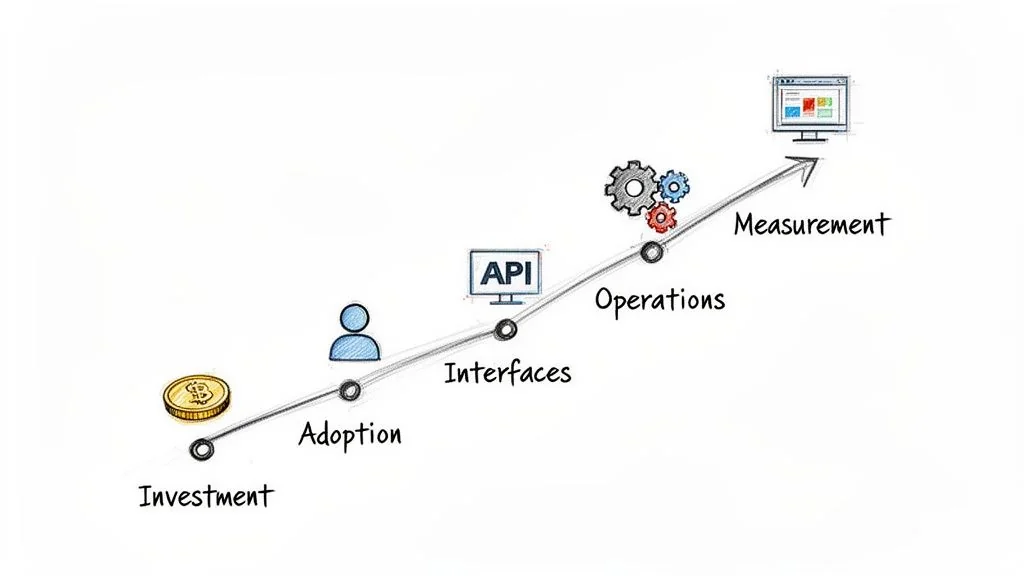
The Platform Engineering Maturity Model
Framing your work with a maturity model helps you articulate progress beyond just “we built a tool.” It translates technical milestones into organizational impact, giving you a roadmap to justify your existence and secure next-round funding.
The five key stages are:
- Investment: Secure initial funding and headcount. Do not promise to boil the ocean. Define one high-impact problem for one small group of developers and get the budget to solve only that.
- Adoption: Deliver a Minimum Viable Platform (MVP) that solves that one problem exceptionally well. Your goal is to win your first handful of internal fans who will evangelize for you.
- Interfaces: Expand self-service. This is where you build the developer portal or CLI that makes your platform easy to use, removing friction and paving the path for broader adoption.
- Operations: Harden the platform. Add SLOs, automated monitoring, and on-call rotations. Treat it like a production service, because it is. Your reliability is your reputation.
- Measurement: Quantify business impact. Now you can connect your platform to hard metrics like lead time for changes, deployment frequency, and developer satisfaction.
Avoiding the Bimodal Split
The pressure to prove value is creating a dangerous divide in the industry. Recent data on platform engineering maturity reveals a stark bimodal split between teams that deliver and teams that die.
By 2026, 35.2% of teams are expected to show measurable value within six months by shipping an MVP. But a staggering 40.9% will fail to deliver any impact within a year, putting their entire charter at risk. You can get more details on how teams are navigating platform maturity challenges.
This split happens for one reason: successful teams focus on delivering a small piece of undeniable value, fast. They prove the concept and earn the right to exist. The failing teams spend a year in a lab building a “perfect” platform that nobody asked for and that delivers zero immediate ROI.
Using Leading Indicators to Secure Funding
To stay on the right side of that divide, you need to show progress with leading indicators long before you can prove direct cost savings. A solid grasp of engineering productivity measurement is non-negotiable here.
Your goal in the first six months is not to prove a hard ROI. It is to prove you can reduce developer toil and increase velocity on modernization initiatives. This is how you build the political capital for long-term investment.
Focus on metrics that show you are removing friction from the software delivery lifecycle. Track these obsessively and share them relentlessly:
- Reduced Developer Onboarding Time: How fast can a new engineer go from getting their laptop to pushing a commit to a new cloud-native service? Measure this in hours, not weeks.
- Increased Deployment Frequency: Are teams using your platform shipping smaller changes, more often? This is a direct signal of reduced risk and increased agility in modernization.
- Faster CI/CD Pipeline Durations: How many minutes (or hours) are you saving developers who used to wait on slow, brittle build processes for legacy and new systems? Add it up. That is real time you are giving back.
These early wins are your currency. They prove your platform engineering team structure is working and your strategy is sound. This is what justifies the next check as you move along the maturity curve.
Your 90-Day Action Plan for Building the Team
Strategy without execution is just talk. This 90-day plan is designed to take your platform team from a whiteboard concept to a functioning unit that delivers its first win for your software modernization program.
This is the tactical blueprint for any CTO or VP of Engineering. It’s how you build real momentum and prove the platform’s value before the organization’s natural inertia stalls the entire initiative.
Days 1-30: Secure Sponsorship and Find Your First Customer
Your first month is about politics and focus. Without executive buy-in and a clear, solvable modernization problem, your team is dead on arrival.
- Secure the Business Case: Get executive sponsorship by tying the platform directly to business outcomes. Do not talk about Kubernetes. Talk about accelerating feature delivery, slashing production incidents during migration, or cutting cloud waste. Frame it in terms of dollars and deadlines.
- Appoint the Platform Product Owner: This is non-negotiable. Name a product owner who will act as the voice of your developers. Their job is to translate developer pain into a prioritized backlog of platform features.
- Find “Customer Zero”: Identify a single, friendly development team struggling with a high-friction process in their modernization effort. This team becomes your first internal customer and design partner.
Days 31-60: Define the MVP and Make the Build-vs-Buy Call
With a customer and a mandate, your focus shifts to defining the smallest possible solution that delivers massive value. This is where you scope your Minimum Viable Platform (MVP).
The goal of the MVP is not to build a comprehensive platform. It is to solve one specific problem so completely that “Customer Zero” becomes your biggest internal advocate. That initial win generates the political capital you need for future investment.
During this phase, you must address the build-vs-buy question. Use this framework to make the call:
- Build In-House When: The problem is unique to your business, and you have the talent to create a competitive advantage. Building commodity components like CI/CD runners from scratch is a common trap—do not fall into it.
- Partner with a Vendor When: You need to get to market faster and the solution solves a common industry problem (like a service catalog or secrets management). A good partner acts as a force multiplier for your team, not just another tool.
Days 61-90: Ship the MVP and Broadcast the Win
The final month is about execution and communication.
- Deliver the MVP: The team builds and delivers the thin-slice solution for “Customer Zero.” It must be polished, well-documented, and demonstrably better than the old way of working.
- Measure the Impact: Track the specific improvements. Did you cut deployment time from hours to minutes? Quantify it. Did you automate a 15-step manual process for environment setup? Show the before-and-after.
- Market Your Success: Broadcast this first victory. Write an internal blog post. Present at the engineering all-hands. Get a powerful testimonial from the team lead of “Customer Zero.” This is how you build demand and justify your team’s continued growth.
Next Steps for Technical Leaders
These are the direct answers to the most common questions we hear from CTOs and VPs of Engineering executing software modernization.
What’s the “Right” Ratio of Platform Engineers to Developers?
Chasing a magic number is starting at the wrong end of the problem. While a hyper-mature organization like SIXT might hit a 20:1 developer-to-platform-engineer ratio, that is the result of years of automation and internal product adoption. They did not start there.
For a new platform team, a ratio between 8:1 and 12:1 is a more grounded starting point. But even that is an output, not a target.
Your first move is not to hire to a ratio. It is to find a high-impact bottleneck for a single, willing pilot team and solve it brilliantly. The ratio improves as your platform proves its value and developers voluntarily adopt your “paved roads” because they are genuinely faster for modernization tasks.
Who Should the Platform Team Report to: The CTO or VP of Engineering?
In almost every successful case, the platform team reports to the head of engineering—usually the VP of Engineering. The reason is simple: their “customers” are the development teams.
This reporting line forces the platform team to stay grounded in the daily friction developers face during modernization. It keeps them honest. Reporting to the CTO can work in a tiny startup or during a massive, top-down technology overhaul, but it carries a huge risk. It creates distance, breeding an “ivory tower” platform that looks great in a slide deck but gets ignored by the engineers it is meant to serve.
The core mission of a platform team is product-oriented enablement, not project-based support or operational fire-fighting.
How Is a Platform Team Different from a DevOps or SRE Team?
While you will find similar skills on all three teams, their core missions are fundamentally different. Confusing them is a classic mistake that undermines modernization efforts.
-
Platform Team: Their job is to build a product. That product is a self-service internal platform that makes developers’ lives easier. Their key metric is developer experience (DevEx), and their output is the “paved road” that simplifies shipping code for everyone.
-
DevOps Team: This role is often more tactical and project-focused. They are typically embedded within or working for specific application teams, building out CI/CD pipelines and automation for a particular service. Think project-based delivery, not a scalable product.
-
SRE Team: SREs are the guardians of production. Their world revolves around the reliability, performance, and operational health of live systems. They own uptime, define and defend SLOs, and are the experts you call when things go sideways in production.