12 Private Cloud Computing Providers: A 2026 Modernization Analysis
Industry data suggests that over 40% of organizations repatriate workloads from public cloud, often citing unforeseen costs and operational complexity. While public cloud offers immense scale, private cloud promises control, performance, and predictable economics for specific use cases. However, selecting from the diverse landscape of private cloud computing providers is a high-stakes decision fraught with hidden costs and technical debt risks. A misstep here can lead to multi-million dollar write-offs and years of architectural regret.
This analysis cuts through the marketing jargon, providing a direct comparison of 12 leading options. We move beyond generic feature lists to focus on the details that impact your P&L and engineering velocity. For readers who need a foundational overview before diving into vendor analysis, it’s essential to grasp the fundamentals of private cloud environments to understand the architectural and operational models discussed here.
This guide provides a skeptical, expert view to help you build a defensible shortlist. We examine specific failure modes, realistic cost structures beyond the list price, and answer the critical question: ‘When does a private cloud deployment actually make financial and technical sense?’ Each vendor profile includes direct links, annotated screenshots, and a clear “When NOT to buy” section, ensuring you can make a decision based on data, not just a sales pitch. We will reference data from Gartner and our internal Modernization Intel research to provide specific, actionable intelligence.
1. AWS Outposts
AWS Outposts extends the native AWS public cloud experience directly into your on-premises data center. It’s not a separate platform but a literal piece of AWS-managed infrastructure, delivered as a rack or server, allowing you to run services like EC2, S3, and RDS locally. This model provides genuine operational parity, using the same APIs, IAM controls, and management consoles as the public AWS cloud. This makes it a strong contender among private cloud computing providers for organizations already standardized on AWS tooling.
The core value is bridging the gap for workloads that cannot move to the public cloud due to strict data residency requirements, local data processing needs, or ultra-low latency dependencies on on-premises equipment. By extending your existing Virtual Private Cloud (VPC) to Outposts, you create a consistent network environment. This architecture simplifies the transition to a hybrid cloud model, as detailed in our guide on on-premise to hybrid cloud migrations.
Use Cases and Limitations
Best For:
- Low-Latency Applications: Manufacturing execution systems (MES), real-time media processing, or high-frequency trading platforms that require single-digit millisecond latency to on-site systems.
- Data Residency: Healthcare, finance, or public sector workloads with non-negotiable requirements to keep data within a specific physical location or country.
- Local Data Processing: Large-scale data analytics or machine learning model training where moving terabytes or petabytes of data to a public region is impractical.
When NOT to use:
- Cost-Sensitive Workloads: The TCO is significant. Outposts require a mandatory, non-trivial Enterprise or On-Ramp Support subscription on top of a 3-year term commitment.
- Fully Disconnected Operations: Outposts require a consistent network connection back to an AWS public region for management, control plane operations, and monitoring. They are not designed for air-gapped environments.
- Multi-Cloud Strategy: By design, Outposts deepens integration with the AWS ecosystem, which conflicts with strategies prioritizing vendor portability.
Visit Website: https://aws.amazon.com/outposts/
2. Microsoft Azure Stack (Hub and HCI)
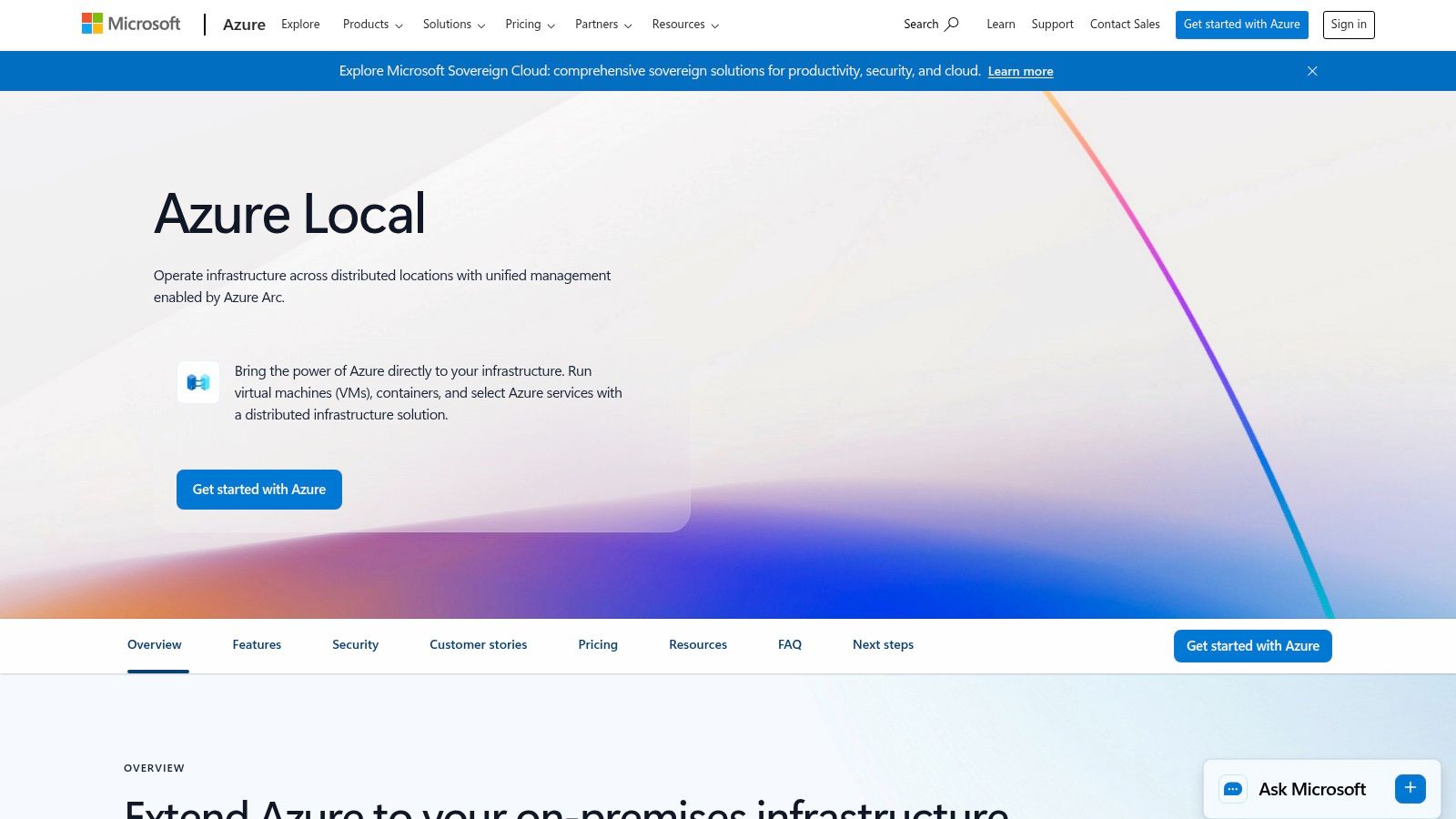
Microsoft’s Azure Stack portfolio extends Azure services and management into your own environment, offering a familiar operating model for teams standardized on Microsoft’s cloud. It comes in two primary forms: Azure Stack Hub, an integrated system that runs a subset of Azure services autonomously, and Azure Stack HCI, a hyperconverged infrastructure solution managed as a native Azure resource. This approach makes it one of the leading private cloud computing providers for organizations aiming to maintain consistent governance and skillsets across hybrid environments.
The key benefit is using the same Azure Resource Manager (ARM) templates, role-based access control (RBAC), and subscription billing models on-premises as you do in the public cloud. This consistency is crucial for streamlining the processes involved in what is application modernization, as it reduces the learning curve and operational friction when deploying applications locally.
Use Cases and Limitations
Best For:
- Azure-Native Development: Teams that want to use Azure PaaS services (like App Service or Functions on Hub) or familiar IaaS management for applications with data residency or latency constraints.
- Edge and Disconnected Scenarios: Azure Stack Hub can operate fully or partially disconnected from the public cloud, making it suitable for remote or ruggedized environments like factory floors or ships.
- Data Center Modernization: Replacing aging virtualization infrastructure with Azure Stack HCI provides a cloud-integrated platform with modern features like Azure Arc management and Azure Kubernetes Service (AKS).
When NOT to use:
- Hardware Agnosticism: Azure Stack Hub requires purchasing specific, validated integrated systems from OEM partners like Dell or HPE, constraining hardware choice.
- Budget-Constrained Virtualization: While HCI offers flexible hardware, the per-core subscription pricing and separate guest OS licensing (e.g., Windows Server) can become more expensive than traditional virtualization for static workloads.
- Multi-Cloud Tooling: The platform is deeply integrated with the Azure control plane and identity systems (Azure AD), creating significant friction for organizations committed to a vendor-neutral, multi-cloud management strategy.
Visit Website: https://azure.microsoft.com/en-us/products/azure-stack/
3. Google Distributed Cloud (GDC)
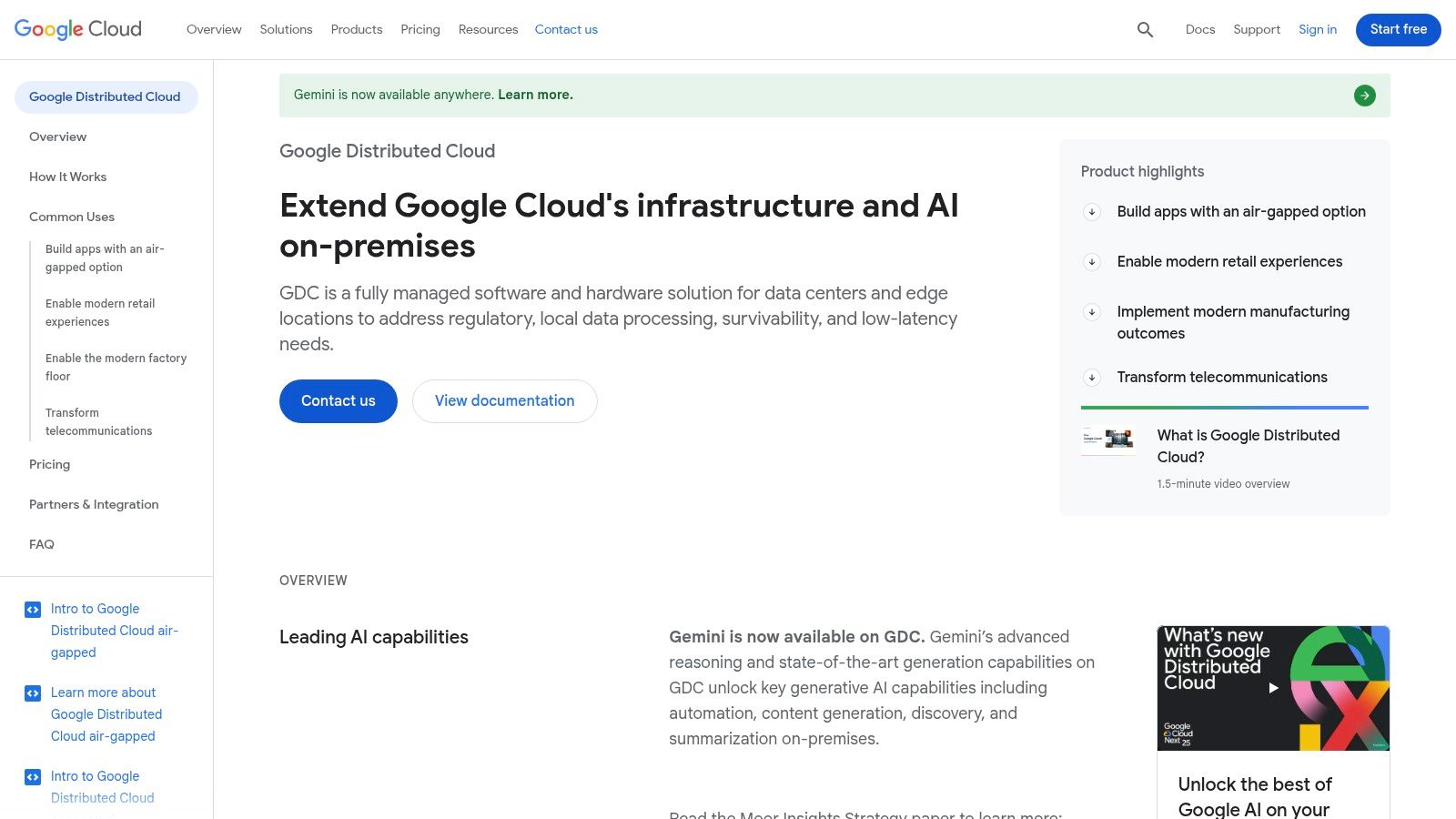
Google Distributed Cloud (GDC) brings managed Google Cloud infrastructure and services into your data center, edge locations, or even ruggedized environments. Its strength lies in its Kubernetes-native foundation, leveraging Anthos to deliver a consistent operational experience between your on-premises and public cloud workloads. This makes it a strong choice for organizations standardizing on Google Cloud Platform (GCP) tooling for container orchestration and modern application development.
The platform is designed to cater to two distinct operational needs: a “connected” version that maintains a link to a Google Cloud region for management, and a fully “air-gapped” version for environments with the strictest security and data isolation requirements. This dual-mode capability provides flexibility for various use cases, from sovereign cloud deployments to low-latency edge computing, making it a versatile contender among private cloud computing providers.
Use Cases and Limitations
Best For:
- Kubernetes-Native Workloads: Organizations heavily invested in Kubernetes and the Anthos ecosystem seeking a consistent development and operations plane across hybrid environments.
- Air-Gapped Operations: Public sector, defense, or industrial settings that legally require a physically disconnected, self-contained cloud environment.
- Edge AI/ML: Deploying Google’s AI and data services closer to the source for real-time inference in retail, manufacturing, or telecommunications.
When NOT to use:
- VM-Heavy Legacy Estates: While GDC supports VMs, its core architecture is optimized for containers and Kubernetes. Organizations with a large, traditional VM footprint may find other solutions a better technical fit.
- Strict Budget Transparency: Pricing for air-gapped deployments is opaque and requires a custom sales quote, which can complicate initial cost modeling.
- Multi-Cloud Management: GDC is fundamentally an extension of the Google Cloud ecosystem. It is not designed to be a neutral management plane for workloads on AWS or Azure.
Visit Website: https://cloud.google.com/distributed-cloud
4. Oracle Cloud@Customer (Dedicated Region and Compute Cloud@Customer)
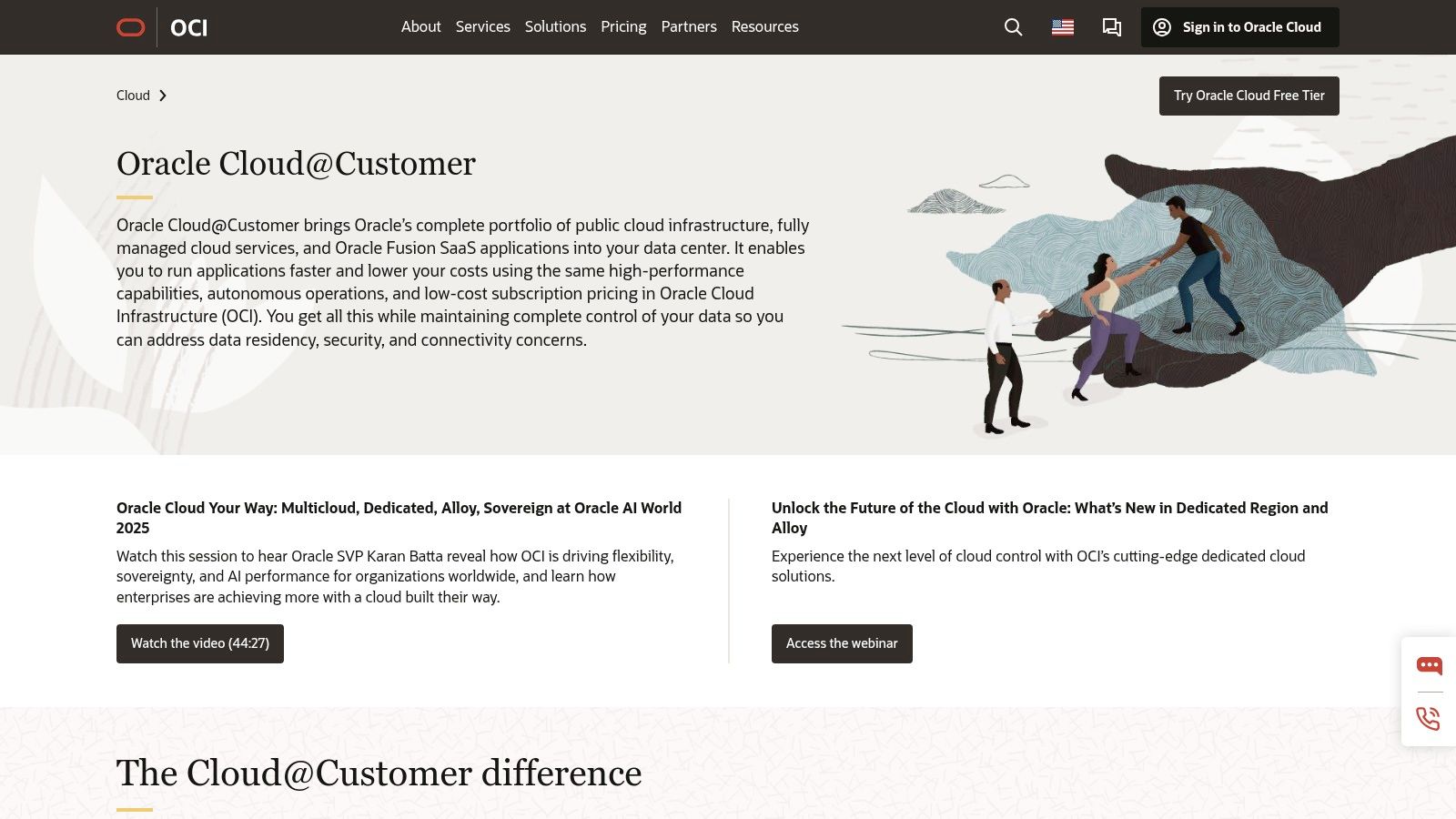
Oracle Cloud@Customer brings the full portfolio of Oracle Cloud Infrastructure (OCI) services directly into your data center. This solution is available in two primary form factors: a complete, self-contained “Dedicated Region” or a smaller, modular “Compute Cloud@Customer” rack. Unlike hybrid extensions that offer a subset of services, this model provides the exact same APIs, SLAs, and even the same list pricing as OCI’s public regions, making it a distinct option among private cloud computing providers for enterprises with heavy Oracle investments.
The primary value proposition is enabling a complete IaaS, PaaS, and even Oracle Fusion SaaS experience on-premises. This addresses the most stringent data sovereignty, residency, and regulatory hurdles by ensuring all data and operations remain within a customer’s physical control. It provides a consistent operational model for organizations that need to run workloads like Oracle Autonomous Database or Exadata Database Service locally while leveraging a cloud consumption model.
Use Cases and Limitations
Best For:
- Data Sovereignty: Government, defense, and highly regulated financial services that legally cannot have data or control planes reside outside their facilities.
- Modernizing Oracle Estates: Organizations aiming to modernize legacy Oracle applications using cloud-native services like Autonomous Database without moving the core data off-site.
- Low-Latency Database Operations: High-performance computing or transaction processing systems tightly coupled with on-premises equipment that require minimal latency to an Oracle database.
When NOT to use:
- Small-Scale Deployments: The financial commitment and operational overhead are substantial. Minimum commitments have historically been in the range of $500K-$600K per year, making it unsuitable for small workloads.
- Rapid Deployment Needs: Site readiness and the deployment window can span multiple months, which does not align with projects requiring immediate infrastructure.
- Vendor-Agnostic Strategies: This solution is fundamentally designed to deepen integration with the Oracle ecosystem, running counter to a multi-cloud or vendor-neutral architecture.
Visit Website: https://www.oracle.com/cloud/cloud-at-customer/
5. IBM Cloud Satellite
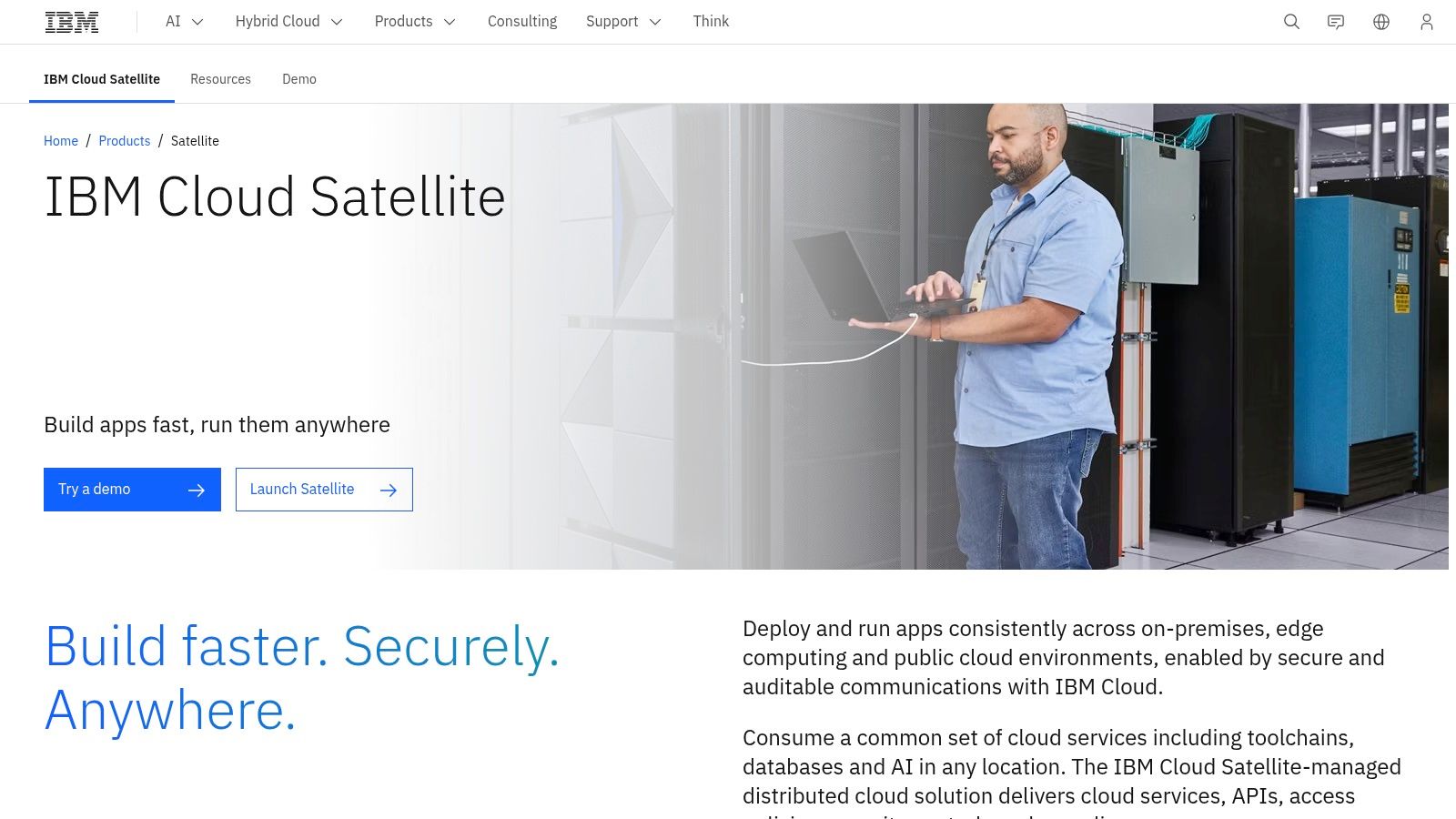
IBM Cloud Satellite offers a distributed cloud solution, enabling you to run IBM Cloud services on your own infrastructure, in edge locations, or even within other public clouds. This “as-a-service” model allows you to consume services like Red Hat OpenShift, databases, and AI tooling wherever you need them, all managed centrally from the IBM Cloud console. This makes it a compelling option for enterprises that require IBM’s robust compliance and security posture while needing deployment flexibility beyond traditional data centers.
The primary benefit is creating a consistent operational experience across disparate environments. You provision a “Satellite Location” on your existing hardware, which then connects securely to the IBM Cloud control plane. This architecture addresses data sovereignty and low-latency processing needs by keeping data and applications local while leveraging a managed, cloud-native service delivery model. It’s one of the few private cloud computing providers that formally supports running its services on another hyperscaler’s infrastructure.
Use Cases and Limitations
Best For:
- Hybrid and Multi-Cloud Operations: Organizations wanting to manage workloads on-prem and in other clouds (e.g., AWS, Azure) through a single IBM control plane.
- Regulated Industries: Companies in finance, healthcare, and government that need to meet strict compliance and data residency rules but want a managed cloud service experience.
- Edge Computing: Deploying AI, IoT, and data analytics services at factory floors, retail stores, or other edge locations where low-latency data processing is critical.
When NOT to use:
- Fully Air-Gapped Environments: Similar to other distributed cloud offerings, Satellite requires a stable, persistent connection back to the IBM Cloud for management and operations.
- Simple On-Premises Virtualization: If your only goal is server virtualization without needing managed cloud services, a traditional hypervisor solution is likely more cost-effective.
- Teams Avoiding Vendor Lock-In: While it can run on other clouds, the entire management layer and service consumption model is deeply integrated with the IBM Cloud ecosystem.
Visit Website: https://www.ibm.com/products/satellite
6. HPE GreenLake for Private Cloud (Private Cloud Enterprise/Business Edition)
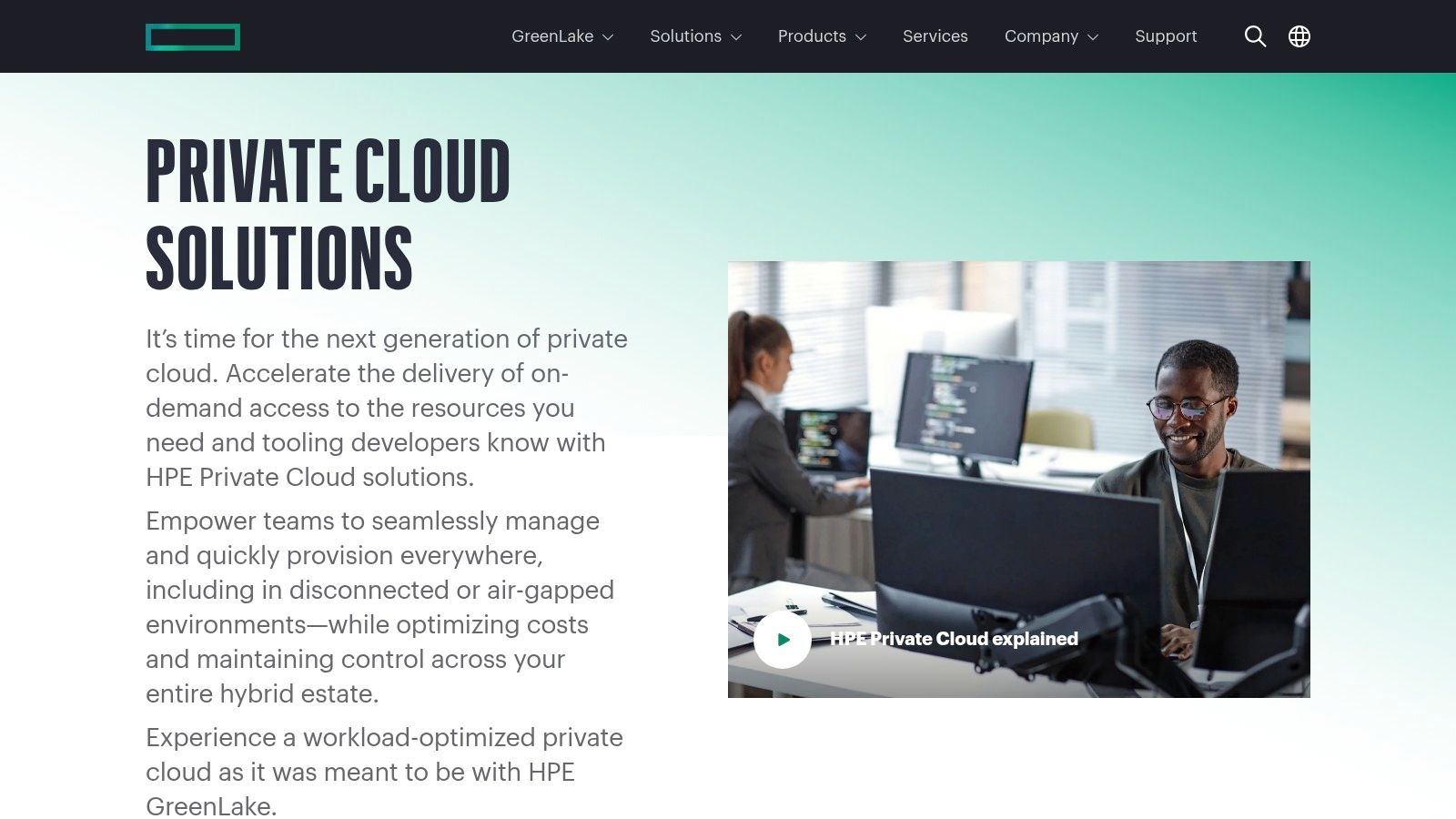
HPE GreenLake for Private Cloud delivers a managed, consumption-based experience that can be deployed in your data center, at the edge, or in a colocation facility. It shifts the traditional hardware procurement model to a pay-per-use service, covering bare metal, VMs, and container workloads. This positions it as a compelling choice among private cloud computing providers for organizations seeking to combine the control of on-premises infrastructure with the financial model of the public cloud.
The platform provides a self-service portal for provisioning resources, complete with role-based access control and Infrastructure as Code (IaC) support via tools like Terraform. It’s designed for enterprises that need a fully managed operational layer, enterprise-grade SLAs, and flexible deployment options, including support for disconnected or air-gapped environments. This makes it a strong contender for industries with stringent security or operational continuity requirements.
Use Cases and Limitations
Best For:
- CapEx to OpEx Shift: Organizations looking to avoid large upfront hardware investments by adopting a pay-per-use, cloud-like billing model for on-premises infrastructure.
- Managed VMware Environments: Teams that want to retain their VMware stack but offload the underlying hardware and platform management to HPE. The option to bring-your-own-license (BYOL) for VMware adds flexibility.
- Air-Gapped Operations: Government, defense, or industrial sectors requiring a modern private cloud that can operate fully disconnected from the public internet.
When NOT to use:
- Transparent, Upfront Pricing: The consumption model is powerful, but detailed pricing is often quote-based and complex. It may require minimum commitments or reservations, making it difficult to budget without engaging sales.
- Pure Self-Service Setups: While the platform offers self-service provisioning, complex integrations or advanced configurations frequently require engagement with HPE professional services, adding to the total cost.
- Multi-Vendor Hardware Strategy: GreenLake is intrinsically tied to HPE hardware and its management ecosystem, making it unsuitable for organizations committed to a multi-vendor on-premises hardware strategy.
Visit Website: https://www.hpe.com/us/en/private-cloud-products.html
7. Dell APEX Private Cloud (and APEX Cloud Services)
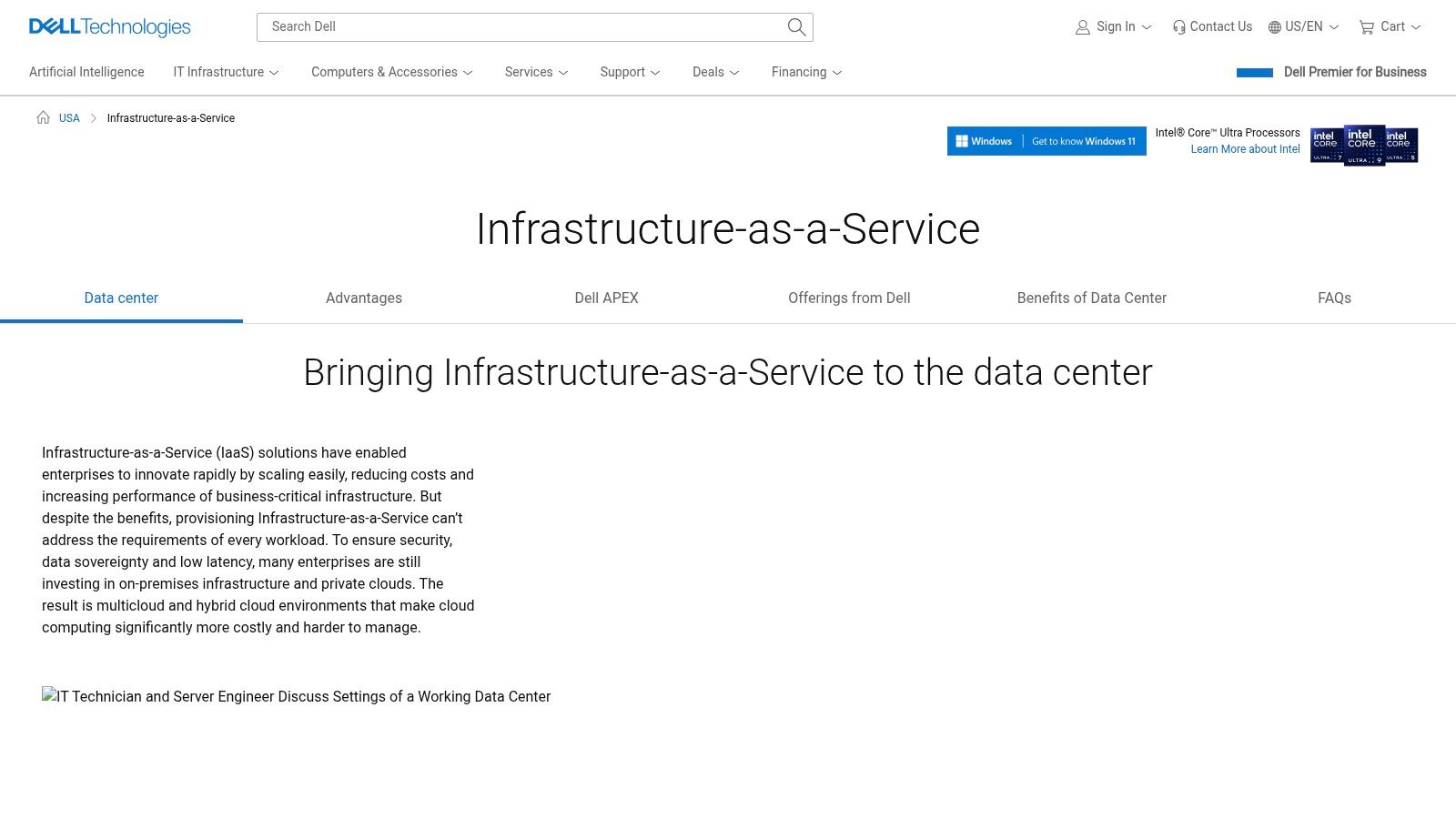
Dell APEX represents a portfolio of as-a-service offerings designed to deliver a cloud-like consumption model for on-premises infrastructure. Built on Dell’s widely deployed hardware like VxRail, it provides a managed private cloud experience, abstracting away the complexities of lifecycle management. This makes it a compelling option among private cloud computing providers for organizations that want a turnkey solution from a single, established hardware vendor.
The core offering is delivered as an integrated stack, commonly with VMware or Red Hat OpenShift, and managed through the central APEX Console. This approach provides a predictable, subscription-based financial model, shifting significant capital expenditures to operational costs. Dell handles the deployment, management, and scaling of the underlying infrastructure, allowing IT teams to focus on application delivery rather than hardware maintenance.
Use Cases and Limitations
Best For:
- Existing Dell/VMware Shops: Organizations already invested in Dell hardware and VMware software can extend their footprint with a consistent operational and financial model.
- CapEx to OpEx Transition: Businesses seeking to move away from large, upfront hardware purchases in favor of a predictable monthly subscription for their private cloud.
- Managed Infrastructure: Teams that need to reduce the operational burden of managing and maintaining on-premises hardware and core software stacks.
When NOT to use:
- Pricing Transparency: Pricing is not publicly available and is typically obtained through a direct sales engagement. This makes initial cost modeling and comparison difficult without a formal quoting process.
- Vendor Lock-in Concerns: The solution is inherently tied to Dell hardware and its chosen software stacks (e.g., VMware). This can conflict with multi-vendor or hardware-agnostic strategies.
- Software Licensing Volatility: Your TCO can be significantly impacted by changes in third-party licensing, particularly within the VMware ecosystem, which may be outside of Dell’s control.
Visit Website: https://www.dell.com/en-us/lp/infrastructure-as-a-service
8. VMware Cloud Foundation (VCF) by Broadcom
VMware Cloud Foundation is an integrated software stack that bundles vSphere, vSAN, NSX, and Aria (formerly vRealize Suite) to deliver a consistent private cloud infrastructure. It standardizes compute, storage, networking, and management, creating an enterprise-ready platform that can be deployed in a private data center, at the edge, or through a partner-managed cloud. VCF’s core value proposition is enabling a unified operating model that spans these environments, making it a cornerstone for many private cloud computing providers and the enterprises they serve.
The platform is engineered for operational consistency and simplifies the lifecycle management of the core software-defined data center (SDDC) components. By leveraging this pre-validated stack, organizations can reduce the complexity of deploying and maintaining a private cloud. However, recent portfolio and licensing changes under Broadcom make it critical to perform a detailed cost analysis, a key part of the cloud cost optimization strategies necessary for modern infrastructure planning.
Use Cases and Limitations
Best For:
- Existing VMware Customers: Organizations with deep investments in vSphere and a workforce skilled in VMware tools can extend their capabilities into a full private cloud with a minimal learning curve.
- Hybrid Cloud Consistency: Businesses that want a seamless operating model and workload portability between their on-premises data centers and VMware-based public clouds (e.g., Google Cloud VMware Engine).
- Enterprise-Grade Resilience: Deploying business-critical applications that require proven high availability, disaster recovery, and robust security features integrated at the platform level.
When NOT to use:
- New or Cloud-Native Projects: Teams building new applications with cloud-native architectures (containers, microservices) may find the infrastructure overhead of VCF excessive compared to lighter-weight platforms like Kubernetes.
- Cost-Driven Decisions: The shift to subscription-based, per-core licensing under Broadcom can represent a significant cost increase for some customers. A thorough TCO analysis is mandatory.
- Organizations Avoiding Vendor Lock-In: VCF deeply integrates an organization into the Broadcom and VMware ecosystem, making it difficult to pivot to alternative hypervisors or multi-cloud management platforms.
Visit Website: https://www.broadcom.com/products/vmware/vcf
9. Nutanix Private Cloud (Nutanix Cloud Platform)
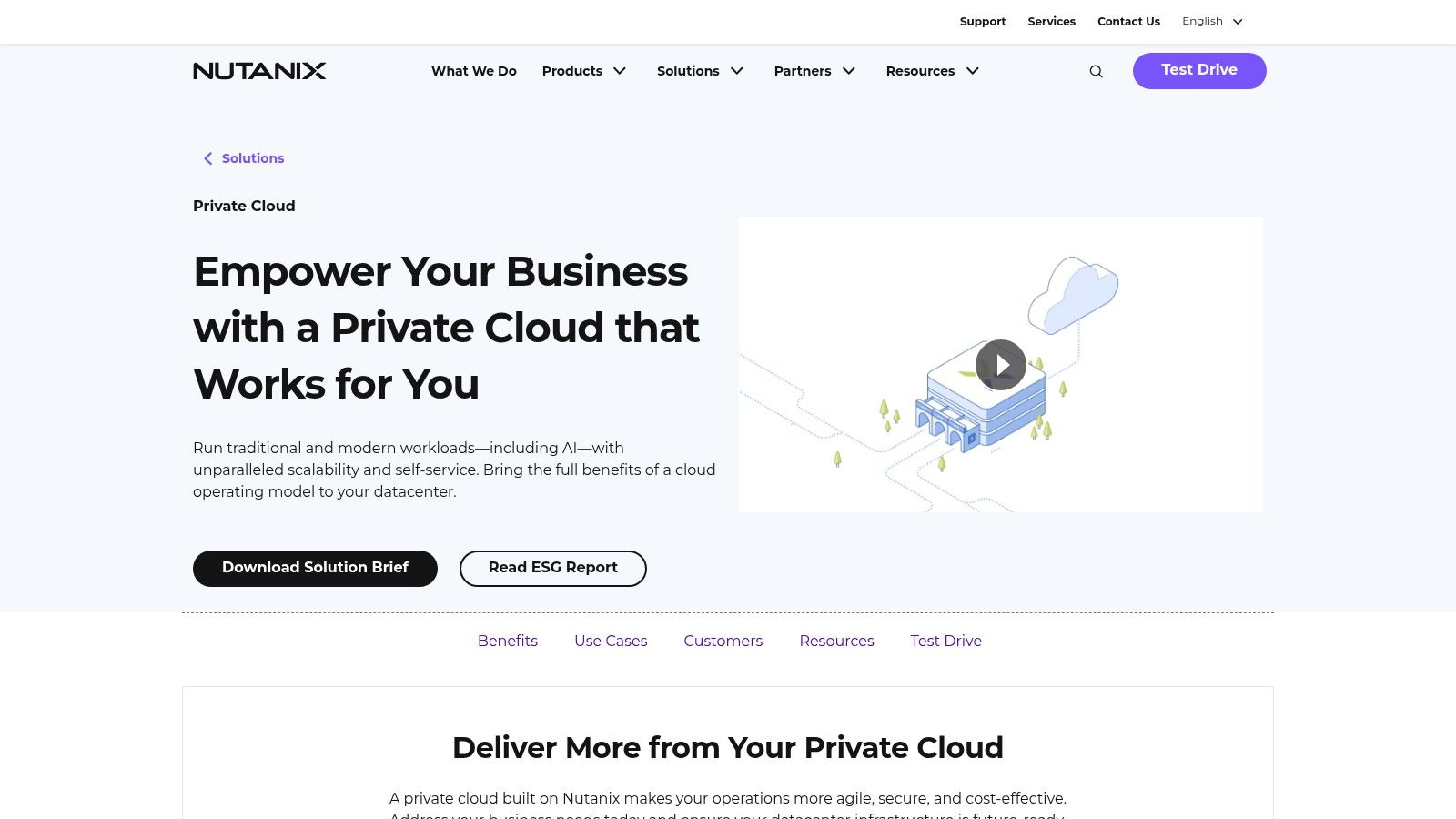
Nutanix offers a private cloud built on its well-regarded hyperconverged infrastructure (HCI) foundation, the Nutanix Cloud Platform. This approach merges compute, storage, and networking into a single, software-defined solution, significantly simplifying data center operations compared to traditional three-tier architectures. The platform supports a wide array of workloads, including standard VMs, Kubernetes containers via Nutanix Kubernetes Platform (NKP), and databases, with a clear path for emerging AI applications.
Its key differentiator is operational simplicity and flexibility, driven by a unified management plane (Prism) and the option to use its native, license-free AHV hypervisor. This makes Nutanix a compelling choice among private cloud computing providers for organizations aiming to reduce vendor lock-in, particularly from VMware, and streamline infrastructure management across their data center and edge locations.
Use Cases and Limitations
Best For:
- VMware Alternatives: Organizations seeking to migrate away from VMware vSphere to reduce hypervisor licensing costs, using the native Nutanix AHV hypervisor.
- Simplified Operations: Teams wanting to eliminate the complexity of managing separate storage, server, and networking silos with a single, integrated platform.
- Hybrid Cloud Integration: Businesses that plan to extend their on-premises environment to public clouds (AWS, Azure) while maintaining a consistent operational model.
When NOT to use:
- Transparent Pricing Needs: The platform is sold through partners and OEMs. Pricing is entirely quote-based, requiring significant engagement and making upfront cost modeling difficult.
- Small-Scale Deployments: While it scales down, the value proposition of HCI is most apparent at a scale where managing separate infrastructure tiers becomes a significant operational burden.
- Deep Public Cloud Integration: If your strategy depends on native, first-party public cloud services and APIs (like AWS Outposts or Azure Stack HCI), Nutanix acts as an abstraction layer rather than a native extension.
Visit Website: https://www.nutanix.com/solutions/private-cloud
10. Red Hat OpenStack Platform
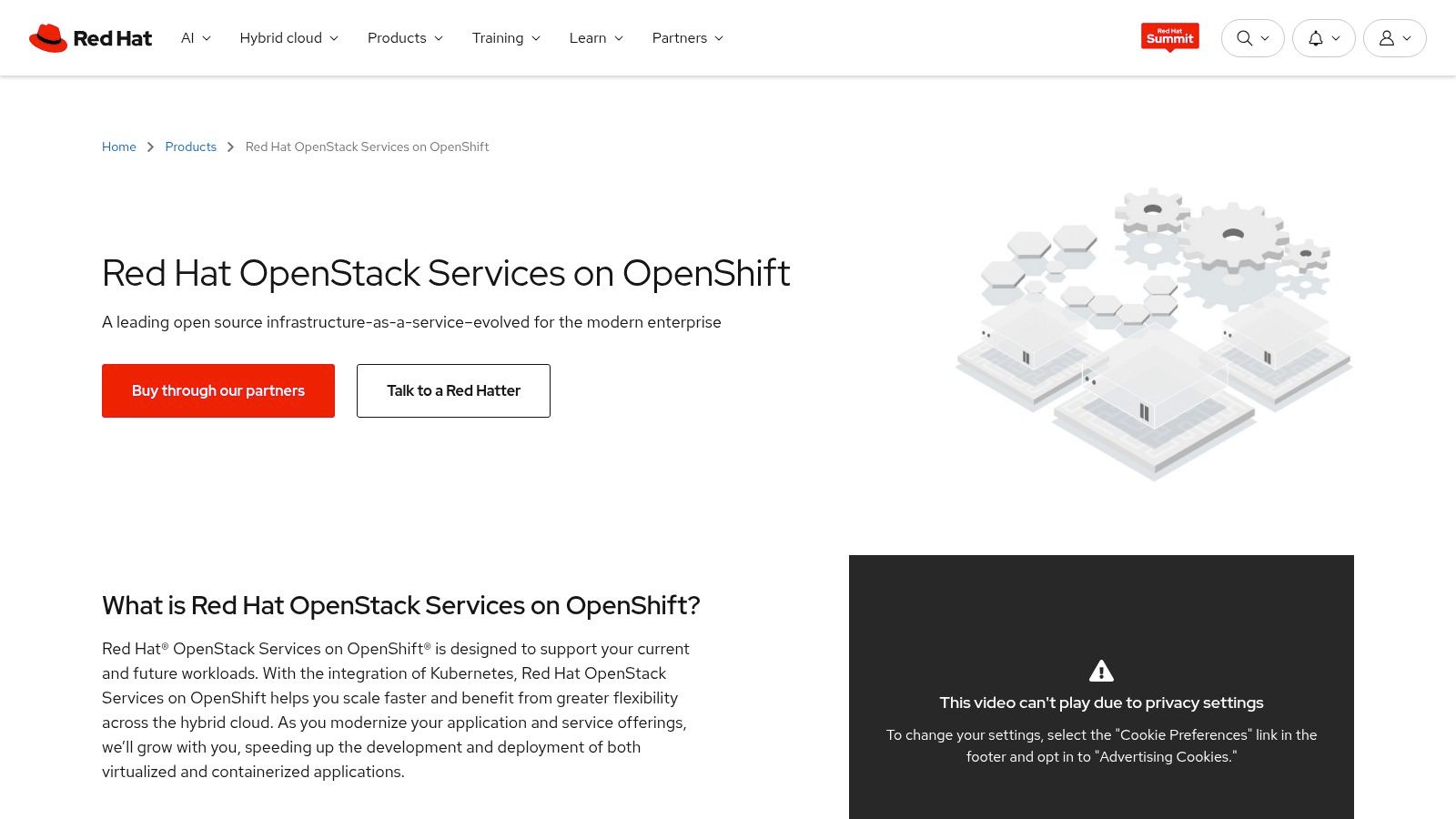
Red Hat OpenStack Platform is a hardened, enterprise-grade distribution of the open-source OpenStack project. It provides a comprehensive Infrastructure-as-a-Service (IaaS) solution that runs on standard, commodity hardware, giving organizations control over their cloud environment. Backed by Red Hat’s extensive support ecosystem and documentation, it integrates deployment and lifecycle management tooling, making a complex open-source project more consumable for enterprises. This makes it a key player for teams that require an open, flexible IaaS but demand the stability and long-term support of an enterprise vendor.
Its core value lies in its flexibility and avoidance of hardware vendor lock-in. The platform is particularly prevalent in telecommunications for Network Functions Virtualization (NFV) and at the edge, where custom configurations and control are paramount. Red Hat provides long support windows (up to five years on select releases) and a structured upgrade path, addressing historical OpenStack challenges around maintainability and operational continuity. For organizations with the right skills, it’s one of the most powerful private cloud computing providers for building a bespoke cloud.
Use Cases and Limitations
Best For:
- Telecommunications (NFV): Deploying and managing virtualized network functions where performance tuning and hardware flexibility are critical.
- Large-Scale Private IaaS: Organizations building a large, internal cloud for developers that mimics public cloud elasticity on their own terms and hardware.
- Research and HPC: Academic and research institutions that need a highly customizable cloud platform for diverse, high-performance computing workloads.
- Strict Data Sovereignty: Building a fully self-managed and self-hosted cloud to meet stringent data control and residency regulations.
When NOT to use:
- Small Teams or Limited Skills: The operational complexity of OpenStack is significant. It requires a dedicated, skilled operations team or a managed services partner to run effectively. It is not a turnkey appliance.
- Hyper-Converged Simplicity: If the goal is a simple, integrated compute and storage solution, HCI platforms like Nutanix or vSAN often provide a lower operational burden.
- Application-Centric Platforms: For teams focused purely on deploying applications with minimal infrastructure management, platforms like Red Hat OpenShift or other Kubernetes distributions are a better fit.
Visit Website: https://www.redhat.com/en/technologies/linux-platforms/openstack-platform
11. Canonical Charmed OpenStack (Ubuntu)
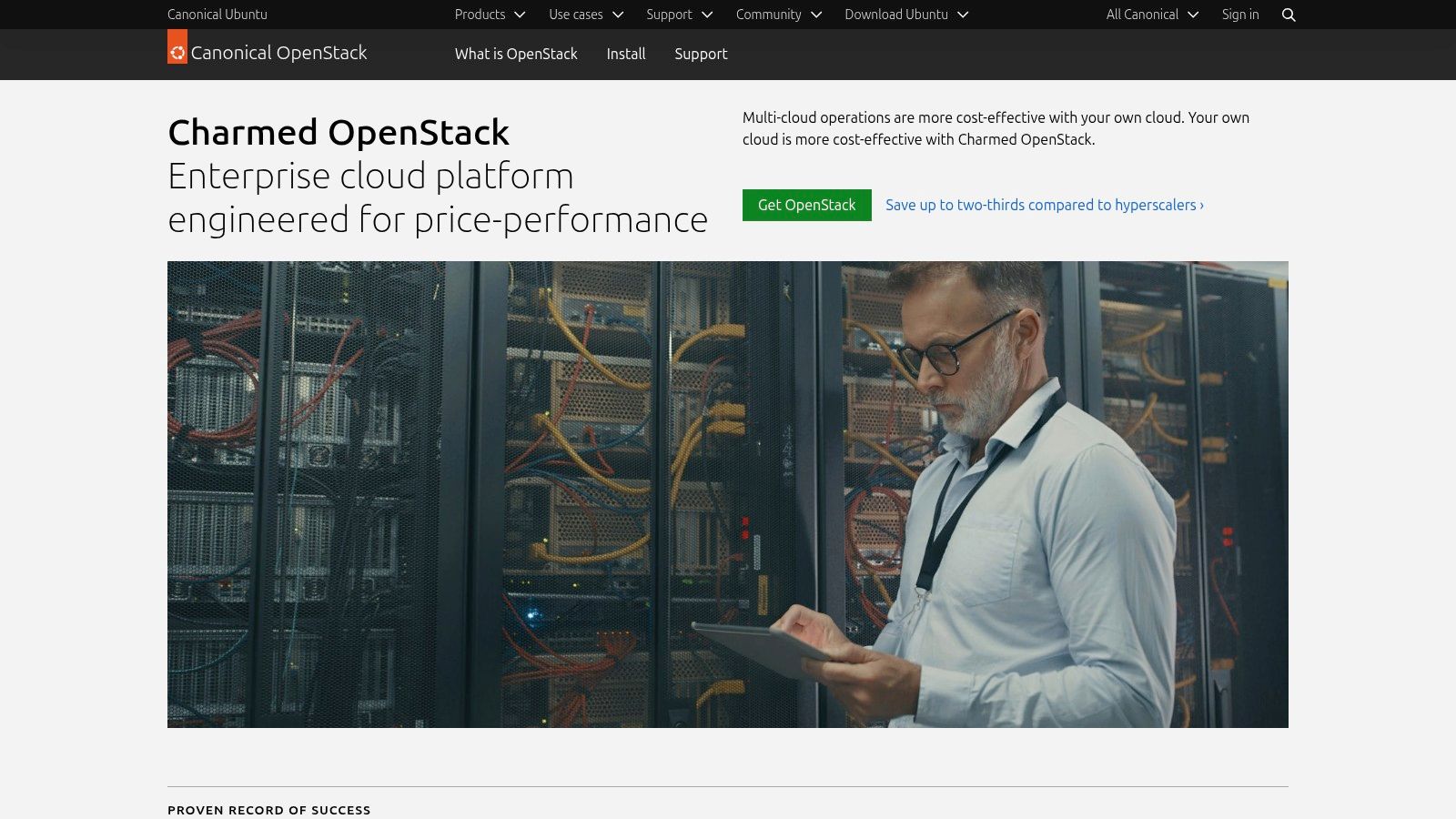
Canonical’s Charmed OpenStack offers a model-driven, automated approach to deploying and managing a private cloud on Ubuntu. It uses Juju charms to codify operational knowledge, which simplifies complex lifecycle management from bare metal provisioning to day-two operations. This makes it a compelling option for teams that want the power and flexibility of OpenStack without the full manual integration overhead. Its strong support for performance extensions also makes it a standout choice among private cloud computing providers for telcos and research institutions.
The platform’s value proposition is its ability to automate the deployment of a highly customizable OpenStack environment. It can integrate an optional Kubernetes layer, allowing both virtual machines and containers to be managed under a single Canonical subscription. This flexibility is key for organizations building out Network Functions Virtualization (NFV) infrastructure or High-Performance Computing (HPC) clusters where specific hardware integrations and performance tuning are critical.
Use Cases and Limitations
Best For:
- NFV & Telco Clouds: Its support for SR-IOV, DPDK, and NUMA makes it ideal for running virtualized network functions (VNFs) that demand high throughput and low latency.
- HPC and AI/ML Workloads: Native vGPU support allows for efficient resource allocation for computationally intensive scientific research or machine learning model training.
- Cost-Conscious OpenStack Deployments: Offers a potentially lower Total Cost of Ownership (TCO) compared to commercially licensed distributions, leveraging Ubuntu’s ecosystem and a single support subscription.
When NOT to use:
- Turnkey, Appliance-Like Solutions: Significant engineering effort is still required for the initial architectural design and charm integration. It is not a “plug-and-play” private cloud.
- Teams Lacking DevOps Skills: The model-driven approach presumes a level of comfort with automation tools (Juju) and infrastructure-as-code principles.
- Transparent Budgeting: Pricing is quote-based and not publicly listed. You must engage with Canonical’s sales team to get cost estimates, which can slow down initial planning.
Visit Website: https://ubuntu.com/openstack
12. Rackspace OpenStack Private Cloud (Managed)
Rackspace offers a managed private cloud built on OpenStack, designed for organizations that want the benefits of a private environment without the significant operational overhead. Instead of building an internal team to manage the complexities of OpenStack, you effectively outsource operations to Rackspace. This service can be deployed in a customer’s data center, a colocation facility, or a Rackspace data center, providing infrastructure flexibility.
The core value proposition is the offloading of specialized operational expertise. Rackspace provides a service backed by a 99.99% OpenStack API uptime guarantee and 24x7x365 operational support. This makes it a compelling choice among private cloud computing providers for enterprises that are committed to the OpenStack ecosystem but lack the deep, in-house skills required to run it reliably at scale. It essentially productizes the operational side of a notoriously complex open-source platform.
Use Cases and Limitations
Best For:
- Lean IT Teams: Organizations that need a dedicated private cloud but cannot justify hiring or training a specialized OpenStack operations team.
- Guaranteed Uptime: Workloads requiring stringent, financially-backed SLAs for API availability that would be difficult to achieve and maintain internally.
- Cost Predictability: Businesses looking for a more predictable operational expense (OpEx) model for their private cloud instead of the variable capital expense (CapEx) and unpredictable costs of self-management.
When NOT to use:
- Small-Scale Deployments: The managed service model and associated costs are generally best suited for larger, more complex environments. Small setups may find the TCO prohibitive.
- Multi-Hypervisor Strategies: The offering is fundamentally OpenStack-centric. If your strategy involves tight integration with other ecosystems like VMware or Hyper-V under a single management plane, this solution creates silos.
- Full Control Requirements: Organizations with security or operational models that require absolute, low-level control over the infrastructure and management tooling will find a managed service restrictive.
Visit Website: https://www.rackspace.com/solutions/private-cloud
Top 12 Private Cloud Providers — Feature Comparison
| Vendor | Primary use / Target audience | Key capabilities | Pricing model / Value | Unique selling point | Key caveats |
|---|---|---|---|---|---|
| AWS Outposts | Enterprises needing low-latency, data‑residency and AWS parity on‑prem | Turnkey AWS hardware; run EC2/EBS/S3/EKS locally; AWS APIs/CloudWatch/IAM | Rack or server purchase with multi‑year terms; includes delivery/maintenance | True AWS operational parity on‑prem | Requires Enterprise Support; commonly long (3yr+) commitments |
| Microsoft Azure Stack (Hub & HCI) | Teams wanting familiar Azure subscription, billing and management on‑prem | Azure Stack Hub (integrated systems) & HCI (hyperconverged), ARM/RBAC parity | Pay‑as‑you‑use or capacity models; EA/Cloud Solution Provider options | Azure management and tooling consistency on‑prem | Hub limited to validated hardware; guest OS licensing for HCI |
| Google Distributed Cloud (GDC) | Kubernetes‑native workloads and Anthos users; connected or air‑gapped needs | Kubernetes/Anthos lineage; connected & air‑gapped models; per‑vCPU/GPU fees | Transparent connected‑server pricing; air‑gapped via sales quote | Strong Kubernetes heritage and Google operations consistency | Air‑gapped pricing by quote; some deployments need Premier Support |
| Oracle Cloud@Customer | Organizations needing a full OCI region or rack‑scale stack on‑prem (DB/SaaS heavy) | Full OCI region or rack; 100+ services including Autonomous DB & Fusion SaaS | Same list pricing as public OCI; historically significant commercial minimums | Full IaaS+PaaS+SaaS parity on‑prem with cloud APIs | Site readiness and multi‑month deployments; notable minimum commitments |
| IBM Cloud Satellite | Enterprises seeking IBM compliance posture across on‑prem/edge/colos | Satellite locations on customer infra/colos; central IBM Cloud management; integrations | Pay‑as‑you‑go, subscriptions and reservation discounts available | IBM enterprise compliance and flexible deployment footprint | Some services require account orchestration; networking/latency planning needed |
| HPE GreenLake for Private Cloud | Teams wanting HPE‑managed consumption private cloud with VMware support | Bare metal/VMs/K8s provisioning; consumption billing; catalog/store; BYO license options | Pay‑per‑use metering, consumption billing; quote/reservation‑based SKUs | Strong VMware/NSX integration and procurement flexibility | Detailed pricing often quote‑based; advanced setups may need HPE professional services |
| Dell APEX Private Cloud | Organizations preferring Dell hardware + managed as‑a‑service | Managed lifecycle, APEX Console, monthly consumption; VMware or Red Hat stacks | Monthly consumption billing; sales‑quoted pricing | Turnkey Dell stacks with single‑pane APEX operations | SKU/region specifics; VMware licensing can affect TCO |
| VMware Cloud Foundation (VCF) by Broadcom | Enterprises standardized on VMware virtualization stack | Integrated vSphere, vSAN, NSX, Aria; license portability; consistent operating model | Typically purchased via OEM/channel; license‑based pricing | De facto enterprise virtualization stack with broad partner ecosystem | Licensing/portfolio changes under Broadcom require careful validation |
| Nutanix Private Cloud | Teams wanting simplified HCI with unified ops and optional AHV | Integrated data services, Prism ops, Calm automation; VMs & containers; AHV option | Quote‑based subscription/pricing via Nutanix or OEM partners | Simplified operations and native AHV to reduce hypervisor license dependency | Pricing quote‑based; capacity planning and sizing still required |
| Red Hat OpenStack Platform | NFV, edge and private IaaS where OpenStack is required with enterprise support | Enterprise OpenStack distro, deployment director, long support windows, SELinux | Subscription/quote pricing; long‑life support options | Mature OpenStack with Red Hat support ecosystem | Higher operational complexity; needs trained teams or managed services |
| Canonical Charmed OpenStack (Ubuntu) | Teams wanting automated OpenStack on Ubuntu with NFV/HPC features | Juju charm automation, optional Kubernetes, SR‑IOV/DPDK/NUMA/vGPU support | Subscription and quote‑based pricing | Model‑driven automation with close upstream alignment | Engineering/integration effort still required vs fully managed stacks |
| Rackspace OpenStack Private Cloud (Managed) | Organizations that want to outsource OpenStack operations and SLAs | Remotely managed OpenStack, 24x7 ops, 99.99% OpenStack API SLA, flexible deployment | Customized pricing based on scope and server count | Offloads operational complexity to experienced operator with SLAs | Pricing is customized; offering is OpenStack‑centric |
Making a Defensible Private Cloud Decision
The private cloud landscape is a complex intersection of hardware, software, and operational models. The primary failure mode in adoption isn’t the technology itself. It’s a fundamental mismatch between a solution’s operational demands and an organization’s actual capabilities and financial realities. The choice is not simply between public and private; it is a granular decision about which operational burden your organization is prepared to assume.
Choosing one of the major private cloud computing providers requires moving beyond feature comparisons. A hyperscaler-in-a-box solution like AWS Outposts or Azure Stack Hub seems straightforward, but its success hinges entirely on your organization’s existing commitment to that specific ecosystem. The TCO models for these platforms often hide significant costs in specialized certifications and the mandatory consumption of higher-level cloud services to justify the investment. An adoption fails when the on-premises hardware becomes a high-cost, underutilized island, disconnected from the broader cloud strategy it was meant to extend.
Conversely, open-source frameworks like OpenStack (managed by Red Hat, Canonical, or Rackspace) promise freedom from vendor lock-in but demand a steep price in operational expertise. Organizations consistently underestimate the engineering headcount required for stable operation. A mid-sized deployment can easily require a dedicated team of 4-6 specialized engineers, costing upwards of $1.2M annually in salaries alone, before even accounting for support contracts and infrastructure. The failure here is a slow burn: a drift into an unmaintainable, bespoke system that becomes its own form of technical debt.
A Framework for Your Final Decision
To avoid these common failure paths, your decision must be grounded in a candid, internal assessment. The ideal provider for your organization will be the one whose model aligns with your operational strengths, not one that forces you to build entirely new competencies under pressure. Before signing a multi-year contract, anchor your strategy by answering three critical questions:
- What is the fully-loaded, three-year Total Cost of Ownership (TCO)? This calculation must include not just the initial hardware and licensing, but also projected support renewals, mandatory training, and the market-rate salaries for the specific engineers needed to manage the platform. Factor in a realistic utilization rate; a 40% utilization of a system priced for 80% is a financial catastrophe.
- Does the operational model require skills we cannot realistically hire or retain? Be honest about the current talent market. If a solution demands three certified Kubernetes networking specialists and you struggle to retain one, that platform presents a significant operational risk. The cost of contractor support to fill these gaps can easily negate any projected savings over public cloud.
- What are our non-negotiable technical and business requirements? Define the specific workloads that must run on-premises. Is it for sub-5ms latency for a manufacturing process? Is it for GDPR or HIPAA data sovereignty that prohibits data from leaving a specific physical location? These non-negotiable items are your true north; any provider that cannot meet them is disqualified, regardless of cost or features.
The Path Forward
The vendors detailed in this guide, from HPE GreenLake and Dell APEX to VMware and Nutanix, each present a unique value proposition and a distinct set of trade-offs. Your final choice of a private cloud computing provider should feel less like a preference and more like an inevitability driven by your data. For organizations exploring various cloud solutions, including potential private cloud options, additional providers like Dr3am Systems’ Cloud offerings can offer comprehensive cloud services that may fit within your strategic evaluation.
Ultimately, a defensible decision is one you can support with a clear financial model, a realistic staffing plan, and a precise alignment to business-critical requirements. This approach transforms the selection process from a vendor bake-off into a strategic, data-driven exercise in risk management and operational alignment.
Your private cloud strategy is too critical to base on vendor-supplied data alone. Modernization Intel provides unbiased, data-driven intelligence and TCO models on over 200 vendors to help you validate your shortlist and avoid costly implementation failures. Get the objective analysis you need to make a truly defensible decision at Modernization Intel.
Need help with your modernization project?
Get matched with vetted specialists who can help you modernize your APIs, migrate to Kubernetes, or transform legacy systems.
Browse Services