
What Is Technology Consulting: A Guide for CTOs
Technology consulting isn’t about outsourcing your core strategy. It’s a targeted strike. You bring in external experts to solve a specific, high-stakes problem your in-house team can’t tackle—either due to a niche skill gap, existing workload, or being too close to the problem to see the objective solution.
This is about a surgical injection of expertise to hit a measurable goal, like migrating a legacy system with a 99.9% data integrity metric or reducing cloud spend by a specific percentage, typically 15-30%.
Defining Technology Consulting Beyond the Buzzwords
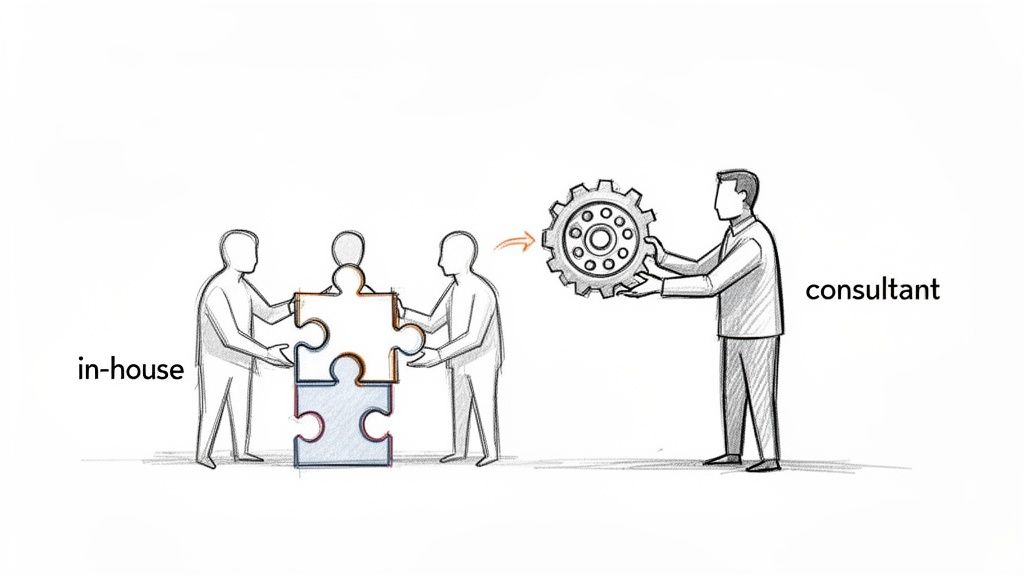
At its core, technology consulting is a lever for technical leaders evaluating the “build vs. buy” equation. The decision to hire a consultant should be strategic, not a reaction to an emergency. It’s about recognizing when the cost of your team’s learning curve, the project delays, or a potential high-cost mistake is greater than the cost of a specialist who has solved the same problem for multiple clients.
The market for these services is projected to exceed $400 billion by 2026 as companies grapple with complex upgrades. Data from various industry reports indicates that 81% of firms plan to use consultants to fill critical skill gaps, and a reported 92% of recent digital transformation projects relied on external partners.
When to Bring in Outside Expertise
A common trigger is the need for an unbiased, outside opinion. Internal teams can be influenced by company politics, personal technology preferences, or the sunk-cost fallacy, making it difficult to get an objective view of a project. This is why many consulting engagements kick off with a comprehensive business technology assessment to map the current state and identify opportunities based on data, not internal biases.
This external viewpoint is crucial for high-stakes projects where a single architectural error could have significant financial or operational impact. You should consider bringing in consultants in these key scenarios:
- Niche Skill Gaps: Your team has strong Java expertise, but you have a monolithic COBOL system that needs migrating. A specialist knows the common failure points, like how to handle fixed-point arithmetic conversions, potentially saving months of trial-and-error.
- Constrained Timelines: A market window is closing, and you need to launch a new product faster than your team can deliver. Consultants can provide the surge capacity needed to hit a deadline without leading to burnout for your full-time staff.
- Complex Modernizations: Projects that involve deep architectural changes or complex data migrations are prone to failure. These require battle-tested experience. For a closer look, see our guide on the modernization of technology.
Ultimately, a consultant’s value is in delivering a specific, pre-agreed outcome with a clear ROI. They de-risk critical initiatives and, if structured correctly, transfer that knowledge to your team.
The Six Core Types of Technology Consulting
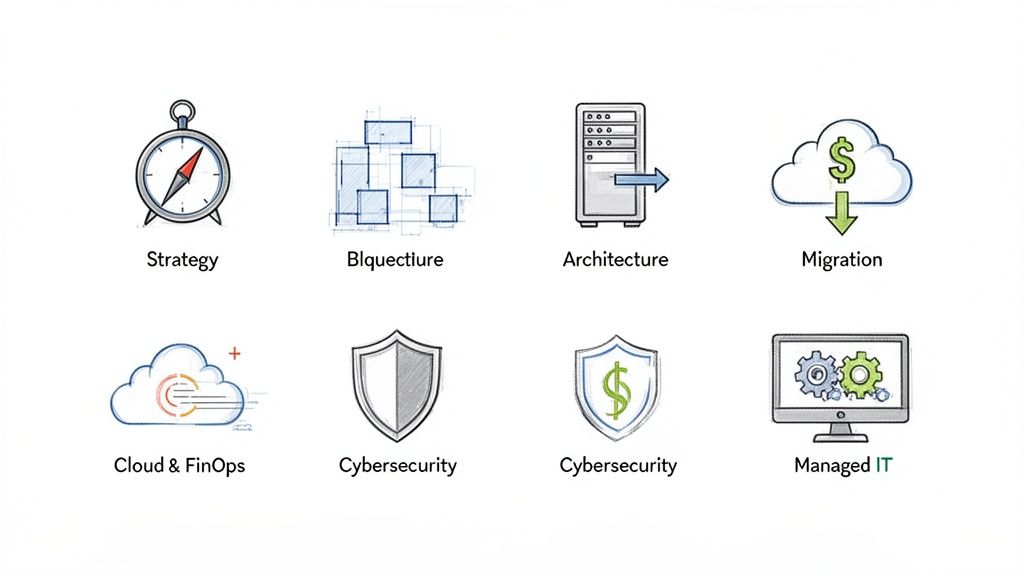
Technology consulting is not a monolithic service. It’s a collection of distinct disciplines, each designed to solve a specific class of business problems. You wouldn’t hire a strategist to debug a memory leak, just as you wouldn’t ask a migration specialist to define your three-year IT roadmap.
Understanding these distinctions is a critical step in avoiding a failed engagement. When you map your problem to the right service type, you can evaluate vendors with the correct skills. Most consulting work falls into one of these six categories.
Mapping Business Problems to Consulting Services
This table connects common business pains to the specific consulting service designed to address them. Use it as a quick reference to identify your problem and the type of firm you should be evaluating.
| Business Problem | Consulting Service Type | Typical Outcome |
|---|---|---|
| ”Our tech spend is reactive; we lack a multi-year plan.” | Technology Strategy & Advisory | A 3-year roadmap with a TCO model. |
| ”We’re starting a new project and need to avoid a rewrite.” | Software & Solution Architecture | A technical blueprint that prevents costly rework. |
| ”Our mainframe is a black box and the talent is retiring.” | System Modernization & Migration | A new, cloud-native system with a zero-downtime cutover. |
| ”Our AWS bill is unpredictable and growing 20% MoM.” | Cloud Services & FinOps | 15-30% reduction in cloud spend within 90 days. |
| ”We need to achieve SOC 2 compliance to close enterprise deals.” | Cybersecurity Consulting | A passed audit and a formal compliance report. |
| ”Our senior engineers are bogged down with helpdesk tickets.” | Managed IT Services | Outsourced IT operations, freeing up core engineering teams. |
This mapping is the filter you should use to build your vendor shortlist. Now, let’s unpack what each of these services entails.
1. Technology Strategy and Advisory
This is the “30,000-foot view.” Strategy consultants don’t write code; they answer foundational business questions with a technological lens. Think “Should we build this new platform from scratch or buy an off-the-shelf solution?” or “How do we need to restructure our engineering team to support international expansion?”
- When to engage: You’re facing a major technology investment or organizational shift and need an objective, data-backed plan.
- Example: A retailer wants to expand its e-commerce presence. A strategy consultant would analyze the market, model the total cost of ownership for platforms like Shopify Plus versus a custom build, and deliver a recommendation tied to financial projections and a risk assessment.
2. Software and Solution Architecture
If strategy is the “what” and “why,” architecture is the “how.” These consultants design the technical blueprint for new systems or figure out how to refactor existing ones. Their work focuses on non-functional requirements: scalability, security, resilience, and maintainability.
They produce the diagrams, documentation, and technical specifications your internal team or an implementation partner will use to build the software.
Key Takeaway: An architect’s main deliverable is a defensible plan, not code. A solid architecture helps prevent expensive rework by ensuring the system can handle future traffic and business needs before significant code is written.
3. System Modernization and Migration
This is a highly specialized discipline focused on moving logic and data from legacy systems (e.g., mainframes, AS/400s) to modern platforms (e.g., cloud-native microservices). This is rarely a simple “lift and shift.” It demands deep expertise in both the old and new technologies to prevent data corruption and business disruption.
- When to engage: Your core business runs on a legacy system that is fragile, expensive, and not well understood by your current team.
- Example: A bank needs to migrate its core transaction logic from a COBOL mainframe to a Java-based microservices architecture. A modernization specialist understands critical details, like ensuring COBOL’s
COMP-3packed-decimal data types are correctly converted to Java’sBigDecimalclass. Mishandling this single detail is a common failure point in an estimated 67% of COBOL migrations, leading to silent, catastrophic rounding errors.
4. Cloud Services and FinOps
This specialty covers everything from the initial cloud migration plan to the ongoing discipline of cost optimization. Previously, these consultants focused on moving clients to AWS, Azure, or GCP. Today, the focus has shifted heavily to FinOps (Financial Operations)—the practice of managing and reducing cloud spend.
Cloud providers have an incentive for you to over-commit on services like Reserved Instances. A FinOps consultant brings the tools and analysis to right-size your environment and eliminate waste, often achieving 15-30% savings on monthly cloud bills.
5. Cybersecurity Consulting
These are the experts you engage to identify and remediate security vulnerabilities. Engagements range from penetration testing (ethically hacking your systems to find weaknesses) to developing the policies and controls needed to pass a SOC 2 or ISO 27001 audit.
Firms are brought in either proactively, to strengthen defenses, or reactively, to manage the aftermath of a security breach, performing forensic analysis to determine the cause and prevent recurrence.
6. Managed IT Services
Unlike project-based services, this is about outsourcing day-to-day operations. A Managed Service Provider (MSP) takes over recurring tasks like network monitoring, helpdesk support, and server patching for a flat monthly fee.
This is a common option for businesses that lack a dedicated internal IT department or want to free up their existing team to focus on more strategic work.
Why Many Technology Consulting Engagements Fail
Companies are investing heavily in external expertise. The global tech consulting market is projected to reach $421 billion by 2025, and 92% of companies report using consultants for digital transformation. However, a significant number of these projects under-deliver. Dive deeper into the consulting market trends here.
The failures are often predictable. They happen because the traditional consulting model can contain misaligned incentives and other structural traps.
This isn’t about blaming vendors. It’s about recognizing the patterns—misaligned incentives, superficial expertise, ineffective knowledge transfer—that lead to budget overruns and solutions that create new problems. If you know what to look for, you can mitigate these risks.
Misaligned Incentives
This is a primary cause of consulting failures. The conflict is simple: your goal is to solve a problem efficiently, but some firms’ business model is based on billing as many hours as possible.
When a firm bills for time and materials, their revenue is tied directly to the length of the engagement. This can create a dynamic that works against your interests:
- Scope Creep: A two-week task can expand into a two-month project as new “requirements” are discovered.
- Bloated Teams: Projects can be staffed with junior consultants who require significant guidance from your engineers, increasing your bill without proportional value.
- The “Land and Expand” Model: A small, well-defined project slowly expands as the consultants identify new issues that fall into their other service offerings.
This is why many FinOps projects deliver a one-time savings report but fail to embed a lasting cost-conscious culture. The consultant’s model can thrive on dependency, not client independence.
Superficial Technical Depth
The second issue is the “strategy gap.” You might hire a firm that produces excellent high-level roadmaps, but their team may lack the deep engineering expertise to implement their own advice. They are generalists who can discuss business outcomes but struggle with low-level technical execution.
An architectural diagram is of little use if the consulting team doesn’t understand the implementation complexities. For instance, recommending a COBOL-to-Java migration is straightforward; knowing that 67% of such projects fail due to mishandling
COMP-3decimal precision is the kind of niche expertise that determines success.
This gap can force your engineering team to do the heavy lifting, translating vague strategies into functional code. In the worst case, your team ends up rewriting the consultants’ flawed work, meaning you’ve paid twice for the same outcome.
Ineffective Knowledge Transfer
The third common failure is the lack of upskilling for your team. A good consulting engagement is a temporary injection of expertise. They should solve a specific problem and enable your team to own the solution long-term.
However, sometimes the opposite occurs. Consultants may build a “black box” solution using proprietary tools or obscure patterns your team cannot support. They fix the immediate issue but create a long-term dependency. The moment something breaks, you have to call them back.
That is not a partnership; it’s vendor lock-in. A successful engagement should leave your team more capable than they were before.
Decoding the True Costs of Technology Consulting
“It’s expensive” is not a useful budget input. To have a credible conversation with finance or evaluate a proposal, you need specific numbers. The cost of technology consulting varies widely, but there are market-driven benchmarks.
It starts with how the engagement is structured.
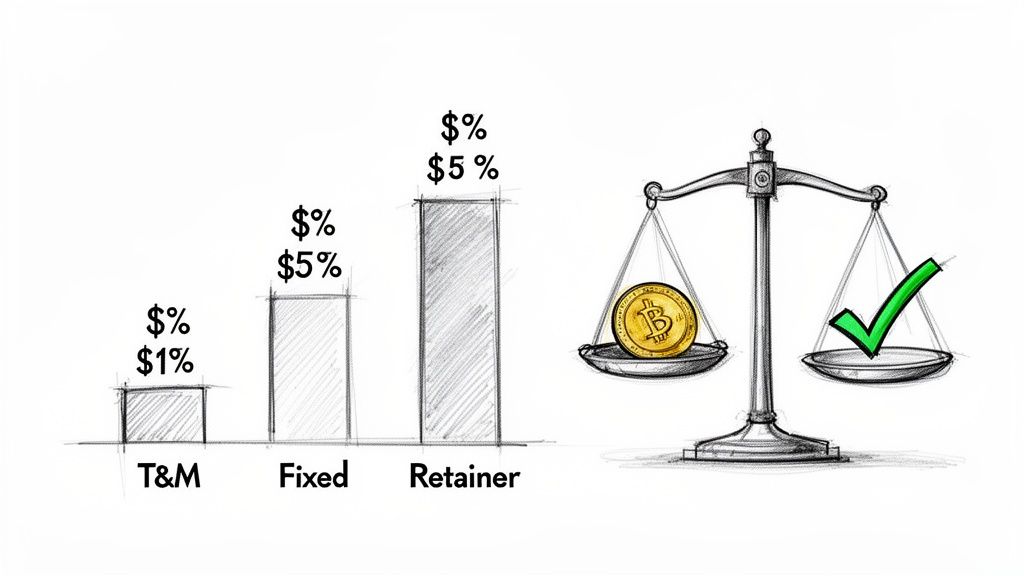
Most proposals will fall into one of three models. Choosing the wrong one is a common way projects go over budget.
Common Pricing Models Explained
The pricing model you choose shifts risk between you and the vendor. The right model depends on how well-defined your project scope is.
- Time and Materials (T&M): You pay for the hours worked. This is suitable for projects where requirements are expected to evolve, but it carries a risk of budget overruns if not managed closely.
- Fixed-Price: The consultant agrees to deliver a specific outcome for a single fee. This model places the risk of inefficiency on the vendor, making it ideal for projects with clear requirements.
- Retainer: You pay a recurring fee for ongoing access to experts. This works best for long-term advisory roles or managed services.
A mismatch here can lead to problems. Applying a T&M model to a poorly defined project can result in significant cost overruns.
Real-World Cost Benchmarks for Consulting Services
Below are some range-bound cost benchmarks for common consulting services. Think of these as market rates. If a vendor quote is significantly outside these ranges, it warrants scrutiny.
This table provides a baseline for evaluating proposals and for budget discussions.
| Consulting Service | Common Pricing Model | Typical Cost Range |
|---|---|---|
| COBOL to Java Migration | Fixed-Price (Per LOC) | $1.50 - $4.00 per line of code |
| Cloud FinOps | Performance-Based | 15-30% of annualized savings |
| Solution Architecture | Retainer or T&M | $175 - $350 per hour |
| Cybersecurity Audit (SOC 2) | Fixed-Price | $25,000 - $80,000+ per audit |
| Managed IT Services | Retainer (Per User/Device) | $75 - $250 per user, per month |
These figures reflect the market value for specialized expertise. For example, a vendor pitching a COBOL migration at $0.50 per line of code is a red flag. They are likely using junior developers or over-relying on automated tools that could miss critical business logic, leading to expensive rework.
Budgeting Insight: For a legacy system with 1 million lines of COBOL, a reasonable migration estimate falls between $1.5M and $4.0M. This kind of calculation is necessary for credible budget planning.
Armed with this data, you can question quotes that are too high or, more dangerously, too low. To get more granular, it’s worth understanding the drivers behind consulting hourly rates.
Knowing the market rate is your best defense against overpaying or underpaying for a project that costs more in the long run.
A Framework for Selecting the Right Consulting Partner
Choosing a technology consulting partner based on a sales pitch is a high-risk approach. You need a structured selection process. This is about finding evidence they can solve your specific technical problem.
Think of it less as a sales cycle and more as a technical due diligence process. The goal is to de-risk a significant investment before a contract is signed.
Step 1: Define Success Metrics First
Before evaluating vendors, define what a successful project looks like in quantitative terms. This internal alignment is a critical and often-skipped step.
These metrics must be specific and tied to business outcomes.
- Weak Metric: “Improve our cloud efficiency.”
- Strong Metric: “Reduce AWS EC2 spending by 18% within 90 days without impacting application performance, measured by a 5% or less increase in P95 latency.”
With clear metrics, every vendor conversation is focused on outcomes, not just their process. It helps filter out firms that cannot commit to tangible results.
Step 2: Vet for Niche Technical Expertise
Generalist firms are common. You often need a partner with deep, narrow expertise in your specific problem domain. This requires asking sharp technical questions that go beyond marketing materials.
When selecting your partner, it’s important to know how to choose a top software engineering consulting firm that can deliver tailored solutions.
For a mainframe modernization project, you might ask: “Describe your process for validating data integrity when migrating COBOL COMP-3 packed-decimal fields to Java’s BigDecimal. What specific testing tools do you use to prevent precision loss?” Their answer will reveal more than a case study.
Step 3: Demand Verifiable Proof
Case studies on a website are marketing assets. You need verifiable proof of their work. Ask to see sanitized—but detailed—project plans, architectural diagrams, or even code samples from relevant past projects.
More importantly, request client references. Ask to speak directly with the technical lead from a project similar to yours. Ask direct questions:
- What was the most significant technical challenge during the project?
- How did the consulting team handle unexpected issues?
- Describe the knowledge transfer. Did your team feel equipped to own the solution afterward?
Step 4: Interview the Delivery Team, Not the Sales Team
You won’t be working with the firm’s VP of Sales. You’ll be working day-to-day with their senior architect and lead engineers. Insist on interviewing the actual delivery team who will be assigned to your project. This is non-negotiable.
This is your chance to assess their technical depth, communication style, and cultural fit with your team. If a vendor resists this, it’s a major red flag.
Step 5: Run a Paid Discovery Project
Before committing to a full-scale engagement, consider a small, paid discovery project. This is the ultimate test drive. A typical discovery lasts two to four weeks with a focused scope, like architecting a single microservice or mapping one critical business process in your legacy system.
This small investment (typically $20k - $50k) is an insurance policy against a multi-million dollar mistake. It gives you an unvarnished look at their technical skills, project management discipline, and how they collaborate with your team.
If you are evaluating different vendors, you should check out our guide on how to choose the right DevOps consulting companies.
When You Should Not Hire a Technology Consultant
Knowing when to bring in a technology consultant is important, but knowing when not to is arguably more critical. Making the wrong call can burn budget, damage team morale, and risk your core intellectual property.
Hiring outside help isn’t a universal solution. Recognizing the red flags is a strategic necessity. Certain situations are structurally misaligned with the consulting model, and proceeding can guarantee friction and wasted money.
When the Problem is Your Core Intellectual Property
If the technical challenge is central to your company’s competitive advantage—your “secret sauce”—outsourcing it is a strategic error. This is about retaining and growing the institutional knowledge that makes you unique. Consultants can build a feature, but they can’t own the long-term evolution of your core product.
Handing this work over denies your internal team the experience they need to innovate. The short-term speed gained can be offset by long-term dependency and a hollowed-out engineering culture.
When the Project Scope is Poorly Defined
A project that begins with a vague objective like “modernize our platform” is a consultant’s dream and a client’s nightmare. That ambiguity can lead to a blank check for time-and-materials billing, where every “discovery” adds to the invoice.
Without a clear definition of done, tied to measurable business outcomes, you are setting up for a potentially endless engagement. A reputable consultant should push back on an undefined scope; one who doesn’t is a major red flag.
When Your Internal Team is Hostile to Outsiders
Technology is not implemented in a vacuum. If your internal engineering team is resistant to external help, the project is at risk from the start. No consultant can force a solution onto a team that is determined to see it fail.
This “not invented here” syndrome can lead to various forms of project resistance. The consultants’ recommendations may be ignored, their code heavily criticized, and the final handoff may be problematic.
When the Budget Only Allows for a Low-Quality Vendor
Choosing the cheapest option in technology consulting can be one of the most expensive mistakes. A low-cost vendor often indicates a lack of senior talent, an over-reliance on junior staff, or a misunderstanding of your project’s complexity.
This path frequently leads to low-quality work that requires a second, more expensive consultant to fix. It is often better to postpone the project than to underfund it with a partner likely to underdeliver.
Frequently Asked Questions
Once proposals are submitted, practical questions arise. These are the high-stakes concerns that CTOs and VPs of Engineering need answered before signing a contract.
Here are direct answers to common questions.
Who Owns the Intellectual Property a Consultant Creates?
This needs to be explicitly defined in your Statement of Work (SOW). The industry standard for reputable firms is “work for hire.” This means your company owns 100% of the intellectual property—code, documentation, diagrams—created specifically for you.
Verify this language is in the contract.
Be wary of any vendor attempting to retain ownership of the core work. A gray area is their internal tooling. Consultants often use pre-existing libraries or scripts. Your contract should grant you a perpetual, royalty-free license to use these tools in the context of the delivered work, but you won’t own the tools themselves. That’s a standard and fair arrangement.
How Can I Ensure Consultants Transfer Their Knowledge?
Knowledge transfer cannot be a passive process; it must be a contracted deliverable. If it’s not in the SOW, it is unlikely to happen effectively.
Here’s how to structure it:
- Mandatory Paired Programming: Specify that the consultant’s engineers must spend a set number of hours (e.g., 10 hours per week) in paired sessions with your team.
- Documentation as a Deliverable: Be explicit. Vague promises of “documentation” are insufficient. Demand architectural decision records (ADRs), sequence diagrams, and a full runbook for operating the new system.
- “Show Me” Acceptance Criteria: Tie the final payment to your team demonstrating they can maintain the system. A good milestone is having your engineer independently deploy a minor bug fix while the consultants observe.
How Do You Measure the ROI of a Consulting Engagement?
You can’t measure ROI effectively unless you define quantitative metrics before the project starts. Vague goals like “improve efficiency” are difficult to measure. The engagement should be tied to a specific business outcome.
For a Cloud FinOps engagement, the ROI is straightforward: you pay a consultant $80,000, and they reduce your annualized AWS bill by $400,000. That’s a 400% ROI. For a modernization project, the calculation might be based on eliminating mainframe licensing fees, which can exceed $500,000 per year.
Other hard metrics could be a reduction in P95 latency for a performance tuning project or a drop in production support tickets after a system stabilization effort. The key is to baseline these numbers before the work begins and measure them again three to six months after the engagement ends.
At Modernization Intel, we provide unbiased data to help you make these critical vendor decisions. Our platform offers intelligence on partner failure rates, real cost benchmarks, and vendor specializations, helping you build a defensible case for your next technology investment. Get your complimentary vendor shortlist.