
Staff Augmentation Services: A Guide to Acquiring Scalable Tech Talent
Staff augmentation services provide a method for filling critical skill gaps without the long-term commitment and overhead of a full-time hire. The model allows for the precise injection of specific expertise when and where it’s needed, for a defined duration, while the client maintains direct project control.
Understanding the Core Function of Staff Augmentation
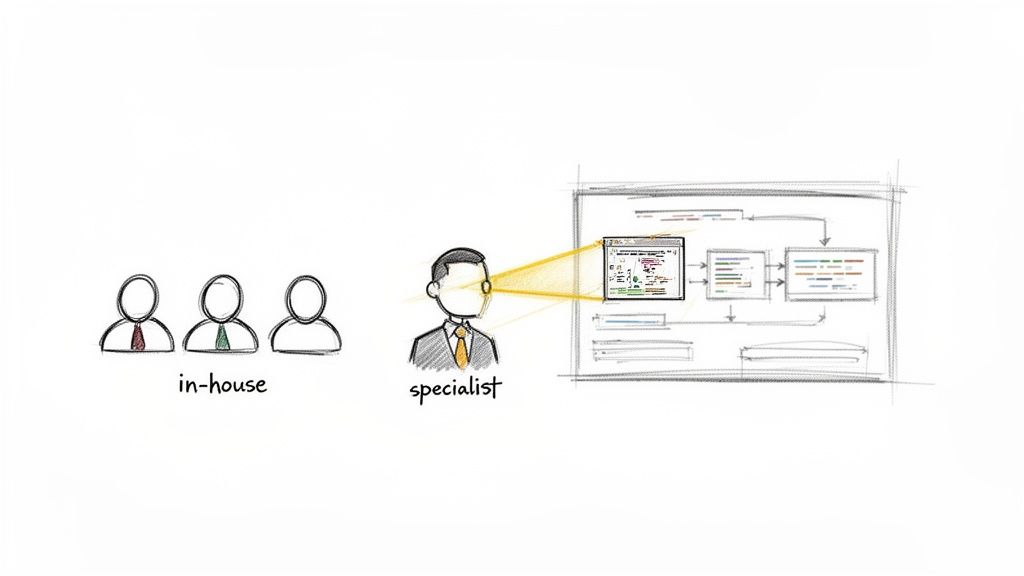
Staff augmentation is not traditional hiring. A useful analogy is bringing in a surgical specialist for a high-stakes operation. The internal team members are the lead surgeons; they own the plan, direct the procedure, and are accountable for the outcome.
The augmented staff member is the niche specialist—an expert in a domain like mainframe migration or cloud security—contracted to handle a specific, complex task the internal team is not equipped for. The specialist provides the skill; the client directs the application of that skill.
This model differs from other outsourcing approaches where entire projects or functions are delegated. With staff augmentation services, the client retains direct managerial control. The contracted expert integrates into existing workflows, reports to internal managers, and participates in daily team meetings. The client is purchasing time and skills, not a pre-defined deliverable.
This distinction is fundamental. Project management, daily execution, and ultimate accountability for success or failure remain with the client. The vendor’s primary function is to provide qualified talent that meets a precise set of requirements.
How It Compares to Other Models
The primary differentiators of staff augmentation are control and integration. It is not project-based outsourcing, where a statement of work is delivered to a third party for independent execution. Augmentation embeds talent directly into the client’s command structure, which can reduce the communication latency and misalignment that often lead to poor outcomes in outsourced projects.
It also differs from managed services, where a provider assumes full ownership of an ongoing function—such as an IT helpdesk or network monitoring—and is accountable for meeting specific Service Level Agreements (SLAs). In a managed services model, the client pays for a guaranteed result. With augmentation, the client pays for expertise.
The following table breaks down the key differences.
Staff Augmentation vs Other Outsourcing Models
This side-by-side comparison illustrates how these models function in practice, with a focus on control and responsibility.
| Attribute | Staff Augmentation | Managed Services | Project-Based Outsourcing |
|---|---|---|---|
| Control | Client manages resources directly. | Vendor manages resources and is accountable for outcomes. | Vendor manages the project, team, and deliverables. |
| Integration | High; resources integrate into the client’s daily operations. | Low; the vendor operates as a separate, accountable unit. | Low to medium; interaction is limited to project scope. |
| Cost Model | Time-based (hourly/monthly rate per person). | Outcome-based (fixed monthly fee tied to an SLA). | Fixed price or time & materials for the entire project. |
| Best For | Filling skill gaps for a specific project or initiative. | Ongoing, repeatable operational functions (e.g., IT support). | Well-defined projects with a clear start, end, and scope. |
Selecting the appropriate model is critical. Staff augmentation is most effective when an organization needs to increase its team’s capability without relinquishing control over project direction.
What’s Driving the Technical Augmentation Market?
Staff augmentation was historically viewed as a tactical, last-resort measure for temporary staffing shortages. Today, it is a component of strategic workforce planning for many technology leaders.
The primary driver of this shift is the imbalance between the supply and demand for specialized technical skills. The need for expertise in complex areas like software modernization has grown faster than the available in-house talent pool.
Market data illustrates this trend. The global market for these services was valued at USD 6.89 billion in 2024 and is projected to reach USD 7.35 billion in 2025. With a compound annual growth rate (CAGR) of 7.11%, it is forecasted to reach USD 11.94 billion by 2032. This indicates a structural shift in how companies construct technical teams.
This growth is not about adding headcount but about acquiring specific capabilities. The market has matured from providing general IT staff to offering specialists with deep, verifiable expertise in specific domains.
The Rise of Niche Specialization
A decade ago, a request for a “Java developer” might have been sufficient. Today, a high-stakes modernization project often requires a Java developer who also understands legacy COBOL data structures like COMP-3, has experience with specific AWS migration tools, and is knowledgeable about financial services compliance.
Generalists are often inadequate for these types of critical initiatives.
This is where the modern augmentation market provides value. It allows engineering leaders to bypass the slow and often unsuccessful process of hiring for niche, short-term needs.
A modern augmentation partner’s function is not to provide more headcount. It is to de-risk a project by injecting the right expertise at the right time. The purchase is capability, not just capacity.
When evaluating vendors, there is a significant difference between a generic staffing firm and the leading IT staff augmentation companies that deliver specialized talent. The evaluation criteria should focus on niche expertise, not bench size.
From Tactical Gap-Filling to Strategic Enabler
Effective engineering leaders no longer view augmentation as a cost center but as a strategic tool for acceleration. It is used to advance crucial projects that would otherwise be delayed pending a difficult hire.
Common applications include:
- Accelerating Legacy Modernization: Engaging engineers fluent in both mainframe languages (like COBOL or PL/I) and modern cloud platforms can significantly reduce migration timelines.
- Improving Cloud Cost Optimization: Embedding a FinOps specialist for a few months can identify and eliminate wasteful cloud spend, a skillset that is difficult to develop internally from scratch.
- Executing Secure Migrations: Hiring a cloud security architect with deep knowledge of a specific compliance framework like HIPAA or PCI-DSS for the project’s duration can help ensure it’s implemented correctly.
This reframing changes the cost-benefit analysis. The discussion shifts from comparing a contractor’s hourly rate to a full-time salary to evaluating the opportunity cost of project delays, the financial risk of a failed migration, and the competitive disadvantage of being unable to adopt modern technology. The market’s growth suggests that more leaders are adopting this perspective.
Calculating the True Cost of Staff Augmentation
To accurately budget for staff augmentation, one must look beyond the vendor’s rate card. The stated hourly or monthly fee often represents only 70-80% of the total cost of engagement. Overlooking indirect expenses is a common cause of budget overruns and stakeholder friction.
A realistic cost model must include both direct vendor fees and the indirect internal costs associated with integrating an external resource into the team. The sticker price is the starting point for the calculation.
Deconstructing the Vendor Rate Card
The most transparent costs are the direct rates paid to the provider. These are typically structured in one of two ways and can vary significantly based on skill set.
- Hourly Rates: This is the most common model, offering flexibility. The client pays for hours worked, which is suitable for projects with variable workloads.
- Monthly Retainers: For longer-term engagements (6+ months), some vendors offer a fixed monthly fee. This provides cost predictability but less flexibility if project needs change.
The rate itself is a function of supply and demand. A generalist front-end developer will have a lower rate than a specialist with deep experience in a niche technology.
Expect significant cost variance between roles. A senior COBOL developer with financial services experience may bill at $150-$225 per hour. A certified FinOps professional could range from $175-$300 per hour due to their direct impact on reducing cloud expenditures.
These rates reflect that the client is paying for specialized expertise not available in-house. For a more detailed breakdown, see our guide on typical consulting hourly rates.
Uncovering the Hidden Internal Costs
The costs that frequently cause budget issues are internal. These are the soft costs that do not appear on an invoice but impact the budget and team productivity.
The total cost of ownership must account for the overhead of onboarding an external resource. This process extends beyond a single day of HR orientation and can be a multi-week effort that consumes time from senior engineers and managers.
Key hidden costs to include in your model:
- Onboarding and Integration Time: This includes setting up development environments, explaining coding standards, and integrating into daily meetings. A common estimate is that a new resource operates at 50% productivity for the first two weeks.
- Knowledge Transfer Overhead: Internal subject matter experts must allocate time to explain system architecture, business rules, and historical context, which directly impacts their own task completion.
- Management Overhead: Project managers and team leads will spend additional time managing tasks, providing feedback, and integrating the new person into existing workflows.
- Productivity Dip of Existing Team: Introducing a new member, regardless of skill, can temporarily disrupt a team’s established communication patterns and workflow. Expect a minor, short-term reduction in the team’s velocity.
The market for these services is expanding rapidly, making accurate cost modeling essential.
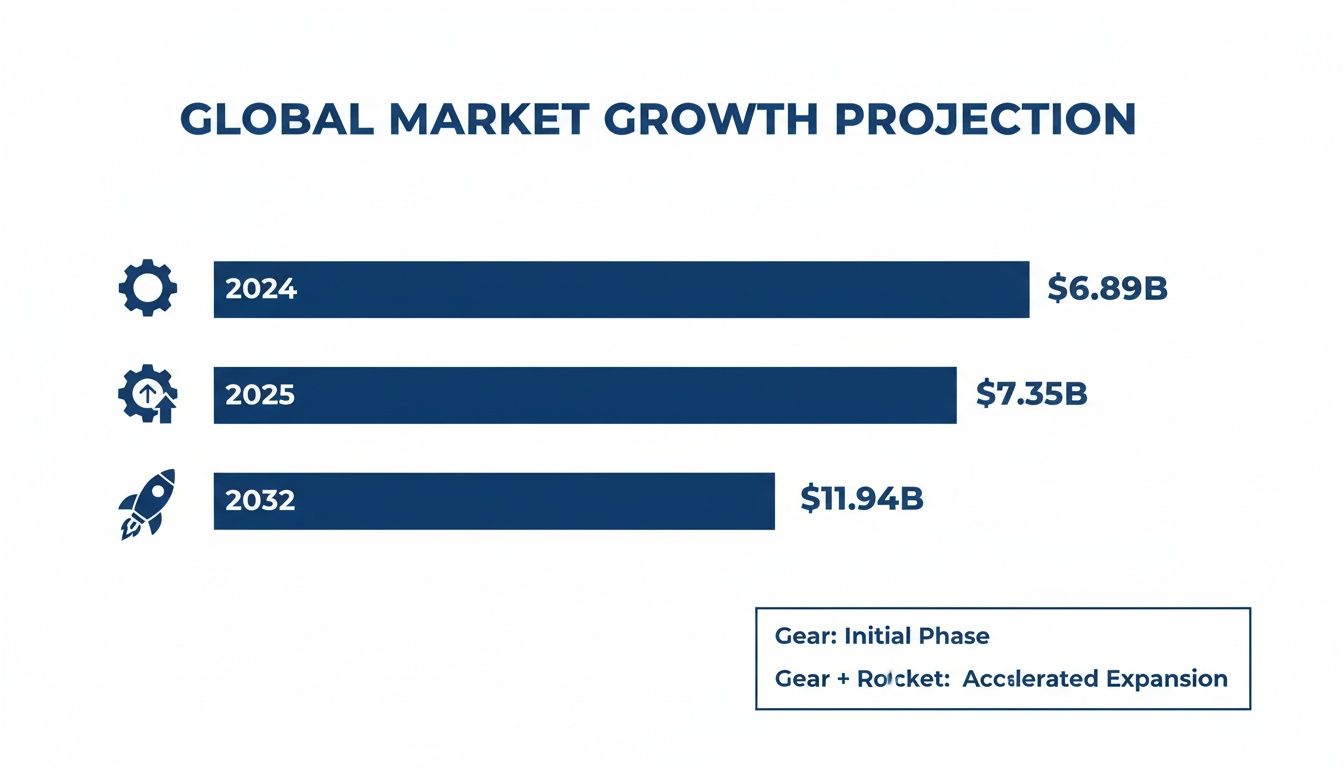
This projection shows the market growing from $6.89B in 2024 to an expected $11.94B by 2032. In a market this active, inaccurate budgeting puts an organization at a competitive disadvantage.
By building a comprehensive cost model that includes both vendor rates and internal overhead, you can develop a budget that is defensible and helps ensure the engagement delivers its expected value without unforeseen financial issues.
Top 3 Reasons Staff Augmentation Engagements Fail
Staff augmentation failures are typically not caused by a single event but by an accumulation of preventable mistakes. These engagements often fail due to a gradual erosion of effectiveness, not a sudden collapse.
The root cause is rarely a developer’s technical inability. The more common problems are mismatches in culture, process, and the specific type of technical expertise required for the project.
1. Misalignment of Culture and Process
A frequent mistake is assuming a skilled engineer will automatically synchronize with a team’s specific workflow and communication style. Placing a developer accustomed to a rigid, waterfall process into a high-velocity agile team creates operational friction. This is not a personality conflict but a process collision.
This friction manifests in ways that reduce productivity:
- Ineffective Stand-Ups: A developer unaccustomed to agile practices may be hesitant to report blockers in daily stand-ups, causing delays to go unaddressed.
- Communication Gaps: If an internal team relies on asynchronous communication via Slack, an augmented member who expects formal meetings for decisions can slow down the entire process.
- Contentious Code Reviews: A misalignment in standards for code quality and documentation can turn collaborative code reviews into bottlenecks, obstructing the delivery pipeline.
This persistent misalignment requires managers to spend time on process and personality issues rather than on project execution.
2. The Pitfall of Inadequate Knowledge Transfer
Another common failure point is an unstructured or non-existent knowledge transfer (KT) plan. Many organizations treat onboarding as a one-time event: a few introductory meetings and a link to documentation. This approach creates a long-term dependency on the temporary staff.
Without a structured, continuous KT process, critical business logic and architectural knowledge remain with the external expert. When the contract ends, that knowledge is lost, leaving the internal team with a significant capability gap.
A successful augmentation engagement should result in the client’s team being more capable than when it started. If the expert’s knowledge is not transferred, the engagement has only provided a temporary solution to a skill gap, not a lasting one.
Effective KT is a deliberate, ongoing strategy. It may include paired programming, mandatory documentation, and formal training sessions where the expert educates full-time staff. Anything less risks accumulating knowledge debt. To learn more about vetting vendor processes, it can be useful to review how to select a website development outsourcing company.
3. Selecting for Cost Over Specialization
Choosing a vendor based on the lowest hourly rate instead of deep, verifiable specialization is a frequent and damaging mistake. This is particularly problematic in legacy modernization, where niche expertise is the primary requirement.
Consider a common project: migrating a COBOL-based financial application to Java.
- The Wrong Choice: Hiring a generalist Java developer from a low-cost provider. The developer is competent in Java but has no experience with mainframe data types.
- The Inevitable Failure: The developer uses standard Java primitives like
doublefor financial calculations, not understanding that COBOL’s COMP-3 data type uses fixed-point arithmetic for precision. This introduces small rounding errors that corrupt financial data over time. The issue may not be detected for months, by which point a data integrity crisis has developed.
According to industry sources, a significant percentage of COBOL migrations fail due to improper handling of decimal precision. A true specialist would use Java’s BigDecimal class from the start, preventing this failure mode. Prioritizing a low rate over proven expertise often leads to higher long-term costs.
A Framework for Evaluating Augmentation Partners

Selecting the right staff augmentation partner requires moving beyond marketing claims to assess verifiable technical competence. The goal is to build a defensible business case based on a vendor’s demonstrated ability to solve a specific problem, not on their sales presentation.
This requires a skeptical examination of their specialization, case studies, and references. The market includes a wide range of providers, from large global firms offering scale to small niche specialists. The objective is to find the correct fit.
Assess for Verifiable Specialization
This is the most important evaluation criterion. A vendor claiming to be a generic “IT services” provider should be viewed with caution. Effective partners typically have deep, narrow expertise in specific domains. The client’s task is to compel them to prove it.
Avoid general questions like, “Do you have Java developers?”
Instead, ask specific, probing questions: “Describe a project where your Java developers migrated a mainframe system with COBOL COMP-3 data types and detail how you addressed the decimal precision issues.” The quality of the answer will reveal their level of expertise.
- Industry Focus: Do they specialize in banking, telecom, or healthcare? Each industry has unique compliance and architectural challenges.
- Technical Niche: Is their area of expertise in cloud cost optimization using FinOps, or migrating PL/I systems to C#?
A vendor specializing in telecom understands the performance requirements of network systems. A banking expert is already familiar with the relevant regulatory frameworks. General expertise is often a liability in specialized projects.
Scrutinize Case Studies for Technical Depth
Most vendor case studies are sanitized marketing documents. The objective is to analyze them for evidence of technical problem-solving, not just positive business outcomes. Look for the technical details that demonstrate experience with similar challenges.
A case study that only states “reduced costs by 20%” lacks substance. A useful case study explains how the result was achieved—the specific architectural trade-offs, the tools used, and the problems that were solved.
Demand a technical explanation of the “how.” If a vendor cannot articulate the specific code-level challenges they overcame in a project similar to yours, they may lack the necessary depth.
Conduct Reference Checks That Probe for Failure
Standard reference checks are often of limited value, as vendors will only provide contacts for satisfied clients. A more effective approach is to inquire about how the partner handled problems. This reveals more about their competence and character.
Ask pointed, non-judgmental questions:
- “Can you describe a time the augmented team missed a critical deadline? How did the vendor’s leadership respond?”
- “Describe a technical disagreement between your team and the vendor’s team. How was it resolved?”
- “What was the most significant challenge during the knowledge transfer process at the end of the engagement?”
The responses to these questions will provide insight into their problem-solving processes, communication under pressure, and commitment to partnership.
For more on engaging external talent, this Founder’s Playbook for Working with Recruiters offers practical insights. For a structured approach to vetting partners, our vendor due diligence checklist provides a comprehensive framework.
When to Avoid Using Staff Augmentation
Staff augmentation is a specific tool for a specific set of problems. Using it inappropriately will not solve the underlying issue and can exacerbate existing organizational problems. Knowing when not to use staff augmentation is as important as knowing when to use it.
The model is designed to fill temporary skill gaps. It is not a solution for systemic flaws in internal processes, culture, or long-term strategy. Attempting to use external talent to patch a dysfunctional operation is a common and costly error.
Fixing Internal Process and Culture Flaws
If internal teams are struggling with unclear roadmaps, poor communication, or a culture that resists agile methodologies, adding more people will likely increase the chaos. An augmented team member cannot fix a dysfunctional environment and will likely become constrained by it.
Be aware of these red flags:
- No defined onboarding process: If you cannot clearly articulate how a new person becomes a productive contributor, an external expert will struggle.
- “Agile” in name only: Daily stand-ups that are inefficient or retrospectives that produce no actionable improvements indicate a process problem, not a personnel problem.
- Poor documentation: Expecting an augmented engineer to become effective without access to well-maintained architectural diagrams and business logic documentation is unrealistic.
Augmentation adds capacity and capability to a functional system. If the system itself is broken, the new additions will be hampered by its flaws, slowing progress and causing frustration for both internal and external team members.
Outsourcing Core Strategic Functions
Another major misapplication is using staff augmentation for core business functions that provide a long-term competitive advantage. While it may be tempting to engage a top-tier expert to build a proprietary algorithm or a core piece of intellectual property, this creates a significant risk of dependency.
When the contract ends, critical knowledge is lost. The internal team is then responsible for maintaining a complex system they did not build and may not fully understand. This is a short-term solution that undermines long-term capability.
Developing in-house expertise for these strategic functions is essential for sustainable growth. While the global IT Staff Augmentation Service market is projected to reach US$1,462 million by 2031, this growth is driven by demand for specialized, non-core functions like legacy migration or cloud optimization. You can learn more about these market drivers in this Valuates Reports analysis.
Staff augmentation is a tactical solution for a well-defined problem. It should be used to accelerate a project, bridge a temporary skill gap, or execute a specific, non-core initiative. If the challenges are cultural, procedural, or strategic, the solutions must be internal.
Staff Augmentation FAQs: The Nitty-Gritty
After deciding to use staff augmentation, several practical questions typically arise. Here are the three most common ones.
Who Owns the IP? (The Non-Negotiable Part)
The answer must be unequivocal: you do.
Your contract with any staff augmentation partner must state that all work product and intellectual property (IP) created by their staff belongs 100% to your company. This is a non-negotiable term. A standard clause should cover all artifacts, including source code, documentation, and any new processes developed during the engagement.
Any hesitation from a vendor on this point is a significant red flag. You are investing in your core business logic, not just purchasing time. Without this clause, you risk future legal disputes over ownership of your competitive advantage.
Your legal team must review the Master Services Agreement (MSA) and Statement of Work (SOW) to confirm that IP ownership is unequivocally assigned to you. Do not proceed without this in writing.
What’s a Realistic Onboarding Timeline?
Vendor claims that their staff will be “committing code on day one” should be treated with skepticism.
A realistic timeline for a new augmented team member to reach 80-90% effectiveness is three to four weeks. The first week is typically dedicated to administrative tasks: HR paperwork, system access, development environment setup, and learning the team structure.
Productive work begins in the following weeks as the resource becomes familiar with the codebase, architecture, and team workflows. This usually starts with small tickets and participation in code reviews. Budgeting for this ramp-up period prevents frustration and sets realistic expectations for your team. Achieving full productivity faster is an exception, not the norm.
How Do We Manage Their Performance?
Performance management is the client’s responsibility, not the vendor’s. The vendor’s role is to provide a qualified individual. Your role is to direct their work, manage their output, and integrate them into your team.
Effective management is the same for augmented staff as it is for full-time employees:
- Assign Clear Tickets: Use your existing project management tools, like Jira or Asana, to assign tasks with clear acceptance criteria.
- Include Them Everywhere: They should participate in all relevant meetings, including daily stand-ups, sprint planning, and 1-on-1s.
- Hold Them to Your Standards: Their work must undergo the same code review and QA process as that of your internal team.
If a performance issue arises, provide direct feedback. If there is no improvement, you should contact the vendor with specific, documented examples of the problem. At that point, the vendor is responsible for addressing the issue or providing a replacement.
At Modernization Intel, we provide data and failure analysis to help you find partners with a track record of delivering on projects similar to yours. Get the unbiased intelligence needed to make a defensible decision. Learn more at https://softwaremodernizationservices.com.