
58% of Enterprise Software Projects Fail. These Procurement Practices Are Why.
Standard procurement processes fail during complex software modernization, leading to significant budget overruns and project failures. Data from a 2020 study by the Project Management Institute (PMI) indicates that 1 in 6 IT projects with budgets over $15 million experience cost overruns of 200%. These failures aren’t random; they stem from a disconnect between generic procurement checklists and the specific risks inherent in acquiring complex software. Common failure points include underestimated costs in total cost of ownership (TCO) models, mismatched vendor specializations, and weak contractual remedies for poor performance.
This guide moves beyond surface-level advice to provide a set of actionable software procurement best practices designed specifically for technical leaders. Instead of generic tips, we will cover data-driven frameworks for rigorous vendor validation, realistic cost modeling, and strategic risk mitigation. To avoid the pitfalls that lead to underwhelming results, a foundational understanding of specific domains, such as Information Technology Procurement, is crucial for developing robust software procurement best practices that address modern technical challenges.
You will learn how to structure a defensible and transparent process, from initial vendor due diligence to post-implementation governance. This includes building effective evaluation scorecards, drafting RFPs that solicit meaningful responses, and negotiating contract clauses that protect your organization’s interests. We will also define clear “when not to buy” decision points, helping you avoid costly commitments to solutions that are a poor technical or financial fit. The goal is to equip you with the tools to make defensible decisions that align with both technical requirements and critical business outcomes, ensuring your next software investment delivers its intended value.
1. Vendor Risk Assessment and Financial Continuity
One of the most critical software procurement best practices involves a combined evaluation of a vendor’s technical capability and their financial stability. This dual-focus assessment ensures a partner is not only competent for the initial project but also viable for the entire lifecycle of your system. A vendor with weak financials, regardless of their technical skill, introduces significant mid-project risk, including potential abandonment, loss of key personnel, or a sudden degradation in support.
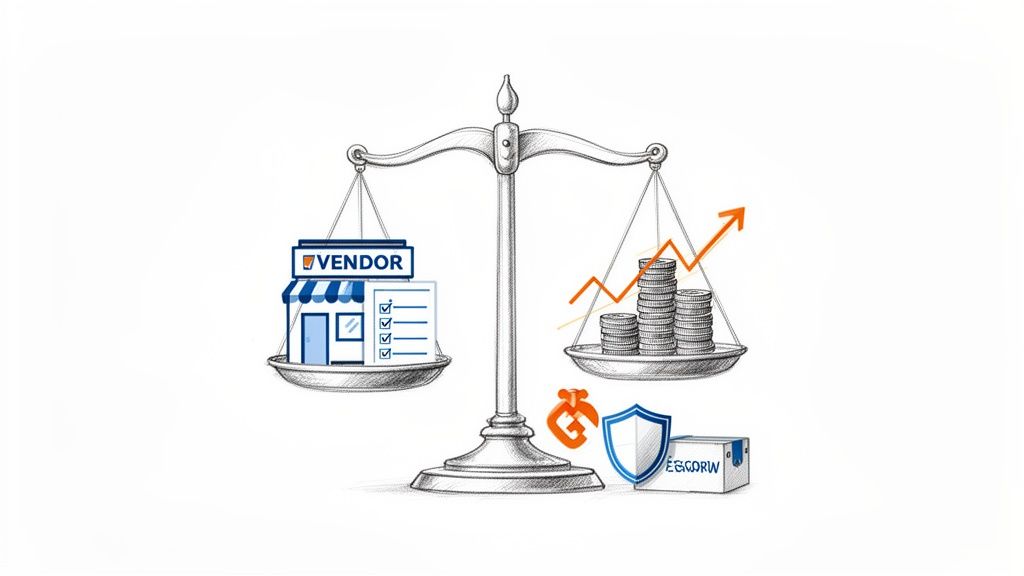
This process goes beyond surface-level due diligence. It requires a skeptical, data-driven approach to verify a vendor’s claims and uncover potential continuity threats before signing a contract. A comprehensive vendor due diligence strategy integrates financial health checks with deep technical vetting to create a holistic risk profile.
How It Works: Implementation in Practice
Start by treating vendor stability as a core, non-negotiable requirement. For instance, when evaluating a VC-backed startup for a critical migration, their technical demo is only part of the story. You must also assess their financial runway, the likelihood of securing their next funding round (e.g., Series B), and their burn rate. A promising startup with less than 12 months of runway is a high-risk partner for a multi-year project.
Similarly, if assessing a mid-market integrator whose revenue has declined for three consecutive quarters, you should classify them as an elevated risk. This doesn’t mean an automatic disqualification, but it does mean you must demand contractual protections like performance bonds or transition guarantees to mitigate the risk of them folding mid-project.
Actionable Tips for Assessment
- Request Granular Failure-Rate Data: Don’t accept aggregate success metrics. Ask for failure rates broken down by technology stack, project complexity, and industry. A vendor claiming a 94% success rate in banking COBOL migrations is a much stronger candidate than one with a generic 90% “project success” rate.
- Verify with Reference Clients: Interview at least three reference clients whose project scope and technical complexity mirror your own. Ask pointed questions about challenges, staff turnover, and how the vendor handled unforeseen issues.
- Obtain Financial Health Reports: Request a Dun & Bradstreet report or similar third-party financial stability analysis to verify revenue claims and check for liens or payment delinquencies.
- Secure Key-Person Clauses: For smaller, specialized firms, insist on “key-person” clauses in the contract. These agreements guarantee that specific experts will remain on your project and outline a clear, acceptable process for their replacement if necessary.
2. Total Cost of Ownership (TCO) Analysis
A critical software procurement best practice is to move beyond the initial license or quote price and conduct a rigorous Total Cost of Ownership (TCO) analysis. This financial model uncovers the full, multi-year cost of a solution by accounting for all associated expenses: implementation, integration, training, ongoing maintenance, and often-overlooked modernization overhead. Failing to model TCO often leads to significant budget overruns and a distorted ROI calculation.
Many procurement decisions are based on a vendor’s attractive per-line-of-code or per-seat quote, which can be misleading. A comprehensive TCO model acts as a financial stress test, revealing the true cost burden and preventing sticker shock when implementation and support invoices arrive. This methodical approach is essential for comparing seemingly disparate proposals on an equal footing.
How It Works: Implementation in Practice
When evaluating a COBOL migration vendor, their initial quote of $2.50 per line of code for 5 million lines appears to be a straightforward $12.5 million project. However, a TCO analysis would factor in the high probability of remediation for decimal precision handling, data validation rework, and performance tuning, which can inflate the actual cost to between $18 million and $20 million.
Similarly, a cloud migration might appear cost-effective based on low initial licensing fees. A TCO model surfaces the hidden costs of cloud management, Reserved Instance optimization, data egress fees, and rebalancing, which frequently add 40-60% to the total spend over the contract term. TCO forces a realistic assessment of these secondary, but substantial, financial impacts.
Actionable Tips for Assessment
- Build Multi-Scenario Models: Create optimistic, realistic, and pessimistic cost scenarios. This helps establish a probable cost range rather than relying on a single, often flawed, vendor estimate.
- Include Internal Labor Costs: Internal engineering time for integration, testing, and training is a major expense. These internal costs often account for 30-50% of the total modernization TCO but are frequently omitted from initial budgets.
- Factor a Modernization Contingency: Allocate a contingency fund of at least 15-20% specifically for modernization-related rework and unforeseen technical debt discoveries. This is a pragmatic step in any legacy system project.
- Validate with Industry Benchmarks: Use third-party data from sources like Gartner or Modernization Intel to cross-reference vendor quotes. If a quote is significantly lower than industry benchmarks ($1.50-$4.00 per LOC for COBOL), it is a red flag for potential scope gaps or hidden fees. For more guidance on this, see our in-depth article on budgeting for IT modernization.
3. Specialized Vendor Selection by Migration Path
One of the most common software procurement mistakes is treating all migration vendors as interchangeable. A generalist integrator might claim proficiency across technologies, but specific migration paths have unique, high-stakes failure modes that only specialists can reliably navigate. This best practice involves prioritizing vendors with proven, niche expertise in your exact source-to-target scenario.
This approach acknowledges that a COBOL-to-Java migration in banking is fundamentally different from a telecom mainframe-to-cloud project. The former involves deep business logic and decimal precision challenges (like COMP-3 to BigDecimal mapping), while the latter is a complex infrastructure and network latency puzzle. A generalist may understand the concepts, but a specialist has already built the tooling and processes to avoid the specific pitfalls that derail these projects.
How It Works: Implementation in Practice
Start by precisely defining your migration path across three dimensions: source technology, target platform, and industry vertical. For example, instead of searching for a “database migration partner,” your requirement becomes “a partner specializing in migrating on-premise Oracle DB with HIPAA-protected data to Azure SQL.” This specificity immediately filters out 95% of vendors.
When evaluating a vendor for a mainframe modernization, don’t just ask if they “do mainframe.” Ask if they specialize in IBM Z to AWS migrations for financial services. A vendor like Astadia or Advanced has a different risk profile and toolset than a general cloud consultant. The specialist will ask about CICS transaction mapping and batch job scheduling, while the generalist might focus only on EC2 instance types.
Actionable Tips for Assessment
- Map Your Scenario: Clearly document your migration path: source language + target platform + industry vertical. Use this three-part definition as your primary filter for all vendor discovery and outreach.
- Request Matched Case Studies: Demand case studies that mirror your three-part scenario. If a vendor can’t provide at least two, they are not a specialist and should be moved to a secondary, higher-risk list.
- Ask About Common Failures: Ask every potential vendor, “What are the top three failure modes you’ve seen in this exact migration path, and what specific tools or processes do you have to prevent them?” Specialists provide granular, technical answers; generalists give vague platitudes.
- Verify Specialization: Look for tangible proof of niche expertise. This could include patents for migration-specific tooling, technical whitepapers on the topic, or key personnel with relevant certifications.
- Interview Specialists First: Always vet at least two highly specialized vendors before considering a generalist system integrator. The insights gained from specialists will equip you to ask tougher, more informed questions of any other potential partners.
4. Clear Definition of Success Metrics and SLAs
One of the most consequential software procurement best practices is to move beyond vague project goals and establish objective, measurable success criteria before a contract is signed. Success must be defined across four dimensions: delivery (timeline, budget), quality (defect rates, performance), business outcomes, and data integrity. Codifying these criteria into contractually enforceable Service Level Agreements (SLAs) with clear penalties transforms ambiguous expectations into a legally binding commitment.
This approach creates a shared, quantitative definition of “done” that protects both you and the vendor. Without it, you risk a project that is technically “complete” but fails to deliver the required performance, quality, or business value, leaving you with little recourse. Precise SLAs ensure that the vendor is held accountable not just for delivering code, but for delivering a functional, performant, and reliable system.
How It Works: Implementation in Practice
Start by defining success from a business perspective, then translate those outcomes into technical metrics. For a mainframe modernization project, a business goal of “reduce processing time” is too vague. A precise SLA would be: “Post-migration, 95% of batch processing jobs must complete within 80% of their mainframe baseline runtime, measured over the first 30 days of production.”
For a cloud migration, a cost-related SLA could state: “The final project invoice must be within 10% of the quoted per-Line-of-Code (LOC) rate, with a fixed-price cap on total expenditure.” Similarly, a timeline SLA for an ERP implementation could be: “95% of all committed project milestones must be delivered within a variance of ±5 business days,” tying service credits directly to chronic delays.
Actionable Tips for Assessment
- Prioritize Data Integrity Metrics: For any data-centric project, include stringent SLAs. For example, specify “100% of COBOL COMP-3 decimal fields must be validated for precision loss with zero tolerance for undetected errors.”
- Establish Performance Baselines: A cloud SLA is weak without a starting point. Mandate that “Post-cutover application performance must remain within 5% of the pre-migration baseline, measured by average API response time over 30 days.”
- Set Thresholds Based on Benchmarks: Do not accept vendor-proposed SLAs without validation. Use industry benchmarks or data from similar internal projects to set realistic but firm performance thresholds.
- Include Escalating Penalties: A weak penalty is no deterrent. Structure SLAs with escalating consequences, such as a 10% service credit for the first miss, increasing to 50% for a third consecutive failure.
- Demand Granular Reporting: Require the vendor to provide weekly SLA performance reports that clearly show metrics, targets, and variance. Insist that any deviation from the target includes a root cause analysis and a remediation plan.
5. Multi-Vendor Evaluation and Competitive Bidding
A structured, competitive procurement process is one of the most effective software procurement best practices for ensuring cost transparency and technical alignment. By evaluating multiple qualified vendors against a standardized set of criteria using a detailed Request for Proposal (RFP), you introduce competitive pressure that surfaces alternative approaches, reveals hidden costs, and significantly reduces the risk associated with single-vendor sourcing. This methodology forces vendors to justify their value proposition against direct competitors.
This process is fundamentally about de-risking a major technical investment by preventing vendor lock-in before the engagement even begins. A well-executed RFP moves the conversation from a vendor’s sales pitch to a data-driven comparison of their capabilities, pricing models, and proposed timelines, empowering you to make a decision based on evidence rather than promises.
How It Works: Implementation in Practice
Start by investing significant time in developing a highly detailed RFP. Vague specifications lead to vague, incomparable proposals. For example, when running an RFP for a COBOL to Java migration in a banking system, your RFP must specify the exact source modules, performance SLAs for the target system, and data precision requirements (e.g., handling COMP-3 data types with Java’s BigDecimal).
Invite a mix of vendors to bid, such as large integrators like Micro Focus and specialized firms like Scalo or Intellias. Their varied approaches will provide a more comprehensive view of the solution landscape. When evaluating proposals, if one vendor’s timeline is 50% shorter than the others, it’s a red flag indicating they’ve likely underestimated complexity, not discovered a magic bullet. This competitive context makes unrealistic claims immediately obvious.
Actionable Tips for Assessment
- Weight Your Criteria Explicitly: Define and share your scoring weights before evaluation to ensure objectivity. A sample weighting might be: Cost 40%, Technical Solution 30%, Timeline Realism 20%, and Vendor Stability 10%.
- Demand Component-Level Pricing: Require vendors to break down their pricing by labor category, tooling licenses, and required infrastructure. This prevents them from hiding high margins in a single lump-sum figure.
- Force Assumption Disclosures: Insist that vendors explicitly list all assumptions that, if proven incorrect, could increase project costs by more than 10%. This surfaces potential budget overruns early.
- Negotiate with Finalists: Once you’ve narrowed the field to two or three finalists, use the competitive data you’ve gathered to negotiate better terms. A further 10-15% cost reduction is often achievable at this stage.
6. Independent Technical Validation and Proof-of-Concept (PoC)
One of the most essential software procurement best practices is to move from vendor promises to verifiable evidence. An independent technical assessment and a tightly scoped Proof-of-Concept (PoC) allow you to validate a vendor’s claims regarding their approach, feasibility, and cost models before committing to a full-scale project. This process serves as a critical, evidence-based go/no-go decision point, uncovering hidden technical pitfalls that sales presentations and slide decks conveniently omit.
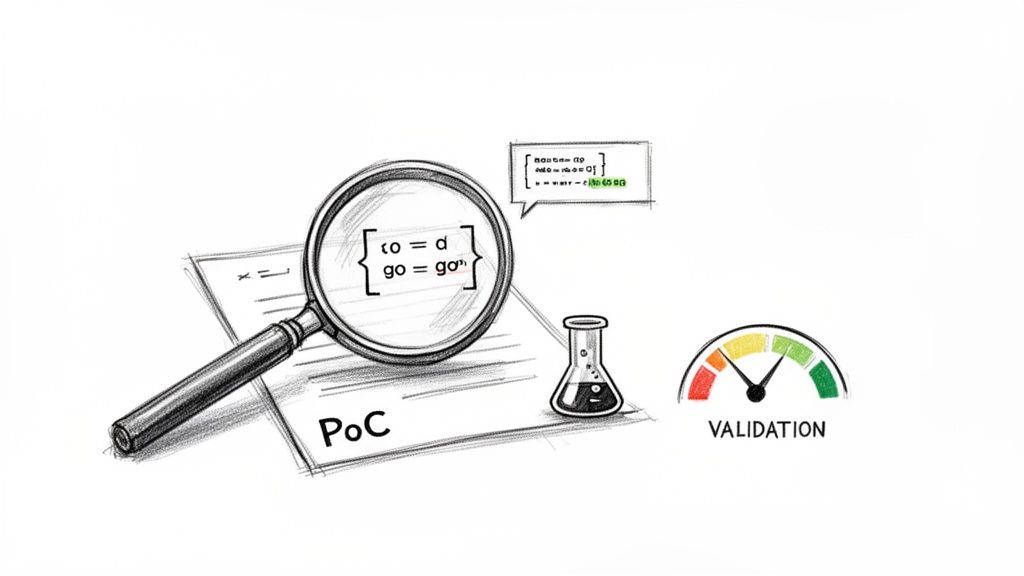
A PoC is not a simplified demo; it is a microcosm of the real project, designed to stress-test the vendor’s methodology and tools against your most complex technical challenges. By isolating a representative slice of your system, you can measure actual performance, data integrity, and cost, creating a reliable forecast for the entire engagement. This de-risks the procurement process by replacing assumptions with empirical data.
How It Works: Implementation in Practice
Treat the PoC as a formal, non-negotiable stage of your procurement. For instance, if evaluating a vendor for a mainframe-to-cloud migration, a strong PoC would involve migrating 50,000 to 100,000 representative lines of COBOL code, including complex business logic and tricky data types. The goal is to validate performance, ensure data integrity, and get a realistic cost-per-line-of-code figure.
Similarly, when considering a database migration, a PoC should involve migrating sample schemas that are known to contain incompatibilities or performance bottlenecks. This allows you to measure the actual remediation effort required, rather than relying on a vendor’s optimistic estimate. The variance between the PoC’s estimated cost and its actual cost is a powerful indicator of the vendor’s accuracy and transparency.
Actionable Tips for Assessment
- Select Hard Use Cases: Choose a PoC sample that contains your most difficult technical challenges, not trivial examples the vendor can easily solve.
- Make Data Validation a Deliverable: Mandate a formal data validation report as a key PoC deliverable, comparing pre- and post-migration datasets to prove integrity.
- Measure PoC Actuals vs. Estimates: A realistic and competent vendor will typically show less than a 10% variance between their PoC cost estimate and the final actuals.
- Require Production-Quality Code: The code delivered in the PoC must meet your production standards, including comprehensive tests and documentation.
- Interview the PoC Team: Speak directly with the engineers who executed the PoC to understand the problems they encountered and how they resolved them. For a deeper dive into vetting technical capabilities, a comprehensive technical due diligence checklist can provide a structured framework.
7. Contract Terms Protecting Buyer Interests and Defining Remedies
One of the most impactful software procurement best practices is negotiating a contract that actively protects your interests rather than simply accepting the vendor’s boilerplate. A strong contract is not about creating an adversarial relationship; it’s about establishing clear, enforceable rules of engagement and pre-defining remedies for non-performance. This shifts risk away from your organization and ensures the vendor is financially and operationally accountable for meeting their commitments.
Without specific protections, you are left with little recourse when a vendor underdelivers, a key engineer leaves, or project costs spiral. A well-constructed agreement defines success, aligns incentives, and provides a clear, non-litigious path to resolution if the partnership falters. This transforms the contract from a legal formality into a critical project management tool.
How It Works: Implementation in Practice
Start by rejecting the vendor’s standard template and introducing your own or a balanced, industry-standard version. For instance, when contracting a modernization partner for a COBOL to Java migration, their standard agreement will likely have a generic “best efforts” clause. Your contract must replace this with specific, measurable guarantees.
A concrete example is a clause stating: “Vendor guarantees zero tolerance for undetected COMP-3 data type conversion errors; vendor is responsible for 100% of remediation costs if such errors are detected in production.” Similarly, for a cloud migration, a generic scope of work is insufficient. A protective clause would state: “Final monthly cloud operational costs will not exceed the vendor’s final estimate by more than 15%; vendor will issue service credits equivalent to any variance above this threshold.”
Actionable Tips for Assessment
- Involve Experienced Counsel: Engage legal counsel specializing in software services and technology contracts, not a generalist. They can identify weaknesses in vendor-provided templates that expose you to risk.
- Define Specific Acceptance Criteria: Avoid vague terms like “user acceptance.” Instead, define precise, measurable criteria for project milestones and final delivery, such as “system must process 5,000 transactions per second with an average latency below 200ms.”
- Negotiate Liability Caps: Do not accept a vendor’s default liability cap, which is often limited to fees paid. Negotiate a reasonable cap, such as 2-3x the total contract value, to ensure the vendor has sufficient skin in the game.
- Demand Precise Remedies: The contract must explicitly state the consequences of failure. This could include fee reductions for missed deadlines, the right to terminate for cause without penalty, or activating an escrow agreement to fund a replacement vendor.
8. Transparent Reference Checking and Customer Interview Process
One of the most revealing software procurement best practices involves moving beyond vendor-curated success stories to conduct rigorous, multi-level reference interviews. This process treats reference checks not as a formality but as a critical intelligence-gathering exercise. It aims to uncover the unvarnished truth about a vendor’s performance, especially how they handle inevitable project failures, scope creep, and budget overruns.
A vendor’s provided reference list is a starting point, not the final word. True diligence requires independently verifying their claims with former clients, engaging technical peers directly, and asking questions designed to expose weaknesses, not just confirm strengths. This skeptical approach provides a realistic preview of the partnership and helps set accurate expectations for project execution and support.
How It Works: Implementation in Practice
When evaluating a vendor for a cloud migration, don’t just speak to the executive sponsor they provide. Insist on interviewing the technical lead who managed the day-to-day work and the project manager who tracked the budget. Ask pointed, specific questions that probe for friction. For example, instead of asking “Was the project successful?”, ask, “Were your final cloud operating costs within 10% of the vendor’s initial estimate? What specific optimizations were required post-migration to control spend?”
Similarly, for a legacy system modernization, drill into technical specifics. A vendor might claim a seamless COBOL-to-Java conversion. Your technical team should ask their reference’s lead engineer: “Did the vendor’s tooling correctly identify all COMP-3 packed decimal fields with potential precision risk, or was significant manual rework required post-conversion?” Hesitation or a vague answer is a major red flag.
Actionable Tips for Assessment
- Interview Multiple Levels: Speak with the executive sponsor, the project manager, and a senior technical lead from each reference company to get a complete picture of the engagement.
- Probe for Failures Directly: Ask direct questions like, “What was the biggest unexpected challenge during the project, and how did the vendor’s team respond?” and “Describe a moment when the vendor’s team failed to meet an expectation.”
- Validate Timelines and Costs: Inquire about schedule and budget adherence. Ask, “Was the project completed on the original schedule? If not, what specific factors caused the delays, and how were they communicated?”
- Ask the Ultimate Question: Conclude each interview by asking, “Knowing what you know now, would you hire this vendor again for a project of similar complexity and strategic importance?” Any answer other than an immediate and unequivocal “yes” should be treated as a warning sign.
9. Ongoing Vendor Performance Monitoring and Governance
A signed contract isn’t the finish line; it’s the starting gun. One of the most critical software procurement best practices is establishing a robust governance framework to monitor vendor performance continuously. This proactive oversight ensures that the value promised during the sales cycle is actually delivered throughout the project lifecycle. Without it, minor deviations in scope, quality, or timeline can silently compound into unrecoverable project failures.
This governance structure moves vendor relationships from a reactive, “break-fix” model to a proactive, data-driven partnership. It formalizes communication, sets clear expectations for performance transparency, and provides defined escalation paths to address issues before they derail a multi-million-dollar modernization effort. It transforms the vendor agreement from a static document into a living operational guide.
How It Works: Implementation in Practice
Effective governance starts before the project kickoff. For instance, when engaging a vendor for a mainframe-to-cloud migration, the contract should stipulate the creation of a joint steering committee. This committee, comprising the client sponsor, the technical lead, and vendor executives, meets monthly to review performance dashboards and approve any significant change requests. This prevents scope creep and ensures executive alignment on progress and obstacles.
Another practical application is implementing quality gates. Before accepting a milestone deliverable, an independent QA team (internal or a third party) validates the vendor’s work against predefined criteria, such as a defect escape rate below 2% or 99.9% data validation accuracy. Passing this gate is a non-negotiable prerequisite for payment, directly tying vendor compensation to quality outcomes.
Actionable Tips for Assessment
- Establish Governance Cadence Pre-Kickoff: Define the structure, meeting frequency (e.g., weekly tactical, monthly strategic), and required attendees for all governance forums in the Statement of Work (SOW).
- Mandate Standardized Reporting: Require the vendor to provide weekly performance data in a standardized format you provide. This should track leading indicators like code churn and developer velocity alongside lagging metrics like timeline variance.
- Assign a Client-Side Governance Lead: Appoint a dedicated internal owner responsible for tracking vendor performance, flagging deviations, and ensuring objectivity in reporting.
- Implement a Formal Escalation Path: Document a clear, time-bound process for escalating unresolved issues, starting with the project manager and moving to executive sponsors within a defined period, such as ten business days. For long-term success, implementing actionable vendor management best practices is crucial to ensure continuous performance and mitigate risks.
10. Knowledge Transfer and Operational Handoff Planning
A common failure point in software procurement is treating the vendor’s exit as an afterthought. Effective software procurement best practices mandate a structured knowledge transfer and operational handoff plan, built into the project from day one. This proactive approach prevents long-term vendor dependency and ensures your internal team can own, operate, and iterate on the new system effectively. Without it, you are merely renting a capability, not building one.
This strategy treats internal enablement as a critical, non-negotiable project deliverable, not a “nice-to-have.” The goal is to systematically de-risk the post-go-live phase by ensuring all operational logic, architectural nuances, and maintenance procedures are meticulously documented and transferred from the vendor’s experts to your own. A successful handoff means your team can handle 95% of Level 1 and Level 2 support incidents without ever calling the vendor.
How It Works: Implementation in Practice
Knowledge transfer must be an active, continuous process, not a document dump in the final week. For instance, when a vendor modernizes a legacy database, don’t just accept a final schema diagram. Mandate that your DBAs shadow the vendor’s engineers during schema design and data migration sprints. They should co-author the documentation on data transformation rules, indexing strategies, and backup/recovery procedures.
Similarly, for a cloud infrastructure handoff, the vendor’s responsibility extends beyond just building the environment. They must deliver runbooks detailing cost optimization tactics, disaster recovery failover steps, and performance monitoring thresholds. The handoff is only complete once your internal operations team can independently manage cost alerts and execute a simulated DR drill based on the vendor’s documentation.
Actionable Tips for Assessment
- Make Knowledge Transfer a Contractual Deliverable: Specify the format, content, and acceptance criteria for all documentation in the Statement of Work (SOW). Link final payment milestones to the successful sign-off of these deliverables.
- Mandate Production-Standard Documentation: Explicitly forbid “throw-away” or proof-of-concept notes. All documentation must be suitable for a new engineer to onboard and troubleshoot the system.
- Define a Graduated Support-Warranty Period: Implement a 60- to 90-day post-launch warranty where the vendor’s involvement gradually decreases. For example, the vendor leads support for the first 30 days, your team leads with vendor backup for the next 30, and your team is fully independent for the final 30.
- Run Pre-Launch War Game Simulations: Before go-live, simulate critical incident scenarios like a database failure or security breach. Your internal team must lead the response using only the vendor-provided documentation, with the vendor acting as observers.
10-Point Comparison of Software Procurement Best Practices
| Practice | Implementation complexity | Resource requirements | Expected outcomes | Ideal use cases | Key advantages |
|---|---|---|---|---|---|
| Vendor Risk Assessment and Financial Continuity | Medium–High — combined financial and technical due diligence | Financial analysts, technical SMEs, reference checks, time for interviews | Reduced risk of mid-project vendor failure; contingency plans and contract protections | Long-duration modernizations, mission‑critical systems, single‑vendor engagements | Validates both financial stability and technical capability; enables exit/escrow clauses |
| Total Cost of Ownership (TCO) Analysis | Medium — multi-year modelling and scenario planning | Finance, PM, benchmarking data, vendor inputs | Realistic multi‑year cost projections and ROI; hidden costs surfaced | Budgeting, vendor comparisons, executive/board approvals | Surfaces hidden modernization costs; supports apples‑to‑apples comparisons and negotiation |
| Specialized Vendor Selection by Migration Path | Medium — mapping specialization to exact migration path | Market research, deep case studies, technical reviewers | Lower failure/rework rates; faster, more predictable delivery for specific migrations | Niche migrations (e.g., COBOL→Java, mainframe→cloud, legacy DB conversions) | Leverages domain‑specific experience to avoid known pitfalls and speed execution |
| Clear Definition of Success Metrics and SLAs | Medium — requires precise metrics and contractual framing | Business owners, technical leads, legal support, measurement tools | Aligned incentives, measurable delivery and quality, contractual recourse | Compliance‑sensitive projects, high‑risk migrations, vendor‑managed work | Creates transparency and enforceable performance expectations |
| Multi‑Vendor Evaluation and Competitive Bidding | High — structured RFP and scoring process | Procurement, evaluation panel, time (8–12 weeks), detailed RFP prep | Improved pricing, alternative approaches identified, reduced single‑vendor risk | Cost‑sensitive procurements, projects with multiple qualified vendors | Typical cost reductions and reduced lock‑in through competition |
| Independent Technical Validation and PoC | Medium–High — PoC setup and independent review | PoC budget, independent technical reviewers, representative code samples | Validated feasibility, realistic cost/timeline estimates, evidence for go/no‑go | High technical uncertainty or unproven vendor claims | Early technical risk discovery and data‑driven decision making |
| Contract Terms Protecting Buyer Interests and Defining Remedies | High — legal negotiation and tailored clauses | Experienced software counsel, procurement, negotiation time | Buyer protections, defined remedies, exit and transition pathways | Large contracts, fixed‑price projects, sensitive data migrations | Limits open‑ended cost risk and enforces vendor accountability |
| Transparent Reference Checking and Customer Interview Process | Medium — structured, multi‑level interviews | Technical interviewers, 5–10 hours per vendor, independent reference sourcing | Real‑world vendor performance insights; warning signs revealed | Pre‑selection vetting, specialist vendors with limited public track record | Validates vendor claims and uncovers failure modes and overruns |
| Ongoing Vendor Performance Monitoring and Governance | Medium — continuous processes and meetings | Client governance lead, dashboards, steering committees, reporting cadence | Early detection of issues, course correction, documented performance history | Long engagements, phased deliveries, SLA‑driven projects | Continuous transparency and formal escalation paths to correct course |
| Knowledge Transfer and Operational Handoff Planning | Medium — structured documentation and training | Training resources, documentation effort, shadowing time, acceptance criteria | Internal operational readiness; reduced vendor dependency post‑go‑live | Projects intending in‑house operations and long‑term support by internal teams | Preserves institutional knowledge and lowers long‑term support costs |
Making Your Next Procurement Decision Defensible
Navigating the software procurement landscape is less about finding the cheapest vendor and more about executing a disciplined, evidence-based process that withstands scrutiny. The best practices detailed in this guide are not merely administrative checks; they are strategic controls designed to de-risk complex technical initiatives and ensure that every dollar spent drives measurable value. From dissecting a vendor’s financial stability to engineering contract clauses that protect your interests, this framework transforms procurement from a reactive purchasing function into a proactive, strategic advantage.
The core principle underpinning these practices is defensibility. When a project encounters inevitable challenges, your procurement process becomes the first line of defense. Can you demonstrate that you rigorously modeled the Total Cost of Ownership, including often-hidden integration and maintenance fees? Did you validate vendor claims through an independent Proof-of-Concept rather than relying on curated demos? Can you point to specific Service Level Agreements (SLAs) with clear remedies for non-performance? A defensible decision is one backed by a clear audit trail of due diligence, competitive analysis, and risk mitigation.
Key Takeaways for Immediate Application
Moving from theory to practice requires focusing on the highest-leverage activities. If you implement nothing else, concentrate on these three areas:
- Shift from Price to Total Cost of Ownership (TCO): The initial license or subscription fee is often less than 50% of the total cost over three to five years. Your analysis must rigorously account for implementation, data migration, training, necessary hardware upgrades, and ongoing support personnel. Building a comprehensive TCO model is one of the most critical software procurement best practices for avoiding budget overruns.
- Mandate Independent Technical Validation: A vendor’s sales demo is a controlled environment designed to highlight strengths and obscure weaknesses. A true Proof-of-Concept (PoC) or a paid pilot program using your data, your infrastructure, and your real-world use cases is non-negotiable. This is where you uncover performance bottlenecks, integration failures, and usability issues before you are contractually committed.
- Weaponize Your Contract: Your contract is not a formality; it is your primary tool for risk management. Focus on negotiating buyer-centric terms. This includes clear data ownership clauses, specific exit rights and de-conversion support, penalties for SLA breaches, and a cap on annual price increases. Never accept a vendor’s standard paper without a thorough legal and technical review.
The Strategic Value of a Disciplined Process
Adopting these software procurement best practices does more than just mitigate risk; it fundamentally elevates the role of technology leadership within the organization. A well-run procurement process demonstrates fiscal responsibility, operational maturity, and a strategic mindset. It proves that technology decisions are not made in a vacuum but are aligned with business objectives and subjected to the same level of rigor as any other major capital investment.
This structured approach also protects your team. It shields them from the pressure of making a “gut-feel” decision and provides them with the data and framework to justify their recommendations. When you can articulate why a more expensive solution was chosen based on a TCO analysis or why a popular vendor was disqualified due to a failed PoC, you build credibility and trust with finance, legal, and executive stakeholders. Ultimately, a world-class procurement function ensures that the software you buy becomes a catalyst for growth, not a source of technical debt and regret.
A defensible procurement decision relies on unbiased, market-validated data, not just vendor claims. Modernization Intel provides this critical layer of independent analysis, offering proprietary data on vendor failure rates, real-world cost benchmarks, and specialized capabilities. Use our platform to validate your vendor shortlist and ensure your chosen partner aligns with market reality.