
12 Public Sector Examples of Tech Modernization (And Why 67% Fail)
Public sector agencies manage critical national infrastructure, from healthcare delivery to law enforcement. A Gartner report indicates that 67% of government IT modernization projects fail to meet their stated objectives, creating a cycle of budget overruns and diminished public trust. This is often not a simple funding issue, but a complex challenge involving entrenched legacy technology, difficult procurement processes, and significant technical debt accumulated over decades. The consequences of failure are severe, impacting everything from citizen services to national security.
This article dissects 12 specific public sector examples of modernization efforts. It provides a data-driven analysis for technical leaders tasked with these high-stakes initiatives, moving beyond surface-level narratives to break down specific migration paths, technical pitfalls, and realistic cost models, such as the typical $1.50 to $4.00 per line of code for COBOL to Java migrations.
We analyze the precise reasons initiatives stall, from floating-point arithmetic errors in mainframe data transfers (e.g., COBOL COMP-3 fixed-point vs. Java primitive floating-point) to miscalculating the engineering overhead for achieving FedRAMP or StateRAMP compliance in a cloud environment. For each case study, we examine which implementation partners specialize where and provide guidance on when not to modernize. This is a collection of strategic analysis designed to equip you with the details needed to navigate these projects.
1. National Health Service (NHS): Migrating Patient Records from Mainframes
The UK’s National Health Service (NHS) represents one of the most complex public sector examples of legacy modernization. Its initiative to migrate electronic health records (EHR) from monolithic mainframes to a distributed, cloud-native architecture is a high-stakes undertaking. The objective is to create interoperable systems for real-time data access across trusts, intended to improve patient outcomes and operational efficiency.
The core technical challenge lies in data integrity and compliance. Migrating petabytes of sensitive patient data requires zero-downtime strategies and precise execution to maintain continuity of care. This is not a simple “lift-and-shift”; it involves data transformation, schema modernization, and ensuring GDPR compliance at every stage.
Strategic Breakdown
- Migration Path: The NHS is pursuing a phased, “strangler fig” pattern. Instead of a high-risk “big bang” cutover, new cloud-native services are built around the legacy core. Over time, these new services incrementally replace mainframe functionalities. For instance, new patient-facing applications are built on modern stacks that pull data from the mainframe via APIs, slowly strangling the old system’s relevance.
- Technical Pitfalls: Early attempts revealed significant data-mapping challenges between legacy EBCDIC data formats and modern UTF-8 systems. Additionally, ensuring transactional consistency between the old and new systems during the phased rollout proved difficult, requiring sophisticated data synchronization and validation tooling.
Key Strategic Point: For mission-critical systems like the NHS, a complete data freeze for migration is not feasible. The modernization strategy must prioritize concurrent operation, where both legacy and new systems run in parallel, synchronizing data until the mainframe can be decommissioned. This dual-run approach is expensive but necessary for risk mitigation.
Actionable Takeaways
- Prioritize Interoperability Standards: Adopt healthcare-specific standards like FHIR (Fast Healthcare Interoperability Resources) from day one to avoid creating new data silos in the cloud.
- Budget for Dual-Run Operations: The period where both mainframe and cloud systems operate concurrently can last for years. This phase often costs 1.5x-2x the normal operating budget, a factor frequently underestimated in initial planning.
- When Not to Modernize: If the core mainframe applications are stable and meet all current clinical safety requirements, a full migration may not be justifiable. Encapsulating the mainframe with a modern API layer can often deliver 80% of the benefits for 20% of the cost and risk.
2. Public Education System: Modernizing Student Information Systems
Public education systems are grappling with the challenge of modernizing decades-old Student Information Systems (SIS). These legacy platforms, often built on-premise with outdated technology, hinder efforts to create a unified, data-driven educational environment. The objective is to move towards centralized, cloud-based systems that offer real-time analytics for educators, seamless integration for administrative tasks, and secure portals for parent and student engagement. This is one of the more complex public sector examples due to the scale and decentralization of school districts.
The primary technical hurdle is data consolidation and standardization. Each school district often operates a bespoke or heavily customized SIS, resulting in disparate data schemas and a lack of interoperability. Merging these fragmented datasets into a single source of truth without disrupting daily school operations is a monumental task.

Strategic Breakdown
- Migration Path: Many successful modernizations adopt a “data warehousing” approach first. Instead of replacing all transactional SIS platforms at once, a centralized cloud data warehouse is established. Data from legacy systems is extracted, transformed, and loaded (ETL) into the central repository, enabling unified analytics and reporting without immediately decommissioning the systems teachers and administrators rely on daily.
- Technical Pitfalls: A common failure point is underestimating the complexity of data cleaning and validation. Inconsistent data entry practices over many years (e.g., “St.” vs. “Street”) create significant data quality issues that can render advanced analytics useless. Furthermore, adhering to student privacy regulations like FERPA during cloud migration adds compliance overhead.
Key Strategic Point: The modernization’s success hinges on demonstrating value to end-users—teachers and administrators—early on. Instead of focusing solely on back-end infrastructure, the strategy must deliver tangible benefits quickly, such as automated state reporting or intuitive performance dashboards. This builds momentum and secures support for more disruptive phases of the project.
Actionable Takeaways
- Standardize Data Models Early: Adopt an industry-standard data model like the Ed-Fi Data Standard. This provides a blueprint for data integration and ensures interoperability with third-party educational applications.
- Invest in Change Management: Teachers and staff are often resistant to new systems. A significant portion of the budget should be allocated to training, support, and demonstrating how the new platform reduces administrative burdens. Learn more about the challenges of such a digital transformation.
- When Not to Modernize: If a district’s existing SIS is stable, meets all state reporting requirements, and has high user adoption, a “rip-and-replace” project is high-risk. Using an integration platform (iPaaS) to connect the legacy SIS to newer tools for analytics or parent communication can deliver specific improvements at a lower cost.
3. Public Transportation Systems: Modernizing Ticketing and Operations
Public transportation systems, like the New York City MTA or Transport for London (TfL), are quintessential public sector examples of modernizing physical infrastructure with a digital overlay. The initiative is shifting from paper-based ticketing systems to integrated, contactless platforms using open-loop payments (credit/debit cards, mobile wallets) and closed-loop smart cards (like Oyster or OMNY). The objective is to reduce friction for riders, decrease operational overhead, and capture transit data.
The core technical challenge is integrating a fragmented ecosystem of hardware (validators, fare gates) and software (payment processors, backend settlement systems) while ensuring high availability and transactional integrity. A single failed transaction can halt passenger flow, making reliability a non-negotiable requirement.
Strategic Breakdown
- Migration Path: Most transit authorities adopt a parallel operations strategy. The legacy system (e.g., MetroCard) remains fully functional while the new contactless system (e.g., OMNY) is deployed alongside it. This allows for gradual user adoption and hardware rollout without a disruptive switchover, mitigating the risk of service interruption for millions of daily commuters.
- Technical Pitfalls: A primary hurdle is the latency of payment authorization. Traditional card transactions can take several seconds, which is unacceptable at a subway gate. This requires a “first-ride risk” model where the system grants access instantly and settles the payment in the background, absorbing the small risk of failed payments to prioritize throughput.
Key Strategic Point: The value is unlocked not just by modernizing payments, but by using the resulting data. Real-time ridership data allows for dynamic service adjustments, optimizing routes and schedules based on actual demand rather than historical surveys. This data-driven approach is fundamental to improving efficiency.
Actionable Takeaways
- Prioritize Open Standards: Adopt open standards like the Calypso Interoperable Fare Management System (CIFMS) to avoid vendor lock-in with proprietary ticketing hardware and software.
- Invest in Real-Time Information APIs: Exposing real-time vehicle location and arrival data through a public API (like the GTFS-RT standard) enables a third-party app ecosystem, offloading some software development costs while improving passenger experience.
- When Not to Modernize: For smaller transit systems with low ridership, the capital cost of a full contactless payment overhaul may not be justified. Simpler mobile ticketing apps or modernizing existing closed-loop card systems can provide a better return on investment.
4. Public Libraries: Modernizing the Integrated Library System (ILS)
Public libraries provide a strong public sector example of digital transformation. The modernization of their core Integrated Library System (ILS) from on-premise, client-server models to cloud-based platforms is critical. The objective is to unify cataloging, circulation, and user management into a single system that supports both physical and digital collections.
The central challenge is managing the transition without disrupting daily operations. Migrating decades of MARC (Machine-Readable Cataloging) records, patron data, and circulation history requires meticulous data cleansing and validation. A failed ILS migration can render a library system inoperable.
Strategic Breakdown
- Migration Path: Most libraries opt for a vendor-led “big bang” migration over a scheduled closure. The interdependent nature of cataloging, patron records, and circulation modules makes a clean cutover more practical than a phased approach. The process involves a final data export, transformation into the new vendor’s format, a full data import, and extensive validation before going live.
- Technical Pitfalls: A primary failure point is poor data mapping from legacy, often customized, MARC fields to the new system’s schema, which can lead to lost metadata. Another pitfall is underestimating the need for network infrastructure upgrades to support a fully web-based SaaS platform, resulting in slow performance.
Key Strategic Point: The success of an ILS migration is highly dependent on the data. A “data-first” strategy, which involves a comprehensive data cleanup and validation project before selecting a new vendor, is crucial. This proactive cleanup can prevent many common migration failures and ensures the library isn’t moving bad data to a new system.
Actionable Takeaways
- Insist on a Full Sandbox Environment: Demand a fully functional sandbox populated with a complete copy of your library’s data for staff training and testing. This is the primary way to uncover data-mapping issues and workflow problems before the go-live date.
- Budget for Third-Party Integrations: Modern ILS platforms are ecosystems. Budget for the costs of re-integrating essential services like self-check kiosks, PC management software, and digital content providers (e.g., OverDrive), as these are rarely included in the base ILS contract.
- When Not to Modernize: If your current on-premise ILS is stable and supported by the vendor, a costly migration may offer a low ROI. Enhancing the existing system with a modern discovery layer (a user-friendly public-facing catalog) can provide an improved user experience for a fraction of the cost.
5. Public Water and Sanitation Services: SCADA Modernization
Public water utilities represent a critical infrastructure modernization challenge, moving from isolated, legacy Supervisory Control and Data Acquisition (SCADA) systems to integrated, IoT-enabled “smart water” grids. This shift aims to improve leak detection, optimize pressure management, and ensure regulatory compliance for water quality. A prime example is Singapore’s PUB, which uses real-time sensors and analytics to manage its water cycle.
The core technical challenge is bridging the operational technology (OT) and information technology (IT) divide. Legacy SCADA systems are often air-gapped for security and use proprietary protocols. Integrating them with modern IT infrastructure for data analysis requires robust security measures to prevent exposing critical control systems to cyber threats.
Strategic Breakdown
- Migration Path: Utilities are adopting a hybrid model. Instead of replacing entire SCADA systems, they overlay IoT sensors and gateways that collect data in parallel. For example, acoustic sensors can be added to pipes to detect leaks, feeding data to a cloud analytics platform without altering the core SCADA valve-control logic. This provides data benefits while de-risking the modernization of the control plane.
- Technical Pitfalls: A key failure point is underestimating the security complexities of connecting OT systems to the internet. Furthermore, data integration between decades-old PLCs (Programmable Logic Controllers) and modern cloud databases often fails due to a lack of standardized communication protocols, requiring expensive custom middleware.
Key Strategic Point: Modernizing water infrastructure isn’t just about sensors; it’s about creating a “digital twin.” This virtual model of the physical network allows for simulations and predictive analytics. For instance, utilities can model the impact of a main break or a sudden demand spike, optimizing response strategies without affecting the live system.
Actionable Takeaways
- Prioritize OT Cybersecurity: Implement a “demilitarized zone” (DMZ) network architecture to securely isolate IT networks from sensitive OT control networks. Use one-way data diodes to ensure data flows out from the OT system for analysis but no commands can flow back in from the less-secure IT environment.
- Invest in Protocol Converters: Budget for industrial gateways and protocol converters (e.g., Modbus to MQTT) early in the project. These are essential for translating data from legacy field devices into a format usable by modern analytics platforms.
- When Not to Modernize: If a SCADA system reliably controls water flow and meets all safety requirements, a full replacement may be unnecessary. Focusing on non-invasive monitoring (e.g., satellite-based leak detection or smart meters) can provide efficiency gains without the risk of disrupting core operations.
6. Public Police and Law Enforcement: Modernizing Legacy Justice Systems
Police and law enforcement agencies are prime public sector examples of organizations reliant on siloed, decades-old data systems. Modernizing these platforms, such as transitioning from mainframe-based Records Management Systems (RMS) to integrated, cloud-native justice platforms, is critical for data-driven policing. The objective is to create a unified data fabric that connects dispatch, records, investigations, and evidence management.
The primary technical hurdle is achieving secure interoperability across jurisdictional boundaries while complying with strict criminal justice information standards like CJIS. Migrating sensitive case files and evidence logs demands a security-first approach, where data encryption, access controls, and auditability are required from the outset.
Strategic Breakdown
- Migration Path: Agencies like Canada’s RCMP are adopting a data-fabric approach. Instead of a high-risk cutover, a modern data platform is implemented to ingest and standardize data from various legacy sources. This creates a “single source of truth” for analytics and new applications, allowing legacy systems to be retired incrementally as their data is fully integrated and validated.
- Technical Pitfalls: A common failure point is underestimating the complexity of data cleansing and schema mapping between disparate systems. For instance, different local precincts might use non-standardized fields for incident reports, making data aggregation difficult without significant pre-processing. The lack of a universal data model often stalls projects.
Key Strategic Point: For law enforcement, operational continuity is paramount. The modernization strategy cannot disrupt active investigations or emergency dispatch. Therefore, a parallel run where the new system shadows the old one is mandatory to allow for rigorous data validation and user training without impacting frontline operations.
Actionable Takeaways
- Adopt a Data-First Strategy: Before selecting a new RMS or analytics platform, invest in creating a standardized, agency-wide data model. This upfront work can prevent vendor lock-in and simplify future integrations.
- Budget for Security Compliance: Achieving and maintaining CJIS compliance in a cloud environment is a significant, ongoing expense, often adding 25-40% to the initial cloud hosting budget for specialized infrastructure, monitoring, and training.
- When Not to Modernize: If an existing RMS is stable and meets all legal requirements, a full replacement may be unnecessary. Building a modern data warehouse or analytics layer on top of the legacy system can provide advanced reporting capabilities for a fraction of the cost and risk.
7. Public Fire and Emergency Services: Predictive Resource Deployment
Public Fire and Emergency Services are shifting from a reactive response model to a proactive, data-driven one. Modernizing these critical public sector examples involves integrating predictive analytics to forecast incident hotspots and optimize resource allocation. Agencies like the London Fire Brigade are using historical incident data, weather patterns, and urban development plans to deploy assets before emergencies occur.
The core technical challenge is integrating disparate data sources—from legacy Computer-Aided Dispatch (CAD) systems to real-time IoT sensor data—into a cohesive predictive model. Ensuring the model’s accuracy and avoiding algorithmic bias are paramount, as flawed predictions could lead to underserved communities.
Strategic Breakdown
- Migration Path: The transition often follows a “data enrichment” model. Initially, agencies build a centralized data warehouse to consolidate historical response data. They then layer on external data sources (weather, traffic). Predictive models are first run in a “shadow mode,” generating forecasts that are compared against actual events to validate accuracy before being used to influence live deployment decisions.
- Technical Pitfalls: A common failure is underestimating the data-cleansing effort required for legacy CAD systems, where inconsistent data entry can corrupt model training. Another pitfall is the “black box” problem; if dispatchers don’t trust the model’s recommendations, they will override them, negating the system’s value. Explainable AI (XAI) is critical for user adoption.
Key Strategic Point: For emergency services, response time is a key KPI. The goal of predictive analytics is not to replace human judgment but to augment it. Successful implementations use analytics to recommend optimal pre-positioning of units, but empower dispatch commanders with the final authority to adjust deployments based on real-time intelligence.
Actionable Takeaways
- Integrate Community Risk Data: Incorporate demographic and building data to assess risk profiles. A neighborhood with older, wood-frame buildings has a different risk profile than one with new, sprinkler-equipped high-rises.
- Plan for Model Drift: A model trained on pre-pandemic traffic patterns may be inaccurate in a post-pandemic world. Budget for continuous model monitoring and retraining to account for changing urban dynamics.
- When Not to Modernize: If an agency’s core challenge is a shortage of fundamental resources (e.g., fire engines, staff) rather than inefficient deployment, investing in predictive analytics is premature. The priority should be securing funding for essential assets and personnel first.
8. Public Parks and Recreation: Modernizing Urban Green Spaces
Public parks and recreation departments manage vital green infrastructure, yet often operate with legacy asset management systems. Modernizing these services means shifting from simple groundskeeping to data-driven environmental management. Initiatives like Singapore’s Park Connector Network (PCN) showcase this shift, using technology and participatory design to enhance public health, biodiversity, and climate resilience.
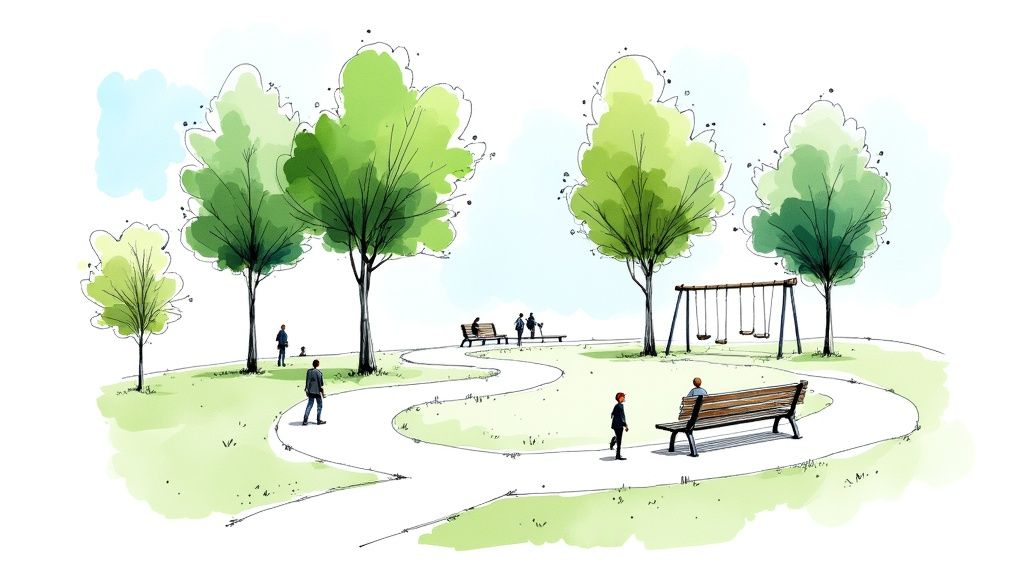
The primary technical challenge is integrating disparate data sources, such as IoT sensors for soil moisture, GIS mapping for asset location, and citizen feedback from mobile apps. Creating a unified “digital twin” of a park system allows for predictive maintenance, optimized water usage, and responsive service delivery.
Strategic Breakdown
- Migration Path: A successful strategy is to pilot smart park technology in a single, high-traffic area before scaling. For example, a city might deploy IoT-enabled irrigation and smart waste bins in one flagship park. The real-time data on savings and efficiency from this pilot is then used to build a business case for a city-wide rollout.
- Technical Pitfalls: Early smart park projects often failed by selecting proprietary, closed-loop sensor systems that could not integrate with existing municipal asset management software. Another common issue is underestimating the need for robust wireless connectivity (e.g., LoRaWAN or public Wi-Fi) across large parklands.
Key Strategic Point: Modernization is not just about technology; it is about process change. Implementing a participatory design platform where residents can propose and vote on new features is as critical as deploying sensors. The goal is to co-create spaces with the community, which can increase usage and reduce vandalism.
Actionable Takeaways
- Adopt Open Data Standards: Mandate that all new technology, from irrigation sensors to lighting controls, uses open APIs and standard data formats to avoid vendor lock-in and ensure future interoperability.
- Implement Tiered Maintenance Programs: Use data to classify park zones by usage and ecological sensitivity. High-use “active zones” might get daily maintenance, while “naturalized zones” receive less intervention, cutting costs and boosting biodiversity.
- When Not to Modernize: If a park primarily serves as a passive nature preserve with minimal built infrastructure, the ROI on a complex IoT sensor network is likely negative. In these cases, low-tech solutions like volunteer-led ecological monitoring programs may deliver better value.
9. Public Housing Programs: Modernizing Tenant and Asset Management
Public housing programs manage vast portfolios of physical assets and sensitive tenant data. Modernization efforts focus on moving from disparate, paper-based, or legacy on-premise systems to integrated, cloud-based property management platforms. The objective is to improve operational efficiency, streamline maintenance, and provide better services for residents, as seen in initiatives by entities like the Singapore HDB.
The primary technical challenge is integrating decades of siloed data. Tenant records, maintenance histories, financial ledgers, and compliance documentation often exist in separate, incompatible formats. Creating a single source of truth requires significant data cleansing, normalization, and migration without disrupting essential services.
Strategic Breakdown
- Migration Path: A common strategy is a module-by-module replacement. Instead of replacing the entire legacy system at once, agencies prioritize the highest-pain-point modules. For example, a new cloud-based maintenance ticketing system is deployed first, integrating with the legacy tenant database via APIs. This is followed by other modules, incrementally building a new, cohesive system.
- Technical Pitfalls: A frequent failure point is underestimating the complexity of asset data. A single building can have thousands of data points (e.g., HVAC service dates, unit layouts). Mapping this unstructured data to a new, standardized database schema is a common source of budget overruns.
Key Strategic Point: Modernization is not just an IT project; it’s a resident services transformation. Successful public housing programs integrate technology with supportive services. The platform should be designed to support case managers and social workers, not just property managers, requiring cross-departmental collaboration from the start.
Actionable Takeaways
- Adopt a Geographic Phasing Strategy: Roll out the new system to a small portfolio of buildings first. This pilot phase can uncover data and workflow issues at a manageable scale before a full-scale deployment.
- Prioritize Mobile-First for Field Staff: Maintenance and inspection staff are primary users. The new platform must have robust, offline-capable mobile functionality. A poor mobile app will lead to low adoption and a return to paper-based workarounds.
- When Not to Modernize: If your current system reliably handles core financial and compliance reporting, a full platform replacement may be unnecessary. A lightweight tenant portal or mobile app integrated via an API layer can often deliver a better resident experience for a fraction of the cost.
10. Public Environmental Protection and Parks Authority: Modernizing Regulatory Monitoring
Public sector examples like the US Environmental Protection Agency (EPA) are modernizing how they manage vast environmental datasets. The shift is from siloed, on-premise databases for air, water, and soil quality to integrated, cloud-based data lakes. This allows for advanced analytics, predictive modeling for pollution events, and real-time public dashboards.
The primary technical hurdle is data harmonization. Environmental data comes from disparate sources like IoT sensors, satellite imagery, and manual lab reports, each with unique formats. Integrating these into a unified model without losing scientific precision or regulatory traceability is a complex data engineering challenge.
Strategic Breakdown
- Migration Path: Agencies are adopting a “data-first” modernization strategy. The initial focus is on aggregating data into a central cloud repository (e.g., AWS S3 or Azure Data Lake). Legacy systems continue to operate but feed data into this central platform, which powers new analytics and reporting tools. This approach provides value from data insights while deferring the risk of replacing core regulatory systems.
- Technical Pitfalls: A common failure point is underestimating the complexity of geospatial data processing in the cloud. Traditional GIS systems do not scale easily. Migrating these workloads often requires specialized cloud services (like Esri’s ArcGIS on cloud platforms) and skills in distributed geospatial analytics, which are often scarce in public agencies.
Key Strategic Point: The goal is not just data centralization but the creation of an “authoritative data platform.” This platform must serve multiple stakeholders, from scientists running climate models to citizens checking local air quality. Failing to design for these diverse access patterns results in a data swamp, not a strategic asset.
Actionable Takeaways
- Standardize on Open Data Formats: Mandate the use of open standards like GeoJSON for vector data and Cloud Optimized GeoTIFF (COG) for raster data from the outset. This can prevent vendor lock-in and improve interoperability between analytical tools.
- Invest in Data Governance Early: Establish clear data ownership, quality, and lifecycle management rules before migrating petabytes of data. Without strong governance, a data lake can quickly become unusable.
- When Not to Modernize: If a legacy environmental monitoring system is highly specialized for a specific pollutant and functions reliably for compliance reporting, a full migration may not be necessary. Building an API wrapper to extract its data into the central platform gains analytical benefits without the risk of disrupting a critical regulatory function.
11. Public Welfare and Social Services: Integrating Siloed Agency Data
Modernizing public welfare and social services involves a critical data integration challenge. Systems for unemployment, housing, and food assistance often operate in isolated legacy silos, preventing a holistic view of a citizen’s needs. The goal is to create a unified eligibility and case management platform, like the UK’s Universal Credit system, to streamline service delivery.
The technical complexity is in harmonizing data. Each agency uses different identifiers, data formats, and eligibility rules. Integrating these requires sophisticated master data management (MDM) and identity resolution to ensure that “John Smith” in one database is the same person as “J. Smith” in another, without creating duplicate records.
Strategic Breakdown
- Migration Path: Most agencies are using an API-driven, federated data model rather than a massive, single data lake. Core legacy systems are encapsulated with modern APIs that expose data in a standardized format. A central “eligibility rules engine” then consumes data from these various APIs to make real-time decisions, leaving the source systems largely intact initially.
- Technical Pitfalls: A primary failure point is underestimating the complexity of identity resolution. Early projects often found that simple rule-based matching created up to a 15% error rate in linking citizen records, leading to incorrect benefit calculations. Successful projects now employ probabilistic matching algorithms and dedicated MDM platforms.
Key Strategic Point: The political and organizational challenge often exceeds the technical one. Different agencies can be protective of their data. The modernization strategy must include a strong governance framework and shared data ownership model from the outset to ensure all stakeholders are invested in the unified platform’s success.
Actionable Takeaways
- Implement a Citizen Master Key: Create a unique, persistent identifier for each citizen that is used across all integrated service agencies. This is the foundational element for accurate data sharing.
- Externalize Business Rules: Abstract eligibility and benefit calculation rules from legacy COBOL or PL/I code into a modern Business Rules Management System (BRMS). This allows policy administrators to update rules without requiring developer intervention.
- When Not to Modernize: If a specific benefit program is highly stable and its underlying system is not a bottleneck, leave it alone. Encapsulating it with an API for data extraction is often sufficient and more cost-effective than a full rewrite.
12. Public Government Administration and Bureaucracy
Public administration forms the operational core of government, managing everything from licensing and permitting to public records. Modernizing these bureaucratic systems, often entangled in paper-based workflows and siloed databases, is a foundational challenge. Estonia’s e-Estonia initiative is a prime example, creating a digital-first society where 99% of public services are online.
The technical goal is to build a secure, interoperable platform that provides a single source of truth for citizen and business data. This requires dismantling legacy departmental systems and replacing them with a service-oriented architecture. The core challenges involve data security, digital identity management, and achieving cross-agency cooperation.
Strategic Breakdown
- Migration Path: Estonia employed a “once-only” principle, building a decentralized data exchange layer called X-Road. Instead of a massive central database, government agencies publish and consume data securely across this platform. This allowed for an incremental rollout where individual agencies could connect their systems to X-Road as they were modernized.
- Technical Pitfalls: A key challenge is establishing a robust digital identity system that citizens trust. Early efforts can fail due to poor user experience or security concerns. Furthermore, ensuring data quality when integrating disparate legacy databases requires extensive data cleansing and standardization before they can be exposed via APIs.
Key Strategic Point: Modernizing public administration is less about a single technology and more about establishing a secure data exchange protocol. The focus should be on building the “digital plumbing” like X-Road first. This interoperability layer allows agencies to modernize at their own pace while immediately gaining the ability to share data securely.
Actionable Takeaways
- Implement a Digital Identity Backbone: A secure, government-backed digital ID is a prerequisite for high-value digital services. Make this a priority project.
- Decentralize Data, Centralize Exchange: Avoid creating a single, massive government database. A federated model using a secure exchange layer like X-Road is more resilient, secure, and politically feasible.
- When Not to Modernize: If a specific agency’s process is highly localized and has no data dependencies on other departments, a full integration into a national platform might be excessive. A simple public-facing web form that creates a PDF for internal processing can sometimes be a sufficient solution.
Comparison of 12 Public Sector Services
| Service | Implementation complexity | Resource requirements | Expected outcomes | Ideal use cases | Key advantages |
|---|---|---|---|---|---|
| National Health Service (NHS) | Very high — national integrated system | Large funding, hospitals, clinicians, pharma | Universal coverage; improved population health | National healthcare delivery; public health emergencies | Eliminates financial barriers; preventive focus |
| Public Education System | High — standardized curricula and logistics | Schools, certified teachers, learning materials | Basic literacy/numeracy; skilled workforce | Compulsory education; workforce development | Promotes equality and social mobility |
| Public Transportation Systems | High — network planning and operations | Capital infrastructure, vehicles, ongoing subsidies | Reduced congestion; lower emissions; mobility | Urban and regional mobility corridors | Scales access; supports economic activity |
| Public Libraries | Medium — facility and program management | Buildings, digital collections, trained staff | Lifelong learning; digital inclusion | Community education and access to information | Bridges digital divide; free knowledge access |
| Public Water and Sanitation Services | Very high — critical utility infrastructure | Treatment plants, pipe networks, monitoring | Safe drinking water; disease prevention | Urban/rural utility delivery; public health protection | Protects health; enables economic activity |
| Public Police and Law Enforcement | High — operational and accountability systems | Trained officers, forensic units, communications | Public order; crime prevention and response | Crime prevention; community safety | Provides legitimate force; coordinated response |
| Public Fire and Emergency Services | High — rapid-response logistics and training | Stations, vehicles, rescue equipment, medics | Life safety; disaster response and mitigation | Fire suppression; rescue and disaster management | Rapid emergency response; saves lives |
| Public Parks and Recreation | Medium — land management and programming | Land, maintenance crews, amenities, programming | Improved physical/mental health; community space | Urban open space; recreation and conservation | Enhances wellbeing; preserves green space |
| Public Housing Programs | High — housing construction and allocation | Capital investment, property management, subsidies | Housing stability; homelessness prevention | Low-income housing and urban planning | Prevents homelessness; promotes inclusion |
| Public Environmental Protection Authority | High — regulatory frameworks and monitoring | Scientific staff, monitoring systems, enforcement | Pollution control; ecosystem preservation | Environmental regulation; climate action | Preserves ecosystems; corrects market failures |
| Public Welfare and Social Services | High — complex benefit and case management | Benefit budgets, caseworkers, administrative systems | Poverty reduction; social safety net | Support for vulnerable populations | Reduces inequality; economic security |
| Public Government Administration & Bureaucracy | High — cross-sector coordination and systems | Administrative staff, IT systems, regulatory frameworks | Rule of law; service delivery enabling other services | Governance, permitting, taxation, records | Provides institutional continuity and services |
Making Defensible Modernization Decisions
The public sector examples detailed throughout this analysis reveal a consistent truth: technology is rarely the primary point of failure in a modernization project. Success or failure is often determined long before the first line of code is written, typically in the planning, vendor selection, and risk assessment phases.
The common thread across these case studies is not a specific technology stack but the anticipation of high-impact pitfalls. Successful projects were defined by their leaders’ ability to look past vendor marketing materials and focus on the operational realities of a complex migration.
Key Insights from Public Sector Modernization
Reviewing these examples, three core principles emerge for any technical leader facing a modernization mandate:
-
Data Integrity is Paramount: The migration of legacy data is not a secondary task; it is often the most complex phase. As seen in social services and healthcare examples, issues with data format conversion (like COBOL’s packed-decimal COMP-3 to Java’s BigDecimal), inconsistent character encoding, and undocumented data dependencies can derail a project. A successful strategy allocates significant resources to data profiling, cleansing, and validation before the primary migration begins.
-
Vendor Lock-In is a Strategic Failure: The promise of a fully integrated, single-vendor platform can be compelling. However, as several transportation and administrative examples demonstrate, this path often leads to escalating costs and limited flexibility. Defensible decisions prioritize solutions with open standards, well-documented APIs, and a clear, contractually guaranteed process for data export.
Strategic Takeaway: Your procurement process should explicitly score vendors on their exit strategy. Ask potential partners: “What is the complete technical process and associated cost for us to migrate all our data and business logic off your platform in three years?” The quality of their answer is an indicator of their business model.
-
The ‘Why’ Must Justify the ‘How’: The most challenging projects are those driven by a vague mandate to “modernize.” The most successful public sector examples began with a precise, measurable business objective, such as reducing citizen wait times for housing applications. This focus is the primary defense against scope creep and the key to building a compelling business case.
Actionable Next Steps for Technical Leaders
Moving from analysis to action requires a disciplined, evidence-based approach. Before signing any contract, ensure your team has completed a rigorous ‘when not to modernize’ analysis. This forces an evaluation of whether the existing system, despite its age, is sufficiently stable and cost-effective to continue operating. Sometimes, the lowest-risk decision is to invest in targeted maintenance rather than a full-scale replacement.
By internalizing the lessons from these diverse public sector examples, you can shift your role from a technology implementer to a strategic partner. Your value lies not in choosing the newest tool, but in architecting a modernization path that is technically sound, financially defensible, and aligned with the core mission of serving the public.
Vetting implementation partners based on their marketing materials is a common cause of failure. Modernization Intel provides data-driven market intelligence to help you see past sales pitches, identify partners with a proven track record in your specific domain, and build a vendor shortlist based on real-world project outcomes. Find the right partner for your public sector modernization project by accessing unbiased, data-backed vendor analysis at Modernization Intel.