
How to Vet Ecommerce Consulting Firms and Avoid a Six-Figure Mistake

Ecommerce consulting firms promise to de-risk complex technical projects like platform migrations, headless implementations, or ERP integrations. The pitch is straightforward: leverage their expertise to deliver a clear business outcome. The reality is often a six-figure project that fails to deliver, crippled by misaligned expertise and vague contracts.
Why Most Ecommerce Vendor Selections Fail
Choosing the wrong ecommerce partner is an expensive error that burns budget, wastes months, and can degrade revenue streams. With a reported 70% of shoppers starting their journey online, a botched migration isn’t a minor setback—it’s a direct hit to the bottom line.
Many technical leaders are persuaded by slick sales decks and polished website portfolios. They fall into the trap of evaluating firms on brand recognition and curated case studies, skipping the rigorous audit of a firm’s actual technical and operational capabilities.
This isn’t about finding the “best” vendor. It’s about identifying the right vendor for your specific technical risks. The goal is to move past the sales pitch and use a skeptical, data-driven playbook for auditing potential partners on their ability to solve the architectural and data problems inherent in modern commerce.
The Misalignment Between Promises and Reality
The market is saturated with firms claiming ecommerce expertise. The global E-Commerce Strategy Consulting market is projected to reach $12.5 billion by 2033, growing at a 12.90% CAGR. This growth provides more options, but it also makes it harder to separate specialists from generalists. You can read the full market research on this trend.
A firm proficient at customizing Shopify themes for startups is almost certainly not the right partner to manage a multi-region headless implementation for a B2B enterprise with complex ERP integrations. The required skillsets have minimal overlap.
The Critical Takeaway: Vendor selection is a technical due diligence process, not a procurement exercise. The objective isn’t to find a “best-in-class” firm, but to find a partner whose technical capabilities match your project’s specific risk profile.
A structured framework is necessary to achieve this. A three-stage filter—Define, Evaluate, and Select—enforces a logical, data-driven approach over reliance on intuition or a compelling presentation.
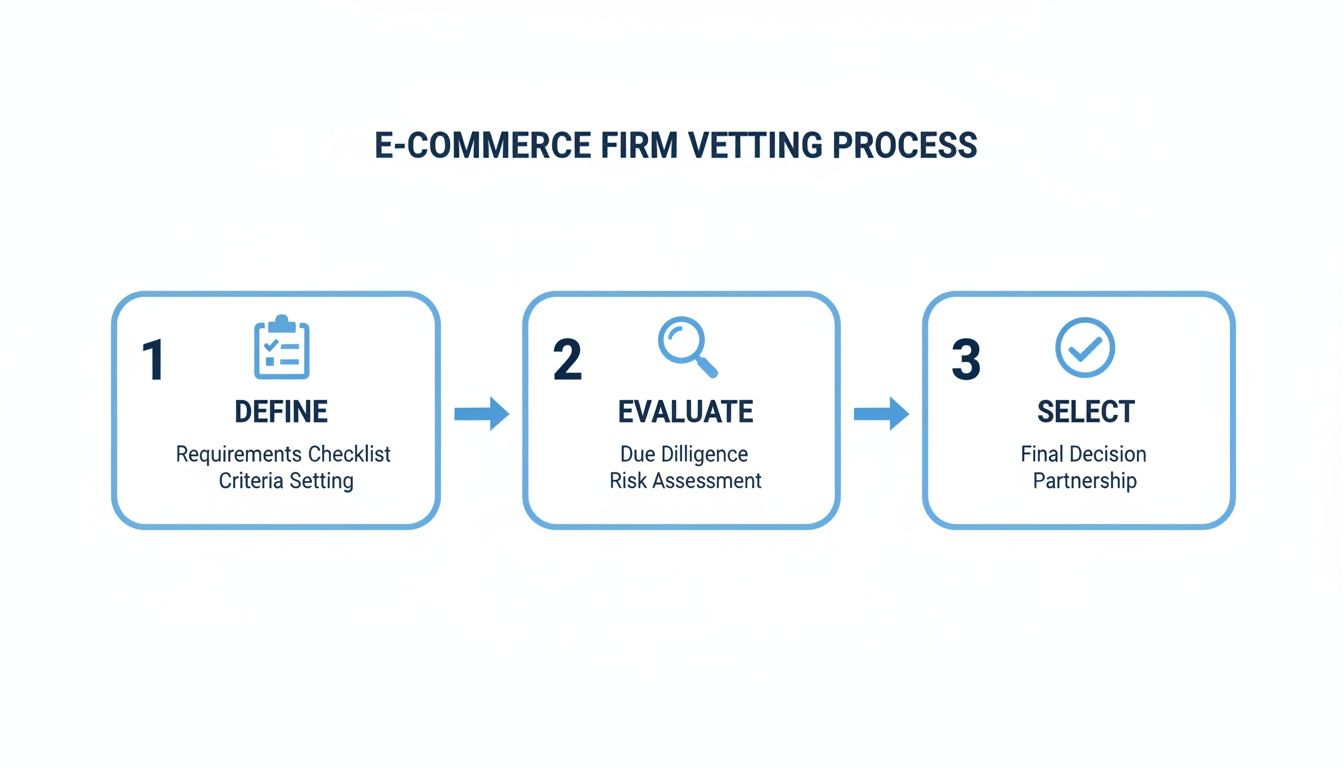
This process mitigates emotional or biased decisions by adhering to facts at each stage, from defining requirements to making the final selection.
Common Failure Points in Vetting Firms
Most selection processes are flawed because they measure the wrong metrics. These are the most common traps:
- Over-indexing on Portfolio Polish: A visually appealing portfolio is a baseline requirement. It reveals nothing about architectural trade-offs, performance tuning, or data migration challenges that occurred behind the scenes.
- Accepting Vague Technical Answers: Do not permit the use of jargon. If a firm cannot provide specific, real-world examples of how they’ve handled issues like API rate limiting or data synchronization, they likely lack the requisite experience.
- Ignoring Team Composition: You are hiring a specific group of individuals, not an entire firm. The team presented during the sales cycle is often not the team that will execute the project. You must vet the actual architects and engineers assigned to your account.
To maintain focus, the following core pillars should form the basis of your evaluation.
Core Vetting Criteria for Ecommerce Consulting Firms
This table summarizes the critical evaluation pillars detailed throughout this guide to help structure your approach.
| Vetting Pillar | Key Question to Answer | Common Failure Signal |
|---|---|---|
| Technical DNA | Does their specific architectural experience match our project’s risks? | They discuss “best practices” but cannot show a GitHub repo or architectural diagram from a comparable project. |
| Team Composition | Who are the actual engineers assigned to our project, and have we vetted them? | The lead architect changes between the sales call and the kickoff meeting. |
| Process & Tooling | How do they manage scope, handle technical debt, and communicate delays? | They lack a defined process for change requests or cannot describe their CI/CD pipeline. |
| Business Acumen | Do they understand our unit economics and how this project drives revenue? | They focus exclusively on technical features without connecting them to business KPIs like CVR or AOV. |
| Cost & Value | Is their pricing model aligned with delivering outcomes, not just billable hours? | They propose a vague “Time & Materials” contract with no caps or deliverable-based milestones. |
Using these pillars as a guide will compel you to look beyond a portfolio and uncover the true capabilities of a potential partner.
Defining Your Technical and Business Requirements
Before evaluating an ecommerce consulting firm, you must precisely define the problem you are solving.
A vague objective like “improve customer experience” is ineffective. It leads to scope creep, budget overruns, and a final product that does not impact key metrics. You will end up comparing sales pitches instead of solutions.
The primary task is to translate high-level business goals into specific, measurable technical requirements. This process forces internal alignment and provides a concrete framework for your RFP.

From Business Goals to Technical Needs
Begin with a business outcome, not a feature list. A consultant’s role is to deliver business value, and your requirements document must reflect this. Every technical specification should trace back to a KPI.
For example, consider a business goal to increase the repeat purchase rate by 15% within 12 months. This goal triggers a series of technical questions that a competent firm must be able to answer.
- Data Unification: How will a single view of the customer be achieved? This likely requires consolidating data from the ERP, POS, and marketing automation platform, pointing to a need for a Customer Data Platform (CDP) implementation.
- Personalization Engine: Once data is unified, what technology will power personalized product recommendations on the homepage or in emails?
- Loyalty Program Integration: Can the current architecture support a flexible, points-based loyalty program, or is a new microservice required?
This process forces a thorough consideration of the entire technology stack needed to achieve the goal, not just the front-end features.
Documenting Your Architectural Non-Negotiables
Your current tech stack has inherent rules and constraints. A firm with expertise in monolithic Shopify Plus builds may be unqualified for a complex, multi-service headless architecture using Commercetools.
You must be explicit about your architectural guardrails.
Your requirements document must specify your stance on major architectural questions. Do not leave room for interpretation.
A significant red flag is an ecommerce consulting firm that proposes a technology solution before conducting a deep analysis of your architectural constraints and data ecosystem. This indicates they are selling a pre-packaged solution rather than addressing your specific needs.
This is about defining the operational boundaries. Your document should specify items such as:
- Architectural Pattern: Are you committed to a microservices architecture, or is a modular monolith more appropriate?
- API Strategy: Is this an API-first project? What are your standards for performance and documentation for new endpoints?
- Platform Expertise: Be specific. Do not just state “ecommerce platform experience.” Specify platforms: Shopify Plus, BigCommerce, Magento, Commercetools.
Outlining Data and Compliance Mandates
Data is the connective tissue of your ecommerce operation. More projects derail from poorly mapped data flows and botched integrations than almost any other cause. Your requirements must detail data management protocols.
Be specific in these key areas:
- PIM/DAM Integration: How will product information and assets be synchronized? Where is the single source of truth?
- ERP & OMS Connectivity: What are the hard requirements for real-time inventory updates and order fulfillment workflows?
- Data Migration: What is the full scope of data being moved (customers, orders, products)? What are the data cleanliness and validation standards?
Finally, do not treat compliance as an afterthought. It has significant architectural implications. For operations in Europe or California, GDPR and CCPA are foundational requirements that dictate data storage, consent management, and API design. Failure to comply can result in substantial fines and loss of customer trust.
How to Evaluate True Technical Competence
Marketing claims are easy to make. Genuine technical expertise is difficult to fake. At this stage, you must move beyond polished case studies and begin auditing a firm’s engineering DNA.
Any ecommerce consulting firm can present a well-designed website. Few can detail the architectural trade-offs that made it performant and scalable under a Black Friday traffic spike. Your role is to identify weaknesses in their narrative. This is not a quiz; it is about de-risking a major technical and financial investment by asking direct questions that probe their real-world experience.
Distinguishing Specialists From Generalists
The market is divided between generalists and specialists. A firm that excels at rapid Shopify Plus theme customizations for D2C brands is almost certainly the wrong choice for a complex B2B marketplace on a headless architecture.
Generalists offer breadth. They are typically proficient across multiple platforms like Shopify, BigCommerce, and Magento (Adobe Commerce). They are a suitable choice for projects where the primary challenge is execution, not complex problem-solving.
Specialists provide critical depth. They might focus exclusively on API-first architectures using tools like Commercetools or specialize in multi-region ERP integrations for manufacturing clients. They are the appropriate choice when a project has significant architectural risk or requires specific domain expertise.
Choosing a generalist for a specialist’s job is a common cause of project failure. You end up paying for their on-the-job training, and their architectural compromises will create long-term technical debt.
To differentiate them, ask them to describe a project they declined and why. A true specialist will have a clear answer about what falls outside their core competency. A generalist’s response will likely be more ambiguous.
This matrix breaks down the different types of firms you’ll encounter.
Consulting Firm Specialization Matrix
This table compares different types of ecommerce consulting firms to help you identify the best fit for your specific modernization needs.
| Firm Type | Core Strength | Ideal Project Type | Potential Drawback |
|---|---|---|---|
| Platform Specialists | Deep expertise in a single platform (e.g., Shopify Plus, BigCommerce). | Store setups, theme customization, app ecosystem integration. | May lack experience with complex, multi-system architectures. |
| Headless/Composable Experts | API-first architecture, modern front-end frameworks (Next.js, Vue). | Custom storefronts, complex integrations, high-performance sites. | Can be over-engineered (and expensive) for simple D2C stores. |
| ERP/Integration Partners | Connecting ecommerce platforms to complex backend systems (SAP, NetSuite). | B2B commerce, multi-warehouse inventory, complex order fulfillment. | The front-end user experience may not be their primary focus. |
| Full-Service Digital Agencies | Strategy, design, development, and marketing under one roof. | Projects where brand and marketing are as important as the tech. | Technical depth can be shallower than a specialized engineering firm. |
Your choice depends on where your project’s greatest risks are. If it’s user experience, a design-led agency might be suitable. If it’s data synchronization with a legacy ERP, an integration partner is the lower-risk option.
Probing Questions For Core Competencies
It is time to move beyond the portfolio and ask questions that reveal their problem-solving processes. Their answers—or lack thereof—will provide critical insights.
Drill down into these areas with specific, technical questions:
- API & Headless Architecture: “Describe a time you dealt with API rate limiting or performance degradation in a headless build. What was the root cause, and how did you re-architect the data flow to solve it?”
- ERP Integration: “Walk me through the most complex ERP integration you’ve managed. What was the data synchronization strategy—webhooks, batch processing, a message queue? What were the primary failure points you had to design around?”
- Performance & Scalability: “Can you share an example of how you performance-tuned a site for a high-traffic event like a product drop? What specific metrics did you monitor, and what changes had the biggest impact on server response time and conversion rate?”
Demand specific, technical answers. If they respond with marketing jargon or deflect, it is a significant red flag. For a deeper dive, our guide on evaluating DevOps consulting companies covers principles for assessing infrastructure competence that are highly relevant here.
Analyze Their Approach to Problem-Solving
The best firms act as strategic technical partners, not just task executors. To assess this, present them with a hypothetical but realistic problem your team is currently facing.
For example: “Our current monolithic platform struggles with inventory updates from our three warehouses, causing overselling during flash sales. We’re considering a microservices-based inventory system. What would be your high-level approach, and what are the top three risks you’d want to mitigate first?”
A competent firm will:
- Ask clarifying questions about your current architecture and data models before proposing a solution.
- Discuss the trade-offs between different approaches, such as an event-driven architecture versus synchronous APIs.
- Identify potential pitfalls beyond the obvious, like data consistency challenges or the need for a robust testing strategy.
This exercise reveals more than a case study. It shows their thought process, comfort with ambiguity, and ability to think architecturally. This level of digital strategy is why the business consulting market is projected to grow from $188.46 billion in 2024 to $273.64 billion by 2031. You can read the full research on how this impacts the projected $31 trillion-plus e-commerce market.
Untangling Cost Models and Finding the Hidden Fees
A proposal can appear sound, but if it is based on a flawed pricing model or contains hidden costs, it can lead to financial overruns. Understanding how ecommerce consulting firms structure their fees is critical to protecting your budget.
This is not about “expensive” versus “cheap.” It’s about dissecting the three main pricing models: fixed-bid, time and materials (T&M), and retainers. Each has trade-offs that must be understood.
Cracking the Common Pricing Models
The engagement structure dictates cost and control. A fixed-bid project offers budget certainty but poses a risk if requirements are not completely locked down.
- Fixed-Bid: Suitable for projects with a clear, stable scope, such as a direct migration from Magento 2 to Shopify Plus. The price is locked in, which benefits budgeting. However, any change triggers a change order, often at a premium. Firms typically include a significant risk premium in the bid.
- Time & Materials (T&M): You pay for hours worked. This model is effective for complex, evolving projects, like building a new composable commerce stack. The primary risk is cost overruns. Without tight oversight and clear milestones, the budget can expand uncontrollably.
- Retainer: A set monthly fee for an on-call team. Ideal for ongoing improvements, optimizations, and post-launch support. It is not well-suited for large, one-off builds where the scope can become ambiguous.
Red Flag: A firm that aggressively pushes one model without understanding your project’s specifics is a concern. A reliable partner will recommend the model that best fits the project’s risk profile, not their billing convenience.
Exposing the Costs That Hide in Plain Sight
The initial proposal amount is rarely the final cost. Vague Statements of Work (SOWs) often conceal hidden fees. You must demand full transparency and investigate line items that vendors may omit.
These are costs frequently excluded from initial bids:
- Third-Party Licensing: If the solution requires a new CDP, PIM, or search provider, those licensing fees are rarely in the firm’s SOW but can add $50,000 - $250,000+ to your annual costs.
- Post-Launch Support: Many firms include a 30- or 60-day warranty. Afterward, every bug fix or minor change is billed at their standard hourly rate, which can range from $175-$350+ per hour.
- Data Migration & Cleanup: This is a classic source of scope creep. The SOW might cover migrating “customer data,” but if 20% of records are duplicates or have formatting issues, the hours for data cleansing will almost always be billed as an extra.
The management consulting market, which informs much of this high-level strategy, has grown from $257.394 billion in 2021 and is expected to hit $334.5 billion by 2025. While large firms offer valuable advice, their fee structures require careful scrutiny.
Forcing Total Cost Transparency
To avoid budget issues, your RFP must demand a detailed cost breakdown. Never accept a single lump-sum figure. Any credible firm should provide this. Our guide on average hourly IT consulting rates provides context for their calculations.
Insist on a proposal that breaks down costs by:
- Phase: Discovery, Design, Development, UAT, Launch.
- Role: Senior Architect, Lead Engineer, Project Manager.
- Deliverable: Tying specific outputs to each cost.
This forces clarity and makes it difficult for a firm to submit a low bid with the intention of recovering costs through change orders and hidden fees.
Building a Data-Driven RFP and Vendor Scorecard
Moving from a longlist of vendors to a shortlist based on intuition or a sales presentation is a flawed approach. A structured, objective process is required. A data-driven Request for Proposal (RFP) and a weighted vendor scorecard are the tools that remove subjective bias and lead to a defensible decision.
The purpose is not just to collect proposals, but to compel firms to provide specific, comparable answers. A generic RFP yields generic marketing responses. A precise one forces them to demonstrate their technical and operational competence.
Designing an RFP That Demands Specificity
An effective RFP does not ask vendors if they have experience with headless commerce. This is a yes/no question that will always be answered affirmatively.
Instead, ask for an architectural diagram from a previous headless project and an explanation of the technical trade-offs made when selecting an API gateway. One approach invites a claim; the other demands proof.
Your RFP should be structured for direct, apples-to-apples comparisons.
- Scenario-Based Questions: Do not ask about their project management methodology. Provide a realistic scenario. “A critical third-party API for inventory management shows intermittent latency two weeks before launch. Detail your communication and triage process, both internally and with our stakeholders.”
- Mandatory Technical Disclosures: Require them to name the specific architects and senior engineers who would be assigned to your project, including their direct experience on similar tech stacks. No substitutions without approval.
- Proof of Process: Request sanitized examples of key documents from past projects, such as a Statement of Work (SOW), a change request form, and a final project retrospective report. These reveal more about their actual work processes than any marketing material.
The quality of an RFP is measured by the quality of the constraints it imposes. A well-designed RFP prevents a vendor from hiding behind vague claims and forces them to engage with your specific technical and business realities.
Implementing a Weighted Vendor Scorecard
Once proposals are received, the scorecard serves as your defense against bias. It ensures every firm is judged by the same criteria, converting subjective impressions into a quantitative score. This makes the final decision transparent and justifiable.
Weighting is crucial. Not all criteria are equal. For a complex migration from a legacy monolith, Technical Expertise might be weighted at 40%. For a simpler project, Cost may be more heavily weighted.
Here is a sample structure:
| Category (Weight) | Criteria | Scoring (1-5) | Notes |
|---|---|---|---|
| Technical Fit (40%) | Proven experience with our specific stack (e.g., Commercetools, Next.js). | Assessed via case studies and a mandatory technical interview. | |
| Quality of proposed architectural approach. | Does it solve for our stated scalability and data risks? | ||
| Relevant Experience (25%) | Projects of similar scale and complexity in our industry (B2B Manufacturing). | To be verified with reference checks. No exceptions. | |
| Project Management (20%) | Clarity of process for scope, communication, and risk management. | Based on RFP response and specific interview questions. | |
| Cost & Value (15%) | Total cost of ownership, not just the proposal price. Transparency of pricing. | Is the cost breakdown clear? Are there hidden fees? |
This structured approach forces a disciplined evaluation. Our comprehensive vendor due diligence checklist provides more detailed criteria to incorporate into your process.
Conducting Reference Checks That Matter
Conduct reference checks, but not the standard ones vendors anticipate. Do not ask, “Were you happy with them?” This is an unproductive question.
Instead, ask targeted, skeptical questions that reveal how the firm behaves under pressure.
Effective questions to ask:
- “Describe the biggest unexpected technical challenge during the project. How did their team handle it?”
- “Tell me about a time when a deliverable was late or over budget. How was that communicated and resolved?”
- “What is one thing you wish this firm did differently in their process?”
These questions uncover a firm’s true operational character. Combining this qualitative feedback with your quantitative scorecard provides a comprehensive, data-backed view for your final decision.
Contract Negotiation and When to Walk Away
The final proposal has been received. The numbers appear correct, and your vendor scorecard has a clear leader. This is the stage where many projects are set up for failure before any code is written.
A weak Statement of Work (SOW) enables scope creep, budget overruns, and friction. This requires more than a legal review; as a technical leader, you must scrutinize clauses that impact project outcomes and protect your team from ambiguity.
Scrutinizing the Statement of Work
A vague SOW primarily benefits the vendor. It provides latitude to interpret requirements in their favor and charge for anything not explicitly detailed. Before signing, ensure the contract has ironclad definitions for these three areas:
- Acceptance Criteria: The term “project completion” is insufficient. Demand specific, measurable criteria for every deliverable. Instead of “mobile-responsive design,” the SOW should specify, “passes Google’s Mobile-Friendly Test and achieves a Core Web Vitals score of ‘Good’ on all key page templates.”
- Intellectual Property Rights: This is non-negotiable. The contract must state unambiguously that all custom code, configurations, and project-related IP are owned entirely by your company upon payment. Any ambiguity can lead to legal complications.
- Termination Conditions: A clear exit strategy is necessary. Define the exact conditions under which either party can terminate the agreement, including non-performance or failure to meet milestones. It should also specify the process for final payments and the handover of all work-in-progress.
A strong SOW links every payment directly to the acceptance of a specific, pre-defined deliverable. If a firm resists this structure, it may indicate a preference for billing for hours over delivering outcomes.
When Not to Hire an Ecommerce Consulting Firm
Sometimes, the most prudent decision is to walk away—not just from a single firm, but from the project for the time being. Initiating an engagement before you are prepared is a reliable way to waste budget and create internal disruption.
These are indicators that you should pause:
- Internal Stakeholders Are Not Aligned: If the CMO, COO, and CTO have conflicting priorities, a consulting firm will be caught in the middle. They cannot resolve internal political issues; they can only execute a clear, unified mandate.
- Requirements Are Still Undefined: If your requirements document contains “TBDs” or vague goals, you are not ready. Bringing in a firm at this stage means you will pay them $200-$400 per hour to perform the internal discovery your team should have already completed.
- The Budget Doesn’t Match the Ambition: You cannot get a complex, multi-region headless build on a budget intended for a simple Shopify theme adjustment. If quotes from multiple credible firms are all 50%+ higher than your budget, the issue is your scope, not their pricing.
Recognizing these internal misalignments before signing a contract will save more money, time, and stress than negotiating a few percentage points off a proposal. The most successful projects begin with internal clarity, not an external SOW.
Frequently Asked Questions
These are direct answers to common questions from technical leaders vetting ecommerce consulting firms.
What Is a Realistic Budget for an Ecommerce Consulting Project?
There is no single number. Cost is tied to complexity.
A straightforward migration, such as from Magento to Shopify Plus, will typically cost between $75,000 and $300,000.
A complex headless build with custom ERP and PIM integrations can easily exceed $500,000, with enterprise-level projects often costing over $1 million. Always demand a line-item breakdown tied to deliverables. If a firm cannot provide this, do not proceed.
How Long Should a Typical Ecommerce Project Take?
Timelines vary based on scope.
A basic Shopify Plus store setup with minimal customization might take 8-12 weeks. A headless implementation with a moderate number of integrations is more likely to be in the 6-9 month range.
Larger projects, such as an enterprise platform migration or a custom build, can take 12-18 months or longer. Be skeptical of any firm that provides a fixed timeline before a thorough discovery phase.
A common failure mode is compressing timelines unrealistically. This often leads to shortcuts in quality assurance, data validation, and performance testing, creating significant technical debt before launch.
What Is a Good Net Promoter Score for Ecommerce Consulting Firms?
Context is crucial for Net Promoter Score (NPS). While any score above 0 is positive, a score between 30 and 50 is generally considered good. The average NPS for B2B ecommerce was 59 in 2024, indicating high expectations.
However, a high NPS does not guarantee technical competence. It measures client satisfaction, which can be influenced by project management or communication, even if the underlying engineering is flawed. Use it as one data point, not the sole criterion.
Making a defensible vendor decision requires deep, unbiased intelligence. Modernization Intel provides the unvarnished truth about implementation partners—their real costs, failure rates, and true specializations—so you can de-risk your next project.
Need help with your modernization project?
Get matched with vetted specialists who can help you modernize your APIs, migrate to Kubernetes, or transform legacy systems.
Browse Services