
84% of Cloud Modernization Projects Fail. Here's a Guide to Not Being One of Them.
“Cloud modernization” isn’t just moving old software to a different server. That’s a lift-and-shift, a tactic that often results in higher costs and zero performance gains. True modernization is a ground-up re-engineering of applications to solve specific business problems, from slow feature releases to operational overhead.
What Cloud Modernization Services Truly Mean
Think of cloud modernization like renovating a historic house. You have a few options.
You could just update the wiring and plumbing while keeping the original structure. This is Rehosting, also known as “lift and shift.” It’s the fastest, lowest-risk path, but the benefits are minimal. You’re still living in the same old house; it just has better pipes.
Or, you could gut the interior and re-architect the floor plan for modern living. This is Re-architecting, where you break a monolithic application into microservices. It’s a much larger project, demanding significant resources and expertise, but it’s the only way to unlock the actual promises of cloud technology.
The market trend is clear. A Gartner report predicts that by 2025, 95% of new digital workloads will be on cloud-native platforms, a significant increase from 30% in 2021. This indicates a definitive shift away from simple migrations toward deep, architectural modernization.
From Technical Debt to Technical Wealth
At its core, a cloud modernization service is hired to address technical debt. Over years, legacy systems become fragile, expensive, and difficult to update. They are a liability that hinders market responsiveness. Modernization aims to convert that liability into a competitive asset.
This transformation targets specific, measurable business outcomes:
- Increased Velocity: Breaking monoliths into smaller, independent services allows teams to deploy updates and new features in days, not months. This is a direct measure of business agility.
- Elastic Scalability: Cloud-native applications can automatically scale to handle traffic spikes and scale down during quiet periods. This provides consistent performance and reduces costs for unused capacity.
- Reduced Operational Costs: Decommissioning on-premise data centers eliminates expenses related to hardware maintenance, physical security, and power consumption.
The objective isn’t merely to “be in the cloud.” It’s to fundamentally change how you build and run software. Lifting and shifting a legacy application to a cloud server often leads to higher operational costs and no performance improvement—a scenario we call a “cloud stall.”
Ultimately, effective cloud modernization services deliver a calculated plan that aligns technology with business goals. Every option, from a minor re-platform to a full re-architecture, has a specific cost, risk profile, and potential return. The key is mapping the correct technical strategy to the specific business problem you need to solve.
The Five Core Strategies for Modernization
Selecting a modernization strategy is not a one-size-fits-all decision. The optimal path depends on an application’s business value, its technical architecture, and your team’s capabilities. A misaligned strategy often leads to budget overruns with minimal demonstrable value.
The five most common strategies, often called the “5 Rs,” provide a clear framework for decision-making. These options range from simple migrations with limited benefits to complex, high-reward overhauls.
This diagram illustrates the two primary paths from a legacy system, each with a different level of complexity.
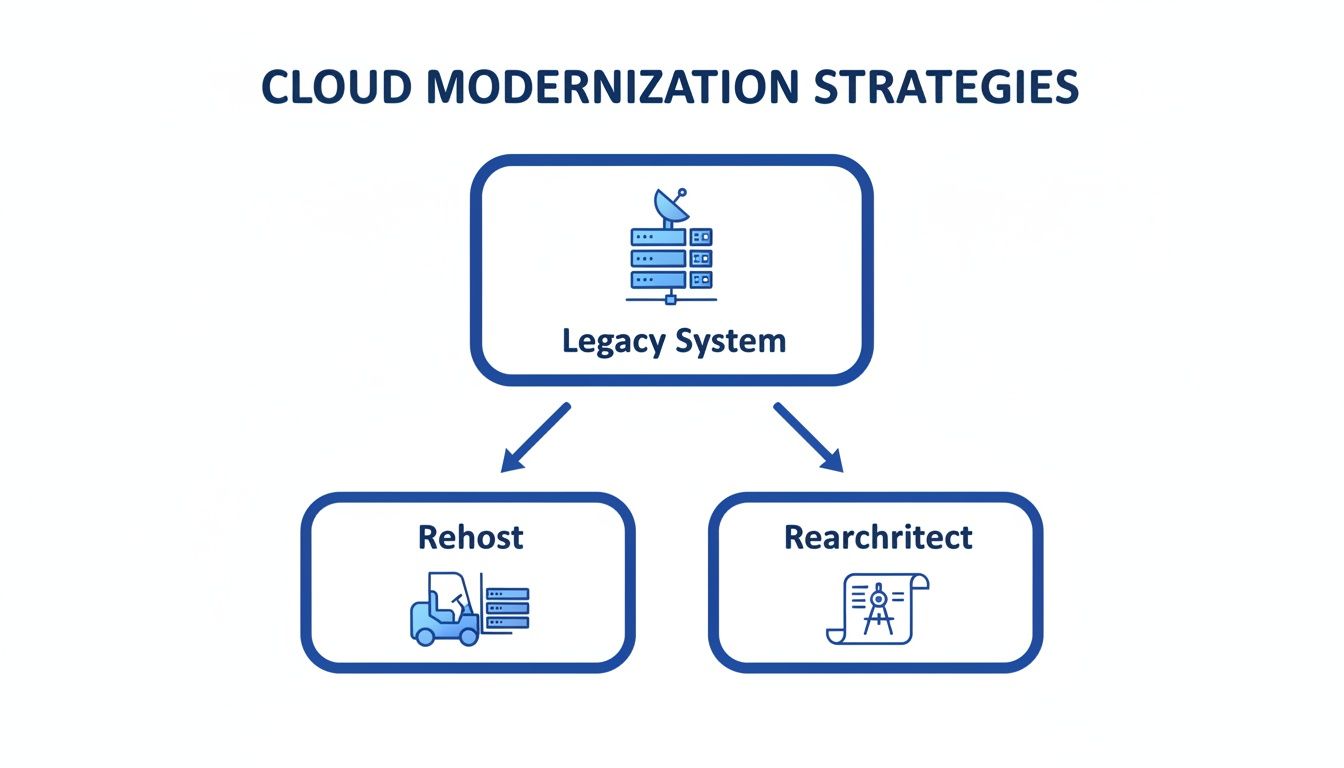
The choice is between a minimal-change “Rehost” or a transformative “Re-architect” for legacy systems.
To clarify this choice, let’s break down the 5 Rs. Each strategy has distinct trade-offs in cost, risk, and potential return. The table below provides a summary before we delve into the details.
A Comparison of Cloud Modernization Strategies
| Strategy | Description | Ideal Use Case | Typical Risk | Effort/Cost |
|---|---|---|---|---|
| Rehost | ”Lift and Shift.” Move the application as-is to cloud infrastructure. | Need to exit a data center quickly; large-scale migrations | Low | Low |
| Re-platform | ”Lift and Reshape.” Make minor cloud optimizations during the migration. | Moving to managed services (e.g., managed databases) | Low-Medium | Low-Medium |
| Repurchase | ”Drop and Shop.” Replace the application with a SaaS solution. | Commodity functions like CRM, HR, or email | Medium | Variable |
| Rearchitect | Radically change the app’s architecture to be cloud-native (e.g., microservices). | Core, high-value applications that need scalability and agility | High | High |
| Retire | Decommission an application that is no longer needed. | Redundant or low-value applications found during analysis | Very Low | Very Low |
Understanding these paths is the first step. The real challenge is mapping applications to the right strategy based on their business impact, not just their technology stack.
1. Rehost (Lift and Shift)
Rehosting is the most direct approach. An application is moved from an on-premise server to a cloud provider like AWS or Azure with minimal or no code changes.
This strategy is fast and carries low risk, making it suitable for exiting a data center contract quickly. However, the benefits are limited. The application remains a monolith and cannot leverage cloud-native features like auto-scaling or serverless functions. You are essentially swapping a capital expense (servers) for an operating expense (cloud bills), which can lead to higher TCO if not managed carefully.
2. Re-platform (Lift and Reshape)
Re-platforming involves making targeted cloud optimizations during migration without altering the core architecture. A common example is migrating a self-managed Oracle database to a managed cloud service like Amazon RDS or Azure SQL Database.
For instance, a monolithic Java application running on a Tomcat server could be packaged into a Docker container and deployed to a managed service like AWS Elastic Beanstalk. The application logic remains unchanged, but deployment and management become easier. The risk and cost are moderate, as is the potential return.
3. Repurchase (Drop and Shop)
Repurchasing involves decommissioning an existing application and replacing it with a Software-as-a-Service (SaaS) product. This is a common strategy for standard business functions, such as replacing a homegrown CRM with Salesforce or an old HR system with Workday.
The primary benefit is offloading management, maintenance, and infrastructure to the SaaS vendor. The trade-offs include the potential loss of custom features and the need to adapt business processes to the SaaS provider’s model. Data migration from the legacy system can also be a significant challenge.
When NOT to buy: If your custom application provides a significant competitive differentiator that a SaaS product cannot replicate, repurchasing could damage your business model. The question is whether the value of customization outweighs the total cost of maintaining the legacy system.
4. Rearchitect and Refactor
This is the most complex and expensive strategy, but it also delivers the most significant transformation. Re-architecting involves rebuilding an application to be cloud-native, typically by decomposing a monolith into a collection of independently deployable microservices.
Refactoring, the process of restructuring existing code for efficiency without changing its external behavior, is integral to this process. For example, a legacy .NET application might be re-architected into microservices running in containers managed by Kubernetes, utilizing API gateways and cloud-native databases.
This approach maximizes agility, scalability, and resilience but requires substantial investment and a highly skilled engineering team. For a closer look at implementation, you can explore various legacy system modernization strategies.
5. Retire
Sometimes, the most effective modernization strategy is to decommission an application. A portfolio analysis will often reveal systems that are redundant, provide low business value, or have functions now covered by other applications.
Identifying and decommissioning these applications is a critical part of a cloud modernization services project. It reduces complexity, shrinks the security attack surface, and frees up capital and personnel for modernizing high-value applications. Retiring legacy software often delivers a surprisingly high and immediate return on investment.
Why Most Modernization Projects Underperform
Many cloud modernization projects fail to meet their objectives. The Standish Group’s 2023 CHAOS report indicates that 31% of all IT projects are canceled before completion, and another 53% are challenged—exceeding their budget, missing deadlines, or failing to deliver the original scope.
Modernization failures rarely result from a single event. They are typically caused by an accumulation of overlooked technical issues and strategic blind spots that erode the budget and prevent the realization of the promised ROI. This is about recognizing the common failure patterns that derail these complex initiatives.
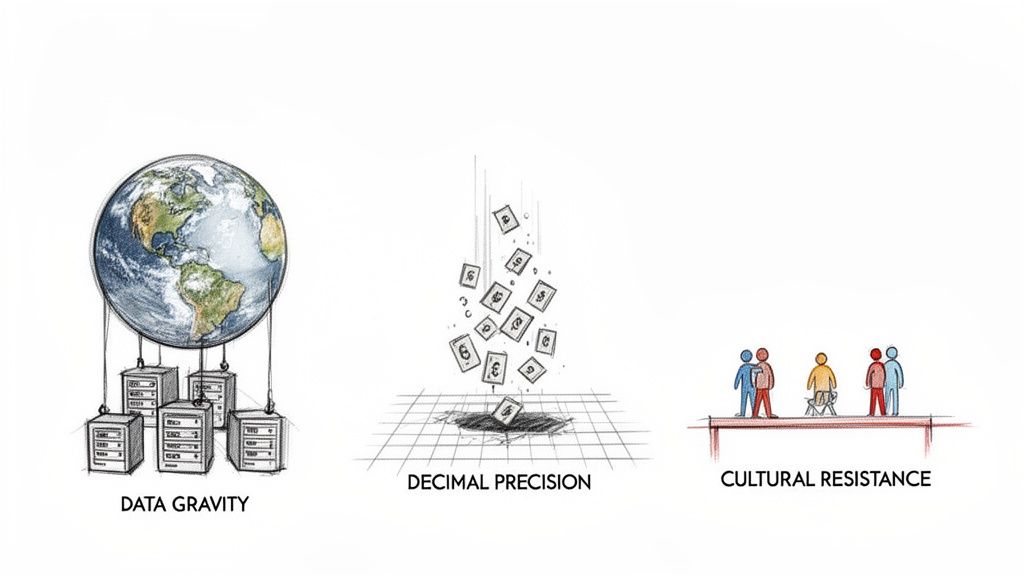
The Decimal Precision Pitfall
A common technical failure occurs when migrating financial systems from mainframes, particularly in COBOL-to-Java conversions. The issue lies in how the two languages handle numerical data.
- COBOL COMP-3 uses fixed-point arithmetic (packed decimal), which stores numbers with perfect precision. This is essential for financial calculations where every cent must be accounted for.
- Java primitives (
float,double) use floating-point arithmetic, which is suitable for scientific calculations but can introduce microscopic rounding errors in financial transactions.
When a team migrates financial logic to Java but fails to use the BigDecimal class to replicate COBOL’s precision, they introduce silent data corruption. Over millions of transactions, these rounding errors can compound into significant reconciliation discrepancies.
// Incorrect: Using floating-point for currency
double price = 10.99;
double tax = price * 0.07; // Potential for rounding errors

// Correct: Using BigDecimal for precise financial calculations
BigDecimal priceBd = new BigDecimal("10.99");
BigDecimal taxRateBd = new BigDecimal("0.07");
BigDecimal taxBd = priceBd.multiply(taxRateBd);
Research indicates that up to 67% of COBOL migrations fail due to improper handling of decimal precision. This error is subtle, difficult to detect in testing, and can be catastrophic in a production environment.
Underestimating Data Gravity
“Data gravity,” a concept from Dave McCrory, describes how large datasets become difficult to move and tend to attract applications and services.
Many leaders underestimate this force, focusing on application code while treating data migration as a secondary task. This leads to two predictable and costly problems:
- High Egress Costs: Cloud providers charge for data transfer out of their networks. Migrating terabytes or petabytes of data can result in unexpected bills reaching hundreds of thousands of dollars in egress fees alone.
- Increased Latency: If an application is modernized in the cloud while its primary database remains on-premise, every query must traverse the network. The resulting latency can render the application unusable for end-users.
Ignoring data gravity creates a dilemma: pay exorbitant egress fees or accept poor application performance. An effective cloud modernization service must begin with a detailed data migration strategy. A formal cloud migration risk assessment can help identify these issues early.
Imposing DevOps on an Unprepared Culture
The third common failure is cultural. Cloud-native systems, especially those based on microservices, require a DevOps mindset, where small, autonomous teams have end-to-end ownership of their services.
However, many large organizations attempt to implement this new operating model without changing their existing siloed structure. They fail to provide adequate training, create psychological safety for experimentation, or adjust organizational charts.
The result is often friction and resistance. Developers are tasked with managing infrastructure they don’t understand, operations teams feel their roles are threatened, and QA processes are disrupted by the shift to continuous delivery. Modernization is as much about changing how people work as it is about changing the technology they use.
Decoding the True Cost of Modernization Services
Budgeting for cloud modernization can be challenging, as vendor proposals often focus on the initial migration while downplaying long-term operational costs.
Most vendors use one of two pricing models: Fixed-Bid or Time & Materials (T&M). A fixed-bid project offers cost certainty, making it suitable for well-defined tasks like a “lift and shift” migration. However, this model becomes rigid and expensive when the scope changes, which is common in complex modernization projects.
T&M offers flexibility but carries the risk of scope creep. It is better suited for exploratory work like re-architecting, where the full scope is not known upfront. Skepticism is warranted; without tight project management, T&M engagements can easily exceed budget.
Concrete Cost Benchmarks
Financial planning requires specific data, not vague terms. Here are real-world cost ranges for specialized modernization work:
- COBOL to Java Migration: A common mainframe modernization project typically costs between $1.50 to $4.00 per Line of Code (LOC). A two-million-line COBOL application could therefore cost between $3M to $8M for code conversion.
- Enterprise Application Re-platforming: Migrating a core system like an on-premise ERP or billing platform to a cloud-native architecture can start at $250,000 and exceed $1.5M, depending on the number of integrations and data complexity.
These figures represent the direct vendor invoice, but they are only part of the total cost.
The Hidden Costs Vendors Rarely Mention
The largest budget overruns often come from costs not included in vendor proposals. These predictable expenses must be factored into a Total Cost of Ownership (TCO) analysis from the outset.
The primary financial risk is not the vendor’s invoice but the cumulative operational costs that follow. A project can become a financial liability if long-term expenses for running, securing, and optimizing the new cloud environment are not planned for.
Key ongoing costs include:
- Data Egress Fees: Cloud providers charge for data moving out of their network. If a modernized application sends significant data back to on-premise systems, these fees can become a substantial recurring operational expense.
- New Software Licensing: Modernization often involves adopting new tools, such as managed enterprise databases or observability and security platforms, which come with new licensing costs.
- Ongoing Cloud Operational Expenses (OpEx): Cloud bills require constant monitoring and optimization to prevent costs from escalating. By 2025, it is projected that 33% of organizations will spend over $12 million annually on public cloud services.
- Team Retraining and Skill Gaps: The costs of training, certifications, and the productivity dip during the learning curve are real and often overlooked project expenses.
Proactive cloud cost optimization strategies are essential for managing these long-term expenses. For a deeper analysis, see our guide on cloud cost optimization strategies.
How to Select the Right Modernization Vendor
Selecting a partner based on generic “cloud expertise” is a significant risk. The skills required to migrate a university’s learning management system are different from those needed to re-architect a core banking platform.
Expertise is specific, deep, and proven within your technical and regulatory context. The vendor selection process must be a forensic analysis of their capabilities. For example, a vendor specializing in mainframe COBOL migrations for finance will focus on data integrity and fixed-point arithmetic, while a telecom billing system specialist will prioritize latency and throughput. These are not interchangeable skill sets.
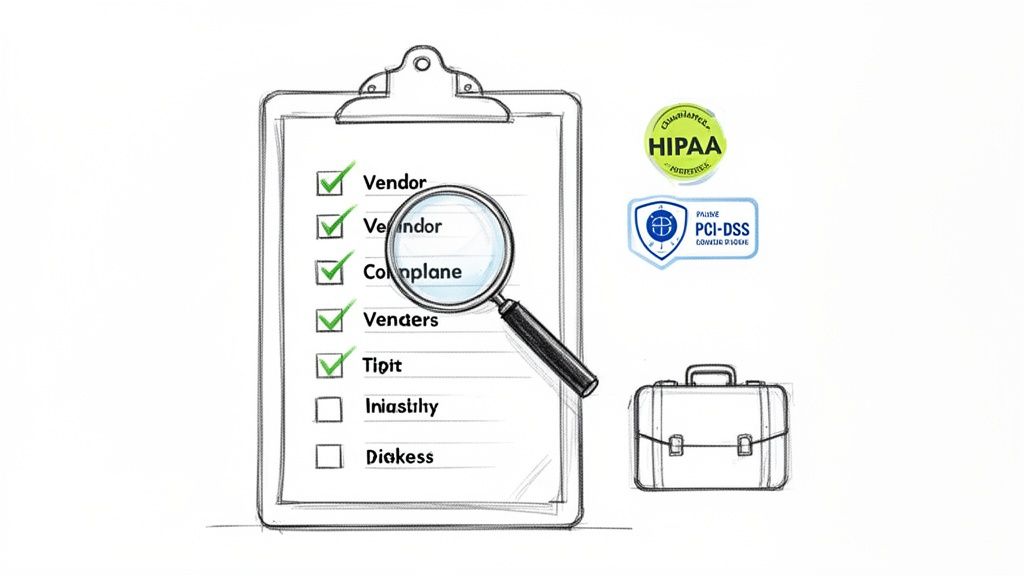
Aligning Specialization with Your Technical Reality
General-purpose IT service providers often struggle with complex modernization. It is critical to verify a vendor’s hands-on proficiency with your specific legacy stack and their experience navigating your industry’s compliance requirements, such as HIPAA in healthcare or PCI-DSS in finance.
This is particularly important in hybrid environments, which are projected to account for 49.63% of the 2025 revenue in this space. Industries like banking, healthcare, and manufacturing use hybrid cloud to meet data sovereignty and latency requirements. This demands partners with expertise in hybrid orchestration tools like Kubernetes and experience managing workloads securely across on-premise and cloud environments.
Critical Questions for Your Vendor Shortlist
Push past marketing presentations with direct, evidence-based questions.
A vendor’s inability to provide quantifiable outcomes from past projects is a significant red flag. If they cannot produce a case study with pre- and post-migration performance metrics, it suggests a lack of successful, measurable engagements.
Use this checklist to assess vendors:
- Data Integrity Methodology: Ask: “Describe your process for ensuring zero data loss during migration.” For a COBOL project, they should immediately discuss handling decimal precision with
BigDecimalor an equivalent. - Quantifiable Case Studies: Demand case studies relevant to your industry and tech stack. Look for specific metrics, such as “Reduced batch processing time by 40%” or “Lowered infrastructure TCO by $1.2M annually.”
- Legacy Stack Experience: Be specific. Ask: “How many projects have you completed involving WebSphere Application Server version 8.5 connecting to a DB2 mainframe database?”
- Failure and Recovery: Ask: “Describe a time a migration project encountered a significant issue. How did you identify it, communicate it to the client, and resolve it?” Their response will reveal their transparency and problem-solving maturity.
- Team Composition: Ask: “Who specifically will be assigned to my project?” Request the résumés of key architects and engineers to verify their direct experience with your technologies.
A defensible vendor decision requires methodical scrutiny. Use our detailed vendor due diligence checklist to ensure a comprehensive evaluation. This rigor is not about mistrust; it’s about de-risking a multi-million dollar investment.
The pressure to modernize is significant, but modernizing every application is a strategic error.
Knowing when to leave a system untouched is as critical as selecting the right vendor. A costly overhaul of a stable system introduces unnecessary risk for minimal return. Not every legacy application requires immediate modernization. The decision must be driven by business outcomes, not by a vendor’s sales cycle.
When NOT to Modernize
- Stable Systems with a Low TCO: If a legacy system is stable, meets business needs, and has a low total cost of ownership (TCO), modernization is likely to introduce risk without a clear ROI.
- Applications with Undocumented Business Logic: Re-architecting a system with poorly documented business logic is extremely high-risk. The process requires reverse-engineering complex rules, which is slow, expensive, and prone to failure.
- Systems Nearing End of Life: Modernizing an application that supports a business process or product line slated for decommissioning within 18-24 months guarantees a negative ROI. Resources are better allocated to accelerating the system’s retirement.
Your Modernization Questions, Answered
Here are answers to common questions from leaders evaluating a modernization project.
What’s a Realistic Timeline for This Kind of Project?
The timeline is dictated by complexity, not by a generic project plan.
- A lift-and-shift (rehosting) project can typically be completed in 3-6 months.
- Re-platforming a mid-sized application may take 6-12 months.
- Re-architecting a core monolithic system into microservices is a significant undertaking that should be planned for 18-24 months or longer, depending on the state of the existing code and data complexity.
How Do We Actually Measure the ROI?
A credible business case must demonstrate gains across four key areas, not just cost savings on servers.
- Total Cost of Ownership (TCO) Reduction: Include savings from data center closures, retired hardware maintenance contracts, and reduced operational headcount.
- Developer Velocity: Measure the increase in deployment frequency and the decrease in lead time for changes.
- System Resilience: Track uptime against SLAs and measure the reduction in Mean Time to Recovery (MTTR).
- Business Agility: Measure the time required to launch new products or features in response to market demands.
A project focused solely on TCO reduction is a tactical expense. Strategic investments are those that make the entire business faster and more resilient.
Should We Use Our In-House Team or Hire a Specialized Vendor?
The decision depends on risk and in-house expertise.
For lower-risk projects like rehosting, an internal team with some cloud experience can often manage the work.
For high-complexity projects, such as rewriting a mainframe application, a specialized vendor is necessary. These partners provide niche skills and proprietary tools that can automate parts of the migration and reduce risk.
A hybrid model, where a specialized vendor augments your internal team to transfer knowledge and de-risk complex components, is often the most effective approach.
Making the right call on a vendor is the most critical decision you’ll make. At Modernization Intel, we provide unbiased, data-driven intelligence on 200+ implementation partners to help you see past the sales pitches and choose a partner with proven success in your specific technical and industry environment. Get Your Vendor Shortlist.