
7 Brand Experience Agencies That Don't Just Win Awards
While brand experience investments are projected to increase by 12% in 2025, internal data shows a disconnect between spend and measurable impact. Many campaigns fail to integrate with core MarTech stacks, leading to attribution gaps where up to 40% of lead data is lost post-event. Furthermore, a common pitfall is selecting a large-scale agency for a niche activation, resulting in budget overruns of 25-30% on average due to mismatched overhead structures. This analysis is designed for technical leaders tasked with vendor selection, focusing on technical integration capabilities, realistic cost benchmarks, and common failure signals to avoid.
This listicle moves beyond creative awards to dissect the operational and technical execution of leading brand experience agencies. For each agency, you will find a detailed breakdown covering:
- Core Specializations: The specific technical and creative domains where they excel.
- Engagement Scope & Cost: Typical project sizes and realistic cost ranges ($150k - $5M+).
- Implementation Pitfalls: Common failure points from a technical leader’s perspective, such as API limitations or data hygiene issues.
- Customer & Sector Fit: Where they deliver maximum value and which industries to avoid.
We provide direct links and a clear, evaluative look to help you select a partner that can deliver a technically sound and ROI-positive brand experience, not just a memorable one.
1. Jack Morton Worldwide
Jack Morton Worldwide is a common choice for enterprise-scale brand activations. The firm provides end-to-end services for live, hybrid, and digital events, making them a default consideration for complex product launches or major conference keynotes where logistical precision is a primary requirement.

Their primary strength lies in executing at-scale physical and hybrid experiences, a domain where many smaller agencies lack the operational depth. Their portfolio includes major tech brands like Samsung and Meta, demonstrating capability in managing intricate technical requirements and global logistics.
Core Specializations & Engagement Scope
- Large-Scale Live Events: Production of major conferences, user summits, and product reveals.
- Sponsorship Activation: Translating brand sponsorships (e.g., sports, entertainment) into interactive audience experiences.
- Employee Engagement: Designing internal events aimed at reinforcing company culture.
Engagements are typically comprehensive, covering strategy, creative, production, technical integration, and post-event measurement.
Cost & Implementation Signals
| Aspect | Details |
|---|---|
| Typical Engagement Cost | $750,000 - $5M+. Pricing reflects the high-touch, full-service nature of their large-scale programs. |
| Common Implementation Pitfalls | Underestimating the long lead times required for flagship events can lead to rushed creative and compromised execution. Failure to provide a clear technical brief and designated internal point-of-contact can create significant friction. |
| Failure Signals | A key failure signal is a lack of alignment between your internal product teams and the agency’s creative team early in the process. If technical demos or product integrations feel like an afterthought in planning, the final experience will likely suffer. |
Customer Fit & When NOT to Buy
Jack Morton is a strong fit for Fortune 500 companies that need a dependable partner for executing marquee moments. Their public RFP and contact information simplify procurement for large organizations. While their digital experience capabilities are robust, they are often linked to a larger live or hybrid event. For purely digital needs, such as developing a standalone virtual platform or an intricate B2B website, a specialized B2B website design agency may offer a more focused and cost-effective solution.
When NOT to buy: Your budget is under $500,000, your timeline is less than six months for a major activation, or you require a nimble agency culture.
Website: https://www.jackmorton.com
2. George P. Johnson (GPJ)
For global user conferences or multi-market roadshows, George P. Johnson (GPJ) offers significant operational depth. They specialize in large, technically complex experiential programs where global logistics and content strategy are critical. GPJ often functions as an integrated partner for organizations managing multi-faceted event portfolios, from flagship conferences to persistent digital experience platforms.
Their key differentiator is the ability to deliver consistent experiences at a global scale, leveraging a vast network to manage everything from venue sourcing to local compliance. The agency’s portfolio shows long-standing relationships with tech clients like IBM and Salesforce, signaling proficiency in handling sophisticated product narratives and enterprise-level security requirements.
Core Specializations & Engagement Scope
- Flagship User Conferences: End-to-end production of large-scale events like Dreamforce, including strategy, content, technology, and logistics.
- Global Roadshows & Tours: Executing multi-city product launches that require consistent messaging and localized execution.
- Digital & Hybrid Event Platforms: Developing and managing persistent digital platforms that complement physical events.
Engagements are typically long-term and strategic, often spanning an entire event calendar. The scope includes deep integration with client-side marketing, product, and engineering teams.
Cost & Implementation Signals
| Aspect | Details |
|---|---|
| Typical Engagement Cost | $1M - $10M+. Pricing reflects their comprehensive, portfolio-level approach to major brand experiences and conferences. |
| Common Implementation Pitfalls | Insufficiently defining the role of technology early on can lead to a generic event platform. A failure to provide GPJ with direct access to technical subject matter experts for content development will result in shallow session tracks. |
| Failure Signals | A primary failure signal is treating GPJ as an event logistics vendor rather than a strategic partner. If your internal team is not prepared for deep collaboration on strategy and content, the engagement will devolve into a tactical execution that fails to deliver strategic value. |
Customer Fit & When NOT to Buy
GPJ is a logical fit for large enterprises that manage a significant portfolio of global events and require a single partner for strategy and execution. Their experience technology and content creation capabilities are well-suited for companies with complex products. While their work can involve physical retail, for a purely digital storefront strategy, a specialized provider from a list of top eCommerce consulting firms might be a better choice.
When NOT to buy: Your needs are for a single, localized event, your budget is below $750,000, or you require an agency that can move with the speed of a smaller firm.
Website: https://www.gpj.com
3. Momentum Worldwide
Momentum Worldwide focuses on connecting brand activations with commerce and culture. The agency blends physical, digital, and retail touchpoints, with a strength in activating brands within high-energy cultural environments like sports and entertainment. This makes them a frequent choice for major consumer-facing rollouts and complex sponsorship campaigns.
What distinguishes Momentum is their explicit investment in using AI and machine learning to inform strategy and measure impact. This data-driven approach is relevant for CTOs tasked with proving the ROI of experiential marketing. Their portfolio includes work for clients like American Express and Verizon, demonstrating an ability to navigate enterprise-level security, data, and integration requirements.
Core Specializations & Engagement Scope
- Sponsorship & Partnership Activation: Turning sports, music, and cultural sponsorships into measurable fan and consumer engagement.
- Shopper & Retail Marketing: Designing in-store and omnichannel experiences that link brand engagement to sales transactions.
- Integrated Commerce Experiences: Blending live events with digital platforms to create paths to purchase.
Engagements often span from strategy and creative concepting through to global execution, including logistical management, technology integration, and analytics.
Cost & Implementation Signals
| Aspect | Details |
|---|---|
| Typical Engagement Cost | $600,000 - $4M+. Costs are driven by the complexity of the integrated campaign, global footprint, and technology requirements. |
| Common Implementation Pitfalls | The agency’s integrated model requires tight alignment between marketing, sales, and technology teams. A failure to unify internal stakeholders around a shared set of KPIs can dilute the campaign’s impact and create execution bottlenecks. |
| Failure Signals | A primary failure signal is treating the commerce or retail component as a bolt-on rather than an integral part of the initial brief. If your internal e-commerce or retail teams are not involved from the start, the experience will likely feel disjointed. |
Customer Fit & When NOT to Buy
Momentum Worldwide is a good partner for large consumer brands that need to translate cultural relevance and major sponsorships into business outcomes. Their global network and focus on integrated commerce make them well-suited for product launches requiring a coordinated multi-market presence.
When NOT to buy: Your budget is below the $500,000 threshold, you need a purely B2B-focused activation without a consumer or retail component, or your organization lacks the cross-functional structure to support an integrated campaign.
Website: https://www.momentumww.com
4. Freeman
Freeman offers an integrated production and logistics backbone for large user conferences or complex trade show presences. As one of North America’s largest event companies, they provide a full-service solution covering strategy, creative, logistics, and production. Their scale is suited for programs where managing numerous vendors across multiple venues is a primary operational risk.
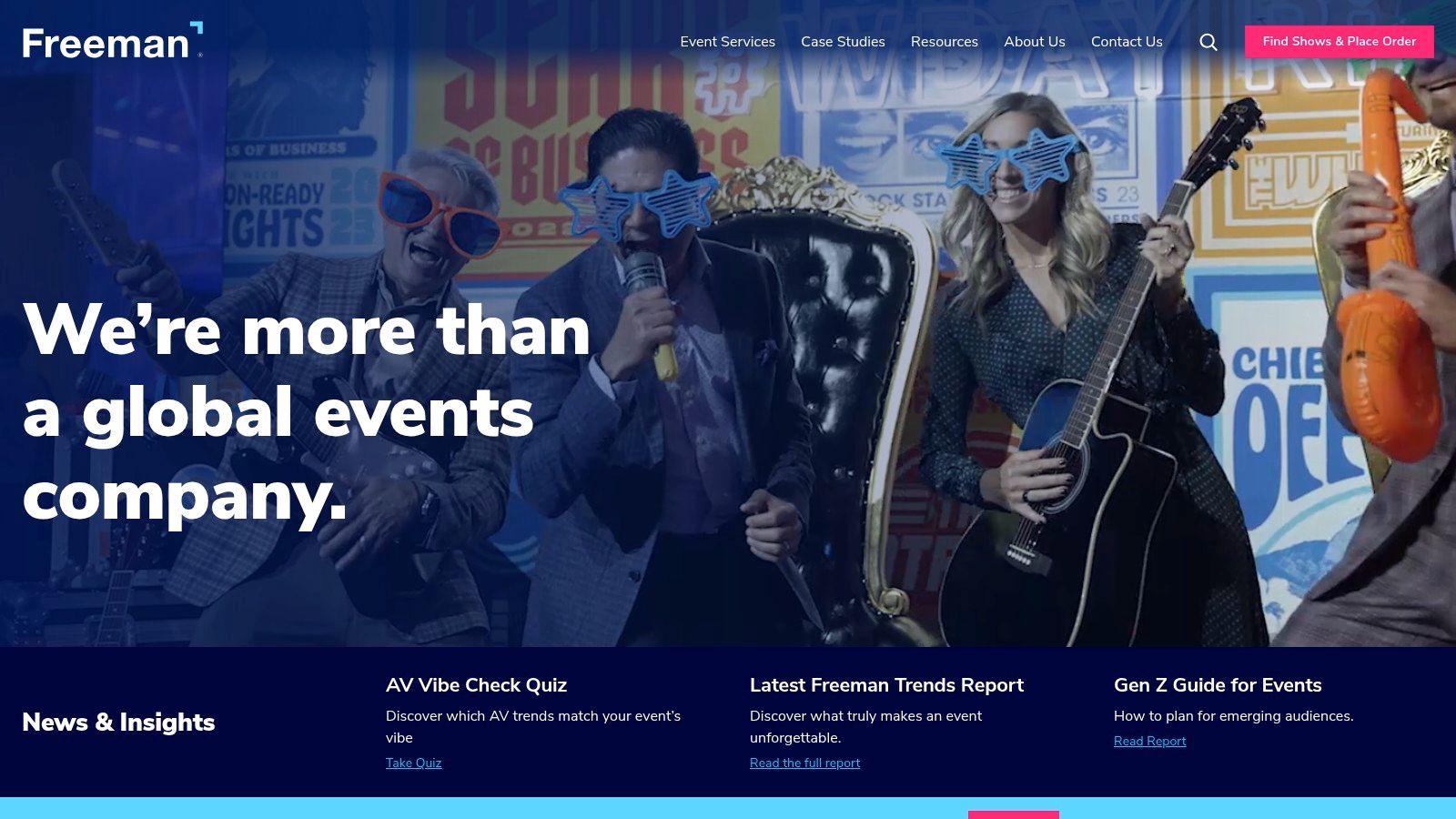
Freeman’s core strength is its in-house infrastructure for event production and logistics. This vertical integration, bolstered by their acquisition of Sparks, minimizes reliance on third-party contractors, giving clients a single point of accountability. Their website provides a public calendar of experiences and clear calls to action, which is advantageous for teams needing to move quickly on vendor selection.
Core Specializations & Engagement Scope
- Large-Scale Conferences & Trade Shows: End-to-end management of major industry events, from exhibit hall design to breakout session production.
- Corporate Events & Exhibits: Designing and building complex, custom exhibits and immersive brand activations.
- Integrated Event Services: Providing a unified solution that includes strategy, creative, audiovisual, digital integration, and logistics.
Engagements are typically large-scale and comprehensive, leveraging their extensive U.S. footprint for rapid mobilization of multi-venue programs.
Cost & Implementation Signals
| Aspect | Details |
|---|---|
| Typical Engagement Cost | $600,000 - $4M+. Pricing reflects their enterprise scale and full-service model, often bundling production, logistics, and creative into a single package. |
| Common Implementation Pitfalls | Relying too heavily on their scale without providing a strong, differentiated creative brief can result in generic corporate event formats. |
| Failure Signals | A key failure signal is a disjointed experience between the digital pre-event campaign and the physical event execution. If the agency’s digital and creative teams aren’t integrated with the production and logistics teams from day one, the audience journey will feel fragmented. |
Customer Fit & When NOT to Buy
Freeman is a solid partner for large enterprises that prioritize logistical certainty and single-vendor management for their most complex events. Organizations running flagship annual conferences or requiring a massive trade show presence will benefit from their production capacity. Their broad capabilities make them one of the most reliable brand experience agencies for executing at scale.
When NOT to buy: You are seeking a specialized, boutique creative partner for a smaller brand moment. Their enterprise structure may be less nimble for projects with budgets under $500,000 or for clients who prefer a high-touch, small-team agency relationship.
Website: https://www.freeman.com
5. Sparks (a Freeman Company)
Sparks translates complex products into tangible, physical brand experiences like trade show exhibits and interactive installations. Acquired by Freeman, Sparks operates with the agility of a creative boutique but is backed by an enterprise-level production infrastructure. This makes them a strong choice for high-profile events like CES or SXSW, where custom-built environments are critical.
Their primary advantage is their in-house fabrication capability, which allows for greater control over quality, timelines, and the integration of technology into physical spaces. The agency’s portfolio highlights work for tech and entertainment brands, demonstrating proficiency in creating immersive environmental designs that can be deployed globally.
Core Specializations & Engagement Scope
- Trade Show Exhibits & Environments: Designing and fabricating large-scale, custom booths and installations for major industry events.
- Pop-Ups & Retail Activations: Creating temporary, high-impact physical experiences designed to generate consumer engagement.
- Live & Digital Event Integration: Merging physical builds with digital content, interactive elements, and hybrid event technology.
Engagements typically focus on the lifecycle of a physical installation, from strategy and environmental design to fabrication, logistics, on-site installation, and measurement.
Cost & Implementation Signals
| Aspect | Details |
|---|---|
| Typical Engagement Cost | $400,000 - $3M+. Costs are driven by the scale of fabrication, material choices, and the complexity of digital integrations. |
| Common Implementation Pitfalls | The fabrication process for custom builds requires significant lead time. A common pitfall is treating the exhibit as a marketing asset and not engaging engineering teams early to validate the technical feasibility of interactive demos. |
| Failure Signals | A clear failure signal is a disconnect between the agency’s creative renderings and the practical realities of your product. If the proposed design cannot realistically house or support your tech demo without significant compromises, the project is at risk. |
Customer Fit & When NOT to Buy
Sparks is a good fit for established tech, automotive, or entertainment companies that rely on major trade shows and physical activations as a core part of their marketing strategy. Their ability to manage everything from creative to fabrication simplifies execution for complex builds. The backing of Freeman provides assurance of delivery at a global scale.
When NOT to buy: Your primary need is purely digital strategy or content creation without a physical component. Also, if your budget is under $250,000 or you require a standard rental solution, their custom-build model may not be the most cost-effective approach.
Website: https://www.wearesparks.com
6. Event Marketer — The It List (Top 100 Experiential Agencies)
“The It List” by Event Marketer is a discovery and vetting tool, not an agency itself. It is a curated annual roundup of the top 100 U.S.-based experiential marketing agencies. This resource is useful for building a qualified shortlist when you need to explore options beyond the largest holding company shops.
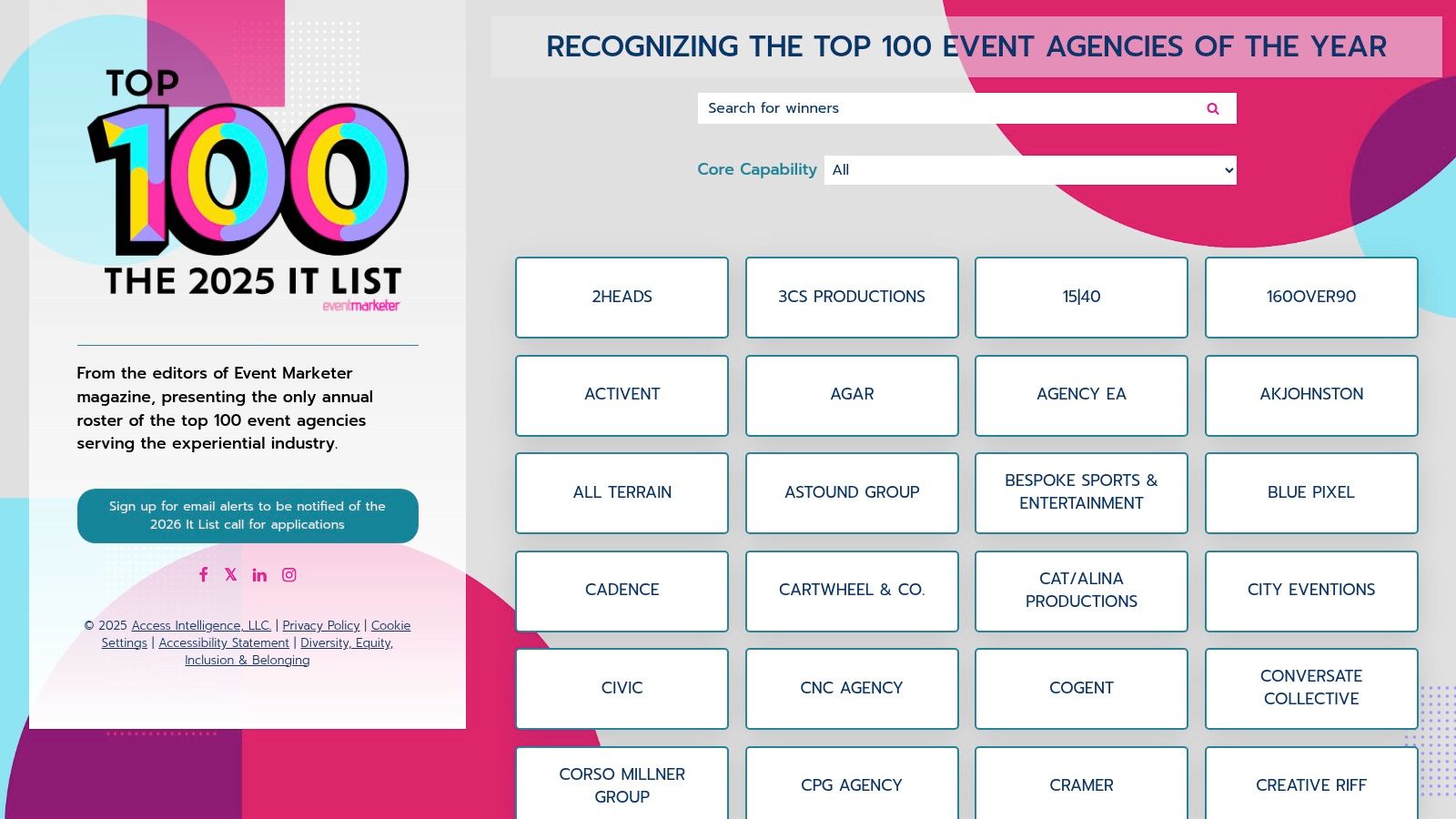
The list’s primary utility is its structured, filterable format, allowing you to identify potential partners based on specific capabilities (e.g., mobile tours, B2B conferences) and industry verticals (e.g., tech, healthcare). This helps narrow a wide field of brand experience agencies to a manageable set for deeper evaluation.
Core Specializations & Engagement Scope
- Agency Discovery: The platform’s core function is to facilitate the discovery of pre-vetted agencies.
- Capability Shortlisting: Users can filter the list to find firms specializing in niche areas like interactive installations or AR/VR experiences.
- Vertical Expertise: Identifies agencies with track records in specific sectors, which can be crucial for understanding nuanced compliance or audience expectations.
The platform provides a starting point. Engagement begins only after you use the list to contact agencies directly.
Cost & Implementation Signals
| Aspect | Details |
|---|---|
| Typical Engagement Cost | Free to access. This is a research tool; costs are incurred with the agencies you engage from the list, which can range from $100,000 to $10M+. |
| Common Implementation Pitfalls | Relying solely on the list without conducting independent due diligence is a significant risk. The list is a starting point, not a substitute for a formal vendor due diligence process. |
| Failure Signals | A failure signal is treating all listed agencies as equal. The list includes a wide spectrum of firms; failing to vet their specific technical capabilities, team structure, and recent relevant work can lead to a poor partnership fit. |
Customer Fit & When NOT to Buy
This resource is a good fit for any technical or marketing leader tasked with building an RFP list for a major brand experience initiative. It’s particularly useful for companies looking to diversify their agency roster or find specialists that a primary Agency of Record (AOR) may not possess.
When NOT to buy: You are looking for a platform to manage the RFP process or need detailed, non-public information like pricing and case studies. The list is a directory; all subsequent outreach and vetting must be done manually.
Website: https://www.eventmarketer.com/event/event-marketer-it-list-2025/
7. Clutch — Experiential Marketing Agency Directory (U.S.)
Clutch’s Experiential Marketing Agency Directory is a due diligence tool. It is a B2B marketplace that provides aggregated, filterable data and verified client reviews on hundreds of brand experience agencies. This allows you to create an initial shortlist and validate agency claims before making first contact.
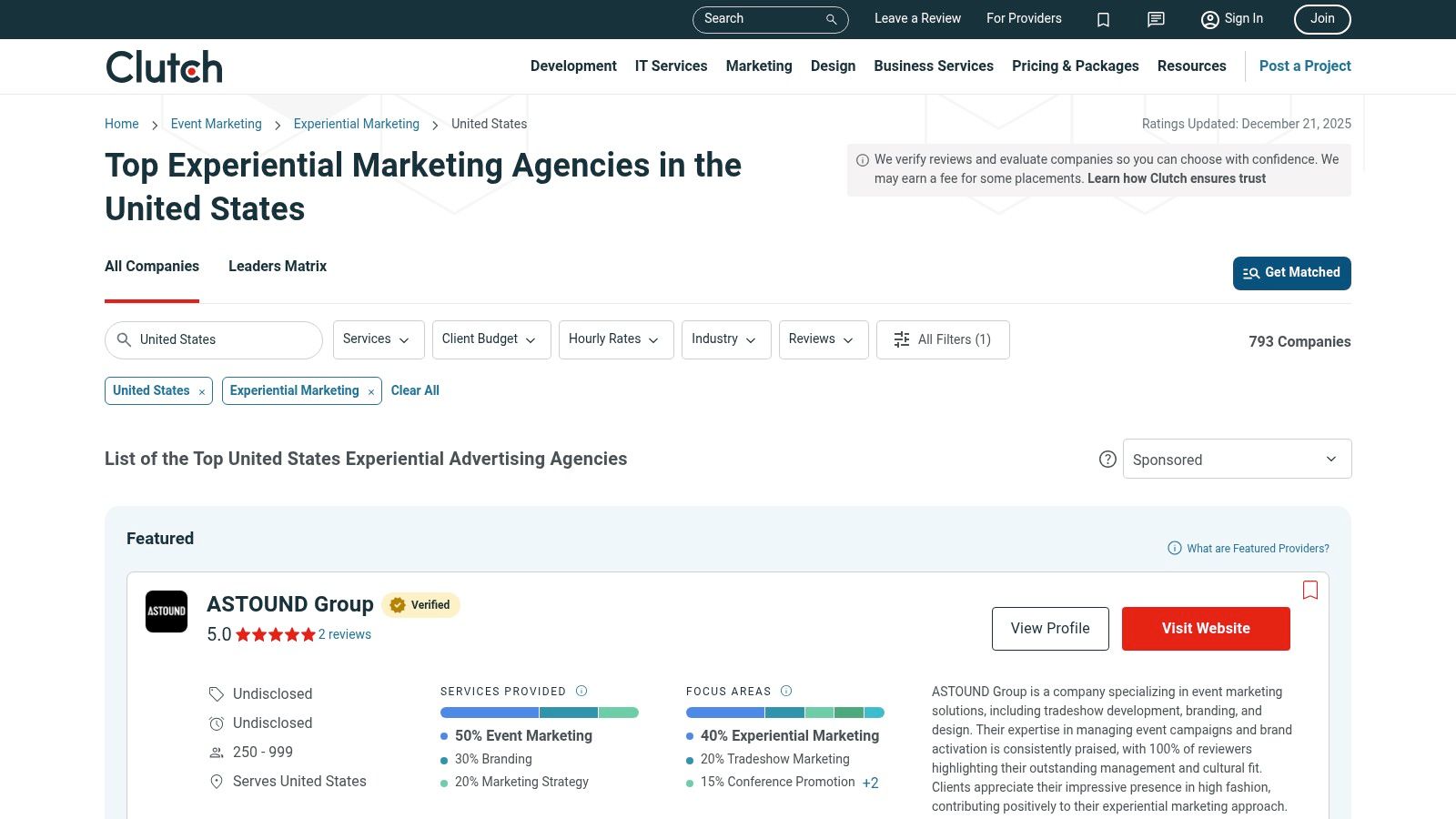
Its primary strength is transparency. The platform’s reliance on verified client reviews, often obtained through direct interviews, provides a layer of credibility. For leaders evaluating an agency’s technical capabilities, these reviews can reveal insights into an agency’s project management and technical execution that are rarely mentioned in curated case studies.
Core Specializations & Engagement Scope
- Vendor Discovery: Filtering agencies by service focus (e.g., event marketing, AR/VR development), location, and budget.
- Social Proof & Validation: Accessing verified client reviews that detail project scope, results, and the working relationship.
- Market Intelligence: Comparing agency profiles and typical project sizes to understand the competitive landscape.
The platform is designed for the research and shortlisting phase of procurement.
Cost & Implementation Signals
| Aspect | Details |
|---|---|
| Typical Engagement Cost | Free for browsing and research. Agency pricing is listed on profiles, typically starting from $50,000+ minimum project sizes, but this varies widely. |
| Common Implementation Pitfalls | Relying solely on the platform’s “Leaders Matrix” ranking without reading the actual reviews. The algorithm can favor agencies with more reviews, not necessarily those with the most relevant technical expertise for your specific project. |
| Failure Signals | A key failure signal is shortlisting agencies based on high-level scores without digging into negative or mediocre reviews. If a review mentions poor technical project management or communication breakdowns, it warrants investigation during your own vetting process. |
Customer Fit & When NOT to Buy
Clutch is a good starting point for any technical leader building a request for information (RFI) or request for proposal (RFP) list. It is particularly useful for mid-market companies or enterprise teams looking for specialized agencies that may not have the global name recognition of a firm like Jack Morton.
When NOT to buy: Your only source of information is Clutch. For a multi-million dollar activation, many top-tier global agencies do not actively manage their profiles. The directory also has a U.S. focus, so it may be less effective for sourcing partners in EMEA or APAC regions.
Website: https://clutch.co/us/agencies/experiential
7-Agency Brand Experience Comparison
| Agency | Implementation complexity | Resource requirements | Expected outcomes | Ideal use cases | Key advantages |
|---|---|---|---|---|---|
| Jack Morton Worldwide | High — large-scale, multi-channel programs | Significant — enterprise budgets, multi-office teams, longer lead times | Scalable, high-quality brand experiences with measurable impact | Global product launches, sponsorship activations, enterprise events | Proven enterprise scale; broad live/hybrid/digital capabilities; public RFP intake |
| George P. Johnson (GPJ) | High — complex conferences and roadshows with tech integration | Significant — global delivery, specialized tech teams, custom pricing | Operationally reliable, tech-enabled measurable outcomes | Multi-market conferences, roadshows, large tech events | Strong operational reliability; experience technology and thought leadership |
| Momentum Worldwide | Medium–High — integrated sponsorship and commerce activations | High — enterprise budgets, AI/ML investment, global team coordination | Personalized, commerce-linked activations with measurable lift | Sponsorships, shopper/retail campaigns, sports and cultural activations | Sponsorship/commerce expertise; AI/ML for personalization and measurement |
| Freeman | High — complex, multi-venue and multi-day logistics | High — extensive production/logistics footprint, rapid U.S. mobilization | Reliable delivery of complex events at scale | Trade shows, exhibitions, multi-day conferences and large live programs | Broad production/logistics infrastructure; high capacity and mobilization speed |
| Sparks (a Freeman Company) | Medium — custom exhibits and fabrication-heavy builds | Moderate–High — fabrication facilities, creative teams, Freeman support | Highly creative, custom exhibits and experiential environments | Exhibits, pop-ups, tours, trade show environments | Creative boutique feel with large-company fabrication and production backing |
| Event Marketer — The It List | Low — editorial discovery and shortlisting tool | Low — time for research; no direct agency fees | Curated shortlist of top experiential agencies by specialty | Agency discovery, shortlist building, benchmarking across specialties | Curated, editorially vetted list; useful for diverse specialty discovery |
| Clutch — Experiential Marketing Directory (U.S.) | Low — marketplace for discovery and validation | Low — research time; relies on platform filters and reviews | Verified client reviews, budget indicators, candidate shortlists | Validating agencies, budget/location filtering, early-stage vendor selection | Transparent client reviews; budget/project data and filtering tools |
Top 3 Reasons Brand Experience Agency Engagements Fail
Choosing a partner from a roster of top-tier brand experience agencies is less about the creative pitch and more about making a technically sound investment. The agencies profiled all demonstrate creative and logistical capabilities. However, a successful engagement hinges on details often overlooked in the initial selection process. A common failure point is neglecting to audit an agency’s data infrastructure and compliance protocols, which can result in significant downstream risk, particularly for activations spanning multiple regulatory environments like GDPR and CCPA.
Key Factors for Your Final Assessment
Before finalizing a partnership, move beyond the case studies and demand technical documentation. Your final decision should be defensible not just to marketing, but to your legal, finance, and engineering teams.
Here are the non-negotiable checkpoints to validate:
- Technical Integration Plan: An agency must provide a detailed plan outlining how their event technologies (e.g., registration platforms, mobile apps) will integrate with your existing martech stack (CRM, marketing automation, data warehouse). Vague promises of “seamless integration” are a significant red flag.
- Data Flow and Governance: Request a data flow diagram showing how personally identifiable information (PII) is captured, transmitted, stored, and processed. Verify their adherence to data privacy regulations and ask for proof of relevant certifications (e.g., ISO 27001).
- Measurement and Attribution Framework: The agency must define specific KPIs that connect experiential activities to business outcomes, such as sales pipeline influence or product adoption rates. Insist on a clear attribution model that can be tracked within your systems.
- Scope and Scalability Audit: Confirm the agency’s in-house technical capabilities versus their reliance on third-party contractors for critical technology components. An over-reliance on external vendors can introduce security vulnerabilities, integration failures, and unpredictable costs.
Selecting the right brand experience agency is an exercise in risk mitigation. The most innovative concept will fail if it’s built on a fragile technical foundation. By focusing on these operational and technical criteria, you can ensure that your chosen partner is equipped not just to create a memorable experience, but to deliver a secure, compliant, and measurable return on investment.
The public-facing case studies from brand experience agencies often omit the critical technical and operational data needed to make a defensible decision. For a deeper analysis of vendor capabilities, common failure points, and specific cost benchmarks based on project scope, Modernization Intel provides unbiased intelligence reports. Use our platform to validate your vendor shortlist and avoid costly misalignments.
Need help with your modernization project?
Get matched with vetted specialists who can help you modernize your APIs, migrate to Kubernetes, or transform legacy systems.
Browse Services